1inch Team Accused of Dumping, On-Chain Data Reveals Sophisticated Trading Strategies of Large Positions

marsbitОпубликовано 2026-01-29Обновлено 2026-01-29

Введение

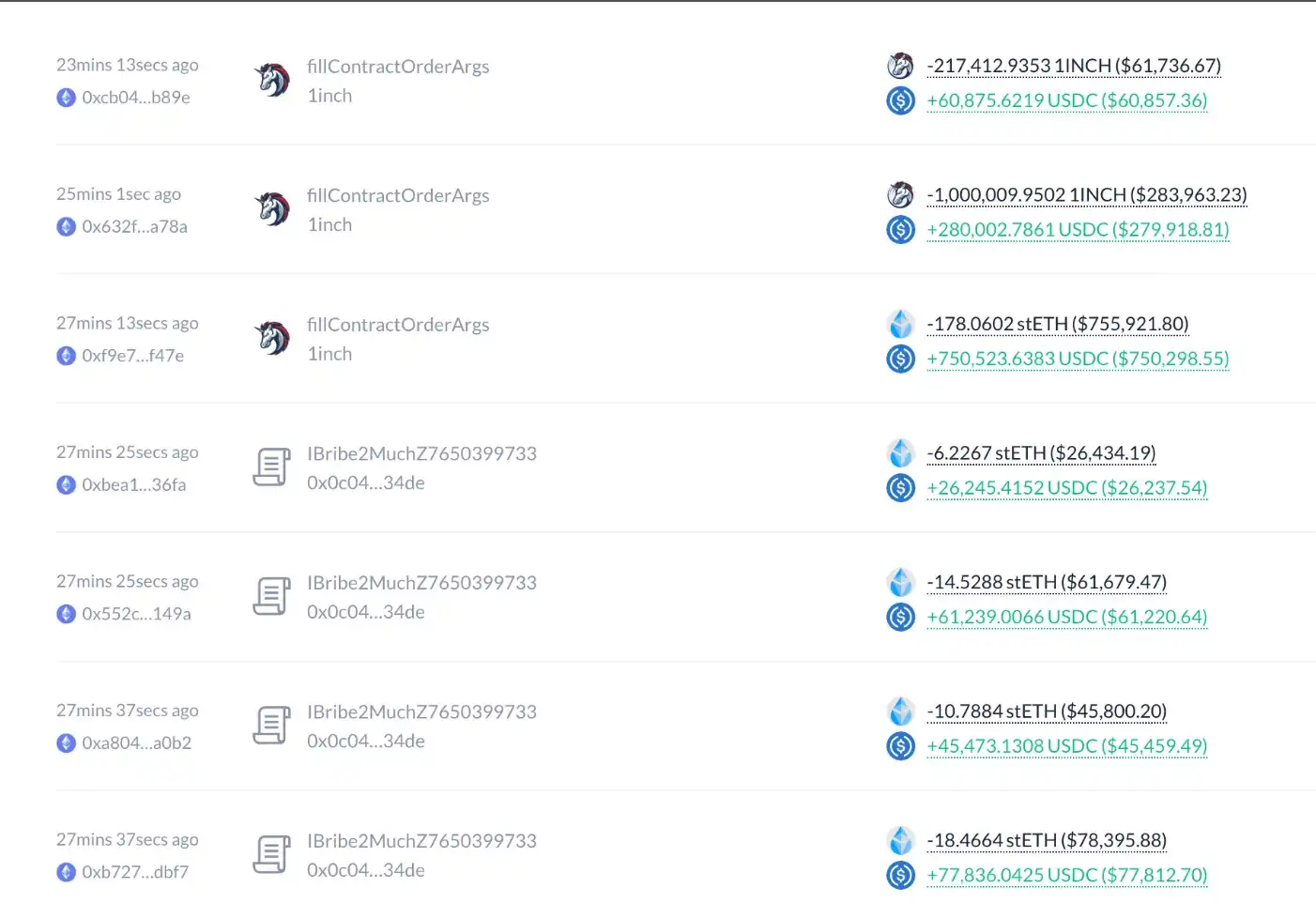
Recent on-chain data from ARKHAM indicated that three wallets labeled as "1inch Team" sold 36.36 million 1INCH tokens, worth $5.04 million, causing the token's price to drop by 16.7% to around $0.1155. The tokens were initially acquired in late 2024 at approximately $0.42 each, meaning the sale resulted in a loss of over $10 million for the seller. This event sparked criticism and raised questions about whether the 1inch team was intentionally dumping tokens. However, the team’s historical trading behavior shows a pattern of strategic accumulation during market lows and gradual profit-taking during highs—not large-scale selling at a loss. For instance, earlier in the year, the team accumulated 1INCH at around $0.20 and sold portions at higher prices, realizing significant profits on 1INCH, ETH, and BTC positions. 1inch officially denied involvement, clarifying that the wallets in question were not controlled by the team or its multisig treasury and that the sell-off was likely executed by a third-party holder. The team emphasized that it does not influence independent token holders' decisions. Despite the clarification, the sell-off exacerbated the token’s already weak market performance. 1INCH has been in a prolonged downtrend since its all-time high of $6, now trading near $0.11. The incident highlights how on-chain labels can be misleading and how low liquidity magnifies the impact of large sales—often harming retail investors the most.

Author | Ethan(@ethanzhang_web3)

Large sales marked as "1inch team" have once again sparked criticism.

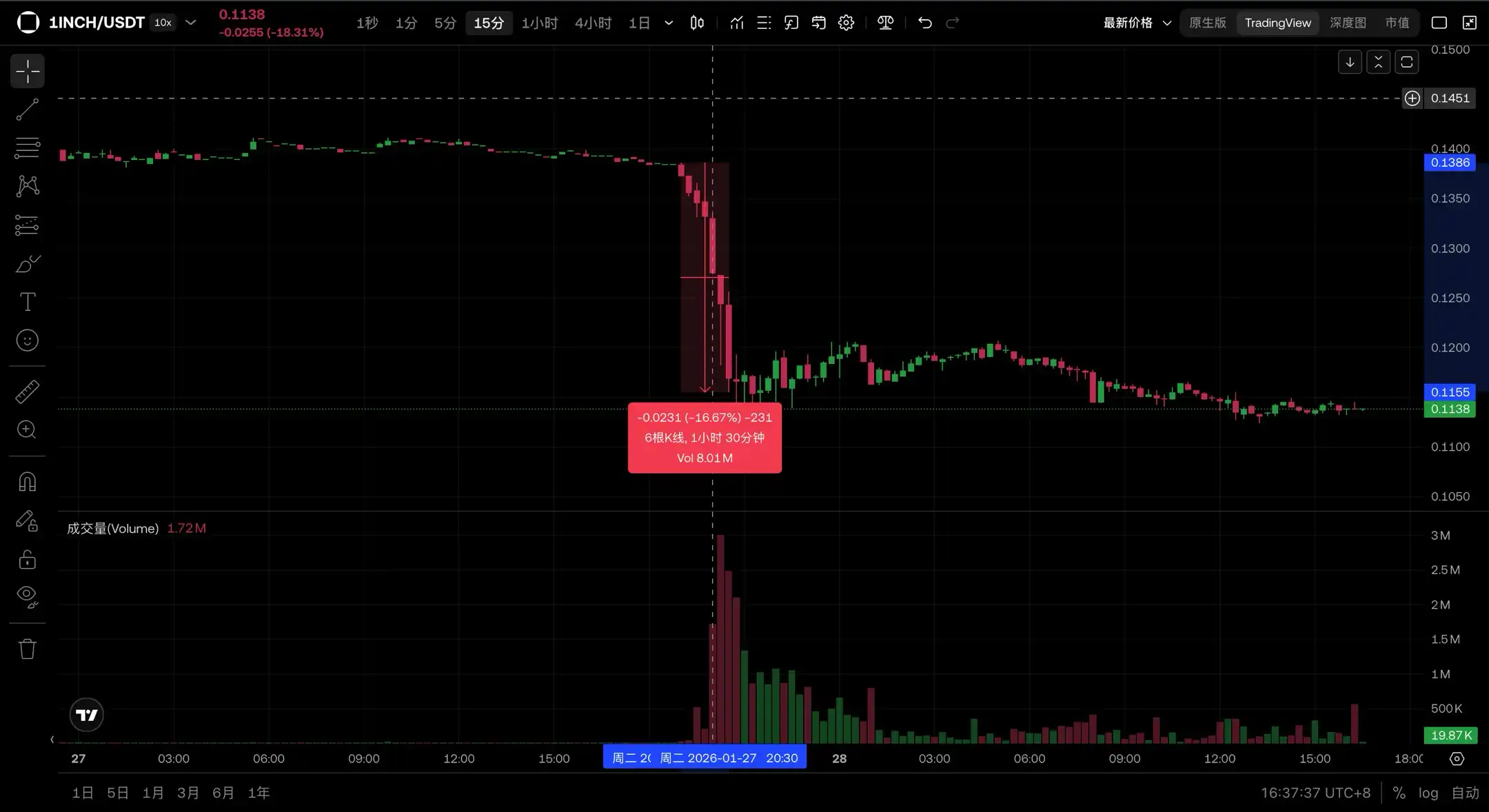
Recently, the on-chain data platform ARKHAM showed that three wallets marked as "1inch team" sold a total of 36.36 million 1INCH tokens, worth $5.04 million. According to OKX market data, affected by this, the price of 1INCH briefly fell by 16.7% to $0.1155, currently reported at $0.1164. A question quickly arose in the market: Is the project team really dumping the tokens themselves?

Looking at this sale alone, the outcome was not ideal. On-chain data shows that the above 1INCH tokens were mainly transferred to the relevant addresses in late November 2024. Based on the price at that time, the cost was approximately $0.42, corresponding to a total value of about $15.27 million. Before this sale, the price of 1INCH had already fallen to around $0.14. Combined with the slippage impact due to the large volume of the sale, the actual loss for this batch of positions may exceed $10 million.

Reference: 1inch Team's Previous Trading Style

Previously, the on-chain operations of the 1inch team investment fund during multiple market fluctuations were regarded by the market as the presence of a "professional trading team."

As early as February to April, the 1inch team investment fund had already begun accumulating 1INCH at low levels. At that time, market sentiment had not yet recovered, and 1INCH had been lingering around $0.2. During this phase, the team invested a total of approximately $6.648 million to buy 33.19 million 1INCH tokens, with an average entry price of about $0.2.

However, this round of buying did not cause significant price fluctuations. What really caught the market's attention was the concentrated buying in early July. From July 6 to 9, the 1inch team investment fund made another move, investing an additional $4.4 million in just a few days to buy 22.99 million 1INCH tokens. As buying continued, the price of 1INCH rose from around $0.18 to $0.206, a short-term increase of about 14%. During this period, the team transferred 3 million USDC to Binance and withdrew 1INCH in batches to their own addresses. The funds were not used all at once, possibly waiting for opportunities, and continued buying.

After July 10, the pace of operations noticeably accelerated. On the afternoon of July 10, the team bought another 4.12 million 1INCH tokens for about $880,000, while also transferring 2 million USDT to Binance to prepare ammunition for subsequent trades. On the evening of July 11, on-chain monitoring showed that the team likely bought another 11.81 million 1INCH tokens at a higher price range, around $0.28. By this point, the address's holdings had increased to 83.97 million 1INCH tokens, with a book value exceeding $23 million. On July 13, the team continued to withdraw 6.334 million 1INCH tokens from Binance.

Looking back to early February, the 1inch team investment fund had cumulatively invested about $13.64 million since the beginning of the year to buy 55.85 million 1INCH tokens, with a comprehensive cost of about $0.244. With the price of 1INCH rising to above $0.39 in mid-July, these positions had already generated paper profits of several million dollars.

It is worth noting that the team was not "only buying and not selling." On the evening of July 13, they began to realize profits on a small scale, selling about 904,000 1INCH tokens at $0.33, exchanging them for $298,000; and in earlier stages, they had already sold some 1INCH tokens in batches at around $0.28.

At the same time, the team also took profits on another important position: ETH, which was bought in February at an average price of $2,577, began to be sold in batches above $4,200, with the ETH position alone realizing profits of millions of dollars.

On August 11, according to on-chain analyst Yu Jin's monitoring, the 1inch team investment fund began to realize some of its earlier positions on-chain. Data showed that they sold 5,000 ETH at an average price of $4,215, exchanging them for 21.07 million USDC; simultaneously, they sold 6.45 million 1INCH tokens at an average price of $0.28, exchanging them for about $1.8 million USDC.

Based on the entry costs, the above ETH was bought by the 1inch team in February this year at an average price of about $2,577; the corresponding 1INCH was mainly accumulated in July, with a comprehensive cost of about $0.253. Based solely on the sold ETH and 1INCH positions, the 1inch team investment fund has realized paper profits of about $8.36 million.

Looking further back, the 1inch team's operational path on BTC is equally clear: "buying against the trend, selling with the trend." During February to March this year, they bought 160.8 WBTC at an average price of about $88,000 during a BTC correction, and completed the sale when BTC approached the $100,000 mark again in May, realizing a total profit of nearly $1 million.

Combining the clues of BTC, ETH, and 1INCH assets, the on-chain operations of the 1inch team investment fund resemble a well-rehearsed capital strategy: completing accumulation during market adjustments, continuously adding positions during the upward trend, and realizing profits in batches when prices enter high ranges.

But This Time, Was It Really Them Operating?

It should be pointed out that comparing this large sale near $0.14 with the past on-chain operations of the 1inch team investment fund reveals: if this sale was indeed directly led by the team, its execution method itself significantly deviates from its past trading logic. Whether in historical operations of BTC, ETH, or 1INCH, the team's more common practice was to realize profits in batches after the price trend was confirmed, rather than selling concentratedly in an obvious low-liquidity range.

For this reason, some market participants began to question: did this selling behavior marked as "1inch team" really come from the team or wallets directly controlled by them.

Subsequently, 1inch official also responded to the related controversy. In a statement, they clearly stated that this selling behavior did not occur in any wallet controlled by the 1inch team, entity, or treasury multi-signature, and the team cannot interfere with the asset allocation and trading decisions of third-party holders.

In other words, the association indicated by on-chain labels does not equate to actual control. Judging from the execution rhythm and price range, this sale is more likely to come from a third-party holder who is no longer under the project's control, rather than a shift in the 1inch team's own trading logic.

In a stage of inherently limited liquidity, a single large sale being quickly equated to "team dumping" is itself an overly compressed interpretation of information. It ignores the natural disconnect between address labels and actual control rights after long-term token circulation.

Returning to 1inch itself. The official statement emphasized that this market fluctuation did not change its core business and long-term direction. Since 2019, 1inch has accumulated a trading volume of nearly $800 billion, and even during market downturns, it can maintain a daily trading scale of hundreds of millions of dollars. The team also stated that it plans to review the token economic model this year to improve overall resilience during periods of low liquidity and downturns. In this context, the discussion around "whether the 1inch team dumped tokens" is more like a misinterpretation amplified by on-chain labels, liquidity environment, and emotional interpretation.

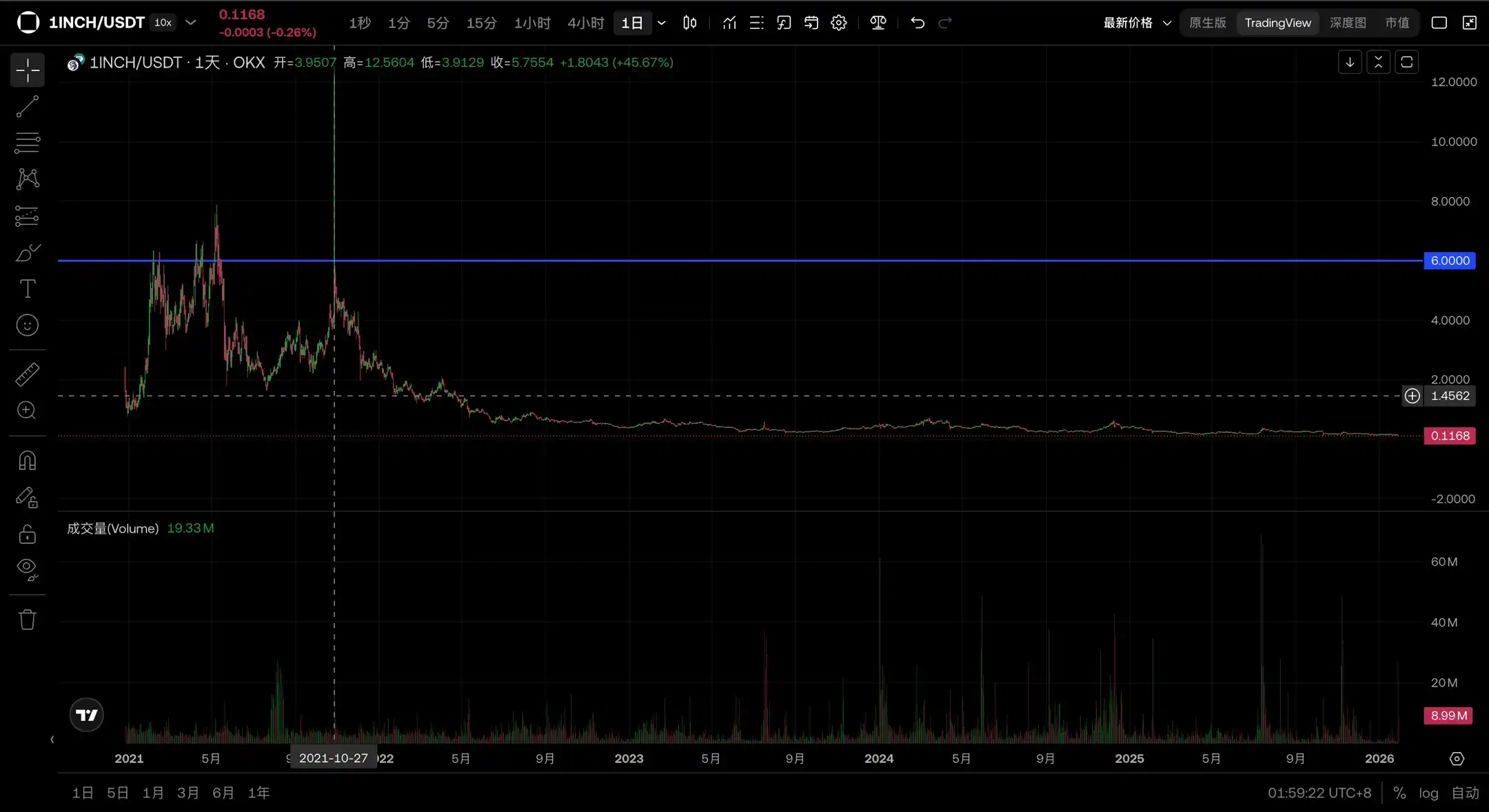
However, even if it is eventually proven to be a misinterpretation, this sale still constituted a secondary impact on the already weakening price of 1INCH. Since the last cycle high of $6, 1INCH has experienced a long-term unilateral decline and is now hovering near $0.11.

On such a trend, the market clearly no longer has enough buffer space to digest any sudden selling signals. This type of amplified selling event ultimately bears the brunt of emotional impact on the weakest end of risk tolerance—retail investors.

Связанные с этим вопросы

QWhat was the recent event that sparked criticism towards the 1inch team, according to the article?

AThree wallets labeled as '1inch team' sold 36.36 million 1INCH tokens, worth $5.04 million, causing the token's price to drop by 16.7%.

QHow does the recent large sell-off at $0.14 contradict the 1inch team's historical trading strategy as described in the article?

AThe team's historical strategy was to accumulate during market adjustments, add positions during rallies, and take profits in batches at higher price ranges. The recent sell-off at a low liquidity price point of $0.14 deviates from this logic of selling after a confirmed uptrend.

QWhat was the official response from 1inch team regarding the sell-off incident?

AThe 1inch team stated that the selling did not occur from any wallet controlled by the 1inch team, entity, or treasury multisig, and that they cannot interfere with the asset allocation and trading decisions of third-party holders.

QWhat key point does the article make about the relationship between on-chain labels and actual control of wallets?

AThe article emphasizes that an on-chain label indicating an association does not equate to actual control. The sell-off was likely from a third-party holder, not the team itself.

QWhat is the long-term price trend for the 1INCH token mentioned in the article?

AThe 1INCH token has been in a long-term downtrend since its previous cycle high of $6 and was trading around $0.11 at the time of the article.

Похожее

NVIDIA Begins Adding Soap to the Bubble

NVIDIA is taking on a dual role: not just as a leading chip supplier, but as a massive capital allocator across the entire AI supply chain. In 2026, the company has committed over $40 billion in investments within five months, targeting everything from optical fiber manufacturing and data center operations to foundational AI model development. This investment spree, described as a systematic "sprinkler" approach, primarily funds companies that are major buyers of NVIDIA's own GPUs. Critics, including analysts from Goldman Sachs, label this a "circular revenue" loop—comparable to a supplier financing a customer to buy more of its products. A prominent example is NVIDIA's investment in OpenAI, which is expected to generate around $13 billion in revenue for NVIDIA, much of which may be reinvested back into OpenAI. While CEO Jensen Huang dismisses the "circular financing" critique as "absurd," arguing the investments are confidence votes in long-term generational shifts, some analysts express discomfort. They note that while investments in critical supply chain components like optics are strategically sound, funding new cloud providers like CoreWeave feels like "pre-paying for your own GPUs." The strategy carries significant risks. If the AI investment cycle turns, the market may question how much demand is genuine versus artificially sustained by NVIDIA's own balance sheet. Despite posting record-breaking earnings—$215.9 billion in annual revenue and $120 billion in net profit for FY2026—NVIDIA's stock fell after its report, signaling that "beating expectations" may no longer be enough to assure investors about the duration of the AI spending boom. The article concludes that while a bubble isn't necessarily a fraud, NVIDIA's actions resemble adding soap to a bubble—making it appear more robust and durable. This creates a complex scenario requiring extreme冷静 from investors to distinguish between real structural growth and financial engineering.

marsbit9 мин. назад

NVIDIA Begins Adding Soap to the Bubble

marsbit9 мин. назад

Short Positions Have Been Squeezed Out: Will the Next Leg of the U.S. Stock AI Rally Continue in Seoul?

"Short Squeeze Exhausted: Will the Next Leg of the AI Rally Continue in Seoul?" A Nomura report suggests the US AI stock rally, which saw the S&P 500 rise ~16.6% in 28 days largely driven by 10 key stocks, may be pausing. The fuel from short covering, CTA fund positioning, and volatility-control strategies is nearing its limit. For the rally to continue, new momentum from retail and sentiment-driven FOMO (Fear Of Missing Out) is needed. South Korea's market provided a potential answer on the very day the report was published. The KOSPI index surged 4.32%, triggering a buy-side circuit breaker, led by massive gains in chip giants SK Hynix (+11.98%) and Samsung. This surge is characterized by retail "hynix FOMO" and overseas funds precisely buying into AI themes via chip-focused ETFs, shifting from broad Korean market ETFs. The Korean rally is a high-beta extension of the US AI capital expenditure story, as major cloud providers plan massive infrastructure spending, directly benefiting memory chip leaders. However, this linkage also implies vulnerability. The sustainability of this next leg depends on whether US tech stocks correct, the trajectory of US inflation (with upcoming CPI data key), and geopolitical tensions around the Strait of Hormuz. Seoul has emerged as the new epicenter of the AI trade, but its fate remains tied to these broader macro and market dynamics.

marsbit14 мин. назад

Short Positions Have Been Squeezed Out: Will the Next Leg of the U.S. Stock AI Rally Continue in Seoul?

marsbit14 мин. назад

Borrowing Money from a Hundred Years Later, Building Incomprehensible AI

Tech giants like Alphabet, Amazon, Meta, and Microsoft are undergoing a radical financial transformation due to AI. Their traditional "light-asset, high-free-cash-flow" model is being dismantled by staggering capital expenditures on AI infrastructure—data centers, GPUs, and power. Combined 2026 guidance exceeds $700 billion, a 4.5x increase from 2022, causing free cash flow to plummet (e.g., Amazon's fell 95%). To fund this, they are borrowing unprecedented sums through long-dated, multi-currency bonds (e.g., Alphabet's 100-year bond). The world's most conservative capital—pensions, insurers—is now funding Silicon Valley's most speculative bet. This shift makes these companies resemble heavy-asset industrials (railroads, utilities) rather than software firms, threatening their premium valuations. Historically, such infrastructure booms (railroads, fiber optics) followed a pattern: genuine technology, overbuilding fueled by competitive frenzy, aggressive debt financing, and a crash triggered by financial conditions—not technology failure. The infrastructure remained, but many original builders and financiers did not survive. The core gamble is a "time arbitrage": using cheap debt today to build scale and lock in customers before AI capabilities commoditize. They are betting that AI revenue will materialize before debt comes due. Their positions vary: Amazon is under immediate cash pressure; Meta's path to monetization is unclear; Alphabet has a robust core business buffer; Microsoft has the shortest path from infrastructure to revenue. The contract is set: the most risk-averse global capital has lent its time to Silicon Valley, awaiting a future that is promised but uncertain.

marsbit1 ч. назад

Borrowing Money from a Hundred Years Later, Building Incomprehensible AI

marsbit1 ч. назад

Торговля

Спот
Фьючерсы

Популярные статьи

Как купить 1INCH

Добро пожаловать на HTX.com! Мы сделали приобретение 1inch (1INCH) простым и удобным. Следуйте нашему пошаговому руководству и отправляйтесь в свое крипто-путешествие.Шаг 1: Создайте аккаунт на HTXИспользуйте свой адрес электронной почты или номер телефона, чтобы зарегистрироваться и бесплатно создать аккаунт на HTX. Пройдите удобную регистрацию и откройте для себя весь функционал.Создать аккаунтШаг 2: Перейдите в Купить криптовалюту и выберите свой способ оплатыКредитная/Дебетовая Карта: Используйте свою карту Visa или Mastercard для мгновенной покупки 1inch (1INCH).Баланс: Используйте средства с баланса вашего аккаунта HTX для простой торговли.Третьи Лица: Мы добавили популярные способы оплаты, такие как Google Pay и Apple Pay, для повышения удобства.P2P: Торгуйте напрямую с другими пользователями на HTX.Внебиржевая Торговля (OTC): Мы предлагаем индивидуальные услуги и конкурентоспособные обменные курсы для трейдеров.Шаг 3: Хранение 1inch (1INCH)После приобретения вами 1inch (1INCH) храните их в своем аккаунте на HTX. В качестве альтернативы вы можете отправить их куда-либо с помощью перевода в блокчейне или использовать для торговли с другими криптовалютами.Шаг 4: Торговля 1inch (1INCH)С легкостью торгуйте 1inch (1INCH) на спотовом рынке HTX. Просто зайдите в свой аккаунт, выберите торговую пару, совершайте сделки и следите за ними в режиме реального времени. Мы предлагаем удобный интерфейс как для начинающих, так и для опытных трейдеров.

394 просмотров всегоОпубликовано 2024.03.29Обновлено 2025.05.13

Как купить 1INCH

Обсуждения

Добро пожаловать в Сообщество HTX. Здесь вы сможете быть в курсе последних новостей о развитии платформы и получить доступ к профессиональной аналитической информации о рынке. Мнения пользователей о цене на 1INCH (1INCH) представлены ниже.

活动图片