Dogwifhat is Latest Solana Meme Coin to Surge, is it the Next Bonk as Sponge V2 Also Gains Momentum

newsbtcОпубликовано 2024-01-11Обновлено 2026-05-22

Введение

WIF takes full advantage of the Dogwifhat meme - made famous by big Gamers - and soars within a few...

HTX will open WIF (dogwifhat) trading on January 11, 2024, at 19:00 (GMT+8).

WIF takes full advantage of the Dogwifhat meme – made famous by big Gamers – and soars within a few days of launch – jumping over 100% in a day.
Meanwhile, the newly upgraded meme coin Sponge V2 also looks set to make its holders gains.
Dogwifhat Takes Off with Strong Gains
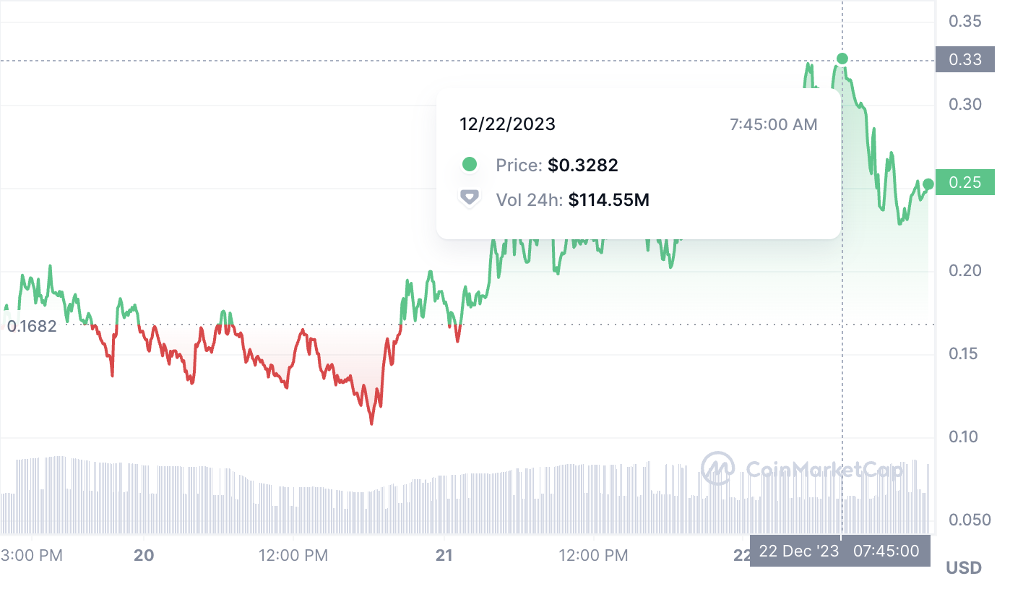
$WIF went live on the Solana blockchain on December 18th, carrying an initial market cap of $100 million before doubling to over $220 million today. The surge began on the 20th when $WIF’s trading price bounced off of $0.105 to reach an ATH (all-time high) of $0.3313 by the 22nd.

According to CoinMarketCap, it corrected to $0.2286 before climbing past $0.25, at the moment of writing.
Dogwifhat took shape as early as November 2019 when (now retired) professional Fortnite player, Issa “Issa” Rahim, changed his X (Twitter) profile image to the famed Shiba Inu dog – except it wore a hand-knit beanie.
A commenter with the handle @Vapurly (who is currently suspended) wrote under the image “Dogwifhat”. By the 20th, Fortnite Streamer, Vraxito changed his profile picture to the same image, and Issa tweeted in response “dogwifhat taking over”.
And indeed it was, with more and more high-profile gamers propelling the trend. Leading eSports organizations like Rogue, G2 Esports, and Cloud9 also hopped on the trend as well as popular American YouTuber, Keemstar.
Thus the meme was born and, most importantly, customisable – with different hats and styles sitting atop the Shiba Inu, per profile.

$WIF takes advantage of Solana’s high-performing network – known for its incredible speed, handling up to 65,000 transactions per second. Its PoS (Proof of Stake) consensus boasts tremendous efficiency, and with efficiency comes low transaction fees.
Another meme coin currently making waves is Sponge V2, the upgraded version of the Sponge token which saw huge gains last year.
Sponge V2 Set to be Bigger than Ever
$SPONGEV2 is the latest offering from the vibrant $SPONGE meme coin community. Meme coin enthusiasts might recall $SPONGE V1’s remarkable journey, as it soared from a $1 million valuation at its inception to an impressive market capitalization exceeding $100 million in the spring of 2023, netting early investors huge gains.
Despite $SPONGE’s subsequent decline, its appeal remains strong. The token currently maintains a base of more than 11,000 token holders and has secured listings on several prominent exchanges, including MEXC, Gate.io and Poloniex.

The team is set to introduce a Play-to-Earn game, potentially drawing in new investors. $SPONGEV2 securing spots on platforms like Binance and OKX could significantly elevate the value of the token, resulting in substantial returns.
With the meme token running on the Ethereum network, it boasts robust speeds and is in line to take advantage of ETH’s potential gains in the coming months.
You can buy $SPONGE with ETH, USDT or Card, then stake that V1 token in order to bridge to the Sponge V2 smart contracts. If you’ve been a long-term holder of the V1 token, be aware that once you stake them they’re irrevocably locked.
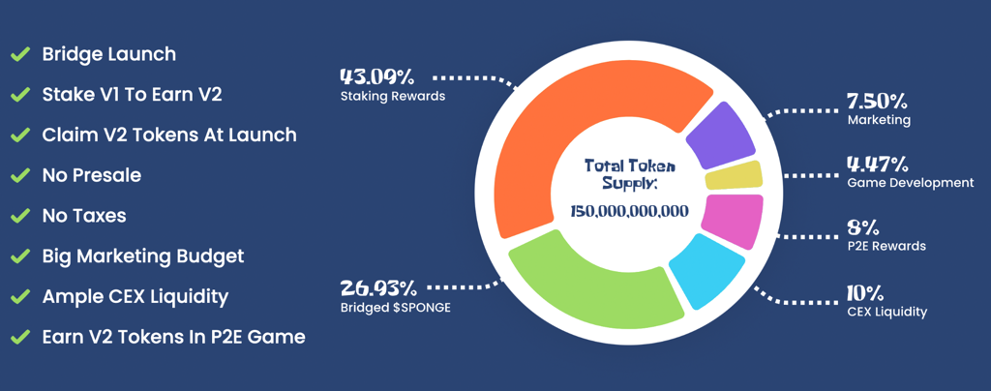
But the more tokens you stake, the more V2 you earn, and if you missed Sponge’s famous 100x pump a few months ago, then you probably won’t want to miss out on this opportunity.
There are 16,800,916,140 tokens remaining, so now’s the time to take advantage of the presale. You can keep up to date with the latest developments of the project via their X, Telegram, and Discord.
Disclaimer: The article is provided for educational purposes only. It does not represent the opinions of NewsBTC on whether to buy, sell or hold any investments and naturally investing carries risks. You are advised to conduct your own research before making any investment decisions. Use information provided on this website entirely at your own risk.

Похожее

GitHub Empire on the Brink of Collapse: Source Code Leak, 18-Year Veteran Leaves, Microsoft Loses 1.5 Billion Developers

GitHub is facing an unprecedented crisis, marked by a massive exodus of developers and severe operational failures. The tipping point came when Mitchell Hashimoto, creator of Ghostty and an 18-year GitHub user, publicly severed ties, citing persistent platform outages that made serious work impossible. This departure highlights a broader pattern of user frustration. The platform's instability has drawn complaints from major corporate clients like Citibank and Intel, forcing Microsoft to issue substantial service credits. A critical incident last month saw an accidentally triggered, unreleased feature cause widespread repository rollbacks, erasing recent code changes and pushing enterprises to migrate. Security has catastrophically breached. In May 2026, hackers infiltrated over 3,800 of GitHub's internal repositories via a poisoned VS Code extension installed by a developer, leading to the attempted sale of core source code for $50,000. This follows the discovery of a critical zero-day vulnerability in March that threatened access to millions of repositories. Internally, GitHub's autonomy has collapsed. After the resignation of CEO Thomas Dohmke in mid-2025, Microsoft eliminated the CEO role, folding GitHub into its CoreAI division under the unpopular leadership of Jay Parikh. This triggered a talent drain, with key executives and engineers leaving. A disruptive migration of GitHub's infrastructure to Azure servers, pushed by CTO Vladimir Fedorov, is blamed for the recurring outages. Competitively, GitHub Copilot is under "existential threat" from superior AI coding tools like Cursor (now owned by SpaceX) and Claude Code, which offer more advanced contextual coding and automation. Ironically, Microsoft's own engineers reportedly preferred Claude Code, forcing management to revoke licenses. Financially, GitHub is a loss leader. Despite Copilot surpassing 4.7 million paid users and $3 billion in annual revenue, the AI inference costs for free services massively outstrip subscription income, hurting Microsoft's cloud margins. The recent shift from a flat fee to a pay-as-you-go model for Copilot has further alienated developers. The core question for Microsoft is whether a centralized code repository remains essential in the AI agent era. The erosion of trust, developer culture, and platform reliability threatens the very ecosystem Microsoft spent decades building.

marsbit1 ч. назад

GitHub Empire on the Brink of Collapse: Source Code Leak, 18-Year Veteran Leaves, Microsoft Loses 1.5 Billion Developers

marsbit1 ч. назад

SEC Promotes Tokenized Stocks, Is the Traditional Finance Industry Starting to Worry?

The U.S. Securities and Exchange Commission (SEC) is preparing to formally release an "innovation exemption" framework this week. This framework would allow third parties to tokenize U.S. stocks like Apple and Tesla without approval from the listed companies. The move, rooted in a deregulatory vision proposed by pro-crypto commissioners earlier this year, could accelerate the migration of traditional stock markets to blockchain. This development poses a structural threat of "fragmentation" to traditional finance. Core concerns are liquidity fragmentation—where trading volume disperses across multiple blockchains and platforms, leading to price disparities and reduced market efficiency—and revenue fragmentation—where trading fees and intermediary income shift away from domestic exchanges to overseas or competing platforms. The report compares the traditional stock market to a monopolistic "supermarket." Tokenization enables countless "street stalls" to operate outside this system, threatening the exchange's dominance, diluting liquidity for large orders, and slicing into revenue streams. Evidence of this capital fragmentation is already emerging. On the same day the SEC signaled the framework, decentralized platform Hyperliquid saw its RWA (real-world asset) open interest hit a record $2.6 billion, driven by demand for 24/7 on-chain trading of traditional assets. Traditional institutions face a dilemma: either collaborate to build tokenization infrastructure proactively or lobby regulators to block innovation. Regulators must balance controlling the pace of innovation with preventing domestic revenue from being captured by offshore platforms. Key future battles will revolve around defining shareholder rights for tokenized assets and regulating platforms that have grown in regulatory gray areas. In the digital asset era, inaction risks the permanent loss of long-held fee monopolies and financial leadership as capital continues to disperse.

marsbit1 ч. назад

SEC Promotes Tokenized Stocks, Is the Traditional Finance Industry Starting to Worry?

marsbit1 ч. назад

A Comprehensive Analysis of On-Chain Pre-IPO: Why is the Pricing Power of SpaceX and OpenAI Moving On-Chain?

This podcast episode explores the rise of on-chain pre-IPO price discovery and trading, focusing on companies like SpaceX, OpenAI, and Anthropic. Key trends include the recent launch of a SpaceX pre-IPO perpetual contract on Hyperliquid, the secondary market trading of AI company shares, and a new partnership between Nasdaq Private Market and Polymarket. Dio Casares explains why AI companies like OpenAI and Anthropic actively deny the legitimacy of secondary trades. Primary reasons are to protect their primary funding rounds (as secondary trades don't provide cash to the company) and to avoid complex legal and administrative responsibilities associated with settling these transactions. He argues that on-chain **derivatives** (like perpetuals) are a more viable solution than **tokenized spot markets**, as they better navigate U.S. regulatory holding period requirements, provide effective hedging, and avoid antagonizing the companies themselves by competing with their primary raises. The discussion covers the risks and methods of gaining pre-IPO exposure, from direct investments and SPVs to riskier, layered structures that can lead to legal complications and settlement issues. Casares also maps the landscape of key players, differentiating between traditional secondary brokers (like Forge, Hiive, and Setter) and on-chain derivatives protocols (like Trade.xyz/Ventuals on Hyperliquid) and tokenization platforms (often on Solana). He positions Patagon as a facilitator for access to private market deals but clarifies it avoids on-chain tokenization to maintain good relations with portfolio companies. Looking ahead, the convergence of a historic IPO pipeline (with potential trillion-dollar valuations), the 24/7 nature of crypto markets, and the strategic use of pre-market perpetuals as a "loss leader" suggest continued growth and competition in the on-chain pre-IPO space.

marsbit1 ч. назад

A Comprehensive Analysis of On-Chain Pre-IPO: Why is the Pricing Power of SpaceX and OpenAI Moving On-Chain?

marsbit1 ч. назад

Token Packages Are Here, Are Telecom Operators in a Hurry?

Major Chinese telecom operators are launching token-based AI computing packages, sparking public debate and highlighting a strategic shift amid slowing traditional revenue growth. In May, Shanghai Telecom introduced token plans (e.g., 9.9 RMB for 10 million tokens), quickly followed by nationwide offerings from China Telecom, China Mobile, and China Unicom. While priced higher than major AI firms like DeepSeek, these packages allow users to access multiple AI models via API using their phone bills, similar to purchasing universal mobile data. The move reflects operators' anxiety as traditional voice, SMS, and data services stagnate. With revenue growth hitting multi-year lows in 2025, AI and computing power represent a critical new frontier. However, current C端 offerings, such as AI photo editing or virtual pets, are seen as non-essential and highlight operators' role as "pipes" or integrators rather than creators of compelling AI products. Beyond consumer packages, operators aim to become key infrastructure players in China’s national computing power network. They position themselves as the "power grid" delivering AI算力, leveraging their vast network of base stations to ensure low-latency, reliable coverage, especially for applications like autonomous driving. This infrastructure role, coupled with unified national调度, could make算力 a ubiquitous utility, driving new consumption scenarios even if mass adoption of token packages remains uncertain.

marsbit1 ч. назад

Token Packages Are Here, Are Telecom Operators in a Hurry?

marsbit1 ч. назад

Торговля

Спот
Фьючерсы

Популярные статьи

Обсуждения

Добро пожаловать в Сообщество HTX. Здесь вы сможете быть в курсе последних новостей о развитии платформы и получить доступ к профессиональной аналитической информации о рынке. Мнения пользователей о цене на SOL (SOL) представлены ниже.

活动图片