Plan for $1M bug bounties and double the nodes in wake of $600M Ronin hack

CointelegraphОпубликовано 2022-04-28Обновлено 2022-04-28

Введение

The Ronin Network and Sky Mavis have vowed to upgrade their smart contracts, offer lucrative bug bounties and ramp up security following the $600 million hack late last month.

The Ronin Network and Sky Mavis have vowed to upgrade their smart contracts, offer lucrative bug bounties and ramp up security following the $600 million hack late last month.
As Cointelegraph previously reported, the Ethereum sidechain developed for the popular NFT game Axie Infinity was the victim of an exploit for 173,600 Ether (ETH) and 25.5 million USD Coin (USDC) worth more than $612 million at the time.
Earlier this month the Federal Bureau of Investigation (FBI) attributed the attack to North Korea-based and state-sponsored hacking group Lazurus, as it fired off a warning to other crypto and blockchain organizations.
Ronin announced its platform changes via a post-mortem report published yesterday, noting that all user funds are in the process of being restored as it vowed to make sure this “never happens again.”
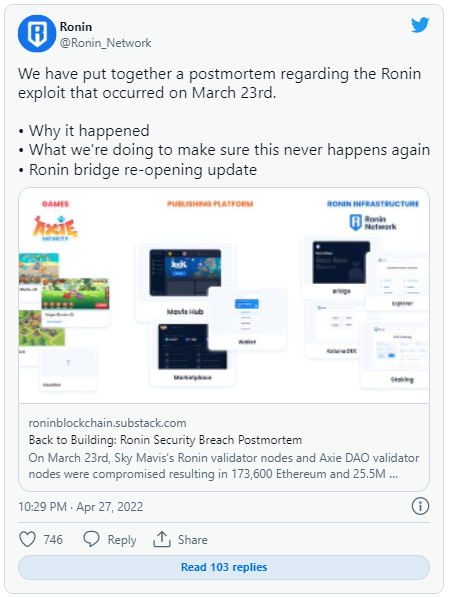
The hack run down
The hack was the result of a spear phishing attack on a former Sky Mavis employee (developers of Axie Infinity). The bad actor was able to leverage the employee’s credentials to access Sky Mavis’s four validator nodes out of a total of nine in the Axie/Ronin ecosystem.
This by itself was not enough to do any damage, but “the attacker found a backdoor through our gas-free RPC node, which they abused to get the signature for the Axie DAO validator.”
“This traces back to November 2021 when Sky Mavis requested help from the Axie DAO to distribute free transactions due to an immense user load. The Axie DAO allowlisted Sky Mavis to sign various transactions on its behalf. This was discontinued in December 2021, but the allow list access was not revoked,” the report reads.
Following the hack, big changes are being implemented at both Sky Mavis and the Ronin Network.
Ronin
The Ronin Network hopes to have its bridge open again by mid to late May, with Binance providing support until then with withdrawal and deposit infrastructure for Axie users.
The team is about 80% through upgrading Ronin bridge smart contracts, they’ll be reworking the backend, migrating all pending withdrawals and launching a validator dashboard that “allows for approving large transactions and adding/removing new validators.”
“The Ronin Network bridge is currently being redesigned and will open once we are confident that it can stand the test of time. We initially expected to be able to deploy the upgrade by the end of April, but this is not a process that we can afford to rush.”
Sky Mavis
Sky Mavis will ramp up its security measures by seeking the help of “top tier security experts,” conducting contract audits and implementing stricter internal procedures such as training courses to “combat external threats.”
Notably, it will also be significantly upping its node count to help decentralize the project. Having already increased from nine to 11, Sky Mavis intends to get that number up to 21 within three months. Longer-term, the project is eyeing more than 100 nodes.
Sky Mavis will also be launching bug bounties of up to $1 million for any white hat hackers who are able to find further vulnerabilities.
“We recognize the importance and value of security researchers’ efforts in helping keep our community safe. Sky Mavis is offering bounties of up to $1 million to encourage responsible disclosure of security vulnerabilities.”


Похожее

Anthropic's IPO Launch: Commercial Miracle or Valuation Bubble?

Anthropic has confidentially filed for an IPO, led by Morgan Stanley and Goldman Sachs, potentially going public by October. Following its latest $650 billion funding round, its pre-IPO valuation stands at $965 billion, with projections reaching up to $2 trillion at listing, which would make it the highest-valued private company ever. The article, written by Fu Sheng, addresses skepticism that this represents an AI bubble akin to the 2000 dot-com crash. It argues the current situation differs fundamentally. Unlike the internet bubble era, which relied on speculative narratives with little revenue, Anthropic's valuation is backed by unprecedented, measurable financial performance. Key data points include: * **Revenue Growth:** ARR skyrocketed from $10 billion in early 2025 to $470 billion by May 2026, targeting $100 billion by year-end—a growth curve unmatched in business history. * **Profitability:** It achieved operating profitability in Q2 2026 with an estimated $5.6 billion profit. * **Efficiency:** With ~3,000 employees and ~$470 billion ARR, its revenue per employee exceeds $10 million. Products like Claude Code, launched less than a year ago, already generate $25 billion in annualized revenue. * **Enterprise Adoption:** It boasts a strong enterprise client base, with 8 of the Fortune 10 and over 1,000 large firms spending over $1 million annually on Claude. The valuation is framed using a traditional SaaS model (e.g., a 10x Price-to-Sales multiple on $100 billion revenue). The author contends the core question for analysts has shifted from "How big could this be?" to "How much is it earning and will earn next quarter?" The discussion extends beyond Anthropic to a broader paradigm shift: the transition from a "carbon-based" to a "silicon-based" economy. Companies are increasingly prioritizing investment in compute and AI capabilities over human resources, as these directly scale productivity and competitive advantage. Anthropic's IPO is thus positioned not just as a corporate milestone, but as a price anchor for this new economic era.

链捕手1 ч. назад

Anthropic's IPO Launch: Commercial Miracle or Valuation Bubble?

链捕手1 ч. назад

Near Returns to the AI Stage: Transformation into a Public Chain Due to 'Payroll Difficulties,' Agent and Privacy Emerge as New Growth Narratives

NEAR Returns to AI Origins: From Payroll Struggles to Blockchain, Now Focusing on AI Agents and Privacy NEAR Protocol's journey began not with grand blockchain ambitions, but from a practical hurdle: its AI startup founders, including Transformer paper co-author Illia Polosukhin, couldn't efficiently pay international developers in 2017. This led them to pivot and build a high-performance, scalable blockchain. After years navigating various crypto narratives like sharding and cross-chain interoperability, NEAR is now leveraging its AI roots to re-enter the AI arena. A key driver is its "NEAR Intents" layer, which abstracts complex cross-chain transactions. Users simply state their goal (e.g., swap BTC for ETH), and a solver network finds the optimal route. This system has processed over $20B in cross-chain volume, generating significant fee revenue. A major growth area is private transactions via "Confidential Intents/Swaps," which hide trade details until settlement to protect against MEV and front-running. Remarkably, private swaps recently accounted for over 40% of NEAR's transaction volume, highlighting strong demand but also potential regulatory scrutiny. With its AI-founder pedigree, NEAR is positioning itself at the intersection of blockchain, AI agents, and privacy, aiming to become infrastructure for the emerging agent economy while navigating the challenges of its rapid adoption.

marsbit3 ч. назад

Near Returns to the AI Stage: Transformation into a Public Chain Due to 'Payroll Difficulties,' Agent and Privacy Emerge as New Growth Narratives

marsbit3 ч. назад

From Ethereum to AI's 'CROPS': What Exactly is This Set of 'Slow Variables' That Vitalik Repeatedly Emphasizes?

In recent discussions, Vitalik Buterin has frequently emphasized the concept of "CROPS," a framework defining core values for Ethereum's development. CROPS stands for Censorship Resistance, Capture Resistance, Open Source, Privacy, and Security. Initially outlined in the Ethereum Foundation's "EF Mandate," it represents a commitment to user sovereignty, ensuring that the network resists external control, remains open, protects privacy, and prioritizes security. The relevance of CROPS extends beyond Ethereum's foundational principles, becoming crucial in the context of AI integration. As AI agents begin handling wallet operations and automated transactions, the risk increases that users may cede control over their digital assets, privacy, and intentions to centralized AI service providers. A "CROPS AI" would therefore emphasize local execution where possible, privacy-preserving remote model calls (e.g., using zero-knowledge proofs), and transparent, verifiable processes to maintain user agency. Vitalik highlights a significant convergence between "CROPS Ethereum access layer" and "CROPS AI." Both address the same fundamental challenge: how users can access powerful services—be it blockchain data via RPCs or AI models—without exposing sensitive information or relinquishing ultimate control. This intersection points toward a future digital entry point that is more private, secure, and user-controlled. Ultimately, CROPS is not merely an abstract ideal but a practical guidepost. It steers development—from protocol resilience and wallet design to AI agent safety—towards a future where users retain self-sovereignty even as digital systems grow more complex and powerful. In an era of accelerating AI adoption, these "slow variables" of censorship resistance, openness, privacy, and security may define Ethereum's enduring value.

marsbit3 ч. назад

From Ethereum to AI's 'CROPS': What Exactly is This Set of 'Slow Variables' That Vitalik Repeatedly Emphasizes?

marsbit3 ч. назад

Торговля

Спот
Фьючерсы
活动图片