Did Vitalik Buterin Signed Up For This Subsocial Web3 Feature?

newsbtcОпубликовано 2022-04-21Обновлено 2022-04-21

Введение

Vitalik Buterin, the inventor of Ethereum, was one of the first users to sign up for the Subsocial’s Dotsama Domains. At least, someone registered the domain vitalik.web3 on the platform....

Vitalik Buterin, the inventor of Ethereum, was one of the first users to sign up for the Subsocial’s Dotsama Domains. At least, someone registered the domain vitalik.web3 on the platform. Via their official Twitter handle, Subsocial welcomed Buterin as they celebrated a new milestone for the platform.

Supported by Polkadot, Subsocial is a suite of substrate pallets with a web user interface, per their official website. The platform enables users to launch their own decentralized social media network.
In that sense, Subsocial describes itself as “a platform for building social networks”. The user under the Vitalik Buterin domain will be able to use it for Polkadot and the Kusama ecosystem.
What Vitalik Buterin Can Do With A Dotsama Domain
Similar to the Ethereum Name Service (ENS), these features enable users to own their domain and redirect it “anywhere”, integrated with Subsocial decentralized applications (dApps), or any Dotsama dApp.
In that way, the user can be easy to find across the entire ecosystem and have more control over their data. The team behind Subsocial said:
Having a single username across hundreds of social dapps will be very convenient, and the consistency would help people to find you on any app. We built a workaround for a non-existent centralized Web2 .sub TLD, and acquired sub.id domain name to redirect Web3 subdomains for all of the Dotsama Domains usernames.
The domains can vary from user to user, some can use the .polka, .ksm, .sub, .movr, or others. SUB holders will have access to 3 different domains.
In addition, the platform claimed to be working on a feature that will enable Web3 creators to monetize their work. Similar to how OnlyFans, Patreon, and other websites operate but are powered by Subsocial’s decentralized platforms.
Vitalik Buterin And The Social Media Debate
Social media has come under the spotlight lately as Tesla’s CEO Elon Musk made Twitter shareholders a multi-billion offer to take over the platform. This has been a cause for controversy in the crypto community as some users believe Musk would “save” the platform, and others that it could “ruin” it.
The inventor of Ethereum weighed in on this debate. Via his personal Twitter account, he said the following:
Don’t oppose Elon running twitter (at least compared to status quo), but I do disagree with the more generalized enthusiasm for wealthy people/orgs hostile-takeovering social media firms. That could easily go *very* wrong (e.g. imagine an ethically-challenged foreign gov doing it)
At the time of writing, Ethereum (ETH) trades at $3,000 with sideways movement on the 4-hour chart.
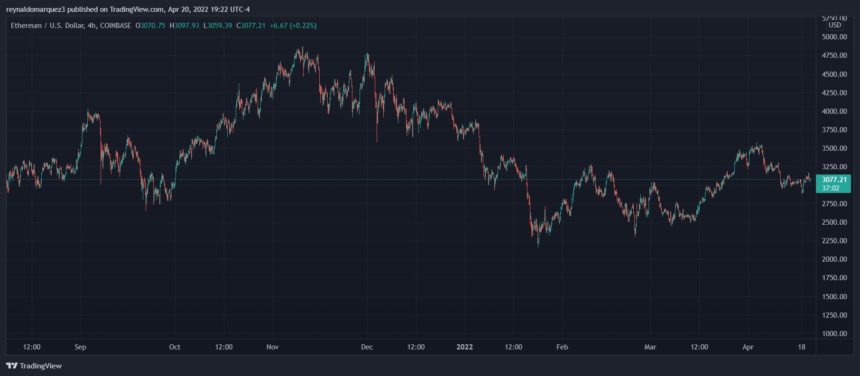
ETH moving sideways on the 4-hour chart. Source: ETHUSD Tradingview Tags:

Похожее

Bitcoin's 'Rally Ends,' Officially Entering the Later Stage of a Bear Market?

Bitcoin prices declined 13% this week, reversing the recent rebound and signaling a likely transition into the later stages of a bear market. Key on-chain metrics deteriorated, with the short-term holder cost basis falling below the Realized Price—a pattern last seen in early 2022, characteristic of bear market maturity. The rally to ~$82k proved to be a bear market bounce, as evidenced by the 90-day realized profit/loss ratio failing to sustain above the bullish threshold of 2. Daily realized losses surged to $1.35B, including significant selling from long-term holders who accumulated near cycle tops, indicating ongoing supply redistribution. Price was rejected almost precisely at the aggregate US spot ETF cost basis of ~$83k, turning that level into resistance and leaving the average ETF investor underwater again. Spot market selling pressure intensified, with the 7-day volume delta turning significantly negative to its weakest level since February. While a major long liquidation event cleared over $400M in leverage, spot demand has not yet stepped in to absorb the resulting supply. Options markets continue pricing in higher future volatility (elevated volatility risk premium) and maintain a skew toward put options, reflecting persistent demand for downside protection, though not yet panic. Overall, market structure remains fragile. Sustained recovery likely requires a reclaim of the ETF cost basis, a shift back to positive spot demand, and a slowdown in realized loss-taking. Until then, the market risks further downside or extended consolidation within the broader bear trend.

Foresight News10 мин. назад

Bitcoin's 'Rally Ends,' Officially Entering the Later Stage of a Bear Market?

Foresight News10 мин. назад

How Risky is the "Death Spiral" of MSTR and STRC?

Summary: This article explores the perceived "death spiral" risk between MicroStrategy (MSTR), its Bitcoin holdings, and its perpetual preferred stock (STRC), drawing comparisons to the LUNA-UST collapse. While both systems feature price anchors, high yields for holders, and potential feedback loops, their core mechanisms differ fundamentally. The MSTR-STRC structure relies on continuous financing to sustain its high dividend payouts, primarily through stock ATM offerings. A negative feedback cycle could occur: falling MSTR stock price makes raising equity capital harder, increasing pressure to sell Bitcoin, which undermines STRC confidence and further depresses MSTR. However, unlike LUNA-UST's automated, direct linkage, the MSTR-STRC loop is weaker and has brakes: STRC dividends can be deferred or rates lowered, and STRC holders have a $100/share liquidation preference in bankruptcy, providing a price floor. The company's sustainability hinges on its ability to continue financing. Its current ~$900 million USD reserves cover only about 6.3 months of its ~$1.71 billion annual interest/dividend burden. The next six months are critical, aligning with both the potential bottom in Bitcoin's four-year cycle and the depletion timeline of its reserves. While a LUNA-style catastrophic collapse is deemed highly unlikely due to structural differences, the key question is whether MicroStrategy can navigate this period through healthy deleveraging to restart its capital engine.

Foresight News28 мин. назад

How Risky is the "Death Spiral" of MSTR and STRC?

Foresight News28 мин. назад

How Much Debt Does Strategy Really Have? Is There a Risk of Implosion?

MicroStrategy's Debt Risk: A Turning Point in the "Never Sell" Strategy As of June 3, 2026, MicroStrategy holds 843,706 bitcoins (valued at ~$53.1B) but faces significant financial obligations. Its capital structure includes $6.75B in convertible notes and $15.48B in perpetual preferred stock (led by the $8.5B STRC series), creating an annual payout burden of ~$1.71B. With software revenue at only ~$500M, interest and dividend obligations far exceed operating income. A critical shift occurred in late May 2026 when the company sold 32 bitcoins for ~$2.5M to cover dividends, breaking CEO Michael Saylor's long-standing "never sell" pledge. This symbolic move triggered a sharp decline in both Bitcoin's price and MSTR stock, reflecting market fears about cash flow sustainability. The core of the strain is the STRC perpetual preferred stock, designed as a "permanent loan" with no maturity date but requiring high monthly dividends (currently 11.5%). Its business model relies on a three-part cycle: issuing new STRC shares, using proceeds to buy more Bitcoin and fund a USD reserve, and using that reserve to pay dividends. This cycle depends on continuous investor demand for STRC and Bitcoin's price appreciation. Analysis shows Bitcoin needs to appreciate at least 2.3% annually to cover the $1.71B in yearly obligations at current holdings. With Bitcoin price down ~22% from March 2026 highs, this pressure has intensified. The company's $900M USD reserve can only cover about 7 months of payments if STRC issuance stalls. Key risks are not immediate bankruptcy or forced Bitcoin liquidation (as BTC is not collateral), but rather: 1) The erosion of MSTR's premium to its Bitcoin holdings (mNAV), which would cripple its ability to raise cheap capital; 2) A vicious cycle where stagnant Bitcoin prices reduce STRC demand, draining the USD reserve and forcing BTC sales, further depressing prices. The period from February 2027 to September 2028 is a crucial test, with over $5.9B in convertible notes facing put options or maturity. In essence, MicroStrategy has evolved from a simple Bitcoin holder into a complex financial entity acting like a "private Bitcoin bank," leveraging its BTC holdings to create layered financial products. Its survival depends on maintaining Bitcoin's price trend, its stock premium, and market appetite for its preferred shares. The recent token sale marks not a betrayal of its Bitcoin thesis, but an admission that the leveraged strategy must eventually be paid for.

marsbit39 мин. назад

How Much Debt Does Strategy Really Have? Is There a Risk of Implosion?

marsbit39 мин. назад

Anthropic Cries Wolf: Is the AGI Threat Real, or Just an IPO Story?

Anthropic has published an article titled "When AI builds itself," discussing the emerging concept of "recursive self-improvement," where AI begins to actively participate in designing, training, testing, and optimizing its own subsequent versions. The company presents internal data showing that by May 2026, over 80% of code merged into its codebase was written by Claude, its AI model. Claude's capabilities have expanded to handling complex, open-ended engineering tasks, achieving a 76% success rate in such areas, and even contributing to research processes, such as optimizing code performance and conducting AI safety experiments. Anthropic outlines an evolution from human-driven development to AI-assisted workflows, culminating in the current stage where AI agents can autonomously write, run, and delegate code. The company cautions that the path toward a "closed loop," where AI continuously improves itself, is becoming visible. It calls for coordinated global mechanisms to potentially slow or pause frontier AI development to allow safety research and societal structures to catch up. However, the timing of this warning coincides with Anthropic's preparations for an IPO, framing the narrative not just as a safety concern but also as a demonstration of Claude's advanced capabilities and its integral role in accelerating Anthropic's own R&D—creating a potential "flywheel" effect for competitive advantage. This contrasts with OpenAI's recent, more policy-oriented discussion of the same risks, highlighting the competitive dynamics in the AI industry as companies position themselves in both the technological and regulatory landscape.

marsbit1 ч. назад

Anthropic Cries Wolf: Is the AGI Threat Real, or Just an IPO Story?

marsbit1 ч. назад

Торговля

Спот
Фьючерсы
活动图片