According to an IRS notice published in 2014, cryptocurrencies including NFTs are classified as “property” meaning they are liable to a capital gains tax similar to stocks or “real” property.
A capital gain occurs if you sell a crypto for more than your initial investment. For instance, if you buy one bitcoin for $20,000 and sell it for $50,000, you have made $30,000 of taxable gains. In other words, if you make profit from the sale of a crypto or a non-fungible token (NFT), you trigger a taxable event in the eyes of the IRS.
How are crypto taxes on capital gains determined?
The length of time that you hold your crypto will affect the amount of capital gains you will be liable to pay.
- If you hold cryptocurrencies for 12 months or less, short-term capital gains tax will apply.
- If you hold crypto for more than 12 months you will be subject to long-term capital gains tax treatment.
According to the IRS, your holding period begins the day after you purchase a crypto. So, it’s important to know when you received your crypto asset and what tax rates and rules apply when you sell or trade it.
Short-term capital gains
For 2021 reporting year, the federal short-term capital gains rate is the same as your ordinary income tax rate, where your tax rate is dependent on your total income, ranging from 10% to 37%.
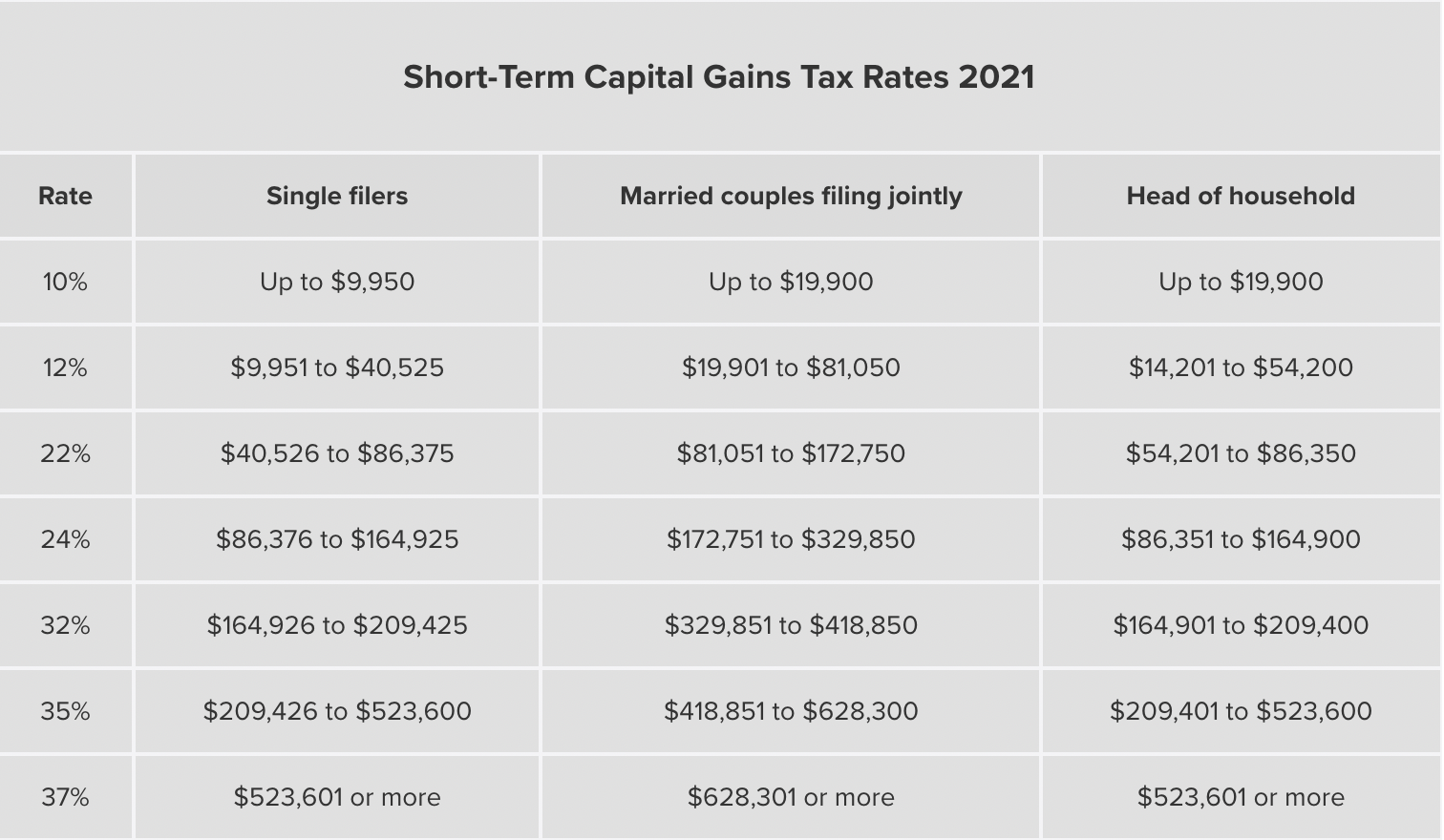
Short-term U.S capital gains tax brackets
For instance, let’s say you earn a salary of $80,000 and made $10,000 in short-term crypto investments; your taxable income sits at a combined amount of $90,000. The first $9,950 of your salary will be taxed 10%. Any income between $9,951 to $40,525 is subject to a 12% tax. Finally, income earned in the $40,526 - $86,375 range will be taxed at 22%.
Since you made $10,000 in short-term crypto investments on top of your $80,000 wage, the portion of short-term crypto investments up to the $86,375 threshold would be taxed at 22%. The remaining $3,625 of the gain would be taxed at 24%.
Long-term capital gains
If you hold crypto for a period longer than 12 months and then opt to sell or trade that crypto, you will be subject to a long-term capital gains tax treatment. Long-term capital gains tax rates have different rates than the short-term capital gains, ranging from 0% to 20% depending on your total income. This is much lower than the short-term capital gains brackets and encourages investors to make longer-term investments.
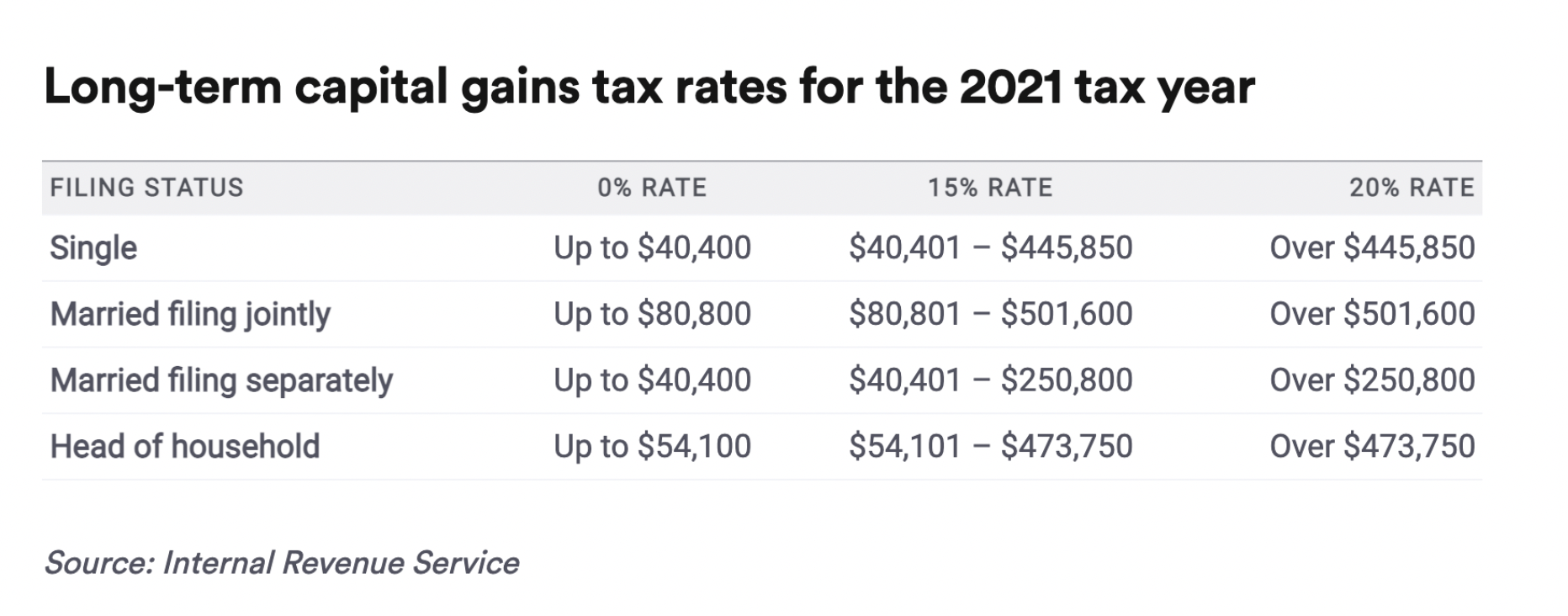
Long-term U.S capital gains tax brackets
Let’s look at a theoretical example of how long-term capital gains can save money compared to short-term capital gains. The chart below shows a married couple with $100,000 earnings jointly filing their capital gains for selling 10 ETH at different times (price of ETH is not based on current price in the example).
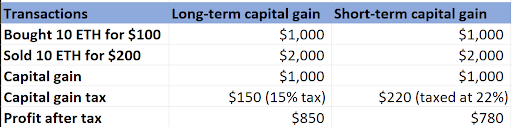
(Capital gains comparison chart)
The couple could save $70 by holding on to their assets for more than 12 months. This may not seem like a lot in this example, but imagine if they were selling 1,000 ETH – that would still be taxed at the 15% rate for long-term capital gains and result in $7,000 saved in taxes.
Taxable events
Having looked at the two types of capital gains you may face and the importance of understanding timing when disposing of crypto, let’s look at what events can trigger a capital gain tax.
- Selling crypto: The most common capital gain trigger event occurs when you sell your crypto for fiat currency. For instance, if you buy 2 ETH for $1,000 and you sell them for $2,000 six months later, you will report a short-term capital gain of $1,000 and be taxed on that amount. The same applies for a long-term capital gain if you hold your ETH for more than 12 months.
- Using your crypto to purchase goods and services: If you use crypto to purchase a good or a service, you will be subject to a capital gain tax. Let’s say you bought one bitcoin for $100 in 2013 and have not touched it since. Now the bitcoin is worth $60,000 and you decide to purchase a new car for $60,000. As a result, you incur a long-term capital gain of $59,900 – the difference between the cost of the car and the value of your bitcoin when you bought the car at $60,000.
- Trading one crypto for another crypto: Trading cryptos is considered a taxable event, regardless of if they are traded directly one-to-one on Uniswap or on an exchange. Let’s say you purchased 10 AAVE for $200 each for a total of $2,000. Later, you traded all your AAVE for ETH. At the time of the trade, AAVE's price is $500, bringing your total AAVE holdings to $5,000. Here you incurred a capital gain of $3,000 that you'll have to report – the difference between the value of your 10 AAVE when purchased and the value of your entire AAVE holdings at the time of trade. This also applies when you use an NFT to purchase crypto.
Special cases
- Crypto donations: The IRS considers crypto donations the same as cash donations, making them tax deductible. The existing limits for deductions range from 20% to 60% of adjusted gross income. However, for the calendar year 2021, you can apply to increase your limit up to 100%. This means you can apply to deduct all your crypto gains and pay no capital gains tax. However, if you sell your crypto and then donate the after-tax cash to a charity, the capital gain could be short-term or long-term depending on the holding period. For more information on donations see here.
- Crypto gifts: If you make a crypto gift to someone, make sure it’s below $15,000 since no gift tax would apply. If you go over, you'll have to file Form 709 and will owe taxes on the gift. However, if you receive crypto as a gift and decide to sell the crypto, then your cost basis will be the same as that of the gift donor and you will have to pay capital gains.
- Inherited crypto assets: Inherited cryptos are liable to the same estate regulations as any other asset class.
Calculating your capital gains
Since 2019, the guidelines on how to calculate crypto-related capital gains has become clearer. In practice there are three ways that you could calculate your capital gains and they can make a big difference on the amount you are taxed.
1. FIFO: First-in-first-out (FIFO) calculates your tax from the time you purchased your crypto to the time you sell it. Using the FIFO method means capital gains will be based on the price of the first of the five bitcoin purchased on March 19, 2017, for $500 each for a total of $2,500, for example. The buyer later sells them for $2,000 each for a total of $10,000 in the same 12 months.
Selling price – purchasing price (first bought bitcoin) = taxable gain
(5 x $2,000) – (5 x $500) = $7,500
2. LIFO: Last-in-first-out (LIFO) calculates your taxes by the last unit purchased and considers it as the first unit eligible for sale. If you bought two bitcoins on March 19, 2017, for $500 and three bitcoins on Feb. 6, 2016, for $400, the calculation will look like this:
Selling price – purchase price (last bought bitcoin) – purchase price (first bought bitcoin) = taxable gain
(5 x $2,000) – (2 x $500) – (3 x $400) = $7,800
3. HIFO: Highest-in-first-out (HIFO) calculates your taxes by taking the coin with the highest purchase price as the one sold first. If the highest price paid for the five bitcoins you were selling was $500 and you purchased three bitcoins at that price and then two more bitcoins at $400, the calculation would look like this, regardless of when you bought those bitcoins:
Selling price – (highest priced bitcoin) - (next highest priced bitcoin) = taxable gain
(5 x $2,000) – (3 x $500) - (2 x $400) = $7,700
With that all said and done, it is important to make sure you keep your crypto transactions in check and record them before taxes are due. This can become even more complex once airdrops, liquidity pools, staking and other crypto products come into play. That’s why it is a good idea to record your trades and potentially seek advice from crypto tax tool experts such as:
By understanding your capital gains and knowing how you might best reduce your tax liability, you will escape the hot seat on tax deadline day!