Shiba Inu Comes Back with Massive 30% Spike in March, Whales' Transactions Increase by 349%

u.todayОпубликовано 2022-03-30Обновлено 2022-03-29

Введение

Shiba Inu once again disrupts the cryptocurrency market with a strong comeback on the scene in March.

Shiba Inu once again disrupts the cryptocurrency market with a strong comeback on the scene in March. Since the lowest trading point in March, SHIB has gained around 30%, which caused an immediate reaction among whales that started actively moving their funds, according to TradingView.
As the Shiba Inu chart suggests, the asset is currently moving in a 25% rally for the last two weeks, showing that risk-on tendencies have returned to the market. We should also point out that SHIB trading volume also saw a major spike on March 28, which made the day the most intense trading one in the last month.
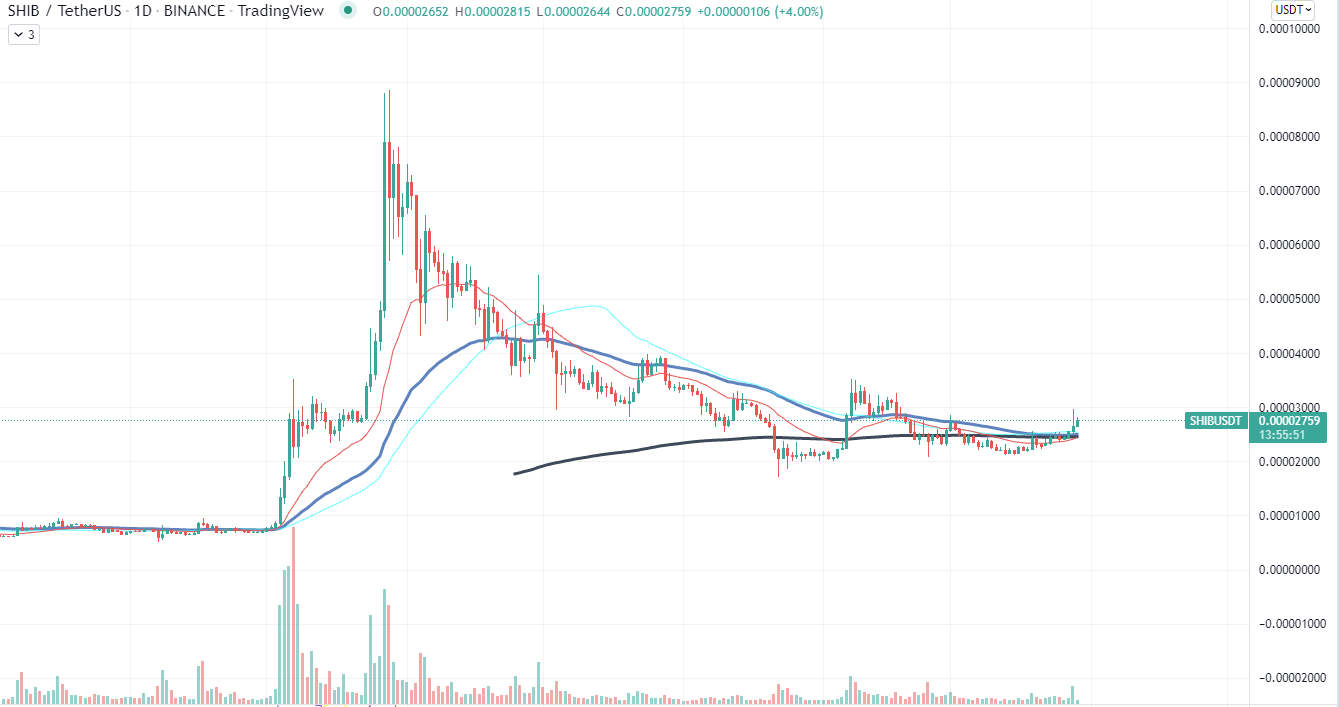
Shiba Inu Chart

Source: TradingView It is also noticeable that the number of large transactions made by whales increased by almost 350% which is a mind-blowing number for a relatively small-cap altcoin like Shiba Inu. Despite the absence of major buying power, whales are most likely redistributing funds to sell or buy additional SHIB tokens.
Shiba Inu technical indicators
Previously, because of the absence of almost any kind of volatility on Shiba Inu tokens, it was relatively hard to use various technical analysis tools; hence, the majority of market participants were unable to properly use this method of price movement prediction and analysis.
But thanks to increased volatility, indicators like the Relative Strength Index and Moving Averages became useful again. According to data provided by indicators, Shiba Inu's spike in volatility was followed by the tightening of various moving averages, including 50- and 200-day lines.
As for the RSI, the indicator's value reached 65, which puts the token close to the "overbought zone," which quite often becomes a reason for a price reversal. At press time, Shiba Inu trades at $0.00002759 with a 4% price increase in the last 24 hours.


Похожее

The Real Battlefield of AI Lies in the 'Dark Forest'

The article "AI's Real Battlefield is in the 'Dark Forest'" discusses the shifting dynamics in the global AI landscape, contrasting the strategic directions of Chinese and U.S. AI developers. Chinese companies like Alibaba (with its "HappyHorse" video model), ByteDance (Seedance 2.0), and Kuaishou (Kling 3.0) have taken the lead in text-to-video generation, surpassing OpenAI’s now-discontinued Sora. These models are deeply integrated into their parent companies’ content ecosystems (e.g., Douyin, Kuaishou), serving to reduce content creation costs and enhance user engagement rather than operating as standalone profit centers. In contrast, U.S. firms are pivoting toward high-stakes enterprise and security applications. Anthropic’s Claude Mythos model demonstrates advanced capabilities in autonomously discovering and exploiting software vulnerabilities, prompting concern at the highest levels of U.S. financial and governmental institutions. OpenAI responded with its own GPT-5.4-Cyber, signaling a strategic shift from consumer-facing products to enterprise-grade tools focused on cybersecurity and programming. The divergence is attributed to fundamental differences in resources and market structures. U.S. companies, backed by vast computational resources (e.g., Amazon and Google supply Anthropic with substantial funding and TPU access), can pursue deep, specialized R&D in high-value B2B sectors. Chinese firms, facing significant compute power constraints and a less mature enterprise SaaS market, have found success by leveraging their massive consumer platforms and optimizing for cost-efficiency. The article warns that the AI race is entering a "dark forest" phase—a reference to competitive dynamics where cybersecurity capabilities could determine digital sovereignty. While Chinese models like Zhipu AI’s GLM-5.1 show promise in narrowing the gap in coding proficiency, the author stresses that achieving parity in security-critical AI will require asymmetric strategies, including greater investment in coding models, adaptation to domestic hardware, and exploring international markets in the Global South.

marsbit4 мин. назад

The Real Battlefield of AI Lies in the 'Dark Forest'

marsbit4 мин. назад

Торговля

Спот
Фьючерсы
活动图片