Bitcoin Giants Shrink: Whales Quietly Hand Off Billions To Institutions

bitcoinistОпубликовано 2025-07-06Обновлено 2025-07-06

Введение

Bitcoin’s price has held steady around $108,100 as of Saturday afternoon after big holders shipped out a massive load of...

Trusted Editorial content, reviewed by leading industry experts and seasoned editors. Ad Disclosure

Bitcoin’s price has held steady around $108,100 as of Saturday afternoon after big holders shipped out a massive load of coins.

Based on reports, whales—those early adopters and big miners—sold over 500,000 BTC in the past 12 months. At today’s rates, that stash is worth north of $50 billion. Institutions grabbed almost every coin they let go. It’s a huge shift in who really owns Bitcoin.

Whales Pass The Torch

According to Bloomberg’s review of 10x Research data, wallets holding between 1,000–10,000 BTC saw their balances slip from over 4.5 million coins in January 2023 to about 4.47 million in July 2025.

At the same time, addresses with 100–1,000 BTC jumped from nearly 4 million to 4.77 million. That shift shows big players trimming back while medium‑size holders, often funds or wealthy clients, build their stacks. It’s happening quietly through in‑kind transfers and private deals that skip public exchanges.
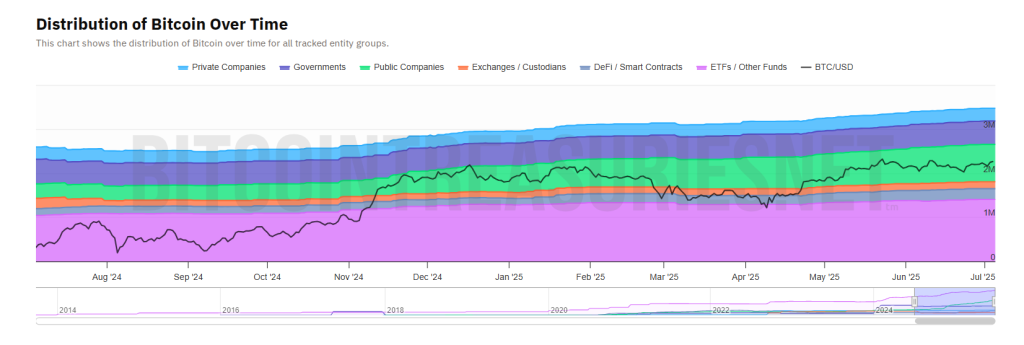
Source: Bitcoin Treasuries

Institutions Ramp Up Their Stakes

Funds, ETFs and corporate treasuries have scooped up almost every coin dropped by whales. Data from Bitcoin Treasuries shows private companies boosted their holdings from 279,374 BTC in July 2024 to 290,883 BTC today.

Public firms climbed from 325,400 BTC to 848,600 BTC. ETFs led the charge, raising their balance from 1,039,000 BTC to 1,405,480 BTC. In total, these groups added 899,198 BTC—about $96 billion—over the past year. That buying power has helped keep the market in balance as whales step back.

BTCUSD currently trading at $108,227. Chart: TradingView

Shift In On-Chain Holdings

Medium-sized wallets are growing while the largest ones shrink. That trend suggests new types of investors are moving in.

Edward Chin, co‑founder of Parataxis Capital, said in‑kind transfers let coins move from anonymous holders to regulated firms without public trades. This quiet pipeline boosts on‑chain activity and brings more oversight to big Bitcoin trades.

Volatility Hits Two-Year Low

As institutional flows rise, price swings have dulled. The Deribit 30‑day volatility gauge sits at its lowest level in two years. Jeff Dorman, CIO at Arca, compared today’s Bitcoin to a steady dividend payer that might deliver annual gains in the 10–20% range.

That’s a far cry from the 1,400% surge seen in 2017. For long‑term savers, steadier returns look more attractive than wild rallies.

Meanwhile, Fred Thiel, CEO of miner MARA Holdings, said his company still holds every coin it mines. But he warned that if whale selling picks up again and institutional appetite fades, prices could lurch lower.

Featured image from Meta, chart from TradingView

Editorial Process for bitcoinist is centered on delivering thoroughly researched, accurate, and unbiased content. We uphold strict sourcing standards, and each page undergoes diligent review by our team of top technology experts and seasoned editors. This process ensures the integrity, relevance, and value of our content for our readers.

Christian, a journalist and editor with leadership roles in Philippine and Canadian media, is fueled by his love for writing and cryptocurrency. Off-screen, he's a cook and cinephile who's constantly intrigued by the size of the universe.

Похожее

Will Quantum Computing Kill Bitcoin and Mining? Is This Alarmist?

The article addresses the recurring concern that quantum computing could break Bitcoin's encryption and disrupt mining. It references a Google Quantum AI white paper from March 2026, which suggests that the resources needed for a quantum computer to crack Bitcoin’s elliptic curve digital signature algorithm (ECDSA) have been reduced by about 20 times. Under ideal conditions, such an attack could theoretically derive a private key from a public key in roughly 9 minutes using 500,000 physical qubits. However, the threat is not immediate. Current quantum processors, like Google’s Willow (105 qubits) or IBM’s Condor (~1,121 qubits), are far from the scale required. The risk primarily targets transaction signatures—especially during the brief window when a transaction is broadcast but not yet confirmed, or when public keys have been historically exposed. It is estimated there is only a 10% probability of a “quantum break” by 2032. The impact on mining is considered negligible. Research indicates that quantum mining would require astronomically high qubit counts and energy—far exceeding entire national grids—making it economically and physically infeasible. The broader solution lies in post-quantum cryptography (PQC). Standards like ML-DSA and SLH-DSA are being developed, and Bitcoin improvement proposals such as BIP 360 aim to reduce quantum vulnerability by modifying transaction structures to avoid exposing public keys. While quantum computing poses a future risk to all public-key encryption systems—not just Bitcoin—the cryptocurrency ecosystem has time to adapt. Upgrades and migration to quantum-resistant algorithms are underway, ensuring the network evolves ahead of the threat.

marsbit2 ч. назад

Will Quantum Computing Kill Bitcoin and Mining? Is This Alarmist?

marsbit2 ч. назад

5 Minutes to Make AI Your Second Brain

This article introduces a powerful personal knowledge management system combining Claude Code and Obsidian, designed to function as an "AI second brain." Unlike traditional RAG systems that perform temporary, one-off retrievals, this system enables AI to continuously build and maintain an evolving knowledge wiki. The architecture consists of three layers: a raw data layer (notes, articles, transcripts), an AI-maintained structured knowledge base that builds cross-references, and a schema layer that governs organization and system logic. Core operations are Ingest (bringing in external information), Query (instant knowledge access), and Lint (checking consistency and fixing issues). The system's power lies in creating a "compound interest" effect for knowledge: it reduces cognitive load by offloading the tasks of connecting, organizing, and understanding information to AI, while simultaneously improving the accuracy and contextual consistency of the AI's outputs. The setup process is quick, requiring users to download Obsidian, create a vault (knowledge repository), configure Claude Code to access that vault, and apply a specific system prompt. Advanced tips include using a browser extension to easily add web content, maintaining separate vaults for work and personal life, and utilizing the "Orphans" feature to identify unlinked ideas. The main drawbacks are the need for visual thinking, a commitment to ongoing maintenance, and local storage usage. Ultimately, the system transforms scattered information into a reusable, interconnected network of knowledge.

marsbit4 ч. назад

5 Minutes to Make AI Your Second Brain

marsbit4 ч. назад

Торговля

Спот
Фьючерсы
活动图片