
Bitcoin’s 1-year returns drop to 23.6% – Is the wild ride over?

AmbcryptoОпубликовано 2025-04-08Обновлено 2025-04-08

Введение

Bitcoin is now in a peculiar phase as far as market cycles are concerned.

For the first time since its 2023-2024 rally, Bitcoin [BTC] has slipped below gold, the S&P 500, and the Nasdaq in annual returns – A stark sign that the wild ride may be over. This shift marks the end of Bitcoin’s speculative bubble and signals its gradual maturation, as it begins to behave less like a rogue asset and more like its traditional counterparts.

Could this be the beginning of a new, steadier chapter for BTC? Or is the market bracing for a larger correction? Either way, the days of 100% gains might be behind us.

Rally that was and the cooldown that followed

Since early 2025, Bitcoin has shown signs of decoupling from risk assets. However, unlike the narrative that this signals BTC’s impending return to $100k, the divergence might mark the start of something quieter – The end of the explosive cycles that defined its past.

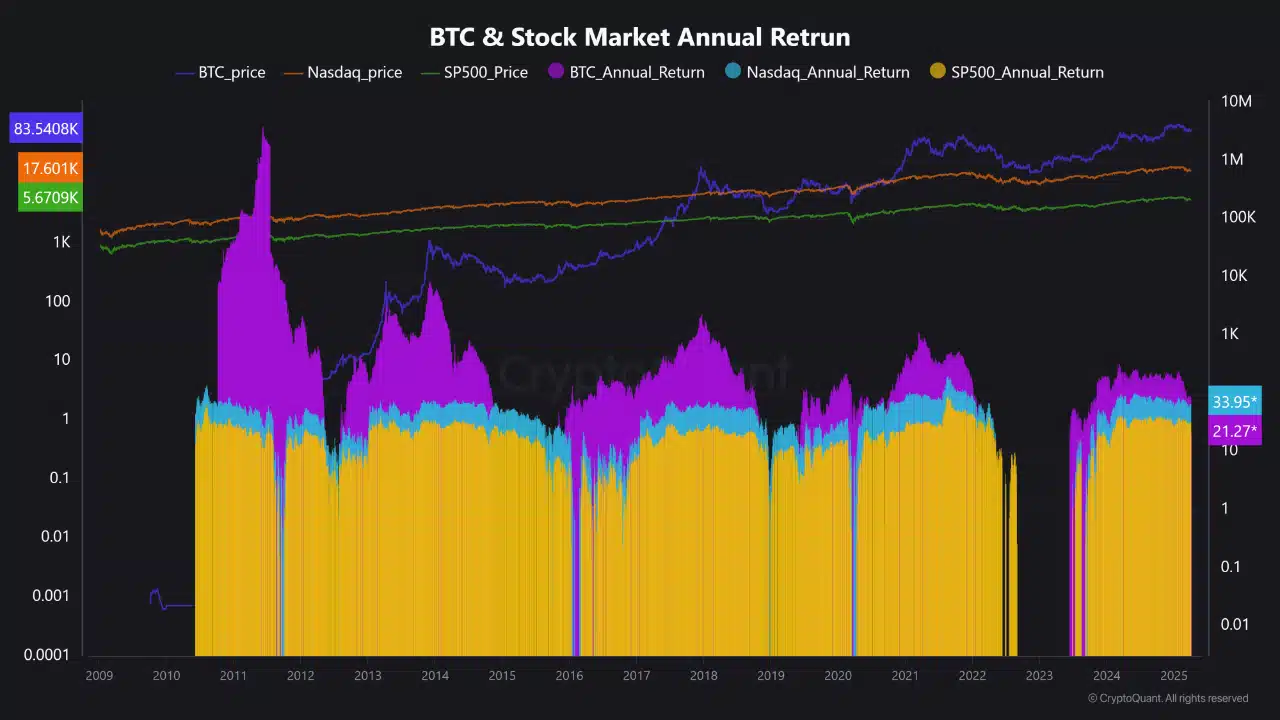
According to on-chain data, Bitcoin’s 1-year returns have now dropped to 23.6%, underperforming –

Nasdaq Composite: 33.5%

S&P 500: 33.9%

Gold Futures: 69.7%

This is the first time in this post-halving cycle that Bitcoin has lagged all three – A meaningful change that alludes to a broader cooldown, rather than an imminent leg up.

What does the data say?

AMBCrypto recently reported that Bitcoin’s relative resilience, compared to equities and gold, is evidence of “haven status” returning, and that it could soon catalyze BTC’s move towards $100k.
However, the data painted a more tempered picture.

While the S&P 500 and Nasdaq remain firmly in the green and gold rallies on safe-haven demand, BTC’s return curve has flattened. Volatility is compressing. The annual return bars – once towering during bull runs – are now shorter, tighter, and more frequent, underlining a retreat from extreme price moves.
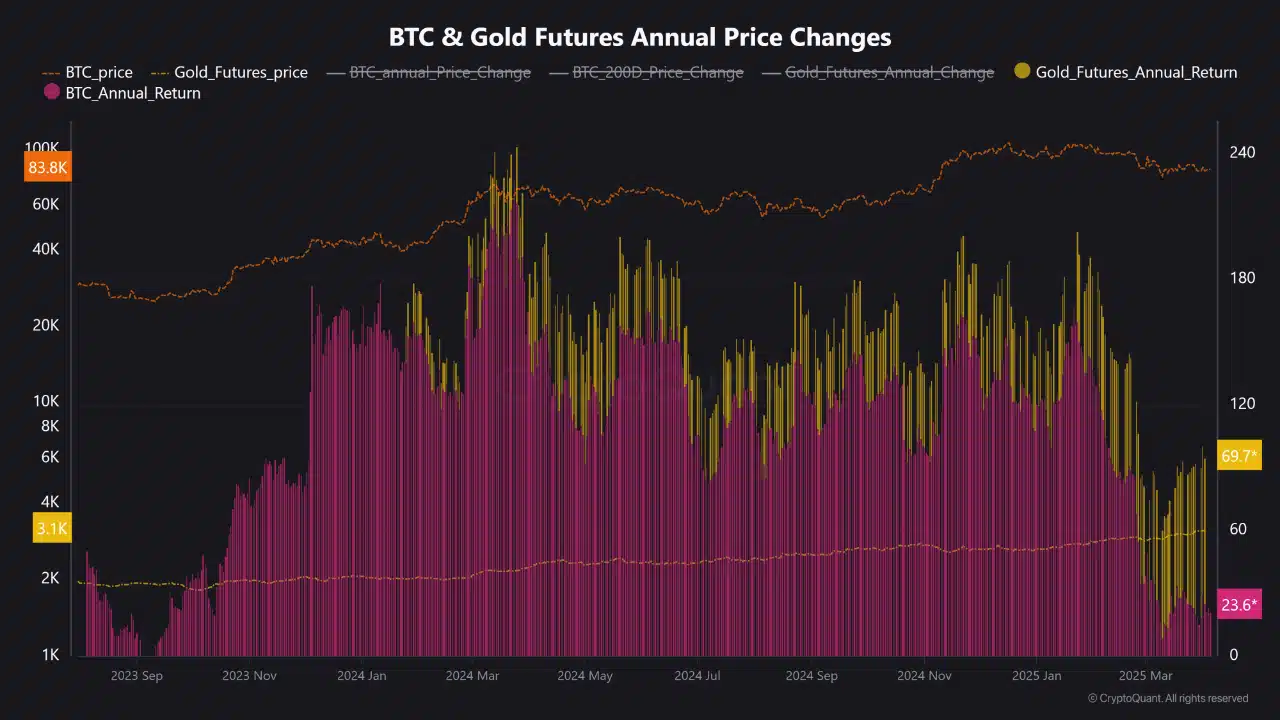
If Bitcoin still behaves like a high-risk, high-reward asset, it would have likely outpaced equities in this volatile macro cycle. Instead, it’s underperforming them.

The maturation of Bitcoin – A risk or an opportunity?

Bitcoin’s modest returns don’t necessarily signal weakness. They may indicate evolution. Rather than breaking away from traditional markets in defiance, Bitcoin may finally be aligning with them – Behaving more like a long-term portfolio asset than a short-term speculation vehicle.

Its underperformance could be a cleansing mechanism – Flushing out excess leverage, dialing down euphoric expectations, and recalibrating investor timeframes. Short-term traders may find less excitement here, but long-term holders could find renewed conviction. This is less about BTC proving itself as a crisis hedge and more about BTC growing into a new asset class – Less explosive, more stable, and perhaps… a little boring.

The question now isn’t whether Bitcoin will hit $100k tomorrow. It’s whether the market is ready for a version of Bitcoin that behaves less like a rocket, and more like a rock.


Похожее

What Does $150 Billion in Annual Derivatives Liquidations Mean for the Market?

According to CoinGlass data, forced liquidations in the cryptocurrency derivatives market reached $150 billion in 2025. While seemingly alarming, this reflects a structural norm in a market where derivatives dominate price discovery. Liquidations act as a periodic cost of leverage, occurring against a backdrop of $85.7 trillion in annual derivatives trading volume. Record-high open interest, crowded long positions, and high leverage—particularly in altcoins—combined with a global risk-off sentiment triggered a major market reversal in October, resulting in over $19 billion in liquidations within days, mostly from long positions. The core issue lies in risk amplification mechanisms: while routine liquidations are absorbed by insurance funds, Automatic Deleveraging (ADL) mechanisms can exacerbate selling during extreme volatility, especially hurting neutral strategies and smaller assets. High exchange dominance (the top four control 62% of derivatives trading) intensified the contagion risk, as synchronized de-risking and similar liquidation logic led to concentrated sell-offs. Infrastructure strain on bridges and fiat channels further hampered arbitrage and liquidity. The $150 billion in yearly liquidations signifies not systemic chaos but the cost of risk transfer. While no default cascades occurred in 2025, the event highlighted structural vulnerabilities of exchange concentration, high leverage, and certain mechanisms—underscoring the need for more robust systems and rational trading practices to prevent future crises.

marsbit30 мин. назад

What Does $150 Billion in Annual Derivatives Liquidations Mean for the Market?

marsbit30 мин. назад

Looking Back at Prediction Markets by the End of 2025: Scale, Players, and the Watershed Moment

By the end of 2025, prediction markets have fundamentally shifted from being event-driven tools reliant on black swan events to platforms sustained by structural trading demand. The total monthly trading volume has grown from under $100 million in early 2024 to over $1 billion by late 2025, indicating a phase of explosive growth and consistent liquidity. The industry has evolved into five distinct segments: 1. **Compliant Markets**: Kalshi (CFTC-regulated, exchange-like) and Polymarket (globally liquid, later US-compliant) lead with institutional and high-frequency trading, especially in sports contracts. 2. **Crypto-Native Experiments**: Platforms like Opinion explore high-risk, crypto-policy, and speculative events, driving innovation but facing regulatory uncertainty. 3. **High-Frequency Trading Platforms**: Limitless shortens contract cycles, blurring lines between prediction markets and derivatives trading. 4. **Embedded Markets**: Myriad Markets integrates prediction features into wallets and super-apps, reducing user acquisition costs and making participation more casual. 5. **Native Information Markets**: Platforms like predict.fun and media integrations use incentives and community mechanisms to blend prediction with content and social interaction. Regulation in 2025 has not meant full liberalization but rather the establishment of boundaries—predictive contracts are recognized as financial instruments, yet state-level gambling laws remain a friction point. The core shift for users is understanding that these markets now price uncertainty and reflect consensus, not just binary outcomes. Looking ahead, prediction markets are becoming tools for understanding uncertainty rather than mere betting arenas, with projections suggesting significant future growth. 2025 marks the beginning of this structural transformation.

比推41 мин. назад

Looking Back at Prediction Markets by the End of 2025: Scale, Players, and the Watershed Moment

比推41 мин. назад

Торговля

Спот
Фьючерсы

Популярные статьи

Тест по Bitcoin Биткоина

HTX Learn: Изучите Bitcoin halving и Заработаете Токены USDT

2.7k просмотров всегоОпубликовано 2024.04.16Обновлено 2024.04.16

Fractal Bitcoin: масштабирование Биткоина с помощью рекурсивной системы

Fractal Bitcoin — масштабное Layer-1-решнение, созданное на базе кода Биткоина, позволяющего достигать бесконечного масштабирования с помощью рекурсивного подхода.

1.9k просмотров всегоОпубликовано 2025.06.30Обновлено 2025.06.30

Обсуждения

Добро пожаловать в Сообщество HTX. Здесь вы сможете быть в курсе последних новостей о развитии платформы и получить доступ к профессиональной аналитической информации о рынке. Мнения пользователей о цене на BTC (BTC) представлены ниже.

活动图片