Why Did Market Sentiment Collapse Completely in 2025? Deciphering Messari's 100,000-Word Annual Report

marsbitPublicado em 2025-12-23Última atualização em 2025-12-23

Resumo

The 2025 crypto market experienced a historic collapse in sentiment, with the Crypto Fear & Greed Index hitting extreme fear levels of 10, despite the absence of systemic failures like exchange collapses or major bankruptcies. Messari's analysis attributes this not to industry failure, but to a deep structural shift: the market is transitioning from a speculative alpha-seeking environment to one dominated by institutional, long-term asset allocators. The core issue is a misalignment of participant identity. While institutions benefited from clear regulations, ETFs, and corporate treasury adoption (DATs), retail traders and active participants suffered from significantly reduced alpha, ineffective narrative cycles, and chronic underperformance of most assets against Bitcoin. The root cause of the emotional breakdown is identified as a crisis in the traditional global monetary system. With government debt consistently outpacing GDP growth worldwide, savers are systematically penalized through inflation, low real interest rates, and financial repression. Crypto, particularly Bitcoin, is not merely a tool for higher returns but offers a predictable, rules-based, and self-custodial monetary alternative. Bitcoin has decisively won the "monetary" competition. Its 429% price appreciation from 2022-2025 and dominant market share (57.3% of total crypto market cap) reflect its role as a non-sovereign store of value. Its "boring" reliability—lacking narratives or promises—is its great...

This article is based on the annual report "The Crypto Theses 2026" released by Messari in December 2025. The full report exceeds 100,000 words, with an official estimated reading time of 401 minutes. The information herein is for reference only and does not constitute any investment advice or offer. We are not responsible for the accuracy of the content, nor do we assume any consequences arising therefrom.

Introduction | The Worst Year for Sentiment, But Not the Most Fragile Year for the System

If we look only at sentiment indicators, the crypto market in 2025 could almost be pronounced "dead."
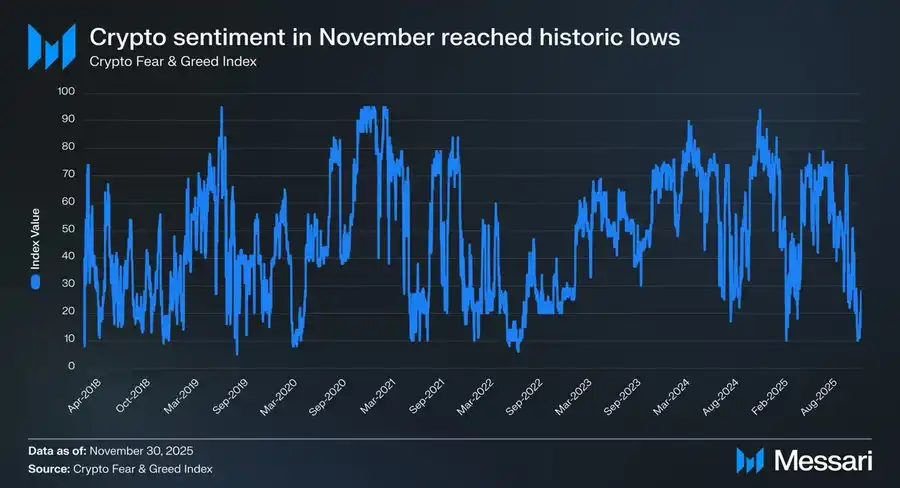
In November 2025, the Crypto Fear & Greed Index fell to 10, entering the "Extreme Fear" zone.

Historically, there have been very few moments when sentiment has fallen to this level:

· March 2020: Liquidity stampede triggered by the global pandemic

· May 2021: Chain reaction of leveraged liquidations

· May–June 2022: Systemic collapse of Luna and 3AC

· 2018–2019: Industry-wide bear market

These periods all share a commonality: the industry itself was failing, and the future was highly uncertain.

But 2025 does not fit this description. No major exchanges misappropriated user assets, no Ponzi projects with market caps of tens of billions of dollars dominated the narrative, the total market capitalization did not fall below the previous cycle's high, stablecoin scale instead hit a new all-time high, and regulatory and institutionalization processes continued to advance.

At the "fact level," this is not a year of industry collapse. However, at the "feeling level," it might be the most painful year for many practitioners, investors, and long-time users.

Why Did Sentiment Collapse?

Messari presents a highly impactful contrast at the beginning of the report:

If you were participating in crypto asset allocation from a Wall Street office building, 2025 might have been the best year since you entered the industry. But if you were staying up late watching charts and searching for Alpha in Telegram and Discord, this is probably the year you missed the "old days" the most.

The same market, two almost diametrically opposed experiences. This is not an accidental mood swing, nor a simple bull-bear switch, but a deeper structural misalignment: the market is changing participants, but most people are still participating in the new system with their old identities.

This Is Not a Market Recap

This article does not intend to discuss short-term price movements, nor does it attempt to answer "will it go up next?".

It is more like a structural explanation:

· Why, while institutions, capital, and infrastructure are continuously strengthening,

· did market sentiment slide to a historic low?

· Why do many people feel "they chose the wrong track," but the system itself has not failed?

In this 100,000-word report, Messari chooses to start from an extremely primitive question: If crypto assets are ultimately a form of "money," then who deserves to be treated as money?

Understanding this is a prerequisite for understanding the complete collapse of market sentiment in 2025.

Chapter 1 | Why Was Sentiment Abnormally Low?

If we look only at the outcome, the sentiment collapse of 2025 is almost "incomprehensible."

In the absence of exchange blow-ups, systemic credit collapses, or core narrative failures, the market nonetheless gave feedback接近 (close to) historical lows in sentiment.

Messari's judgment is very direct: This is an extreme case of "severe decoupling between sentiment and reality."

1. Sentiment Indicators Have Entered a "Historical Anomaly Zone"

The Crypto Fear & Greed Index falling to 10 is not an ordinary correction signal.

In the past decade, this value has only appeared at very few moments, and each time it appeared, it was accompanied by real and profound industry-level crises:

· Breakdown of the funding system

· Collapse of credit chains

· Market doubt about "whether the future exists"

But these problems did not appear in 2025.

No core infrastructure failed, no mainstream assets were liquidated to zero, and no systemic events occurred that could shake the industry's legitimacy. From a statistical perspective, this sentiment reading does not match any known historical template.

2. The Market Did Not Fail; "Personal Experience" Did

The collapse of sentiment did not come from the market itself, but from the subjective experience of the participants. Messari repeatedly emphasizes an overlooked fact in the report: 2025 was a year where the institutional experience was far better than the retail experience.

For institutions, this was an extremely clear, even comfortable environment:

· ETFs provided low-friction, low-risk allocation channels

· DATs (Digital Asset Treasuries) became stable, predictable long-term buyers

· Regulatory frameworks began to clarify, and compliance boundaries gradually became visible

But for a large number of participants under the old structure, this year was exceptionally brutal:

· Alpha significantly decreased

· Narrative rotation failed

· Most assets underperformed BTC for a long time

· The relationship between "degree of effort" and "results" was completely broken

The market did not reject people; it just changed the reward mechanism.

3. "Not Making Money" Was Misinterpreted as "The Industry Is Failing"

The real trigger for sentiment was not price decline, but cognitive dissonance. In past cycles, the implicit assumption of Crypto was: as long as you are diligent enough, early enough, and aggressive enough, you can obtain超额回报 (excess returns).

But 2025 was the first time this assumption was systematically broken.

· Most assets no longer gained premiums for "storytelling"

· L1 ecosystem growth no longer automatically translated into token returns

· High volatility no longer meant high returns

The result was that many participants began to have an illusion: If I didn't make money, then the entire industry must have a problem. Messari's conclusion is恰恰相反 (precisely the opposite): The industry is becoming more like a mature financial system, not a machine that continuously produces speculative红利 (dividends).

4. The Essence of the Sentiment Collapse Is Identity Misalignment

Synthesizing all phenomena, the implicit answer given by Messari is only one: The sentiment collapse of 2025 is essentially an identity misalignment.

· The market is tilting towards "asset allocators," "long-term holders," and "institutional participants"

· But a large number of participants still exist with the identity of "short-term Alpha seekers"

When the system's reward logic changes, and the participation method does not adjust同步 (synchronously), sentiment is必然 (bound to) collapse first. This is not a personal capability issue, but the friction cost of an era角色切换 (role shift).

Summary | Sentiment Did Not Tell You the Truth

The market sentiment of 2025 truly reflected the pain of the participants, but did not accurately reflect the state of the system.

· Sentiment collapse ≠ Industry failure

· Increased pain ≠ Value disappearance

It only提示 (indicated) one thing: the old way of participation is quickly becoming obsolete. Understanding this is a prerequisite for entering the next chapter.

Chapter 2 | The True Root of the Sentiment Collapse: The Monetary System Is Failing

If we stay only at the market structure level, the sentiment collapse of 2025 is still not fully explained. The real problem is not:

· Alpha decreased

· BTC is too strong

· Institutions entered

These are only superficial phenomena. The deeper judgment given by Messari in the report is: The collapse of market sentiment essentially stems from a long-ignored fact—the monetary system we are in is continuously putting pressure on savers.

A Chart That Must Be Faced: Global Government Debt Is Out of Control
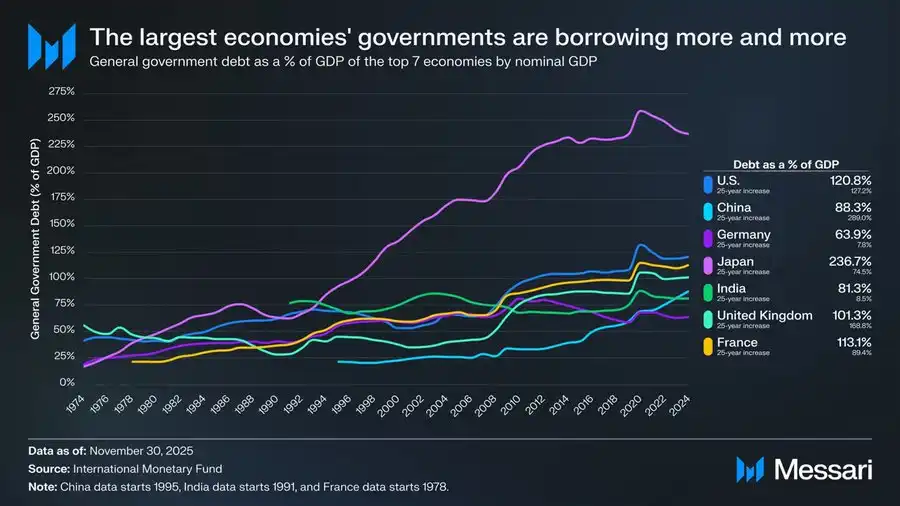
This chart is not a macro background decoration, but the logical starting point of the entire Cryptomoney argument.

Over the past 50 years, the ratio of government debt to GDP in major global economies has shown a highly consistent, almost irreversible upward trend:

· United States: 120.8%

· Japan: 236.7%

· France: 113.1%

· United Kingdom: 101.3%

· China: 88.3%

· India: 81.3%

· Germany: 63.9%

This is not the result of governance failure in a particular country, but a common outcome spanning systems, political structures, and development stages. Whether democratic countries, authoritarian states, developed economies, or emerging markets, government debt has long outpaced economic growth.

What This Chart Really Shows Is Not "High Debt," but "Savings Are Being Systematically Sacrificed"

When government debt growth长期 (long-term) outpaces economic output, the system can only maintain stability in three ways:

1. Inflation

2. Long-term low real interest rates

3. Financial repression (capital controls, withdrawal restrictions, regulatory intervention)

Regardless of which path is adopted, the ultimate cost will be borne by the same group: savers. Messari uses an extremely restrained but heavily weighted sentence in the report: When debt grows faster than economic output, the costs fall most heavily on savers. Translated: When debt outpaces growth, savings are注定 (destined) to be the sacrificed party.

Why Did Sentiment Collapse集中 (concentratedly) in 2025?

Because 2025 is the year when more and more participants clearly realized this for the first time.

Before this:

· "Inflation is only temporary"

· "Cash is always safe"

· "Fiat currency is stable in the long run"

And reality is constantly否定 (negating) these assumptions.

When people发现 (discover):

· Hard work ≠ Wealth preservation

· The act of saving itself is continuously shrinking

· The difficulty of asset allocation has significantly increased

The collapse of sentiment does not come from Crypto, but from a shaken confidence in the entire financial system. Crypto is just where this impact is felt first.

The Significance of Cryptomoney Is Not "Higher Returns"

This is also a point that Messari repeatedly emphasizes but is极易 (very easily) misinterpreted. Cryptomoney does not exist to promise higher returns.

Its core value lies in:

· Predictable rules

· Monetary policy not arbitrarily changed by a single institution

· Assets can be self-custodied

· Value can be transferred cross-border without permission

In other words, what it provides is not a "money-making tool," but: In a world of high debt and low certainty, it重新给予 (re-grants) individuals the right to choose their money.

The Sentiment Collapse Is Actually a Form of "Sobering Up"

When you place this debt chart alongside the 2025 market sentiment, you find a counterintuitive conclusion: The extreme pessimism of sentiment does not mean industry failure, but means more and more people are beginning to realize that the problems of the old system are real.

The problem with Crypto has never been "useless." The real problem is: It no longer produces easy excess returns for everyone.

Summary | From Sentiment, to Structure, to Money Itself

This chapter addresses a fundamental question: Why did market sentiment fall to a historic low in the absence of a systemic crash? The answer is not in the K-line charts, but in the monetary structure.

· Sentiment collapse is the表象 (surface phenomenon)

· Paradigm shift is the过程 (process)

· Monetary system imbalance is the根因 (root cause)

And this is precisely why Messari chose to start the entire report with "money" rather than "applications."

Chapter 3 | Why Only BTC Is Treated as "Real Money"

If you have read this far, you can easily have a question: If the problem lies in the monetary system, then why is the answer BTC, and not something else?

Messari's judgment in the report is exceptionally clear: BTC is no longer on the same competitive dimension as other Crypto assets.

1. Money Is Not a Technical Problem, but a Consensus Problem

This is the first key to understanding BTC. Messari repeatedly emphasizes a fact容易被工程师忽略 (easily overlooked by engineers) in the original text: Money is a social consensus, not a technical optimization problem. In other words:

· Money is not about "who is faster"

· Not "who is cheaper"

· Nor "who has more functions"

But rather who is长期稳定地 (long-term and stably) treated as a store of value. From this perspective, Bitcoin's victory is not mysterious.

2. Three Years of Data Have Written the Answer on Its Face
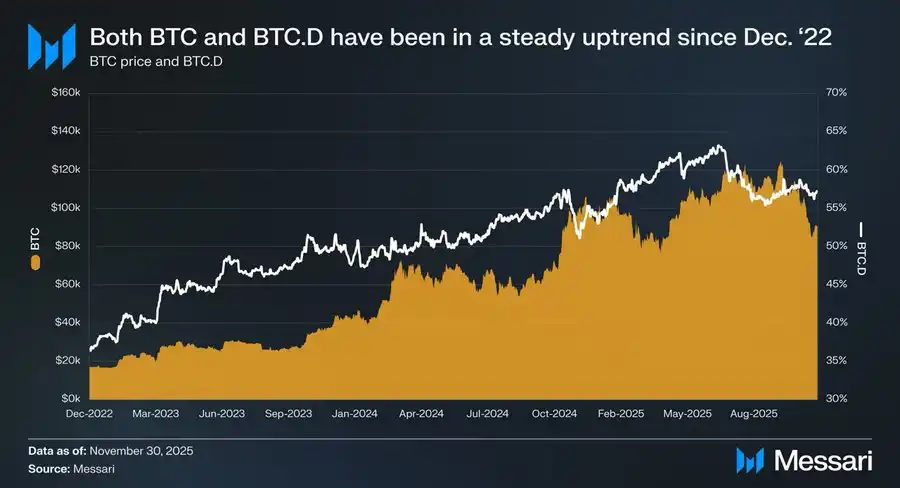
From December 1, 2022, to November 2025:

· BTC rose 429%

· Market cap from $318 billion → $1.81 trillion

· Global asset ranking entered the top ten

And more importantly, the relative performance: BTC.D (Bitcoin Dominance) from 36.6% → 57.3%. In a cycle where "theoretically, altcoins should soar," funds instead持续回流 (continuously flowed back) to BTC. This is not the偶然结果 (accidental result) of a market cycle; this is the market重新做资产分类 (re-categorizing assets).

3. ETFs and DATs Are Essentially "Institutionalizing Consensus"

Messari's evaluation of ETFs is very restrained, but the conclusion is extremely weighty. Bitcoin ETFs are not simply "new buying pressure"; what they truly change is: who is buying + why they are buying + how long they can hold

· ETFs turned BTC into a compliant asset

· DATs made BTC part of corporate balance sheets

· National reserves elevated BTC to the "strategic asset" level

When BTC is held by these actors, it is no longer: "a high-volatility risk asset that can be abandoned at any time" but rather: a monetary asset that must be held long-term and cannot afford to make mistakes. Money, once treated this way,很难再退回去 (is difficult to go back).

4. Why BTC, the More "Boring" It Is, the More It Resembles Money

This might be the most counterintuitive point of 2025:

· BTC has no applications

· No narrative rotation

· No ecosystem stories

· Not even "new things"

But precisely because of this, it meets all the characteristics of "money":

· Does not rely on future promises

· Does not need growth narratives

· Does not require teams to持续交付 (continuously deliver)

It only needs to not fail.

And in a world of high debt and low certainty, "not failing" is itself a scarce asset.

5. BTC's Strength Is Not a Market Failure

Many people's pain comes from an illusion: "BTC's strength means the market is not right." Messari's judgment is恰好相反 (precisely the opposite): BTC's strength is the market becoming more rational.

When the system begins to reward:

· Stability

· Predictability

· Long-term credibility

Then all strategies relying on "high volatility for high returns" will appear increasingly painful. This is not BTC's problem; this is a participation method problem.

Summary | BTC Didn't Win; It Was Chosen

BTC did not "defeat" other assets. It was just repeatedly verified by the market in an era of continuous monetary system failure as:

· The asset that needs the least explanation

· The asset that relies the least on trust

· The asset that needs the fewest promises about the future

This is not the result of a market cycle, but a kind of role confirmation.

Chapter 4 | When the Market Only Needs One Kind of "Money," the L1 Story Begins to Fail

After confirming that BTC has been selected by the market as the "primary Cryptomoney," one question cannot be avoided: If the answer for money already exists, then what is left for Layer 1? Messari does not directly give a conclusion, but after reading this section, a trend is very clear: L1 valuations are being forced to move from "future narratives" back to "real-world constraints."

1. A Harsh but True Fact: 81% of the Market Cap Is in the "Money" Narrative
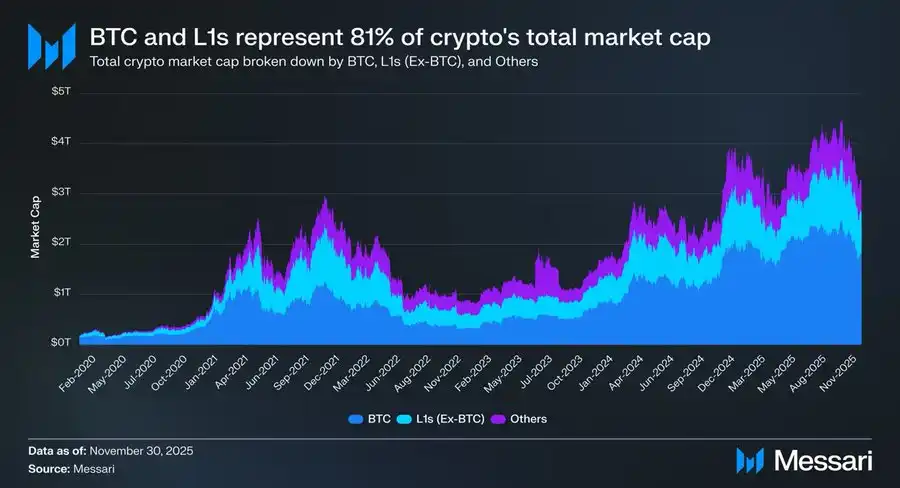
As of the end of 2025, the entire crypto market cap is approximately $3.26T:

· BTC: $1.80T

· Other L1s: approx. $0.83T

· Remaining assets: less than $0.63T

Combined: approximately 81% of the crypto asset market cap is being priced by the market as "money" or "potential money." What does this mean? It means that L1 valuations are早已不是 (long since not) priced on the logic of "application platforms," but on the logic of "does it qualify to be money?"

2. The Problem Is: Most L1s Do Not Qualify

The data provided by Messari is very direct and very冷酷 (cold).
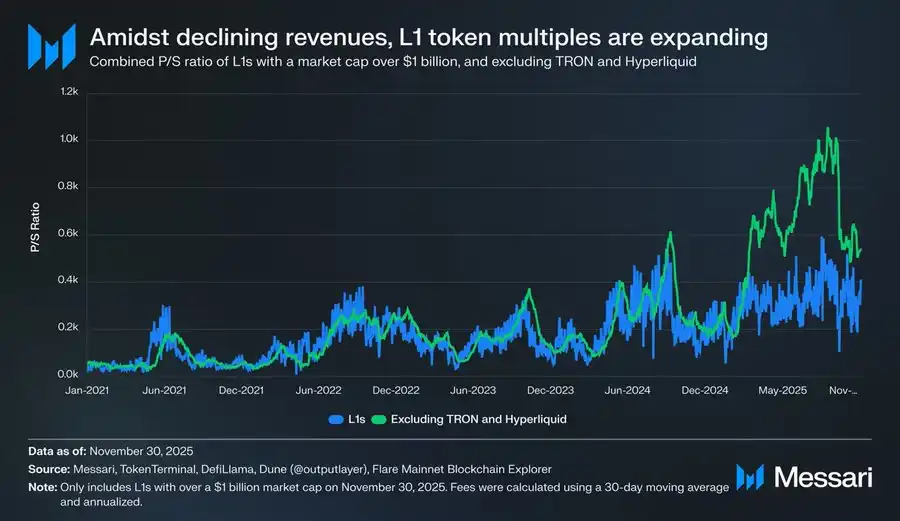
After剔除 (excluding) outliers with abnormally high revenue like TRON and Hyperliquid:

· The overall revenue of L1s continues to decline

· But valuation multiples are却在 (instead) continually rising

The adjusted P/S ratios are as follows:

· 2021: 40x

· 2022: 212x

· 2023: 137x

· 2024: 205x

· 2025: 536x

Meanwhile, total L1 revenue:

· 2021: $12.3B

· 2022: $4.9B

· 2023: $2.7B

· 2024: $3.6B

· 2025 (annualized): $1.7B

This is a剪刀差 (scissors gap) that cannot be reasonably explained by "future growth."

3. L1s Are Not "Undervalued"; They Are "Reclassified"

Many people's pain stems from a misunderstanding: "Are L1s being错杀 (wrongfully killed) by the market?". Messari's judgment is恰恰相反 (precisely the opposite): The market is not wrongfully killing L1s; it is reducing their "monetary imagination space."

If an asset:

· Cannot store value stably

· Cannot be held long-term

· And cannot provide certain cash flow

Then it ultimately only has one pricing method left: high beta risk asset.

4. The Example of Solana Actually Explains Everything

SOL was one of the few L1s that outperformed BTC in 2025. But Messari points out a highly damaging fact:

· SOL ecosystem data grew by 20–30 times

· The price only outperformed BTC by an additional 87%

In other words: to obtain "significant excess returns" relative to BTC, an L1 needs an生态爆发 (ecosystem explosion) of orders of magnitude. This is not "not trying hard enough," but the回报函数 (return function) has been rewritten.

5. When BTC Becomes "Money," the Burden on L1s Actually Becomes Heavier

This is a structural change that many people have not realized. Before BTC's monetary status was clear:

· L1s could tell the story of "becoming money in the future"

· The market was willing to pay提前付费 (prepay) for this possibility

Now:

· BTC has solidified its position

· The market is no longer willing to pay the same premium for a "second money"

Thus, L1s face a more difficult question: If not money, then what exactly are you?

Summary | The Problem of L1s Is Not Competition, but Positioning

L1s did not "lose to BTC." What they lost is:

· In the dimension of money

· The market no longer needs more answers

And once they lose the shelter of the "monetary narrative," all valuations must重新接受现实约束 (re-accept real-world constraints).

This is the direct source of the sentiment collapse for a large number of participants in 2025.

Perguntas relacionadas

QWhy did market sentiment in the crypto space collapse in 2025, according to the Messari report?

AThe collapse in market sentiment was not due to a systemic failure of the industry, but rather a structural shift where the market began rewarding stability, predictability, and long-term credibility (like BTC) over high-risk, high-reward strategies. This caused a severe cognitive and identity mismatch for participants still using old, speculative methods.

QWhat fundamental issue does the Messari report identify as the root cause of the 2025 sentiment crash?

AThe root cause is the ongoing failure of the global traditional monetary system, where government debt growth has consistently outpaced economic output for decades. This systemically sacrifices savers through inflation, low real interest rates, and financial repression, eroding confidence in traditional finance.

QHow does the report explain Bitcoin's (BTC) dominant performance and its role in the 2025 market?

ABTC is no longer competing on the same plane as other crypto assets. It has been selected by the market as 'money' due to its predictable rules, immutable monetary policy, self-custody, and permissionless value transfer. Its 'boring' and reliable nature makes it a scarce asset in a high-debt, low-certainty world, and it is now treated as a long-term hold by institutions, corporations (DATs), and even national reserves.

QWhat does the data show about the valuation of Layer 1 (L1) blockchains compared to their fundamentals in 2025?

AThe data shows a severe and growing disconnect. The aggregate Price-to-Sales (P/S) ratio for L1s skyrocketed to 536x in 2025, while their total annualized revenue plummeted to $1.7B. This indicates that their valuations were not based on current fundamentals or cash flow but on a narrative that has now been reclassified by the market.

QWhy did the strong performance of Bitcoin (BTC) cause pain for many investors and participants in 2025?

AThe pain was caused by a paradigm shift in the market's reward mechanism. Participants who were accustomed to earning alpha through aggressive speculation, narrative trading, and investing in altcoins found that these strategies failed. The market began systematically rewarding long-term holders and institutional asset allocators instead, making the 'old way' of participating ineffective and emotionally painful.

Leituras Relacionadas

Will the Fed Still Cut Interest Rates? Tonight's Data Is Crucial

The core debate surrounding the Federal Reserve's potential interest rate cuts is intensifying amid geopolitical conflict and rebounding inflation. The key question is whether high energy prices will cause persistent inflation or weaken consumer demand enough to force the Fed to cut rates. Citigroup presents a bullish case for cuts, arguing that oil supply disruptions from the Strait of Hormuz are temporary and will not lead to lasting inflationary pressure. They point to receding bond yields and oil prices as evidence the market is pricing in a short-lived shock. Citi's data also shows tightening financial conditions, a stabilizing labor market, and healthy tax returns, supporting their view that the path to lower rates remains open. Conversely, Deutsche Bank offers a starkly contrasting, more hawkish outlook. They argue the Fed's current policy is already neutral and expect rates to remain unchanged indefinitely. Their view is based on stalled disinflation progress and a shift toward more hawkish rhetoric from key Fed officials like Waller, who cited risks from prolonged Middle East conflict and tariffs. Other officials, including Williams and Hammack, signaled rates would likely stay on hold for a "considerable time." The market pricing has shifted dramatically, now forecasting zero cuts in 2026. The imminent release of the March retail sales "control group" data is highlighted as a critical test. This metric, which excludes gas station sales, will reveal if high gasoline prices are eroding consumer spending in other areas. A weak reading could support the case for imminent rate cuts, while a strong one would bolster the argument for the Fed to hold steady. This data is pivotal for determining the near-term policy path.

marsbitHá 8m

Will the Fed Still Cut Interest Rates? Tonight's Data Is Crucial

marsbitHá 8m

The Second Half of Macro Influencer Fu Peng's Career

Fu Peng, a prominent Chinese macroeconomist and former chief economist of Northeast Securities, has joined Hong Kong-based digital asset management firm Bitfire Group (formerly New Huo Group) as its chief economist. This move, announced in April 2026, triggered an 11% surge in Bitfire's stock price. Fu, known for his accessible macroeconomic commentary and large social media following, will focus on integrating digital assets into global asset allocation frameworks, particularly combining FICC (fixed income, currencies, and commodities) with cryptocurrencies for institutional clients. His career includes roles at Lehman Brothers and Solomon International, with significant influence gained through public communication. However, in late 2024, Fu faced temporary social media bans after a controversial private speech at HSBC on China's economic challenges, though he denied regulatory sanctions. He later left Northeast Securities citing health reasons. Bitfire, a licensed virtual asset manager serving high-net-worth clients, seeks to build trust and attract traditional capital through Fu’s expertise and credibility. The partnership represents a strategic shift for both: Fu enters the crypto sector after a traditional finance peak, while Bitfire aims to leverage his macro framework for institutional adoption. Outcomes remain uncertain regarding capital inflows and compatibility within corporate structure.

marsbitHá 1h

The Second Half of Macro Influencer Fu Peng's Career

marsbitHá 1h

Trading

Spot
Futuros

Artigos em Destaque

O que é $S$

Compreender o SPERO: Uma Visão Abrangente Introdução ao SPERO À medida que o panorama da inovação continua a evoluir, o surgimento de tecnologias web3 e projetos de criptomoeda desempenha um papel fundamental na formação do futuro digital. Um projeto que tem atraído atenção neste campo dinâmico é o SPERO, denotado como SPERO,$$s$. Este artigo tem como objetivo reunir e apresentar informações detalhadas sobre o SPERO, para ajudar entusiastas e investidores a compreender as suas bases, objetivos e inovações nos domínios web3 e cripto. O que é o SPERO,$$s$? O SPERO,$$s$ é um projeto único dentro do espaço cripto que procura aproveitar os princípios da descentralização e da tecnologia blockchain para criar um ecossistema que promove o envolvimento, a utilidade e a inclusão financeira. O projeto é concebido para facilitar interações peer-to-peer de novas maneiras, proporcionando aos utilizadores soluções e serviços financeiros inovadores. No seu núcleo, o SPERO,$$s$ visa capacitar indivíduos ao fornecer ferramentas e plataformas que melhoram a experiência do utilizador no espaço das criptomoedas. Isso inclui a possibilidade de métodos de transação mais flexíveis, a promoção de iniciativas impulsionadas pela comunidade e a criação de caminhos para oportunidades financeiras através de aplicações descentralizadas (dApps). A visão subjacente do SPERO,$$s$ gira em torno da inclusão, visando fechar lacunas dentro das finanças tradicionais enquanto aproveita os benefícios da tecnologia blockchain. Quem é o Criador do SPERO,$$s$? A identidade do criador do SPERO,$$s$ permanece algo obscura, uma vez que existem recursos publicamente disponíveis limitados que fornecem informações detalhadas sobre o(s) seu(s) fundador(es). Esta falta de transparência pode resultar do compromisso do projeto com a descentralização—uma ética que muitos projetos web3 partilham, priorizando contribuições coletivas em vez de reconhecimento individual. Ao centrar as discussões em torno da comunidade e dos seus objetivos coletivos, o SPERO,$$s$ incorpora a essência do empoderamento sem destacar indivíduos específicos. Assim, compreender a ética e a missão do SPERO é mais importante do que identificar um criador singular. Quem são os Investidores do SPERO,$$s$? O SPERO,$$s$ é apoiado por uma diversidade de investidores que vão desde capitalistas de risco a investidores-anjo dedicados a promover a inovação no setor cripto. O foco desses investidores geralmente alinha-se com a missão do SPERO—priorizando projetos que prometem avanço tecnológico social, inclusão financeira e governança descentralizada. Essas fundações de investidores estão tipicamente interessadas em projetos que não apenas oferecem produtos inovadores, mas que também contribuem positivamente para a comunidade blockchain e os seus ecossistemas. O apoio desses investidores reforça o SPERO,$$s$ como um concorrente notável no domínio em rápida evolução dos projetos cripto. Como Funciona o SPERO,$$s$? O SPERO,$$s$ emprega uma estrutura multifacetada que o distingue de projetos de criptomoeda convencionais. Aqui estão algumas das características-chave que sublinham a sua singularidade e inovação: Governança Descentralizada: O SPERO,$$s$ integra modelos de governança descentralizada, capacitando os utilizadores a participar ativamente nos processos de tomada de decisão sobre o futuro do projeto. Esta abordagem promove um sentido de propriedade e responsabilidade entre os membros da comunidade. Utilidade do Token: O SPERO,$$s$ utiliza o seu próprio token de criptomoeda, concebido para servir várias funções dentro do ecossistema. Esses tokens permitem transações, recompensas e a facilitação de serviços oferecidos na plataforma, melhorando o envolvimento e a utilidade gerais. Arquitetura em Camadas: A arquitetura técnica do SPERO,$$s$ suporta modularidade e escalabilidade, permitindo a integração contínua de funcionalidades e aplicações adicionais à medida que o projeto evolui. Esta adaptabilidade é fundamental para manter a relevância no panorama cripto em constante mudança. Envolvimento da Comunidade: O projeto enfatiza iniciativas impulsionadas pela comunidade, empregando mecanismos que incentivam a colaboração e o feedback. Ao nutrir uma comunidade forte, o SPERO,$$s$ pode melhor atender às necessidades dos utilizadores e adaptar-se às tendências do mercado. Foco na Inclusão: Ao oferecer taxas de transação baixas e interfaces amigáveis, o SPERO,$$s$ visa atrair uma base de utilizadores diversificada, incluindo indivíduos que anteriormente podem não ter participado no espaço cripto. Este compromisso com a inclusão alinha-se com a sua missão abrangente de empoderamento através da acessibilidade. Cronologia do SPERO,$$s$ Compreender a história de um projeto fornece insights cruciais sobre a sua trajetória de desenvolvimento e marcos. Abaixo está uma cronologia sugerida que mapeia eventos significativos na evolução do SPERO,$$s$: Fase de Conceituação e Ideação: As ideias iniciais que formam a base do SPERO,$$s$ foram concebidas, alinhando-se de perto com os princípios de descentralização e foco na comunidade dentro da indústria blockchain. Lançamento do Whitepaper do Projeto: Após a fase conceitual, um whitepaper abrangente detalhando a visão, os objetivos e a infraestrutura tecnológica do SPERO,$$s$ foi lançado para atrair o interesse e o feedback da comunidade. Construção da Comunidade e Primeiros Envolvimentos: Esforços ativos de divulgação foram feitos para construir uma comunidade de primeiros adotantes e investidores potenciais, facilitando discussões em torno dos objetivos do projeto e angariando apoio. Evento de Geração de Tokens: O SPERO,$$s$ realizou um evento de geração de tokens (TGE) para distribuir os seus tokens nativos a apoiantes iniciais e estabelecer liquidez inicial dentro do ecossistema. Lançamento da dApp Inicial: A primeira aplicação descentralizada (dApp) associada ao SPERO,$$s$ foi lançada, permitindo que os utilizadores interagissem com as funcionalidades principais da plataforma. Desenvolvimento Contínuo e Parcerias: Atualizações e melhorias contínuas nas ofertas do projeto, incluindo parcerias estratégicas com outros players no espaço blockchain, moldaram o SPERO,$$s$ em um jogador competitivo e em evolução no mercado cripto. Conclusão O SPERO,$$s$ é um testemunho do potencial do web3 e das criptomoedas para revolucionar os sistemas financeiros e capacitar indivíduos. Com um compromisso com a governança descentralizada, o envolvimento da comunidade e funcionalidades inovadoras, abre caminho para um panorama financeiro mais inclusivo. Como em qualquer investimento no espaço cripto em rápida evolução, potenciais investidores e utilizadores são incentivados a pesquisar minuciosamente e a envolver-se de forma ponderada com os desenvolvimentos em curso dentro do SPERO,$$s$. O projeto demonstra o espírito inovador da indústria cripto, convidando a uma exploração mais aprofundada das suas inúmeras possibilidades. Embora a jornada do SPERO,$$s$ ainda esteja a desenrolar-se, os seus princípios fundamentais podem, de facto, influenciar o futuro de como interagimos com a tecnologia, as finanças e uns com os outros em ecossistemas digitais interconectados.

69 Visualizações TotaisPublicado em {updateTime}Atualizado em 2024.12.17

O que é $S$

O que é AGENT S

Agent S: O Futuro da Interação Autónoma no Web3 Introdução No panorama em constante evolução do Web3 e das criptomoedas, as inovações estão constantemente a redefinir a forma como os indivíduos interagem com plataformas digitais. Um projeto pioneiro, o Agent S, promete revolucionar a interação humano-computador através do seu framework aberto e agente. Ao abrir caminho para interações autónomas, o Agent S visa simplificar tarefas complexas, oferecendo aplicações transformadoras em inteligência artificial (IA). Esta exploração detalhada irá aprofundar-se nas complexidades do projeto, nas suas características únicas e nas implicações para o domínio das criptomoedas. O que é o Agent S? O Agent S é um framework aberto e agente, especificamente concebido para abordar três desafios fundamentais na automação de tarefas computacionais: Aquisição de Conhecimento Específico de Domínio: O framework aprende inteligentemente a partir de várias fontes de conhecimento externas e experiências internas. Esta abordagem dupla capacita-o a construir um rico repositório de conhecimento específico de domínio, melhorando o seu desempenho na execução de tarefas. Planeamento ao Longo de Longos Horizontes de Tarefas: O Agent S emprega planeamento hierárquico aumentado por experiência, uma abordagem estratégica que facilita a decomposição e execução eficientes de tarefas intrincadas. Esta característica melhora significativamente a sua capacidade de gerir múltiplas subtarefas de forma eficiente e eficaz. Gestão de Interfaces Dinâmicas e Não Uniformes: O projeto introduz a Interface Agente-Computador (ACI), uma solução inovadora que melhora a interação entre agentes e utilizadores. Utilizando Modelos de Linguagem Multimodais de Grande Escala (MLLMs), o Agent S pode navegar e manipular diversas interfaces gráficas de utilizador de forma fluida. Através destas características pioneiras, o Agent S fornece um framework robusto que aborda as complexidades envolvidas na automação da interação humana com máquinas, preparando o terreno para uma infinidade de aplicações em IA e além. Quem é o Criador do Agent S? Embora o conceito de Agent S seja fundamentalmente inovador, informações específicas sobre o seu criador permanecem elusivas. O criador é atualmente desconhecido, o que destaca ou o estágio nascente do projeto ou a escolha estratégica de manter os membros fundadores em anonimato. Independentemente da anonimidade, o foco permanece nas capacidades e no potencial do framework. Quem são os Investidores do Agent S? Como o Agent S é relativamente novo no ecossistema criptográfico, informações detalhadas sobre os seus investidores e financiadores não estão explicitamente documentadas. A falta de informações disponíveis publicamente sobre as fundações de investimento ou organizações que apoiam o projeto levanta questões sobre a sua estrutura de financiamento e roteiro de desenvolvimento. Compreender o apoio é crucial para avaliar a sustentabilidade do projeto e o seu impacto potencial no mercado. Como Funciona o Agent S? No núcleo do Agent S reside uma tecnologia de ponta que lhe permite funcionar eficazmente em diversos ambientes. O seu modelo operacional é construído em torno de várias características-chave: Interação Humano-Computador Semelhante: O framework oferece planeamento avançado em IA, esforçando-se para tornar as interações com computadores mais intuitivas. Ao imitar o comportamento humano na execução de tarefas, promete elevar as experiências dos utilizadores. Memória Narrativa: Utilizada para aproveitar experiências de alto nível, o Agent S utiliza memória narrativa para acompanhar os históricos de tarefas, melhorando assim os seus processos de tomada de decisão. Memória Episódica: Esta característica fornece aos utilizadores orientações passo a passo, permitindo que o framework ofereça suporte contextual à medida que as tarefas se desenrolam. Suporte para OpenACI: Com a capacidade de funcionar localmente, o Agent S permite que os utilizadores mantenham o controlo sobre as suas interações e fluxos de trabalho, alinhando-se com a ética descentralizada do Web3. Fácil Integração com APIs Externas: A sua versatilidade e compatibilidade com várias plataformas de IA garantem que o Agent S possa integrar-se perfeitamente em ecossistemas tecnológicos existentes, tornando-o uma escolha apelativa para desenvolvedores e organizações. Estas funcionalidades contribuem coletivamente para a posição única do Agent S no espaço cripto, à medida que automatiza tarefas complexas e em múltiplos passos com mínima intervenção humana. À medida que o projeto evolui, as suas potenciais aplicações no Web3 podem redefinir a forma como as interações digitais se desenrolam. Cronologia do Agent S O desenvolvimento e os marcos do Agent S podem ser encapsulados numa cronologia que destaca os seus eventos significativos: 27 de Setembro de 2024: O conceito de Agent S foi lançado num artigo de pesquisa abrangente intitulado “Um Framework Agente Aberto que Usa Computadores como um Humano”, mostrando a base para o projeto. 10 de Outubro de 2024: O artigo de pesquisa foi disponibilizado publicamente no arXiv, oferecendo uma exploração aprofundada do framework e da sua avaliação de desempenho com base no benchmark OSWorld. 12 de Outubro de 2024: Uma apresentação em vídeo foi lançada, proporcionando uma visão visual das capacidades e características do Agent S, envolvendo ainda mais potenciais utilizadores e investidores. Estes marcos na cronologia não apenas ilustram o progresso do Agent S, mas também indicam o seu compromisso com a transparência e o envolvimento da comunidade. Pontos-Chave Sobre o Agent S À medida que o framework Agent S continua a evoluir, várias características-chave destacam-se, sublinhando a sua natureza inovadora e potencial: Framework Inovador: Concebido para proporcionar um uso intuitivo de computadores semelhante à interação humana, o Agent S traz uma abordagem nova à automação de tarefas. Interação Autónoma: A capacidade de interagir autonomamente com computadores através de GUI significa um avanço em direção a soluções computacionais mais inteligentes e eficientes. Automação de Tarefas Complexas: Com a sua metodologia robusta, pode automatizar tarefas complexas e em múltiplos passos, tornando os processos mais rápidos e menos propensos a erros. Melhoria Contínua: Os mecanismos de aprendizagem permitem que o Agent S melhore a partir de experiências passadas, aprimorando continuamente o seu desempenho e eficácia. Versatilidade: A sua adaptabilidade em diferentes ambientes operacionais, como OSWorld e WindowsAgentArena, garante que pode servir uma ampla gama de aplicações. À medida que o Agent S se posiciona no panorama do Web3 e das criptomoedas, o seu potencial para melhorar as capacidades de interação e automatizar processos significa um avanço significativo nas tecnologias de IA. Através do seu framework inovador, o Agent S exemplifica o futuro das interações digitais, prometendo uma experiência mais fluida e eficiente para os utilizadores em diversas indústrias. Conclusão O Agent S representa um ousado avanço na união da IA e do Web3, com a capacidade de redefinir a forma como interagimos com a tecnologia. Embora ainda esteja nas suas fases iniciais, as possibilidades para a sua aplicação são vastas e cativantes. Através do seu framework abrangente que aborda desafios críticos, o Agent S visa trazer interações autónomas para o primeiro plano da experiência digital. À medida que avançamos mais profundamente nos domínios das criptomoedas e da descentralização, projetos como o Agent S desempenharão, sem dúvida, um papel crucial na formação do futuro da tecnologia e da colaboração humano-computador.

521 Visualizações TotaisPublicado em {updateTime}Atualizado em 2025.01.14

O que é AGENT S

Como comprar S

Bem-vindo à HTX.com!Tornámos a compra de Sonic (S) simples e conveniente.Segue o nosso guia passo a passo para iniciar a tua jornada no mundo das criptos.Passo 1: cria a tua conta HTXUtiliza o teu e-mail ou número de telefone para te inscreveres numa conta gratuita na HTX.Desfruta de um processo de inscrição sem complicações e desbloqueia todas as funcionalidades.Obter a minha contaPasso 2: vai para Comprar Cripto e escolhe o teu método de pagamentoCartão de crédito/débito: usa o teu visa ou mastercard para comprar Sonic (S) instantaneamente.Saldo: usa os fundos da tua conta HTX para transacionar sem problemas.Terceiros: adicionamos métodos de pagamento populares, como Google Pay e Apple Pay, para aumentar a conveniência.P2P: transaciona diretamente com outros utilizadores na HTX.Mercado de balcão (OTC): oferecemos serviços personalizados e taxas de câmbio competitivas para os traders.Passo 3: armazena teu Sonic (S)Depois de comprar o teu Sonic (S), armazena-o na tua conta HTX.Alternativamente, podes enviá-lo para outro lugar através de transferência blockchain ou usá-lo para transacionar outras criptomoedas.Passo 4: transaciona Sonic (S)Transaciona facilmente Sonic (S) no mercado à vista da HTX.Acede simplesmente à tua conta, seleciona o teu par de trading, executa as tuas transações e monitoriza em tempo real.Oferecemos uma experiência de fácil utilização tanto para principiantes como para traders experientes.

927 Visualizações TotaisPublicado em {updateTime}Atualizado em 2025.03.21

Como comprar S

Discussões

Bem-vindo à Comunidade HTX. Aqui, pode manter-se informado sobre os mais recentes desenvolvimentos da plataforma e obter acesso a análises profissionais de mercado. As opiniões dos utilizadores sobre o preço de S (S) são apresentadas abaixo.

活动图片