Tracking 118 Coins Launched in 2025: 85% Are Below Their Initial Valuation at Launch

深潮Publicado em 2025-12-22Última atualização em 2025-12-22

Resumo

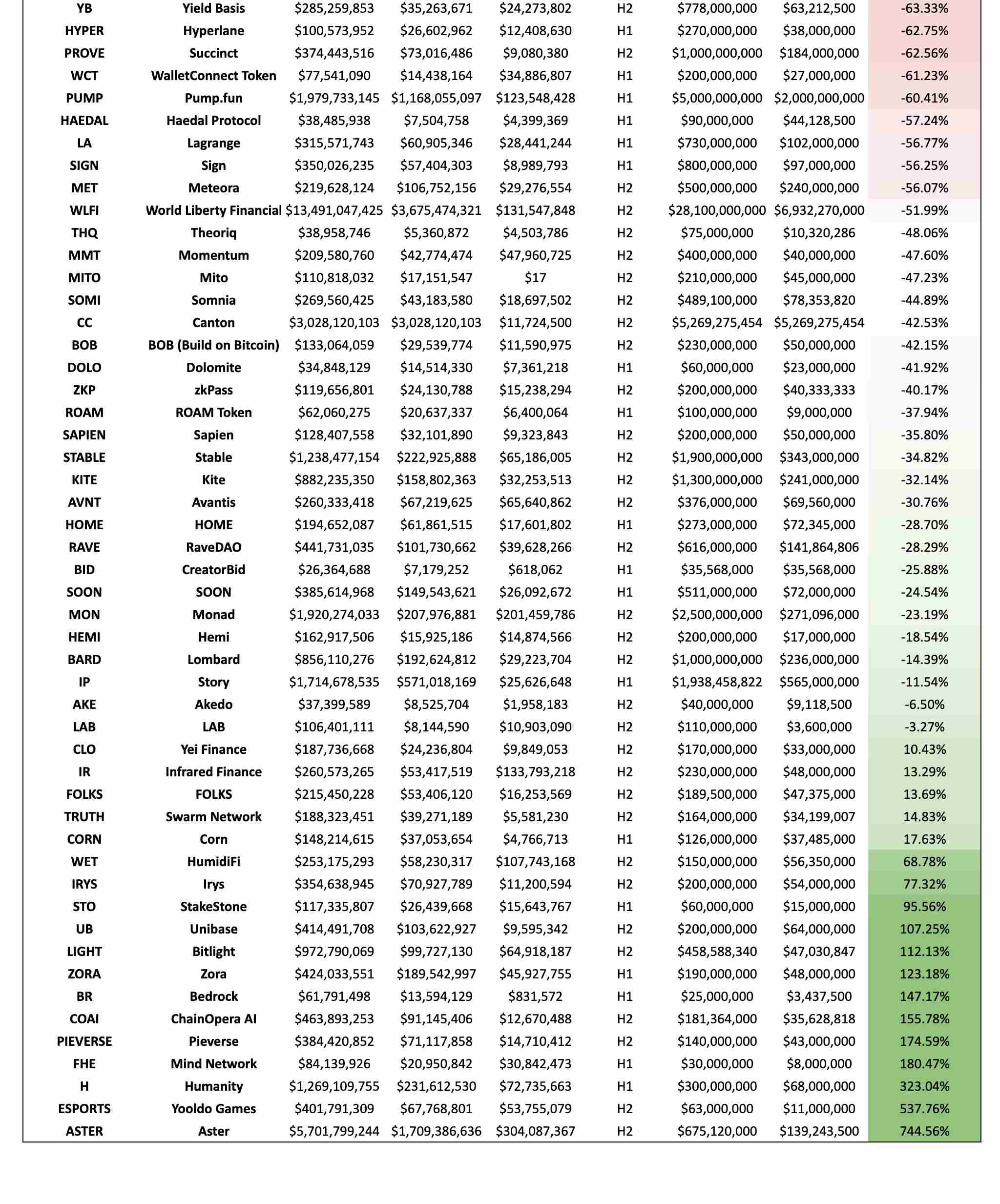
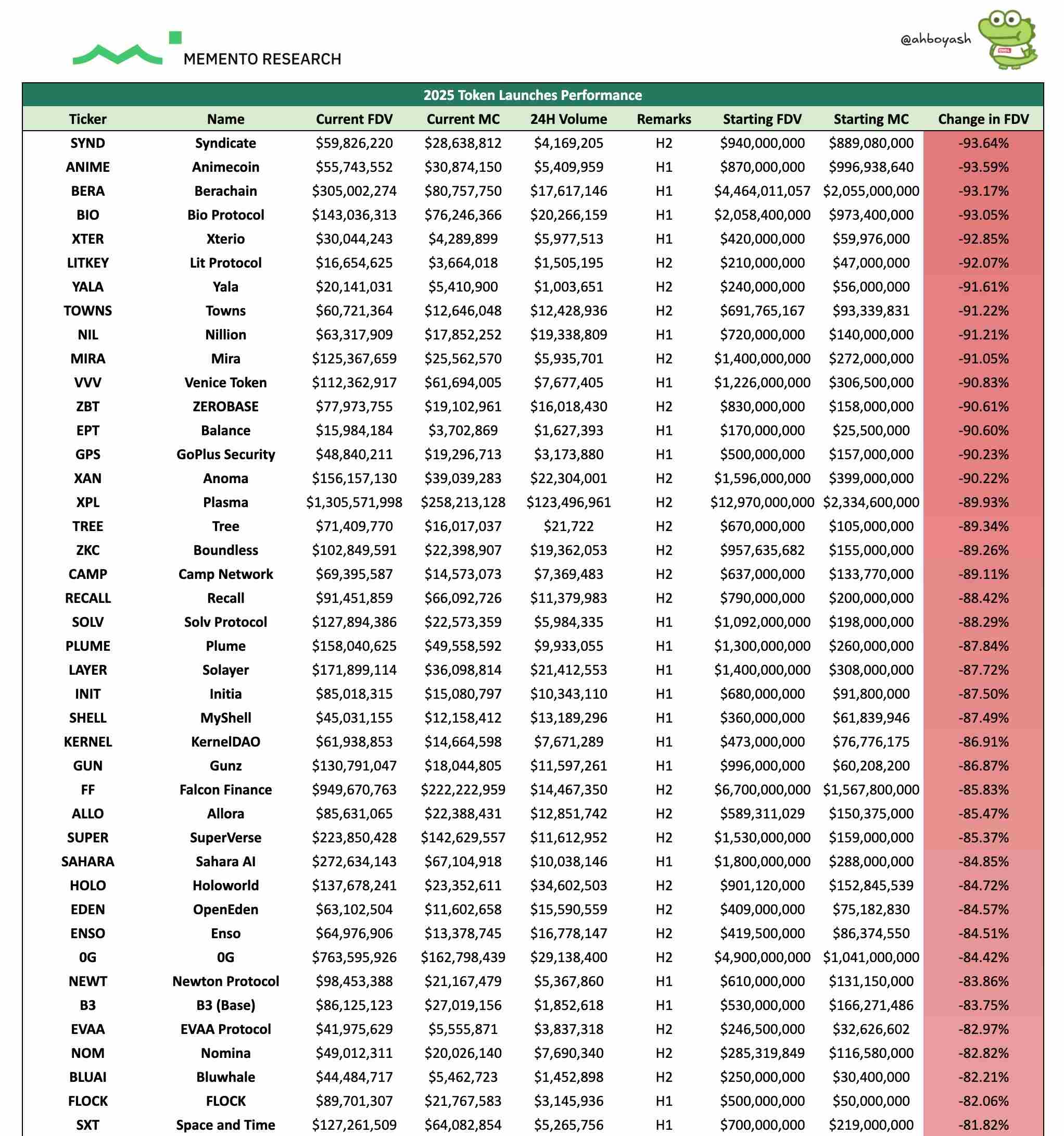
An analysis of 118 Token Generation Events (TGEs) that occurred in 2025 reveals a significant downturn in post-launch performance. The study compared each token's current fully diluted valuation (FDV) to its valuation at issuance. Key findings show that 84.7% (100 out of 118) of these assets are currently valued below their initial TGE price. This indicates that approximately 4 out of every 5 new tokens are trading at a lower valuation than at launch. The median token experienced a 71% decline in FDV (and a 67% drop in market cap) since its release. Only 15% of the tokens analyzed have maintained a valuation higher than at their TGE. The report concludes that participating in a TGE can no longer be considered a form of "early investment" under these market conditions.

Author:Ash

Compiled by: Deep Tide TechFlow

We tracked 118 Token Generation Events (TGEs) launched in 2025 and compared their current fully diluted valuation (FDV) with their valuation at issuance. The results are as follows:

  • 84.7% (100 out of 118) currently have a valuation lower than at TGE;

  • This means approximately 4 out of every 5 newly issued tokens are valued below their issuance level;

  • The median token's fully diluted valuation (FDV) has fallen by 71% since issuance (market cap down 67%);

  • Only 15% of tokens remained "green" (i.e., above issuance valuation) after TGE.

Nowadays, participating in a TGE can hardly be considered "early investment" anymore. How lamentable.

View the complete data via the link
Perguntas relacionadas

QWhat percentage of the 118 tokens tracked from 2025 TGEs are currently valued below their initial valuation?

A84.7% (100 out of 118 tokens) are currently valued below their initial TGE valuation.

QHow does the median token's Fully Diluted Valuation (FDV) perform compared to its issuance valuation?

AThe median token's FDV has declined by 71% since its issuance.

QWhat proportion of the tracked tokens maintained a valuation higher than their initial issuance?

AOnly 15% of the tokens remained 'green' (valued above their initial issuance valuation).

QAccording to the article, what is the current perception of participating in a Token Generation Event (TGE)?

AParticipating in a TGE is no longer considered 'early investment'.

QWhat metric, besides FDV, is mentioned to have declined for the median token since issuance?

AThe market capitalization of the median token has declined by 67% since issuance.

Leituras Relacionadas

The King of Blind Date Attire in Korea: How SK Hynix Made a Comeback Against Samsung?

In South Korea's dating scene, SK Hynix employees are now highly sought after, a status shift fueled by the company's astronomical profits and employee bonuses, projected to reach up to 6.1 million RMB per person by 2027. This marks a dramatic reversal for the long-time second-place player in memory semiconductors, which has now surpassed its rival Samsung in annual operating profit. The turnaround story began in 2008 when a struggling Hynix, emerging from bankruptcy restructuring, took a risky bet by agreeing to develop High Bandwidth Memory (HBM) with AMD. At the time, HBM had no clear market beyond high-end graphics cards and was a costly, complex technology. Major players like Samsung, pursuing its own HMC technology, declined. For Hynix, with only memory as its core business, it was a gamble born of necessity. The pivotal moment came in 2012 when SK Group Chairman Chey Tae-won acquired Hynix. Defying industry downturns, he invested heavily in R&D and fabrication, sustaining the HBM project through over a decade of commercial uncertainty and internal challenges. A key break occurred around 2016-2017 when Samsung faced production issues supplying HBM2 for Google's TPU, allowing SK Hynix to gain a crucial foothold in the data center market. The AI explosion post-ChatGPT in 2022 was the catalyst, turning HBM into a critical bottleneck for AI accelerators like NVIDIA's GPUs. By 2025, SK Hynix captured 62% of the global HBM market, leaving Samsung at 17%. For the first time, its annual operating profit exceeded Samsung's. Analysts point to the "innovator's dilemma" to explain Samsung's miss: its vast, successful business portfolio made it risk-averse, preventing an all-in bet on the initially niche HBM technology. In contrast, SK Hynix, as a challenger with its back against the wall, had no choice but to commit fully. The story highlights how Korea's chaebol system allows for ultra-long-term bets beyond quarterly pressures. However, SK Hynix's lead isn't guaranteed. Samsung is aggressively catching up on HBM4, and challenges like customer concentration (heavy reliance on NVIDIA) and technical hurdles in advanced packaging remain. The narrative underscores a market truth: the greatest alpha often comes from betting on uncertain, long-term directions others dismiss, much like HBM in 2008.

marsbitHá 30m

The King of Blind Date Attire in Korea: How SK Hynix Made a Comeback Against Samsung?

marsbitHá 30m

Understanding Hash in One Article: The "Browser Miner" on Ethereum

Hash is an Ethereum-based ERC-20 token described as a "browser-minable post-quantum token." Its key features include enabling browser-based GPU mining without specialized hardware, a fixed supply cap of 21 million tokens, immutable and permissionless smart contracts with no team allocation or pre-mining, and an emphasis on post-quantum security using Keccak256 hashing. The mining mechanism is a simplified on-chain proof-of-work where miners solve unique challenges tied to their wallet address. Key design elements prevent answer theft, with epochs resetting every 100 blocks (~20 minutes) and a per-block minting limit. Emission follows a Bitcoin-like halving schedule every 100,000 mints, starting at 100 tokens per mint. Projections suggest all tokens could be mined within approximately 294 days if a target rate of one mint per minute is sustained. Hash emphasizes "post-quantum" security by leveraging hash-based primitives like Keccak256, which are considered more resistant to quantum attacks compared to elliptic-curve cryptography. While not a fully post-quantum asset, it aligns with Ethereum's broader post-quantum research narrative. The project completed its Genesis sale at $0.03 and began trading on Uniswap, with its price reaching around $0.19. The initial circulating supply is small, with 5% sold in Genesis and 5% allocated to liquidity. The majority (47.6% of total supply) is allocated to early-stage mining, leading to a front-loaded emission schedule. This structure, combined with low initial liquidity, makes Hash a high-volatility, high-risk project dependent on sustained miner participation and market demand to absorb new supply.

marsbitHá 43m

Understanding Hash in One Article: The "Browser Miner" on Ethereum

marsbitHá 43m

Trading

Spot
Futuros
活动图片