The State of TRON H2 2025: Stablecoin Settlement at Scale Amid Rising Competition

TheNewsCryptoPublicado em 2026-01-29Última atualização em 2026-01-29

Resumo

In the second half of 2025, TRON focused on operational execution and targeted growth, prioritizing initiatives with clear ROI and real-world adoption. Key developments included strategic integrations with platforms like Kalshi and Revolut, enhancing its role as a low-fee, fast settlement layer for stablecoins. The network expanded into chain abstraction through a collaboration with NEAR and improved developer infrastructure with Alchemy RPC support. TRX performance remained strong, rising 26% in 2025, and the network deepened interoperability with Base via LayerZero. TRON maintained its leadership in stablecoin settlement, processing trillions in annual volume and growing monthly active stablecoin users by 38% to over 10 million. Despite increased competition from chains like Plasma and Solana, TRON's stablecoin supply grew 41%, primarily driven by USDT. On-chain metrics showed 300M+ monthly transactions and 20M monthly active accounts, with over half being stablecoin users. Revenue peaked in Q3 but declined in Q4 due to market conditions. Looking ahead, TRON aims to defend its market share by maintaining predictable fees, expanding payment provider integrations, and reducing UX friction.

In our previous report, we covered the events that shaped TRON in the first half of 2025. We looked at how TRON expanded its lineup of Super Representatives. We also covered its technical integrations to support developers and the broader ecosystem. Finally, we discussed the launch of another stablecoin on its network, USD1.

In the second half of 2025, the focus of the TRON team was on operational execution and targeted growth. Rather than chasing speculative integrations, TRON prioritized initiatives with clear ROI and real-world adoption. The team also doubled down on TRON’s core value proposition of low fees, fast settlement, and predictable costs. Together, these efforts improved TRON’s positioning as a blockchain financial infrastructure.

Ecosystem Growth

In H2 2025, TRON’s ecosystem growth strategy centered on distribution and execution, with an emphasis on consumer-facing integrations and coordinated enhancement of TRON’s go-to-market strategy. The network expanded fintech and wallet integrations, including WireX Pay and other user tools, broadening access points for TRX and USDT on TRON across everyday payment and wallet surfaces.

A key example was TRON’s integration with Kalshi, which enabled deposits and withdrawals via TRX and USDT on TRON and positioned TRON as a liquidity rail supporting prediction market activity. In parallel, Revolut selected TRON for a blockchain infrastructure integration tied to its “Crypto 2.0” initiative, adding in-app TRX staking, supporting stablecoin remittances, and 1:1 fiat-to-stablecoin conversion across its European footprint. Together, these launches emphasized TRON’s strengths as a settlement layer: fast confirmations, low fees, and deep stablecoin liquidity.

TRON also expanded into chain abstraction and intent-based UX, reflecting a push to reduce friction for both users and developers. Through a strategic collaboration with NEAR, TRON integrated NEAR Intents, enabling intent-based swaps and cross-chain transfers that abstract away bridging and chain mechanics. This positioned TRON within a broader multichain execution stack designed to simplify onboarding and make interoperability feel native, while also opening up a wider design space for DeFi and emerging AI-driven workflows.

On developer infrastructure, TRON added Alchemy RPC support, improving reliability and scalability for builders, and continued strengthening wallet connectivity through MetaMask and WalletConnect. It also enhanced security and monitoring tooling via ecosystem integrations, supporting more mature production workflows as partner activity scaled. Complementing these upgrades, Ledger added full native TRON support, enabling organizations to manage TRX and TRC20 tokens like USDT with governance controls, multi-approval flows, and whitelisting, with an emphasis on clear-signing protections. This broadened TRON’s enterprise readiness by connecting stablecoin-heavy workflows to higher-assurance operational and security tooling.

The FSRA of ADGM accepted USDT on TRON as an Accepted Fiat-Referenced Token, allowing ADGM-licensed entities to use it in regulated activity. The milestone strengthened TRON’s institutional positioning as a compliant, low-fee stablecoin settlement rail, supported by ongoing regulator engagement and financial crime prevention efforts.

TRX Performance and Cross-Chain Expansion

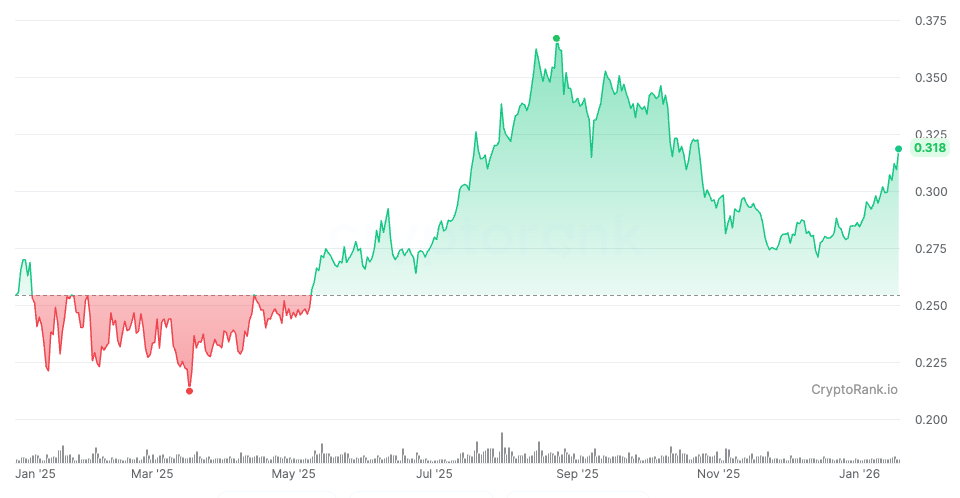
Amid the ecosystem expansion and ongoing infra improvements, TRX, the native token of the TRON blockchain, delivered a strong performance in 2025. TRX was up 26% since Jan 1, 2025, with a significant share of that upside concentrated in Q2 to Q3.

TRON also pushed deeper into interoperability through an integration with Base, the Ethereum L2 incubated by Coinbase. Enabled by LayerZero, the bridge allows TRX to move onto Base and be accessed directly in the Base App via Base-native DEXs such as Aerodrome, expanding TRX liquidity and utility beyond TRON’s own execution environment. In the context of TRON’s scale and payments-first positioning, the Base connection reinforced the broader trend toward multichain participation and lower-friction capital movement across ecosystems.
TRON is Leading Stablecoin Settlement Despite Increased Competition

One of TRON’s key competitive advantages is its strength in stablecoin settlement. Despite the launch of several stablecoin-focused blockchains, including Plasma and Stable, TRON maintained leading positions across multiple stablecoin indicators throughout 2025.

Across the year, TRON ranked among the top chains by P2P stablecoin transaction volume, closely followed by Ethereum. This reflected TRON’s role as a global stablecoin settlement rail, processing trillions in annual payment volume and continuing to serve high-frequency, cost-sensitive flows.

This performance was supported by expanding real-world usage, including merchant payments, payroll, and remittances, particularly across LATAM, Africa, and Asia. In parallel, TRON deepened engagement with global payment providers and PSPs, strengthening settlement efficiency and stablecoin treasury operations to support larger, more consistent transaction throughput.

In 2025, monthly active stablecoin users on TRON grew 38% and surpassed 10 million. This reflects steady growth in stablecoin-using addresses over time, signaling more sustainable, recurring adoption rather than one-off activity.

Stablecoin Monthly Active Users on TRON

However, TRON still ranked second behind Ethereum, which continued to lead in stablecoin supply due in part to its large USDC supply. The gap to the next tier of chains remained wide, reinforcing a clear separation between the top two settlement networks and the rest.

That said, competition in stablecoin settlement continued to intensify. New entrants and fast-growing environments began appearing in the top 10, including HyperEVM and stablecoin-focused Plasma, signaling a broader push to capture stablecoin-driven payments and transfer flows.

Stablecoin supply on TRON rose 41% in 2025, primarily driven by USDT growth. Beyond USDT, TRON’s stablecoin base also expanded through higher supply of USDD and TUSD, alongside several newly added stablecoins.

TRON On-Chain Metrics Overview

Usage Metrics

In 2025, TRON’s transaction count followed a steady uptrend and surpassed 300M monthly transactions for the first time since mid-2023. Versus January 2025, monthly transactions were up by nearly 50%.

However, TRON faced strong competition from major general-purpose chains. Solana, BNB Chain, and Base saw periods of elevated activity driven largely by memecoin trading and other user-facing dApps. By contrast, TRON’s activity was primarily stablecoin-led, reflecting its role as a settlement network rather than a memecoin trading venue.

By the end of 2025, TRON averaged around 20M monthly active accounts, up 33% versus the start of the year. As shown above, just over 50% of these accounts were stablecoin users, while the remainder was primarily driven by TRX transfers and smart contract activity that did not involve stablecoins.

Monthly Active Addresses

Revenue Outlook

Revenue trended up through the first three quarters of 2025. In Q3 2025, TRON’s staking revenue reached a new all-time high of nearly $900M, while burn-related revenue remained relatively stable at around $150M to $180M. In Q4, total revenue declined sharply, driven primarily by broader market weakness and the corresponding drop in TRX price.

Compared with H1 2025, Solana outpaced TRON (and Ethereum) in H2, moving into the top spot for burn-related revenue. TRON’s position remained relatively stable, and it retains a credible path to reclaim the top rank if Solana’s activity cools, particularly if on-chain trading flows become more competitive and fragmented across venues and chains.

TRON DeFi Landscape Overview

Throughout 2025, TVL on TRON was volatile, largely reflecting TRX price action. Even so, TVL was up 15% versus the start of 2025. That growth was not enough to keep TRON in the top five chains by TVL, as it ceded rank to Bitcoin, Base, and BNB Chain, according to DeFiLlama.

The Bottom Line

2025 reinforced TRON’s core positioning as a stablecoin-led settlement network. Stablecoin supply grew 41%, monthly active stablecoin users rose 38% to over 10M, and activity rebounded to 300M+ monthly transactions, reflecting sustained demand for low-fee, high-throughput transfers.

In 2026, competition should intensify from both stablecoin-focused chains like Plasma and fast-growing general-purpose ecosystems like Solana, Base, and BNB Chain. For TRON, defending share will likely come down to keeping fees and settlement predictable, expanding distribution through payment providers and fintech partners, and continuing to reduce UX friction through interoperability and developer tooling.

Disclaimer: TheNewsCrypto does not endorse any content on this page. The content depicted in this Press Release does not represent any investment advice. TheNewsCrypto recommends our readers to make decisions based on their own research. TheNewsCrypto is not accountable for any damage or loss related to content, products, or services stated in this Press Release.


TagsStablecoinTron

Perguntas relacionadas

QWhat were the key areas of TRON's focus in the second half of 2025?

AIn the second half of 2025, TRON's focus was on operational execution and targeted growth. The team prioritized initiatives with clear ROI and real-world adoption, doubled down on its core value proposition of low fees, fast settlement, and predictable costs, and improved its positioning as a blockchain financial infrastructure.

QWhich two major integrations are highlighted as examples of TRON's ecosystem growth in H2 2025?

ATwo major integrations highlighted were with Kalshi, which enabled deposits and withdrawals via TRX and USDT, and with Revolut for its 'Crypto 2.0' initiative, which added in-app TRX staking, stablecoin remittances, and fiat-to-stablecoin conversion.

QHow did TRX, the native token of the TRON blockchain, perform in 2025?

ATRX delivered a strong performance in 2025, with its price increasing by 26% since January 1, 2025. A significant share of that growth was concentrated in the second and third quarters.

QWhat was the growth rate for both stablecoin supply and monthly active stablecoin users on TRON in 2025?

AIn 2025, the stablecoin supply on TRON rose by 41%, and the number of monthly active stablecoin users grew by 38%, surpassing 10 million.

QDespite increased competition, how did TRON rank in terms of stablecoin settlement compared to other chains?

ATRON maintained a leading position in stablecoin settlement, ranking among the top chains by P2P stablecoin transaction volume, closely following Ethereum. It processed trillions in annual payment volume and continued to serve high-frequency, cost-sensitive flows.

Leituras Relacionadas

The King of Blind Date Attire in Korea: How SK Hynix Made a Comeback Against Samsung?

In South Korea's dating scene, SK Hynix employees are now highly sought after, a status shift fueled by the company's astronomical profits and employee bonuses, projected to reach up to 6.1 million RMB per person by 2027. This marks a dramatic reversal for the long-time second-place player in memory semiconductors, which has now surpassed its rival Samsung in annual operating profit. The turnaround story began in 2008 when a struggling Hynix, emerging from bankruptcy restructuring, took a risky bet by agreeing to develop High Bandwidth Memory (HBM) with AMD. At the time, HBM had no clear market beyond high-end graphics cards and was a costly, complex technology. Major players like Samsung, pursuing its own HMC technology, declined. For Hynix, with only memory as its core business, it was a gamble born of necessity. The pivotal moment came in 2012 when SK Group Chairman Chey Tae-won acquired Hynix. Defying industry downturns, he invested heavily in R&D and fabrication, sustaining the HBM project through over a decade of commercial uncertainty and internal challenges. A key break occurred around 2016-2017 when Samsung faced production issues supplying HBM2 for Google's TPU, allowing SK Hynix to gain a crucial foothold in the data center market. The AI explosion post-ChatGPT in 2022 was the catalyst, turning HBM into a critical bottleneck for AI accelerators like NVIDIA's GPUs. By 2025, SK Hynix captured 62% of the global HBM market, leaving Samsung at 17%. For the first time, its annual operating profit exceeded Samsung's. Analysts point to the "innovator's dilemma" to explain Samsung's miss: its vast, successful business portfolio made it risk-averse, preventing an all-in bet on the initially niche HBM technology. In contrast, SK Hynix, as a challenger with its back against the wall, had no choice but to commit fully. The story highlights how Korea's chaebol system allows for ultra-long-term bets beyond quarterly pressures. However, SK Hynix's lead isn't guaranteed. Samsung is aggressively catching up on HBM4, and challenges like customer concentration (heavy reliance on NVIDIA) and technical hurdles in advanced packaging remain. The narrative underscores a market truth: the greatest alpha often comes from betting on uncertain, long-term directions others dismiss, much like HBM in 2008.

marsbitHá 6m

The King of Blind Date Attire in Korea: How SK Hynix Made a Comeback Against Samsung?

marsbitHá 6m

Understanding Hash in One Article: The "Browser Miner" on Ethereum

Hash is an Ethereum-based ERC-20 token described as a "browser-minable post-quantum token." Its key features include enabling browser-based GPU mining without specialized hardware, a fixed supply cap of 21 million tokens, immutable and permissionless smart contracts with no team allocation or pre-mining, and an emphasis on post-quantum security using Keccak256 hashing. The mining mechanism is a simplified on-chain proof-of-work where miners solve unique challenges tied to their wallet address. Key design elements prevent answer theft, with epochs resetting every 100 blocks (~20 minutes) and a per-block minting limit. Emission follows a Bitcoin-like halving schedule every 100,000 mints, starting at 100 tokens per mint. Projections suggest all tokens could be mined within approximately 294 days if a target rate of one mint per minute is sustained. Hash emphasizes "post-quantum" security by leveraging hash-based primitives like Keccak256, which are considered more resistant to quantum attacks compared to elliptic-curve cryptography. While not a fully post-quantum asset, it aligns with Ethereum's broader post-quantum research narrative. The project completed its Genesis sale at $0.03 and began trading on Uniswap, with its price reaching around $0.19. The initial circulating supply is small, with 5% sold in Genesis and 5% allocated to liquidity. The majority (47.6% of total supply) is allocated to early-stage mining, leading to a front-loaded emission schedule. This structure, combined with low initial liquidity, makes Hash a high-volatility, high-risk project dependent on sustained miner participation and market demand to absorb new supply.

marsbitHá 20m

Understanding Hash in One Article: The "Browser Miner" on Ethereum

marsbitHá 20m

OpenAI's Largest Internal Wealth Creation: 600 People Cash Out a Total of $6.6 Billion, 75 Take Home the Maximum $30 Million Each

A Wall Street Journal report reveals OpenAI's unprecedented pre-IPO wealth creation. In a single employee stock sale last October, over 600 current and former employees sold shares, collectively cashing out approximately $6.6 billion. Due to high investor demand, the company tripled the individual sale cap to $30 million, with about 75 employees selling the maximum amount. This event represents the largest such transaction in tech industry history for a private company. OpenAI's valuation was $500 billion for this tender offer. Employees with over two years of tenure were eligible, allowing many post-ChatGPT hires their first liquidity event. The company's stock has reportedly grown over 100-fold in seven years. Following a restructuring, employees collectively hold about 26% of OpenAI. The scale of executive wealth is also staggering. In court testimony related to Elon Musk's lawsuit, President and co-founder Greg Brockman confirmed his OpenAI stake is worth around $30 billion. Analysis indicates about 165 current and former employees hold a combined ~$164.9 billion in equity, averaging nearly $1 billion per person in paper wealth. OpenAI's per-employee stock-based compensation is estimated to be 34 times the average of major tech firms before their IPOs. OpenAI continues its rapid ascent, closing a $122 billion funding round at an $852 billion valuation in March. With monthly revenue hitting $2 billion, over 900 million weekly ChatGPT users, and plans for a potential trillion-dollar IPO in late 2026, this wealth-creation engine shows no signs of stopping.

链捕手Há 42m

OpenAI's Largest Internal Wealth Creation: 600 People Cash Out a Total of $6.6 Billion, 75 Take Home the Maximum $30 Million Each

链捕手Há 42m

Trading

Spot
Futuros

Artigos em Destaque

Como comprar TRX

Bem-vindo à HTX.com!Tornámos a compra de TRON (TRX) simples e conveniente.Segue o nosso guia passo a passo para iniciar a tua jornada no mundo das criptos.Passo 1: cria a tua conta HTXUtiliza o teu e-mail ou número de telefone para te inscreveres numa conta gratuita na HTX.Desfruta de um processo de inscrição sem complicações e desbloqueia todas as funcionalidades.Obter a minha contaPasso 2: vai para Comprar Cripto e escolhe o teu método de pagamentoCartão de crédito/débito: usa o teu visa ou mastercard para comprar TRON (TRX) instantaneamente.Saldo: usa os fundos da tua conta HTX para transacionar sem problemas.Terceiros: adicionamos métodos de pagamento populares, como Google Pay e Apple Pay, para aumentar a conveniência.P2P: transaciona diretamente com outros utilizadores na HTX.Mercado de balcão (OTC): oferecemos serviços personalizados e taxas de câmbio competitivas para os traders.Passo 3: armazena teu TRON (TRX)Depois de comprar o teu TRON (TRX), armazena-o na tua conta HTX.Alternativamente, podes enviá-lo para outro lugar através de transferência blockchain ou usá-lo para transacionar outras criptomoedas.Passo 4: transaciona TRON (TRX)Transaciona facilmente TRON (TRX) no mercado à vista da HTX.Acede simplesmente à tua conta, seleciona o teu par de trading, executa as tuas transações e monitoriza em tempo real.Oferecemos uma experiência de fácil utilização tanto para principiantes como para traders experientes.

1.7k Visualizações TotaisPublicado em {updateTime}Atualizado em 2025.03.21

Como comprar TRX

Discussões

Bem-vindo à Comunidade HTX. Aqui, pode manter-se informado sobre os mais recentes desenvolvimentos da plataforma e obter acesso a análises profissionais de mercado. As opiniões dos utilizadores sobre o preço de TRX (TRX) são apresentadas abaixo.

活动图片












