Robinhood Gains a New Batch of Stock Investors, the Oldest is 1 Year Old, the Youngest is -3 Years Old

marsbitPublicado em 2026-04-08Última atualização em 2026-04-08

Resumo

On April 6, the U.S. Treasury announced that Robinhood, in collaboration with BNY Mellon, has been selected as the broker and initial custodian for the "Trump Accounts" (also known as 530A accounts). Established under the "Big and Beautiful" Act authorized by former President Trump in June 2025, the program aims to create tax-advantaged investment accounts for children born between January 1, 2025, and January 1, 2029. Each account will receive an initial $1,000 from the federal government. Private donations, such as Michael Dell’s $6.25 billion contribution, will add $250 for eligible lower-income families. Families can also deposit up to $5,000 annually per child. Funds are restricted to low-cost index funds or ETFs tracking broad market indices like the S&P 500 and cannot be withdrawn until the child turns 18. With an estimated 14.4 million children eligible, the program could inject over $14.4 billion in government funds alone, growing significantly with private and family contributions. This creates a long-term, passively managed pool of capital potentially worth hundreds of billions of dollars. Robinhood stands to benefit significantly by gaining millions of young users who will be tied to the platform from birth, with their accounts converting to IRA-like structures upon adulthood. This provides Robinhood with a long-term client base, stable custodial assets, and entry into government-backed financial infrastructure, diversifying its business beyond its traditional ...

Author: Azuma, The Block

On April 6 local time, the U.S. Department of the Treasury officially announced the latest developments regarding 'Trump Accounts' — The Bank of New York Mellon (BNY) has been selected as the designated financial agent of the U.S. government, responsible for managing the initial accounts; Robinhood will cooperate with BNY, serving as the broker and initial custodian for the 'Trump Accounts'.

All parties will work together to support the Treasury's goal of ensuring that every eligible newborn American citizen can quickly and conveniently obtain a 'Trump Account'.

What is a 'Trump Account'?

The so-called 'Trump Account', also known as a 530A account, is a tax-advantaged investment account plan established on June 9, 2025, under the authorization of the 'Big and Beautiful' Act by then-President Donald Trump. It aims to set up government-funded savings accounts for children of U.S. citizens born between January 1, 2025, and January 1, 2029.

The initial funding for 'Trump Accounts' primarily comes from government appropriations, private donations, and family deposits. The federal government will provide $1,000 in initial funding for each account; Dell founder Michael Dell and his wife announced a donation of $6.25 billion in December last year, which will open accounts for 25 million children from families with a regional median income below $150,000, injecting $250 into each account; parents, friends, and other designated individuals can also deposit funds into specified accounts, but a maximum of $5,000 can be deposited per child per year.
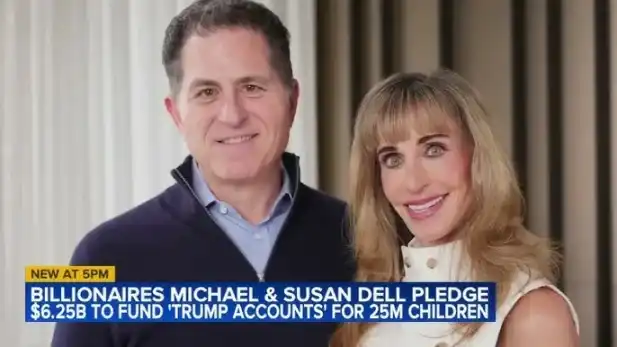
Odaily Note: Michael Dell couple, who donated $6.25 billion. Trump called this 'one of the most generous acts in American history'.

In terms of investment, 'Trump Accounts' will be limited to investing in low-cost investment funds or exchange-traded funds (ETFs) that track broad stock indices such as the 'S&P 500' index, and cannot be used to invest in specific industry or sector indices. The usage of funds is also restricted. Before the child turns 18 and becomes a legal adult on January 1 of that year, funds in the account cannot be withdrawn for any reason (unless the child passes away or the funds are transferred to another similar restricted account). After the child turns 18, the account will receive the same treatment as a traditional Individual Retirement Account (IRA).

According to the current plan, 'Trump Accounts' are tentatively scheduled to begin accepting initial deposits on July 4, 2026 (the 250th anniversary of the signing of the U.S. Declaration of Independence). This timing coincides with the run-up to the 2026 midterm elections and is expected to be a major policy 'trump card' for the Republican Party to win voters.

What is the Potential Scale?

According to statistics from Statista, since 2020, the annual number of births in the United States has fluctuated around 3.6 million.

Using this data as a benchmark, the planned coverage period from January 1, 2025, to January 1, 2029, is expected to include approximately 14.4 million newborn American children. If the federal government opens a $1,000 'Trump Account' for each child, this implies a massive fund of $14.4 billion; with potential private donations and family deposits, this number will continue to grow to hundreds of billions of dollars; if the plan continues to be promoted as a long-term initiative after 2029, its potential scale will be even more staggering.

Due to its operational characteristics of long-term lock-up, passive investment, and continuous new inflows, the 'Trump Account' will essentially become a long-term passive fund pool with a potential scale of hundreds of billions of dollars. Compared to a simple child welfare attribute, this更像是 establishing a long-term capital transmission channel between fiscal policy and the capital market, directly integrating the future generation into the stock market system.

The Biggest Beneficiary: Robinhood?

After the 'Trump Account' plan was announced, financial institutions such as JPMorgan Chase, Charles Schwab, and Robinhood began fierce competition for related services. With the U.S. Treasury Department officially designating Robinhood as the broker and initial custodian yesterday, Robinhood, which has obtained the 'entry ticket', is poised to become one of the most direct beneficiaries of this plan.

The most直观 benefit lies on the user side. According to the current policy coverage calculation, 'Trump Accounts' will correspond to tens of millions of newborn accounts, and the interaction portal for these accounts will be completed through a unified application — in other words, Robinhood will acquire a batch of potential users bound to the platform from birth. The oldest of these users is only 1 year old, and the youngest hasn't even been born yet... More importantly, these users are not one-time traffic but potential clients with an extremely long lifecycle. After the children turn 18, the accounts will convert into long-term investment accounts similar to IRAs, which means Robinhood has the opportunity to directly承接 these users into their adult investment behaviors and further extend into more business scenarios such as ETFs, options, and even crypto assets. From a lifecycle perspective, this is almost the longest possible user path a broker can obtain.

The benefits on the asset side are equally significant. The funds in 'Trump Accounts' have obvious long-term lock-up characteristics, hardly flowing out before the child reaches adulthood, while the investment scope is limited to index funds. This type of fund is extremely high-quality custody asset for brokers — low volatility, long retention, predictable scale. Furthermore, Robinhood's core label in the past has been a 'retail trading platform', with growth highly dependent on market conditions and trading activity. The 'Trump Account' introduces low-frequency, long-term, passive investment funds, which are closer to the capital attributes of traditional wealth management businesses. As the proportion of such funds increases, it will also enrich Robinhood's business diversity to a certain extent,补齐相对短板.

At the same time, the endorsement at the policy level also has symbolic significance. Participating in an account plan led by the Treasury Department brings Robinhood into the U.S. government's financial infrastructure system for the first time. This not only enhances its institutional credibility but also provides new narrative space for its future expansion into retirement accounts, long-term investment, and wealth management businesses.

From a political perspective, the 'Trump Account' is an important policy chip for the Republican Party facing the midterm elections; from a capital market perspective, this plan introduces an institutionalized long-term source of funds into the U.S. stock market. Robinhood happens to be at the intersection of both — as millions of newborns who have not yet entered society are 'automatically opening accounts', this policy design围绕选票 has also quietly laid a growth curve for Robinhood that could last for more than a decade.


Perguntas relacionadas

QWhat is the 'Trump Account' and what is its purpose?

AThe 'Trump Account', also known as a 530A account, is a tax-advantaged investment account plan established under the 'Big and Beautiful' Act. Its purpose is to provide government-funded savings accounts for children born between January 1, 2025, and January 1, 2029, who are U.S. citizens.

QWhich financial institutions were selected to manage the 'Trump Accounts' and what are their roles?

ABNY Mellon was selected as the designated financial agent to manage the initial accounts. Robinhood will partner with BNY Mellon, serving as the broker and initial custodian for the accounts.

QWhat are the sources of initial funding for a 'Trump Account' and what are the contribution limits?

AInitial funding comes from a $1000 federal grant, private donations (e.g., a $250 donation from the Michael Dell family for eligible children), and deposits from parents/friends, who can contribute up to $5000 per child per year.

QWhat is the potential scale of the 'Trump Account' program in terms of the number of children and total assets?

AThe program is expected to cover approximately 14.4 million children born during the eligibility period. With the $1000 federal grant alone, this represents $14.4 billion in assets, with the total potential size growing to hundreds of billions when including private and family contributions.

QWhy is Robinhood considered a major potential beneficiary of the 'Trump Account' program?

ARobinhood gains a long-term user base locked in from birth, with accounts converting to IRA-like accounts at age 18. It also acquires high-quality, long-term, passive assets that diversify its business beyond its traditional reliance on active retail trading, and receives a significant credibility boost from the government partnership.

Leituras Relacionadas

Vitalik: We Need to Create Sanctuaries, Not Fight AI

In a recent interview, Vitalik Buterin, founder of Ethereum, addresses the central anxiety of the AI era. He argues the primary risk isn't AI's intelligence, but human passivity—ceding decisions, privacy, and agency to centralized systems or "super AIs" for a sense of "disempowering safety." His solution is not to fight AI, but to build "sanctuary technologies." These are optional, non-totalizing spaces that protect users while preserving their sovereignty and privacy. Ethereum is presented as a prime example, offering a parallel financial system one can freely choose, not a fix for the old one. Reflecting on his journey from a 19-year-old on "autopilot" to an active "pilot," Vitalik notes the world reinvents itself every 5-10 years. To keep up, individuals must actively pilot their lives, not be passive passengers. He stresses that active learning vastly outperforms passive learning, even with equal time invested. His practical advice for builders and individuals in the AI age includes: periodically forcing oneself to do tasks manually to keep the mind engaged; prioritizing active learning and verification over outsourcing answers; building tools that help retain human agency; not outsourcing all strategic thinking to AI; and preserving serendipity through real-world interactions. Ultimately, Buterin redefines Ethereum/crypto's role: not to win against or fix the old world, but to provide a free, optional alternative. The core message is that as AI grows more powerful, the truly scarce resource will be proactive humans who retain their sovereignty, privacy, and capacity for independent thought. The era demands not less tool use, but more intentional and active use of technology.

链捕手Há 2h

Vitalik: We Need to Create Sanctuaries, Not Fight AI

链捕手Há 2h

Conversation with Patagon Founder: Revealing the Inside Story of Anthropic's Secondary Market

**Summary: Inside Anthropic's Massive, Opaque Secondary Market** In a revealing interview, Patagon founder Dio Casares pulls back the curtain on the booming, high-risk secondary market for shares in companies like Anthropic. This private market, fueled by companies staying private longer and massive funding rounds, is estimated to involve hundreds of billions of dollars. Casares distinguishes between two types of "secondary" trading: 1. **Company-approved SPV (Special Purpose Vehicle) sales:** Where new capital flows into the company, often facilitated by select private equity firms. Anthropic supports this to manage liquidity and pre-IPO selling pressure. 2. **The "gray" market:** Platforms like Hive and Forge that match buyers and sellers, often creating pricing confusion and competing with official funding rounds. These intermediaries are widely disliked by companies. The market structure is complex and fragmented, relying heavily on personal connections. Brokers connect buyers and sellers, often layering multiple SPVs to pool capital, with single transaction fees as high as 10%. Strikingly, some finance professionals earn more from this trading than from their primary investment roles. **Key risks highlighted include:** * **High Fraud Rates:** An estimated 10-20% of transactions involve fake stock certificates or sellers who take payment without having the shares. * **Complex, Risky Structures:** Nested SPVs, "forward contracts" on employee equity, and tokenized private equity create layers of opacity. This is exemplified by a recent incident where an xAI employee's shares were revoked after an espionage allegation, leaving buyers empty-handed. * **Post-IPO "Settlement Hell":** After an IPO, delays in distributing shares through multiple SPV layers and decisions by fund managers to hold onto shares could trigger years of lawsuits as downstream investors are locked out. **For small investors** holding positions through tokenized vehicles or layered SPVs, it's often impossible to verify the underlying asset. Casares advises caution: if the investment feels wrong, consider exiting. As the private market now surpasses IPO fundraising, this "wild west" ecosystem faces a looming reckoning. While it will likely professionalize, the post-IPO period for a company like Anthropic could unleash a wave of disputes, exposing the vulnerabilities built into this frenzied, largely unregulated marketplace.

marsbitHá 4h

Conversation with Patagon Founder: Revealing the Inside Story of Anthropic's Secondary Market

marsbitHá 4h

Trading

Spot
Futuros
活动图片




