Bitcoin Treasury Firm Strategy To Repurchase $1.5B Of Convertible Notes — Details

bitcoinistPublicado em 2026-05-17Última atualização em 2026-05-17

Resumo

Bitcoin treasury firm Strategy (formerly MicroStrategy) plans to repurchase approximately $1.5 billion of its convertible notes due in 2029 for an estimated $1.38 billion. According to a filing with the SEC, the company will fund the buyback using cash reserves, proceeds from securities sales, and/or potential sales of Bitcoin. This move, authorized by Chairman Michael Saylor, follows recent comments from CEO Phong Le about possible scenarios for selling Bitcoin to enhance shareholder value. The repurchase could positively impact equity holders by preventing future stock dilution. The news follows a record $1.53 billion trading volume for Strategy's preferred stock (STRC), a key instrument for its Bitcoin acquisitions. The firm remains the largest corporate Bitcoin holder with 818,869 BTC.

Bitcoin treasury company Strategy (formerly MicroStrategy) has disclosed its intention to repurchase $1.5 billion of its 2029 convertible debt notes. This move comes amid commentary on the shift in the Michael Saylor-led firm’s “Never Sell” perspective, intensifying focus on the company’s market actions in the coming weeks.

Will Strategy Sell Bitcoin To Repurchase Its Debt?

In a May 15th post on the social media platform X, Strategy’s chairman, Michael Saylor, confirmed that the firm has filed to repurchase $1.5 billion principal amount of its convertible senior notes due in 2029. This decision comes as part of the outcome of privately negotiated transactions with holders of this debt security.

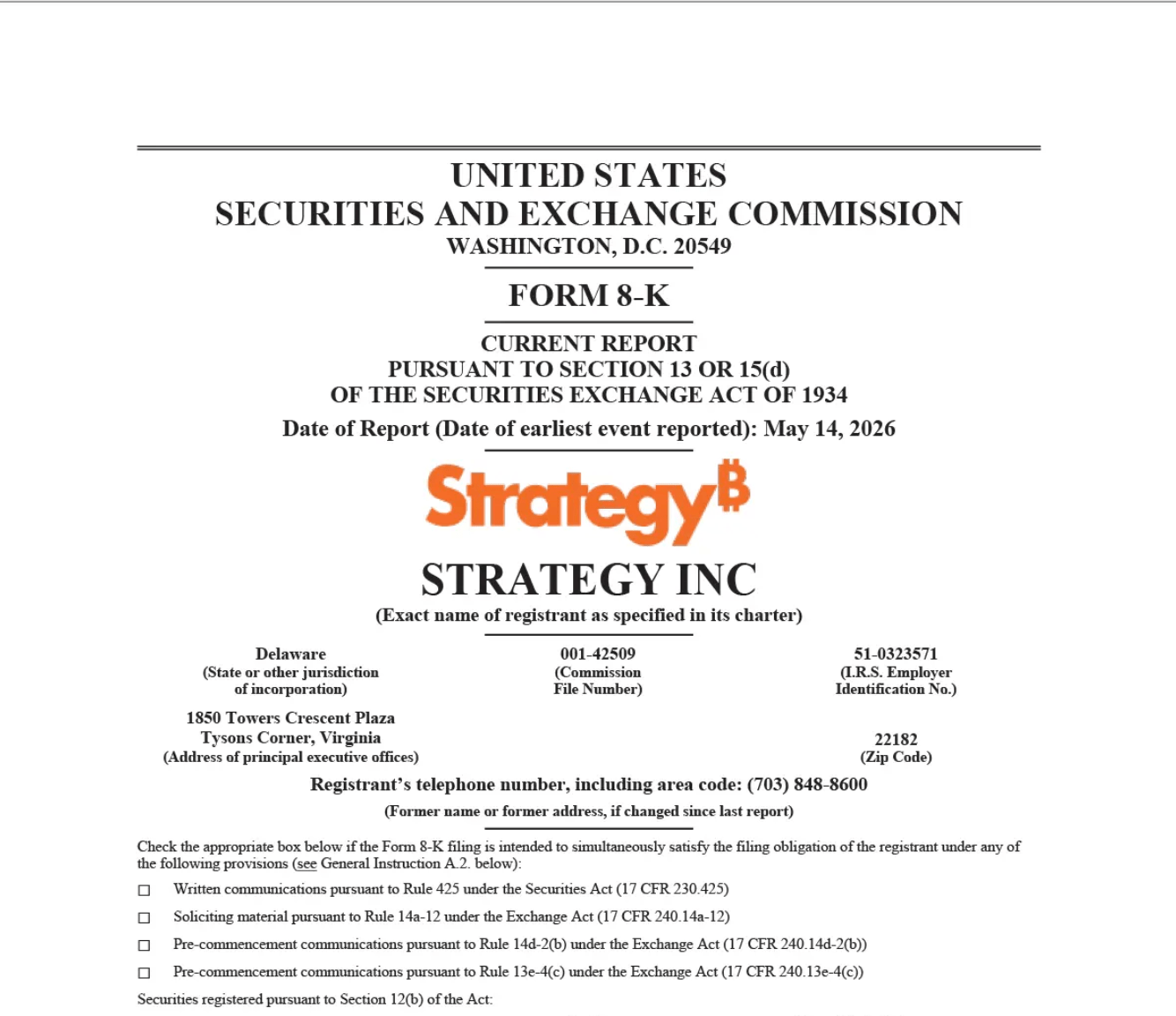
In the Form 8-K filed with the United States Securities and Exchange Commission (SEC) on May 14th, Strategy disclosed that it agreed to retire approximately $1.50 billion in aggregate principal amount of the 2029 Notes for an estimated aggregate cash repurchase price of approximately $1.38 billion.
Source: Strategy

The official filing read:

The final aggregate cash repurchase price for the Repurchased Notes is subject to adjustment, and will be based in part on the daily volume-weighted average price per share of Strategy’s class A common stock, par value $0.001 per share (the “Class A Common Stock”), during an agreed upon measurement period (the “Measurement Period”).

The Bitcoin treasury firm also revealed that these repurchase transactions will be funded with available cash reserves, proceeds from sales of securities under its at-the-market offering program, and/or proceeds from the sale of Bitcoin. Quite interestingly, this filing comes barely a week after the company’s CEO, Phong Le, highlighted scenarios in which the firm might shed some of its Bitcoin holdings.

According to the executive, this included situations that would increase shareholder value, such as dividend payments. It remains to be seen whether the firm debt repurchase falls into the category of activities that warrants the sale of a portion of its Bitcoin.

Merely looking at the action, retiring these convertible notes could be positive for equity investors, as it means that the hybrid debt instrument holders won’t be able to convert to common stock (and potentially dilute the shareholders). Instead, the repurchase gives Strategy a perfect opportunity to reorganize its balance sheet and capital structure.

Strategy’s STRC Registers Record High Daily Trading Volume

Interestingly, the news of this debt repurchase comes merely a day after STRC, Strategy’s Variable Rate Series A Perpetual Stretch Preferred Stock, posted its highest daily trading volume of $1.53 billion on Thursday, May 14th. This represents a significant jump from the previous record of $1.1 bill reached on April 13.

This trading explosion in STRC, which has been Strategy’s capital-raising instrument for purchasing Bitcoin, could help the firm raise about $735 million to buy BTC. As of this writing, the firm maintains its position as the largest corporate Bitcoin holder, with a stash of 818,869 Bitcoin, worth about $66 billion.

The price of BTC on the daily timeframe | Source: BTCUSDT chart on TradingView

Perguntas relacionadas

QWhat is the Bitcoin treasury firm formerly known as MicroStrategy planning to repurchase?

AThe Bitcoin treasury firm Strategy (formerly MicroStrategy) is planning to repurchase $1.5 billion principal amount of its convertible senior notes due in 2029.

QHow does Strategy plan to fund the repurchase of its convertible notes?

AStrategy plans to fund the repurchase transactions with available cash reserves, proceeds from sales of securities under its at-the-market offering program, and/or proceeds from the sale of Bitcoin.

QWhy could retiring the convertible notes be positive for Strategy's equity investors?

ARetiring the convertible notes could be positive for equity investors because it prevents holders of the debt instrument from converting to common stock, which would potentially dilute the shareholders. It also gives Strategy an opportunity to reorganize its balance sheet and capital structure.

QWhat recent record was set by Strategy's STRC preferred stock, and what could it enable the firm to do?

AStrategy's STRC (Variable Rate Series A Perpetual Stretch Preferred Stock) posted its highest daily trading volume of $1.53 billion on May 14th. This trading activity could help the firm raise about $735 million to buy Bitcoin.

QHow much Bitcoin does Strategy currently hold, and what is its approximate value?

AStrategy currently holds 818,869 Bitcoin, which is worth approximately $66 billion, maintaining its position as the largest corporate Bitcoin holder.

Leituras Relacionadas

Vitalik: We Need to Create Sanctuaries, Not Fight AI

In a recent interview, Vitalik Buterin, founder of Ethereum, addresses the central anxiety of the AI era. He argues the primary risk isn't AI's intelligence, but human passivity—ceding decisions, privacy, and agency to centralized systems or "super AIs" for a sense of "disempowering safety." His solution is not to fight AI, but to build "sanctuary technologies." These are optional, non-totalizing spaces that protect users while preserving their sovereignty and privacy. Ethereum is presented as a prime example, offering a parallel financial system one can freely choose, not a fix for the old one. Reflecting on his journey from a 19-year-old on "autopilot" to an active "pilot," Vitalik notes the world reinvents itself every 5-10 years. To keep up, individuals must actively pilot their lives, not be passive passengers. He stresses that active learning vastly outperforms passive learning, even with equal time invested. His practical advice for builders and individuals in the AI age includes: periodically forcing oneself to do tasks manually to keep the mind engaged; prioritizing active learning and verification over outsourcing answers; building tools that help retain human agency; not outsourcing all strategic thinking to AI; and preserving serendipity through real-world interactions. Ultimately, Buterin redefines Ethereum/crypto's role: not to win against or fix the old world, but to provide a free, optional alternative. The core message is that as AI grows more powerful, the truly scarce resource will be proactive humans who retain their sovereignty, privacy, and capacity for independent thought. The era demands not less tool use, but more intentional and active use of technology.

链捕手Há 3h

Vitalik: We Need to Create Sanctuaries, Not Fight AI

链捕手Há 3h

Conversation with Patagon Founder: Revealing the Inside Story of Anthropic's Secondary Market

**Summary: Inside Anthropic's Massive, Opaque Secondary Market** In a revealing interview, Patagon founder Dio Casares pulls back the curtain on the booming, high-risk secondary market for shares in companies like Anthropic. This private market, fueled by companies staying private longer and massive funding rounds, is estimated to involve hundreds of billions of dollars. Casares distinguishes between two types of "secondary" trading: 1. **Company-approved SPV (Special Purpose Vehicle) sales:** Where new capital flows into the company, often facilitated by select private equity firms. Anthropic supports this to manage liquidity and pre-IPO selling pressure. 2. **The "gray" market:** Platforms like Hive and Forge that match buyers and sellers, often creating pricing confusion and competing with official funding rounds. These intermediaries are widely disliked by companies. The market structure is complex and fragmented, relying heavily on personal connections. Brokers connect buyers and sellers, often layering multiple SPVs to pool capital, with single transaction fees as high as 10%. Strikingly, some finance professionals earn more from this trading than from their primary investment roles. **Key risks highlighted include:** * **High Fraud Rates:** An estimated 10-20% of transactions involve fake stock certificates or sellers who take payment without having the shares. * **Complex, Risky Structures:** Nested SPVs, "forward contracts" on employee equity, and tokenized private equity create layers of opacity. This is exemplified by a recent incident where an xAI employee's shares were revoked after an espionage allegation, leaving buyers empty-handed. * **Post-IPO "Settlement Hell":** After an IPO, delays in distributing shares through multiple SPV layers and decisions by fund managers to hold onto shares could trigger years of lawsuits as downstream investors are locked out. **For small investors** holding positions through tokenized vehicles or layered SPVs, it's often impossible to verify the underlying asset. Casares advises caution: if the investment feels wrong, consider exiting. As the private market now surpasses IPO fundraising, this "wild west" ecosystem faces a looming reckoning. While it will likely professionalize, the post-IPO period for a company like Anthropic could unleash a wave of disputes, exposing the vulnerabilities built into this frenzied, largely unregulated marketplace.

marsbitHá 4h

Conversation with Patagon Founder: Revealing the Inside Story of Anthropic's Secondary Market

marsbitHá 4h

Trading

Spot
Futuros
活动图片