Metaplanet Fuels Bitcoin Bet With $50M Zero-Cost Debt Move

bitcoinistPublicado em 2026-04-25Última atualização em 2026-04-25

Resumo

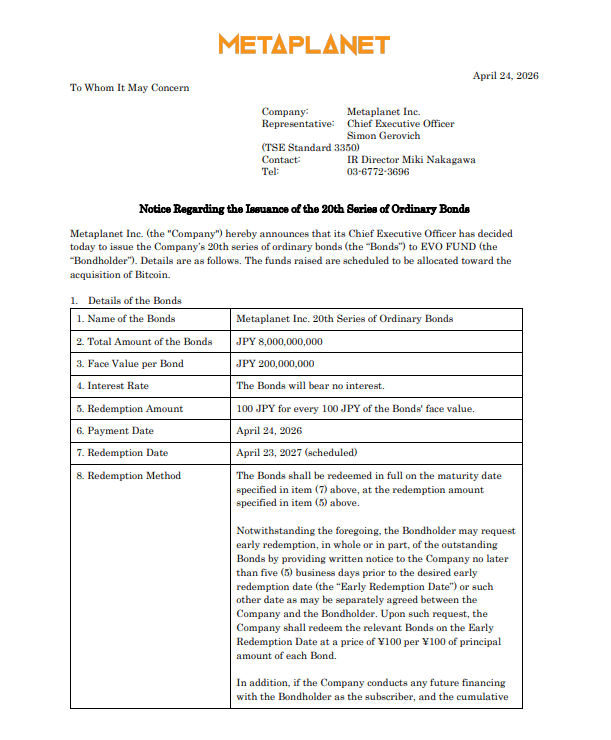
Metaplanet, a Tokyo-listed company, has raised 8 billion yen (approximately $50 million) through a zero-coupon bond issuance to the EVO Fund. The bonds carry no interest and are due for full repayment in April 2027. All proceeds will be used to purchase additional Bitcoin. This aggressive, unsecured debt structure relies on Bitcoin's future price appreciation to repay the principal. The EVO Fund, which has financed multiple such bond issuances for Metaplanet, holds the right to demand early repayment with short notice. This latest move expands Metaplanet's position as one of the largest corporate Bitcoin holders globally, with over 40,000 BTC. The company's share price fell 3.6% upon the announcement.

A Tokyo-listed company is borrowing $50 million to buy Bitcoin — and it won’t pay a single dollar in interest to do it. Metaplanet announced Thursday it had sold its 20th series of ordinary bonds, worth 8 billion Japanese yen, to EVO Fund — a Cayman Islands-based investor tied to Evolution Financial Group.

Bonds With No Interest Rate Attached

The bonds carry a zero-coupon rate, meaning Metaplanet pays no interest over the life of the loan. The full principal comes due in April 2027. All proceeds go directly toward buying more Bitcoin.

The structure is aggressive by any measure. The company is betting that Bitcoin’s price a year from now will be high enough to justify repaying the loan at face value.

Based on filings, the bonds are unsecured, which means there is no collateral backing the debt. EVO Fund also holds the right to demand early repayment with just five business days’ notice — a clause that could put pressure on Metaplanet if crypto markets turn sharply.
A Pattern, Not A One-Off

This isn’t the first time EVO Fund has bankrolled Metaplanet’s Bitcoin buying. Reports indicate the firm has been the primary subscriber across multiple rounds of zero-coupon bond issuances that Metaplanet has used to fund its growing crypto stockpile.

The two parties have built a financing relationship that has helped Metaplanet accumulate one of the largest corporate Bitcoin holdings in Asia.

Going into this latest raise, Metaplanet already held roughly 40,177 BTC — built largely through an aggressive first quarter when it added more than 5,000 Bitcoin in three months.

BTCUSD now trading at $78,287. Chart: TradingView

That puts the company third among publicly listed firms worldwide by Bitcoin holdings, according to available data. The only companies ahead of it are operating at a significantly larger scale.

Comparisons to Strategy, the US firm that pioneered the corporate Bitcoin treasury model, have followed Metaplanet for some time. Both companies have used debt markets, not just cash on hand, to keep buying. But Metaplanet’s repeated use of a single investor for zero-rate funding sets it apart.

Stock Slips As Deal Is Announced

Metaplanet’s share price fell about 3.60% on the day the deal was disclosed, based on Yahoo Finance data. The drop suggests some investors aren’t fully sold on the strategy, even as the company keeps pushing forward.

Metaplanet said in its filing that the bond issuance is expected to have only a minimal impact on its consolidated results for the 2026 fiscal year. It added that if any significant change to its financial position emerges from the deal, it will issue a follow-up disclosure promptly.

Bitcoin was trading at $77,650 at the time of the announcement — the price Metaplanet needs to at least hold for its zero-cost debt bet to break even.

Featured image from Unsplash, chart from TradingView

Perguntas relacionadas

QWhat is the key financial strategy Metaplanet is using to acquire more Bitcoin, and what are its unique terms?

AMetaplanet is issuing zero-coupon bonds worth 8 billion yen (approx. $50M) to the EVO Fund. The bonds carry no interest, and the full principal is due in April 2027. The proceeds are used to buy Bitcoin, making it a bet that Bitcoin's price will be high enough by then to repay the loan.

QWho is the sole investor purchasing Metaplanet bonds, and what is a potential risk for Metaplanet in this agreement?

AThe sole investor is the EVO Fund, a Cayman Islands-based entity tied to Evolution Financial Group. A key risk is that the bonds are unsecured (no collateral) and the EVO Fund holds the right to demand early repayment with just five business days' notice, which could pressure Metaplanet if crypto markets decline sharply.

QHow does this recent bond issuance fit into Metaplanet's broader corporate strategy?

AThis is not a one-off event but part of a pattern. The EVO Fund has been the primary subscriber for multiple rounds of Metaplanet's zero-coupon bond issuances. This financing relationship has helped the company accumulate one of the largest corporate Bitcoin holdings in Asia, currently over 40,000 BTC.

QHow did the market initially react to the announcement of this debt deal?

AMetaplanet's share price fell approximately 3.60% on the day the deal was disclosed, suggesting that some investors are skeptical or not fully convinced of the aggressive strategy of using debt to buy more cryptocurrency.

QWhat is the break-even price for Metaplanet's Bitcoin bet with this new debt, and what was the price at the time of the announcement?

AFor its zero-cost debt bet to break even, Metaplanet needs the price of Bitcoin to at least hold at the level it was when the deal was announced. At that time, Bitcoin was trading at $77,650.

Leituras Relacionadas

Making AI Products Is No Longer the Hard Part; Being Seen Is: Developers, Web3, and Chinese AI Opportunities at mu Shanghai

The article discusses the shifting challenges of AI entrepreneurship, based on insights from the mu Shanghai AI WEEK event in May 2026. As AI tools drastically lower the barrier to creating product prototypes, the core difficulty for startups has moved from "how to build" to "who to build for"—finding real users, sustainable business models, and community engagement. The event itself was structured as an extended, immersive developer community space rather than a traditional conference, attracting a global mix of participants (40% AI, 20-30% Web3). This format emphasized deep networking and collaborative creation over one-way presentations. A key observation is that with powerful models and coding assistants becoming ubiquitous, execution is less of a moat. The new scarce resource is judgment—identifying valuable, defensible scenarios where an application won't be quickly rendered obsolete by the next model update. This pushes competition downstream to distribution, user acquisition, and commercialization. Notably, many Web3 practitioners are migrating into AI, bringing with them expertise in community building, global collaboration, and grassroots marketing—skills highly relevant as AI apps fight for visibility. Meanwhile, opportunities in AI hardware, robotics, and embodied intelligence are seen as more durable, leveraging China's robust manufacturing and supply chain ecosystem as a key advantage. The article notes that major Chinese model companies (like MiniMax) are now actively competing for developer mindshare through community programs, hackathons, and improved tooling, recognizing developers as core users. Ultimately, the conclusion is that while AI simplifies building, the harder part of the journey is ensuring a product is truly needed, understood, and retained by its users.

marsbitHá 4m

Making AI Products Is No Longer the Hard Part; Being Seen Is: Developers, Web3, and Chinese AI Opportunities at mu Shanghai

marsbitHá 4m

Why is the RWA Boom Failing to Benefit DeFi?

The rapid growth of the tokenized real-world assets (RWA) market, now nearing $30 billion on-chain, has largely bypassed the DeFi ecosystem. Only about $2.47 billion is actively locked in DeFi protocols, indicating a penetration rate of just 9%. A major barrier is the "permissioned" architecture of most RWA products, like BlackRock's BUIDL fund, which are designed for institutional compliance. They require whitelisting, off-chain settlement, and strict investor accreditation, making them incompatible with open, permissionless DeFi applications like Aave or Uniswap. This is evident in categories like bonds/money market funds ($16.6B on-chain, $920M in DeFi) and tokenized equities ($2.7B on-chain, $78M in DeFi). Notable exceptions are private credit protocols (e.g., Maple Finance, Centrifuge) and assets like Ondo's USDY, which were designed from inception for DeFi composability, allowing them to be used freely as collateral. Morpho and Aave Horizon also demonstrate successful RWA lending integrations. However, industry reports (IOSCO, ECB) warn that growth may remain confined within traditional financial systems due to fragmented regulations, lack of unified standards, and inherent conflicts between DeFi's open logic and compliance requirements like minimum investments and fixed redemption windows. The RWA sector is effectively split into two markets: a compliant, permissioned on-chain finance market and a smaller DeFi-native market focused on composability. For DeFi penetration to rise significantly, asset issuers must prioritize designs that enable permissionless circulation from the start, moving away from models centered solely on institutional compliance.

marsbitHá 25m

Why is the RWA Boom Failing to Benefit DeFi?

marsbitHá 25m

Clarity Act Outlook: No Yield, No Payment

"Clear Act Outlook: No Yield, No Payment" analyzes the evolving U.S. regulatory landscape for stablecoins, focusing on the interplay between the proposed "Clarity Act" and the existing "Genius Act." The article argues that the Genius Act successfully fostered "payment stablecoins" by permitting tokenized assets like U.S. Treasuries as reserves. This created a structured market where stablecoin issuers (like USDC) must hold these reserves, often purchased as Tokenized Money Market Funds (TMMFs) from giants like BlackRock. These TMMFs are primarily B2B products, ensuring user-facing stablecoins remain non-interest-bearing and used primarily for payments. The upcoming Clarity Act is seen as the next phase, aiming to restrict passive yield on stablecoins. Its goal is to dismantle the arbitrage advantage of offshore stablecoins like USDT by redirecting Treasury demand towards compliant, U.S.-sanctioned TMMFs. For on-chain and compliant offshore dollars, this creates new pressure: they must spur adoption and utility to generate yield, as simple Treasury staking may be restricted. This indirectly promotes dollar circulation and sustained Treasury purchases. Ultimately, the analysis posits that U.S. regulation seeks to create a new dollar distribution model. By separating payment function from yield generation and anchoring both to U.S. debt instruments, it aims to embed the dollar and Treasury demand into the global crypto economy, managing yields through sanctioned intermediaries while leaving room for DeFi and cross-border arbitrage.

marsbitHá 53m

Clarity Act Outlook: No Yield, No Payment

marsbitHá 53m

Trading

Spot
Futuros

Artigos em Destaque

Como comprar MOVE

Bem-vindo à HTX.com!Tornámos a compra de Movement (MOVE) simples e conveniente.Segue o nosso guia passo a passo para iniciar a tua jornada no mundo das criptos.Passo 1: cria a tua conta HTXUtiliza o teu e-mail ou número de telefone para te inscreveres numa conta gratuita na HTX.Desfruta de um processo de inscrição sem complicações e desbloqueia todas as funcionalidades.Obter a minha contaPasso 2: vai para Comprar Cripto e escolhe o teu método de pagamentoCartão de crédito/débito: usa o teu visa ou mastercard para comprar Movement (MOVE) instantaneamente.Saldo: usa os fundos da tua conta HTX para transacionar sem problemas.Terceiros: adicionamos métodos de pagamento populares, como Google Pay e Apple Pay, para aumentar a conveniência.P2P: transaciona diretamente com outros utilizadores na HTX.Mercado de balcão (OTC): oferecemos serviços personalizados e taxas de câmbio competitivas para os traders.Passo 3: armazena teu Movement (MOVE)Depois de comprar o teu Movement (MOVE), armazena-o na tua conta HTX.Alternativamente, podes enviá-lo para outro lugar através de transferência blockchain ou usá-lo para transacionar outras criptomoedas.Passo 4: transaciona Movement (MOVE)Transaciona facilmente Movement (MOVE) no mercado à vista da HTX.Acede simplesmente à tua conta, seleciona o teu par de trading, executa as tuas transações e monitoriza em tempo real.Oferecemos uma experiência de fácil utilização tanto para principiantes como para traders experientes.

292 Visualizações TotaisPublicado em {updateTime}Atualizado em 2025.03.21

Como comprar MOVE

Discussões

Bem-vindo à Comunidade HTX. Aqui, pode manter-se informado sobre os mais recentes desenvolvimentos da plataforma e obter acesso a análises profissionais de mercado. As opiniões dos utilizadores sobre o preço de MOVE (MOVE) são apresentadas abaixo.

活动图片













