Low Investment Isn't Apple's Immunity Pass

marsbitPublicado em 2026-08-01Última atualização em 2026-08-01

Resumo

While Meta and Google face investor scrutiny over ballooning AI capital expenditures, Apple's minimal AI investment has paradoxically become a strength. Its market cap recently reclaimed the global top spot, surpassing $5 trillion. The irony is deep: Apple's own AI efforts have lagged, with "Apple Intelligence" delayed and core talent lost, forcing reliance on partners like Google Gemini and Alibaba's Qianwen. Its Q3 FY2026 (Q2 CY) earnings initially seemed stellar. Revenue hit $109.4B (up 16% YoY), with iPhone and Mac sales, growing 22% and 29% respectively, driving most of the growth. However, the stock fell over 8% post-earnings. The primary concern was a weaker Q4 revenue growth forecast of 9-11%, below expectations, due to looming supply chain constraints. Apple is feeling the indirect cost of the AI boom. Soaring memory and chip prices, fueled by massive data center investments from Microsoft, Amazon, and others, are forcing Apple to raise Mac and iPad prices significantly. The upcoming iPhone launch is also expected to see substantial price hikes. Despite avoiding heavy AI infrastructure spending—its capital expenditures are actually down 28%—Apple cannot escape the industry-wide supply and cost pressures. While Apple's operating cash flow remains robust, its substantial R&D spending (up 32% YoY) has yet to yield major AI breakthroughs. As Tim Cook prepares to step down as CEO, Apple faces a challenging transition: balancing its premium hardware success against the ...

By Shan Shang, Author: I Xue Xingxing, Editor: I Jiang Jiao

While tech giants like Meta and Google face skepticism due to their ever-ballooning AI capital expenditures, Apple's unproductive AI efforts have ironically become a bright spot.

This week, Apple's market cap surpassed Nvidia's, reclaiming the top global spot, with its intraday market value briefly breaking through $3 trillion. Prior to the earnings release, Apple's stock price had accumulated a gain of over 24% this year, making it the only one among the "Magnificent Seven" to achieve double-digit growth.

This is somewhat ironic. Over the past two years, Apple has suffered repeated failures in the AI field. Apple Intelligence has been repeatedly delayed, core AI talent has been continuously lost, ultimately forcing the company to rely on Google's Gemini and Alibaba's Qianwen for implementation. As domestic automakers would say, this is handing over one's soul.

However, as peers' AI spending wars become increasingly extravagant and blind, investors are beginning to panic about whether these investments will ever see returns. Although Apple is behind in AI, it also hasn't burdened itself with heavy capital expenditures. People used to criticize Apple for its slow AI progress, but now they're praising its virtue of restraint.

——This is probably the so-called 'benefit from peer comparison'; standing still can also be a form of leading.

However, the market's enthusiasm didn't last long. In the early morning of July 31, Beijing time, Apple released its Q3 2026 fiscal year (calendar year Q2) earnings report. Revenues from iPhone, Mac, and other businesses significantly exceeded market expectations, driving quarterly revenue up 16% year-over-year, setting a new historical record for the period.

But after the report's release, Apple's stock price fell over 8% in after-hours trading. Meanwhile, Microsoft, Nvidia, and Amazon's stock prices saw noticeable recoveries. Microsoft surged 15.51% in a single day, and Amazon, which also reported earnings alongside Apple, rose over 10% in after-hours trading.

iPhone Saves Apple Once Again

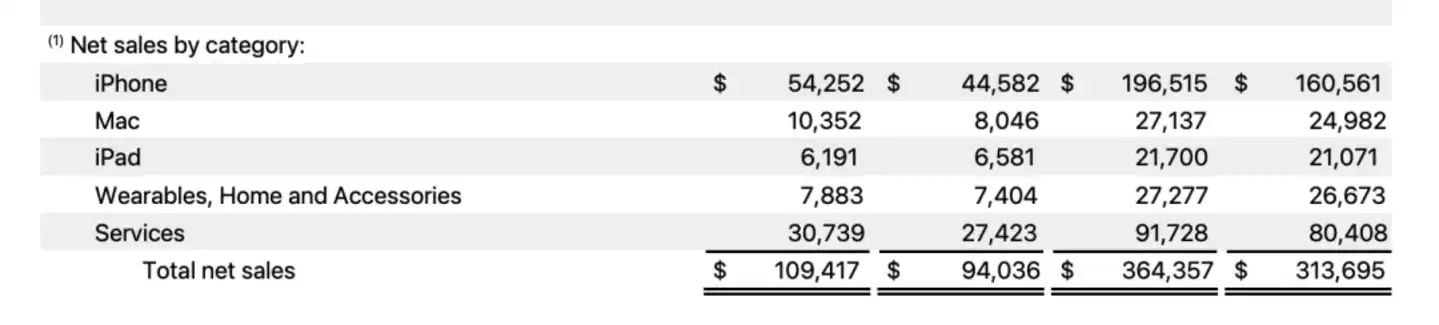
Looking solely at the quarter's performance, Apple delivered a quite outstanding earnings report, with multiple metrics hitting historical highs for the period. The report shows Apple's quarterly revenue was $109.417 billion, up 16.4% year-over-year; net profit was $29.789 billion, up 27.1% year-over-year.

Cook proudly announced in a press release, "We delivered our strongest June quarter ever, with double-digit revenue growth in iPhone, Mac, Services, and across all geographic segments."

iPhone and Mac once again saved Apple, together contributing to about 78% of Apple's quarterly revenue increment, the biggest drivers of its revenue growth. iPhone revenue for the quarter grew 21.7% year-over-year to $54.252 billion, accounting for about 63% of Apple's revenue increment. iPhone's share of total company revenue also rose from 47.4% in the same period last year to 49.6%.
Apple Earnings Report

Omdia's previously released Q2 2026 global smartphone shipment data shows that while global smartphone shipments declined 6% year-over-year for the quarter, Apple achieved 23% year-over-year growth, ranking second globally, with shipment volume hitting a historical high for the period. In contrast, Samsung's market share only grew 5% for the quarter, while Xiaomi, OPPO, and Vivo all saw significant declines, with Xiaomi down 26% year-over-year.

The facts prove that although the marketing narrative of AI phones has been building wave after wave, at least from the current market perspective, what consumers are more willing to pay for is hardware performance and product design. The unintelligent Siri hasn't affected iPhone's popularity at all.

Although Mac's contribution to absolute revenue increment is not as high as iPhone's, its growth rate far exceeded market expectations. Quarterly Mac revenue grew 28.7% year-over-year to $10.352 billion, $1.84 billion higher than market expectations. This was achieved despite supply constraints for high-end chips and some Mac products being in short supply. Apple management previously stated that demand for the MacBook Neo far exceeded expectations, and products like the Mac mini and Mac Studio have also been selling well driven by AI development demand.

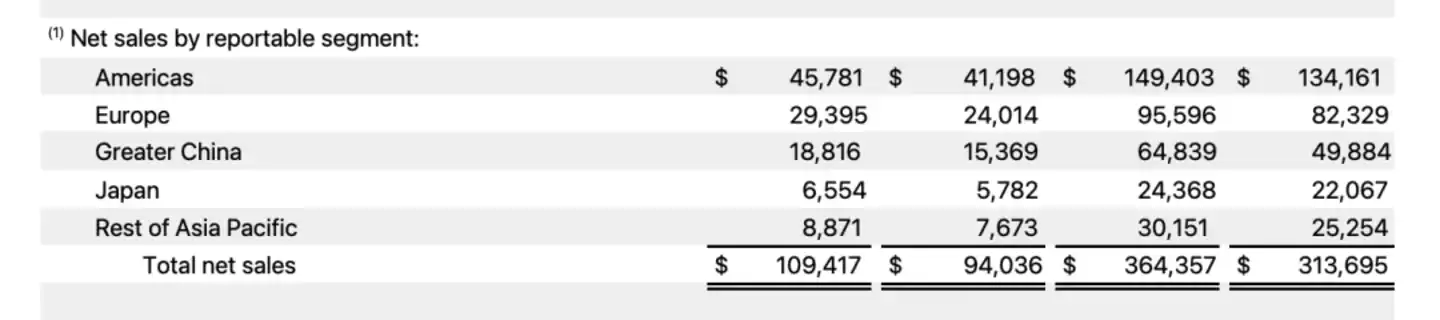
Apple achieved double-digit growth in nearly all global markets. Americas revenue grew 11.1%, Europe and Greater China both grew 22.4%, Japan grew 13.4%, and other Asia-Pacific markets grew 15.6%. However, this quarter's revenue growth rate in the Greater China region was slightly below market expectations and also lower than last quarter's 28% growth rate.
Apple Earnings Report

Apart from iPhone and Mac, Apple's other businesses performed relatively flat. iPad revenue fell 5.9% year-over-year to $6.191 billion, the only product line to decline year-over-year. Cook attributed this to a high base from last year's cheaper iPad. Wearables, Home, and Accessories revenue grew 6.5% year-over-year to $7.883 billion.

Against the favorable backdrop of product revenue growing 18.1% year-over-year, Apple's quarterly Services revenue was $30.739 billion, growing only 12.1% year-over-year, both lower than the company's overall growth rate and below market expectations. In comparison, Apple's Services revenue growth last quarter was 16.3%.

The slowdown in Services growth is partly due to the "Apple Tax" beginning to loosen. In recent years, more and more countries and regions have begun challenging the closed ecosystem of the App Store.

The EU has already required Apple to open up to third-party app stores, and the Epic Games lawsuit against Apple forced it to allow external payment links in the US. In March this year, under domestic regulatory pressure, Apple also lowered the commission rate for China's App Store.

The gross margin for the Services business reached 75.6%, far higher than the Products business's 40.1%. Its slowing growth has somewhat impacted Apple's profit performance. Apple's gross margin last quarter was 49.3%; this quarter, after deducting tariff refunds, the gross margin is approximately 48.1%, an actual sequential decline of about 1.2 percentage points.

However, Apple's Services revenue may see some growth with the landing of the new Siri. Apple's new AI-powered Siri and Apple Intelligence are set to launch next quarter. Cook hinted during the earnings call that due to rising computing costs, some AI features might require payment to use.

Avoided AI Spending Burn, But Not AI Price Hikes

Although Apple delivered a quarter of bright growth, the market generally held a pessimistic view. After the earnings release, Apple's after-hours stock price plunged over 8%.

The direct trigger was Apple's pessimistic guidance for the next quarter. Apple expects next quarter's revenue to grow only 9% to 11% year-over-year, below market expectations. Apple management stated during the earnings call that besides the impact of foreign exchange fluctuations, the negative effects of supply chain constraints will intensify quarter by quarter after Q3, adversely affecting the iPhone, Mac, and iPad business lines.

Cook stated that supply chain constraints are mainly concentrated in the Mac product line, with the root cause being extremely strong market demand that they don't have enough capacity to absorb. "In the coming quarter, we will face tremendous pressure on the supply chain side." Apple's M-series chips are mainly manufactured by TSMC, but TSMC's capacity is also increasingly being ceded to AI chips.

Prior to this, Apple has already had to significantly raise prices due to rising memory and chip costs, covering many product lines including Mac and iPad, with some product prices increasing by over 3,000 yuan at the highest. Cook described during the earnings call that the current rise in memory prices is equivalent to a once-in-a-century flood, showing exponential growth, forcing them to adjust prices.

But the last price increase did not include Apple's most important iPhone product line. The market expects Apple's new iPhone to be released this autumn to see significant price hikes, with the starting price of the foldable iPhone possibly as high as over $2,000. The hot sales of iPhone last quarter might partly be related to consumers' panic buying before the price adjustment—considering new models are about to be released, the past second quarter has typically been a slow sales season for iPhone.

Under the pressure of price hikes, market confidence in iPhone sales next quarter is insufficient. Apple management's guidance for iPhone revenue growth next quarter is only around 15%, below Wall Street's expectation of 17.6%.

Apple is already preparing for the increasingly severe supply chain constraints. This quarter, Apple's inventory rose from last quarter's $6.747 billion to $11.092 billion, a sequential increase of 64.4% and an 87.2% year-over-year increase from $5.925 billion in the same period last fiscal year, nearly doubling year-over-year.

According to Bloomberg, Apple is negotiating memory chip purchases with ChangXin Memory Technologies (CXMT) and Yangtze Memory Technologies Corp (YMTC). But this move faces opposition from the US government and Micron Technology. Cook said during the earnings call that the global DRAM market is currently controlled by three companies—Samsung, Micron, and SK Hynix—and adding suppliers would help improve supply and prices.

Not spending on AI doesn't allow Apple to stay out of this AI frenzy. The record-breaking AI data center construction by tech giants like Microsoft, Google, Amazon, and Meta will also directly impact Apple's memory and chip supply, subsequently hurting its revenue.

Currently, the full-year AI capital expenditures announced just by Microsoft, Google, Amazon, and Meta will exceed $720 billion, far surpassing last year's $455.8 billion. Massive AI investments directly caused Google and Amazon's free cash flow to turn negative this quarter, while Meta's free cash flow also plummeted 91%.

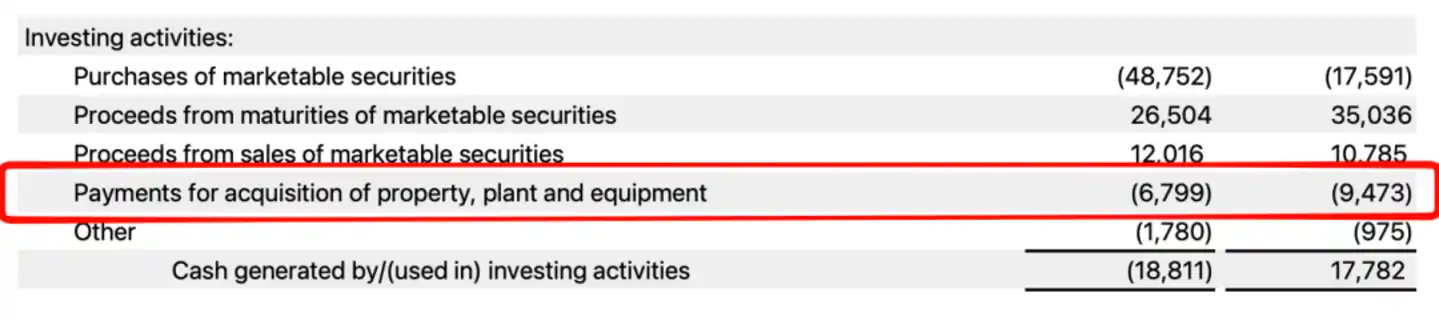
In comparison, Apple's capital expenditures this year have not only not grown but have even declined. In the first three quarters of fiscal 2026, Apple's expenditures on purchasing property, plant, and equipment were only $6.799 billion, down 28.2% year-over-year.
Apple Earnings Report

Restrained capital expenditures helped Apple's quarterly operating cash flow hit a historical high for the period. Operating cash flow for the first nine months of this fiscal year reached $117 billion, up 43.1% year-over-year. Cook is truly a master of capital management, helping the company save money even as he approaches retirement.

This is not to say Apple neglects AI investment. Compared to other manufacturers' greater enthusiasm for investing in AI computing power, Apple's investments seem to flow more into the R&D field.

This quarter, Apple's R&D expenses reached $11.729 billion, up 32.3% year-over-year, a growth rate approximately twice that of revenue. For the first three quarters of fiscal 2026, Apple's R&D expenses were $34.035 billion, up 32.5% year-over-year.

Just, such large-scale R&D investment has ultimately failed to yield many significant AI achievements, which is another level of "Only Apple can do."

This was Cook's last time participating in Apple's earnings call. This September, he will officially step down as Apple CEO. Cook specifically thanked the outside world during the earnings call, "Thank you to all our shareholders, especially the long-term shareholders who have trusted us over the years."

He said he has full confidence that Apple's future is bright.

Criptomoedas em alta

Perguntas relacionadas

QAccording to the article, why did Apple's stock price surge despite its lack of significant achievements in AI?

AThe article states that while other tech giants like Meta and Google are facing skepticism due to their massive and escalating AI capital expenditures, Apple's relative lack of such spending became a highlight. Investors began to panic about whether the huge AI investments by others would yield returns. Therefore, Apple's slower pace in AI, which previously drew criticism, was later viewed as a virtue of restraint, leading to a stock price increase. The article sums it up as 'it's all thanks to the contrast with peers, where standing still can also be a form of leading.'

QWhat were the main drivers of Apple's revenue growth in the reported quarter?

AThe main drivers of Apple's revenue growth in the reported quarter were the iPhone and Mac product lines. Specifically, iPhone revenue increased by 21.7% year-over-year, contributing approximately 63% of the company's total revenue increment. Mac revenue also grew significantly by 28.7%. Together, these two product lines accounted for about 78% of Apple's total revenue growth for the quarter.

QWhat factor is cited as the primary reason for the negative market reaction following Apple's strong quarterly earnings report?

AThe primary reason for the negative market reaction (a sharp drop in after-hours trading) was Apple's pessimistic guidance for the next quarter. Apple projected revenue growth of only 9% to 11% for the upcoming quarter, which fell below market expectations. Management cited supply chain constraints, particularly affecting the Mac product line due to high demand and insufficient capacity, as a major factor that would negatively impact several business lines in the quarters ahead.

QHow does Apple's approach to AI capital expenditure differ from companies like Microsoft, Google, and Amazon?

AApple's approach to AI capital expenditure is significantly more restrained. While companies like Microsoft, Google, Amazon, and Meta have announced record-breaking AI capital expenditures (exceeding $720 billion in total for the year), Apple's capital spending on property, plant, and equipment has actually decreased. In the first three quarters of the 2026 fiscal year, Apple's spending in this area was $6.799 billion, a 28.2% year-over-year decline. This financial prudence has helped Apple achieve record operating cash flow. However, the article notes Apple's research and development (R&D) expenses have grown substantially, suggesting its AI investment is more focused on R&D rather than massive infrastructure build-out.

QWhat are the key supply chain challenges Apple is facing, and how is it attempting to address them?

AApple is facing severe supply chain constraints, primarily in memory (DRAM) and chip supply. The article attributes this to the booming demand for AI chips from other tech giants, which pressures the production capacity of suppliers like TSMC. Rising memory and chip costs have forced Apple to significantly increase prices for products like Mac and iPad. To address these challenges, Apple is reportedly negotiating with Chinese memory chip manufacturers ChangXin Memory Technologies and Yangtze Memory Technologies to diversify its supply chain, although this move faces opposition from the U.S. government and Micron Technology.

Leituras Relacionadas

Breaking: Google Earth Urgently Pulls Back Nano Banana 2 Image Generation Feature!

Google Earth's newly launched "Create image" feature, powered by the Nano Banana 2 AI image generation model, was abruptly withdrawn shortly after its release due to being "played" by users. The feature allowed users to generate and overlay AI-created visuals directly onto real-world satellite and 3D maps in Google Earth. The tool enabled creative applications like historical recreations (e.g., visualizing ancient Pompeii), generating informational graphics for landmarks, and envisioning architectural projects or futuristic cityscapes on real terrain. It operated under "geospatial grounding," meaning the AI respected the underlying geography, topography, and perspective of the chosen map view. The model also integrated with Gemini to retrieve relevant factual information. However, upon release, users quickly tested its limits. A prominent example involved reimagining Philadelphia's historic Independence Hall as a post-apocalyptic ruin overrun by "happy" zombies, evil clowns, and giant alien mechs. This highlighted both the feature's playful potential and its risks regarding the generation of inappropriate or misleading content on realistic maps, leading to its swift temporary removal. Google stated it would re-release the feature after implementing "enhanced guardrails." Analysts note this move strategically leverages Google's vast proprietary geospatial data, positioning its AI not just for artistic generation but for spatially accurate world visualization—a unique advantage in the competitive AI image generation landscape.

marsbitHá 53m

Breaking: Google Earth Urgently Pulls Back Nano Banana 2 Image Generation Feature!

marsbitHá 53m

Altman Admits: Overestimated AI Snatching Jobs! Huang Renxun: The Unemployment Narrative Is Completely Backwards

Sam Altman has revised his earlier predictions about AI rapidly replacing jobs, admitting he overestimated the speed at which AI would eliminate entry-level white-collar roles. Speaking on the "Invest Like the Best" podcast, he stated that people do not truly want an AI CEO, as accountability and human connection remain critical. He found that individuals prefer interacting with people who can be held responsible for decisions. Similarly, NVIDIA's Jensen Huang argued that the narrative of AI destroying jobs is misguided. He distinguishes between tasks and jobs, noting that while AI can automate specific tasks, entire jobs—encompassing communication, judgment, coordination, and accountability—are not eliminated. He cited examples like radiologists and software engineers, where demand for these roles has increased as AI handles repetitive tasks, allowing for business expansion and the creation of more positions. Data from a University of Maryland and LinkUp study supports this, showing that U.S. job postings for new graduates have actually risen, countering the fear of vanishing entry-level roles. However, a significant shift is occurring: the traditional entry-level tasks that help newcomers gain experience are being automated, making initial career access more challenging. The key insight is that as AI takes over standardized tasks, the enduring value of human work shifts toward areas of responsibility, trust-building, and final decision-making—aspects that AI cannot replicate. The real "moat" for professionals lies in these irreplaceable human elements.

marsbitHá 58m

Altman Admits: Overestimated AI Snatching Jobs! Huang Renxun: The Unemployment Narrative Is Completely Backwards

marsbitHá 58m

Weekly Editor's Picks (0725-0731)

Weekly Editor's Picks (0725-0731) provides a curated selection of deep analysis, filtering out market noise. Key themes from this week include: **Macro & Policy:** The Federal Reserve's upcoming meeting is marked by high uncertainty, balancing cooling inflation data against persistent price pressures. Meanwhile, the U.S. crypto regulatory Clarity Act faces critical political hurdles, with its 2026 passage probability seen as low. **Investing & Crypto:** Analysis suggests long-term crypto success depends on conviction through volatile cycles, focusing on assets like Bitcoin and core smart contract platforms. A trend noted is the increasing similarity between global equity markets (especially tech) and crypto, driven by narrative and leverage. Several major crypto protocols show strong revenue growth, but this isn't always translating to token price appreciation due to sell pressure and structural factors. **AI & Semiconductors:** Nvidia's rising credit default swap rates signal market concern over AI infrastructure financing risks. The storage sector experienced volatility as markets began pricing in potential 2027 oversupply. Despite a record profitable quarter, SK Hynix's results were deemed "below expectations," reflecting heightened investor demands for future growth visibility. **Markets & DeFi:** TradeXYZ demonstrated remarkable accuracy in pre-market pricing for a major A股 listing. The token ONDO saw gains, linked to its growing role in the on-chain tokenized stock ecosystem. **Ethereum:** Post-Pectra upgrade, a major structural shift is underway as Lido begins migrating millions of ETH to new validator architectures designed for capital efficiency. **Also Highlighted:** Butian's bullish stock market move; OpenAI's Altman promising major advances; Samsung and SK Hynix securing large AI chip deals; Apple reaching a $5T market cap; and ongoing discussions around exchange security following Poolin's bankruptcy case.

marsbitHá 1h

Weekly Editor's Picks (0725-0731)

marsbitHá 1h

PA Graphics Explanation | One Chart to Understand the Major Web3 Events in August 2026

**PANews Crypto Calendar: Key Web3 Events in August 2026** PANews introduces its revamped crypto calendar, featuring comprehensive coverage, flexible filtering, and easy export options. The market in August will be shaped by multiple key events across macroeconomics, regulation, tokenomics, and project developments: * **Macro & Policy:** Key US economic data releases (July Non-Farm Payrolls, CPI), the Federal Reserve meeting minutes, and the Jackson Hole Economic Symposium will be in focus. On the regulatory front, the US Senate plans to release a new draft of the *CLARITY Act*, while the EU's expanded crypto ban against Belarus comes into effect. * **Token Unlocks:** Significant token unlocks are scheduled for assets including ENA, AVAX, CONX, ZRO, and KAITO, which may influence market volatility. * **Project Updates & Shutdowns:** Several services, including Exchange Art, Ctrl Wallet, Zapper, NFTfi, and Summer.fi, are set to cease operations or undergo major adjustments. Users are advised to manage their assets accordingly. * **Corporate Activity:** Q2 earnings reports from companies like SpaceX, Circle, and Nvidia are due. Unitree Robotics will initiate its IPO subscription on the STAR Market, and Moonshot AI plans to begin a Pre-IPO financing round. * **Industry Events:** Major conferences such as Bitcoin Asia 2026 and the 2026 Digital Expo will take place. The overarching market narrative for August will revolve around macroeconomic expectations, regulatory developments, token unlock schedules, and ongoing industry consolidation.

marsbitHá 2h

PA Graphics Explanation | One Chart to Understand the Major Web3 Events in August 2026

marsbitHá 2h

Trading

Spot

Artigos em Destaque

O que é $S$

Compreender o SPERO: Uma Visão Abrangente Introdução ao SPERO À medida que o panorama da inovação continua a evoluir, o surgimento de tecnologias web3 e projetos de criptomoeda desempenha um papel fundamental na formação do futuro digital. Um projeto que tem atraído atenção neste campo dinâmico é o SPERO, denotado como SPERO,$$s$. Este artigo tem como objetivo reunir e apresentar informações detalhadas sobre o SPERO, para ajudar entusiastas e investidores a compreender as suas bases, objetivos e inovações nos domínios web3 e cripto. O que é o SPERO,$$s$? O SPERO,$$s$ é um projeto único dentro do espaço cripto que procura aproveitar os princípios da descentralização e da tecnologia blockchain para criar um ecossistema que promove o envolvimento, a utilidade e a inclusão financeira. O projeto é concebido para facilitar interações peer-to-peer de novas maneiras, proporcionando aos utilizadores soluções e serviços financeiros inovadores. No seu núcleo, o SPERO,$$s$ visa capacitar indivíduos ao fornecer ferramentas e plataformas que melhoram a experiência do utilizador no espaço das criptomoedas. Isso inclui a possibilidade de métodos de transação mais flexíveis, a promoção de iniciativas impulsionadas pela comunidade e a criação de caminhos para oportunidades financeiras através de aplicações descentralizadas (dApps). A visão subjacente do SPERO,$$s$ gira em torno da inclusão, visando fechar lacunas dentro das finanças tradicionais enquanto aproveita os benefícios da tecnologia blockchain. Quem é o Criador do SPERO,$$s$? A identidade do criador do SPERO,$$s$ permanece algo obscura, uma vez que existem recursos publicamente disponíveis limitados que fornecem informações detalhadas sobre o(s) seu(s) fundador(es). Esta falta de transparência pode resultar do compromisso do projeto com a descentralização—uma ética que muitos projetos web3 partilham, priorizando contribuições coletivas em vez de reconhecimento individual. Ao centrar as discussões em torno da comunidade e dos seus objetivos coletivos, o SPERO,$$s$ incorpora a essência do empoderamento sem destacar indivíduos específicos. Assim, compreender a ética e a missão do SPERO é mais importante do que identificar um criador singular. Quem são os Investidores do SPERO,$$s$? O SPERO,$$s$ é apoiado por uma diversidade de investidores que vão desde capitalistas de risco a investidores-anjo dedicados a promover a inovação no setor cripto. O foco desses investidores geralmente alinha-se com a missão do SPERO—priorizando projetos que prometem avanço tecnológico social, inclusão financeira e governança descentralizada. Essas fundações de investidores estão tipicamente interessadas em projetos que não apenas oferecem produtos inovadores, mas que também contribuem positivamente para a comunidade blockchain e os seus ecossistemas. O apoio desses investidores reforça o SPERO,$$s$ como um concorrente notável no domínio em rápida evolução dos projetos cripto. Como Funciona o SPERO,$$s$? O SPERO,$$s$ emprega uma estrutura multifacetada que o distingue de projetos de criptomoeda convencionais. Aqui estão algumas das características-chave que sublinham a sua singularidade e inovação: Governança Descentralizada: O SPERO,$$s$ integra modelos de governança descentralizada, capacitando os utilizadores a participar ativamente nos processos de tomada de decisão sobre o futuro do projeto. Esta abordagem promove um sentido de propriedade e responsabilidade entre os membros da comunidade. Utilidade do Token: O SPERO,$$s$ utiliza o seu próprio token de criptomoeda, concebido para servir várias funções dentro do ecossistema. Esses tokens permitem transações, recompensas e a facilitação de serviços oferecidos na plataforma, melhorando o envolvimento e a utilidade gerais. Arquitetura em Camadas: A arquitetura técnica do SPERO,$$s$ suporta modularidade e escalabilidade, permitindo a integração contínua de funcionalidades e aplicações adicionais à medida que o projeto evolui. Esta adaptabilidade é fundamental para manter a relevância no panorama cripto em constante mudança. Envolvimento da Comunidade: O projeto enfatiza iniciativas impulsionadas pela comunidade, empregando mecanismos que incentivam a colaboração e o feedback. Ao nutrir uma comunidade forte, o SPERO,$$s$ pode melhor atender às necessidades dos utilizadores e adaptar-se às tendências do mercado. Foco na Inclusão: Ao oferecer taxas de transação baixas e interfaces amigáveis, o SPERO,$$s$ visa atrair uma base de utilizadores diversificada, incluindo indivíduos que anteriormente podem não ter participado no espaço cripto. Este compromisso com a inclusão alinha-se com a sua missão abrangente de empoderamento através da acessibilidade. Cronologia do SPERO,$$s$ Compreender a história de um projeto fornece insights cruciais sobre a sua trajetória de desenvolvimento e marcos. Abaixo está uma cronologia sugerida que mapeia eventos significativos na evolução do SPERO,$$s$: Fase de Conceituação e Ideação: As ideias iniciais que formam a base do SPERO,$$s$ foram concebidas, alinhando-se de perto com os princípios de descentralização e foco na comunidade dentro da indústria blockchain. Lançamento do Whitepaper do Projeto: Após a fase conceitual, um whitepaper abrangente detalhando a visão, os objetivos e a infraestrutura tecnológica do SPERO,$$s$ foi lançado para atrair o interesse e o feedback da comunidade. Construção da Comunidade e Primeiros Envolvimentos: Esforços ativos de divulgação foram feitos para construir uma comunidade de primeiros adotantes e investidores potenciais, facilitando discussões em torno dos objetivos do projeto e angariando apoio. Evento de Geração de Tokens: O SPERO,$$s$ realizou um evento de geração de tokens (TGE) para distribuir os seus tokens nativos a apoiantes iniciais e estabelecer liquidez inicial dentro do ecossistema. Lançamento da dApp Inicial: A primeira aplicação descentralizada (dApp) associada ao SPERO,$$s$ foi lançada, permitindo que os utilizadores interagissem com as funcionalidades principais da plataforma. Desenvolvimento Contínuo e Parcerias: Atualizações e melhorias contínuas nas ofertas do projeto, incluindo parcerias estratégicas com outros players no espaço blockchain, moldaram o SPERO,$$s$ em um jogador competitivo e em evolução no mercado cripto. Conclusão O SPERO,$$s$ é um testemunho do potencial do web3 e das criptomoedas para revolucionar os sistemas financeiros e capacitar indivíduos. Com um compromisso com a governança descentralizada, o envolvimento da comunidade e funcionalidades inovadoras, abre caminho para um panorama financeiro mais inclusivo. Como em qualquer investimento no espaço cripto em rápida evolução, potenciais investidores e utilizadores são incentivados a pesquisar minuciosamente e a envolver-se de forma ponderada com os desenvolvimentos em curso dentro do SPERO,$$s$. O projeto demonstra o espírito inovador da indústria cripto, convidando a uma exploração mais aprofundada das suas inúmeras possibilidades. Embora a jornada do SPERO,$$s$ ainda esteja a desenrolar-se, os seus princípios fundamentais podem, de facto, influenciar o futuro de como interagimos com a tecnologia, as finanças e uns com os outros em ecossistemas digitais interconectados.

178 Visualizações TotaisPublicado em {updateTime}Atualizado em 2024.12.17

O que é $S$

O que é AGENT S

Agent S: O Futuro da Interação Autónoma no Web3 Introdução No panorama em constante evolução do Web3 e das criptomoedas, as inovações estão constantemente a redefinir a forma como os indivíduos interagem com plataformas digitais. Um projeto pioneiro, o Agent S, promete revolucionar a interação humano-computador através do seu framework aberto e agente. Ao abrir caminho para interações autónomas, o Agent S visa simplificar tarefas complexas, oferecendo aplicações transformadoras em inteligência artificial (IA). Esta exploração detalhada irá aprofundar-se nas complexidades do projeto, nas suas características únicas e nas implicações para o domínio das criptomoedas. O que é o Agent S? O Agent S é um framework aberto e agente, especificamente concebido para abordar três desafios fundamentais na automação de tarefas computacionais: Aquisição de Conhecimento Específico de Domínio: O framework aprende inteligentemente a partir de várias fontes de conhecimento externas e experiências internas. Esta abordagem dupla capacita-o a construir um rico repositório de conhecimento específico de domínio, melhorando o seu desempenho na execução de tarefas. Planeamento ao Longo de Longos Horizontes de Tarefas: O Agent S emprega planeamento hierárquico aumentado por experiência, uma abordagem estratégica que facilita a decomposição e execução eficientes de tarefas intrincadas. Esta característica melhora significativamente a sua capacidade de gerir múltiplas subtarefas de forma eficiente e eficaz. Gestão de Interfaces Dinâmicas e Não Uniformes: O projeto introduz a Interface Agente-Computador (ACI), uma solução inovadora que melhora a interação entre agentes e utilizadores. Utilizando Modelos de Linguagem Multimodais de Grande Escala (MLLMs), o Agent S pode navegar e manipular diversas interfaces gráficas de utilizador de forma fluida. Através destas características pioneiras, o Agent S fornece um framework robusto que aborda as complexidades envolvidas na automação da interação humana com máquinas, preparando o terreno para uma infinidade de aplicações em IA e além. Quem é o Criador do Agent S? Embora o conceito de Agent S seja fundamentalmente inovador, informações específicas sobre o seu criador permanecem elusivas. O criador é atualmente desconhecido, o que destaca ou o estágio nascente do projeto ou a escolha estratégica de manter os membros fundadores em anonimato. Independentemente da anonimidade, o foco permanece nas capacidades e no potencial do framework. Quem são os Investidores do Agent S? Como o Agent S é relativamente novo no ecossistema criptográfico, informações detalhadas sobre os seus investidores e financiadores não estão explicitamente documentadas. A falta de informações disponíveis publicamente sobre as fundações de investimento ou organizações que apoiam o projeto levanta questões sobre a sua estrutura de financiamento e roteiro de desenvolvimento. Compreender o apoio é crucial para avaliar a sustentabilidade do projeto e o seu impacto potencial no mercado. Como Funciona o Agent S? No núcleo do Agent S reside uma tecnologia de ponta que lhe permite funcionar eficazmente em diversos ambientes. O seu modelo operacional é construído em torno de várias características-chave: Interação Humano-Computador Semelhante: O framework oferece planeamento avançado em IA, esforçando-se para tornar as interações com computadores mais intuitivas. Ao imitar o comportamento humano na execução de tarefas, promete elevar as experiências dos utilizadores. Memória Narrativa: Utilizada para aproveitar experiências de alto nível, o Agent S utiliza memória narrativa para acompanhar os históricos de tarefas, melhorando assim os seus processos de tomada de decisão. Memória Episódica: Esta característica fornece aos utilizadores orientações passo a passo, permitindo que o framework ofereça suporte contextual à medida que as tarefas se desenrolam. Suporte para OpenACI: Com a capacidade de funcionar localmente, o Agent S permite que os utilizadores mantenham o controlo sobre as suas interações e fluxos de trabalho, alinhando-se com a ética descentralizada do Web3. Fácil Integração com APIs Externas: A sua versatilidade e compatibilidade com várias plataformas de IA garantem que o Agent S possa integrar-se perfeitamente em ecossistemas tecnológicos existentes, tornando-o uma escolha apelativa para desenvolvedores e organizações. Estas funcionalidades contribuem coletivamente para a posição única do Agent S no espaço cripto, à medida que automatiza tarefas complexas e em múltiplos passos com mínima intervenção humana. À medida que o projeto evolui, as suas potenciais aplicações no Web3 podem redefinir a forma como as interações digitais se desenrolam. Cronologia do Agent S O desenvolvimento e os marcos do Agent S podem ser encapsulados numa cronologia que destaca os seus eventos significativos: 27 de Setembro de 2024: O conceito de Agent S foi lançado num artigo de pesquisa abrangente intitulado “Um Framework Agente Aberto que Usa Computadores como um Humano”, mostrando a base para o projeto. 10 de Outubro de 2024: O artigo de pesquisa foi disponibilizado publicamente no arXiv, oferecendo uma exploração aprofundada do framework e da sua avaliação de desempenho com base no benchmark OSWorld. 12 de Outubro de 2024: Uma apresentação em vídeo foi lançada, proporcionando uma visão visual das capacidades e características do Agent S, envolvendo ainda mais potenciais utilizadores e investidores. Estes marcos na cronologia não apenas ilustram o progresso do Agent S, mas também indicam o seu compromisso com a transparência e o envolvimento da comunidade. Pontos-Chave Sobre o Agent S À medida que o framework Agent S continua a evoluir, várias características-chave destacam-se, sublinhando a sua natureza inovadora e potencial: Framework Inovador: Concebido para proporcionar um uso intuitivo de computadores semelhante à interação humana, o Agent S traz uma abordagem nova à automação de tarefas. Interação Autónoma: A capacidade de interagir autonomamente com computadores através de GUI significa um avanço em direção a soluções computacionais mais inteligentes e eficientes. Automação de Tarefas Complexas: Com a sua metodologia robusta, pode automatizar tarefas complexas e em múltiplos passos, tornando os processos mais rápidos e menos propensos a erros. Melhoria Contínua: Os mecanismos de aprendizagem permitem que o Agent S melhore a partir de experiências passadas, aprimorando continuamente o seu desempenho e eficácia. Versatilidade: A sua adaptabilidade em diferentes ambientes operacionais, como OSWorld e WindowsAgentArena, garante que pode servir uma ampla gama de aplicações. À medida que o Agent S se posiciona no panorama do Web3 e das criptomoedas, o seu potencial para melhorar as capacidades de interação e automatizar processos significa um avanço significativo nas tecnologias de IA. Através do seu framework inovador, o Agent S exemplifica o futuro das interações digitais, prometendo uma experiência mais fluida e eficiente para os utilizadores em diversas indústrias. Conclusão O Agent S representa um ousado avanço na união da IA e do Web3, com a capacidade de redefinir a forma como interagimos com a tecnologia. Embora ainda esteja nas suas fases iniciais, as possibilidades para a sua aplicação são vastas e cativantes. Através do seu framework abrangente que aborda desafios críticos, o Agent S visa trazer interações autónomas para o primeiro plano da experiência digital. À medida que avançamos mais profundamente nos domínios das criptomoedas e da descentralização, projetos como o Agent S desempenharão, sem dúvida, um papel crucial na formação do futuro da tecnologia e da colaboração humano-computador.

795 Visualizações TotaisPublicado em {updateTime}Atualizado em 2025.01.14

O que é AGENT S

Como comprar S

Bem-vindo à HTX.com!Tornámos a compra de Sonic (S) simples e conveniente.Segue o nosso guia passo a passo para iniciar a tua jornada no mundo das criptos.Passo 1: cria a tua conta HTXUtiliza o teu e-mail ou número de telefone para te inscreveres numa conta gratuita na HTX.Desfruta de um processo de inscrição sem complicações e desbloqueia todas as funcionalidades.Obter a minha contaPasso 2: vai para Comprar Cripto e escolhe o teu método de pagamentoCartão de crédito/débito: usa o teu visa ou mastercard para comprar Sonic (S) instantaneamente.Saldo: usa os fundos da tua conta HTX para transacionar sem problemas.Terceiros: adicionamos métodos de pagamento populares, como Google Pay e Apple Pay, para aumentar a conveniência.P2P: transaciona diretamente com outros utilizadores na HTX.Mercado de balcão (OTC): oferecemos serviços personalizados e taxas de câmbio competitivas para os traders.Passo 3: armazena teu Sonic (S)Depois de comprar o teu Sonic (S), armazena-o na tua conta HTX.Alternativamente, podes enviá-lo para outro lugar através de transferência blockchain ou usá-lo para transacionar outras criptomoedas.Passo 4: transaciona Sonic (S)Transaciona facilmente Sonic (S) no mercado à vista da HTX.Acede simplesmente à tua conta, seleciona o teu par de trading, executa as tuas transações e monitoriza em tempo real.Oferecemos uma experiência de fácil utilização tanto para principiantes como para traders experientes.

1.4k Visualizações TotaisPublicado em {updateTime}Atualizado em 2026.06.02

Como comprar S

Discussões

Bem-vindo à Comunidade HTX. Aqui, pode manter-se informado sobre os mais recentes desenvolvimentos da plataforma e obter acesso a análises profissionais de mercado. As opiniões dos utilizadores sobre o preço de S (S) são apresentadas abaixo.

活动图片