Lighter TGE Imminent: Full Overview of Timeline, On-Chain Signals, and Market Pricing

Odaily星球日报Publicado em 2025-12-24Última atualização em 2025-12-24

Resumo

Lighter, a perpetual contract trading platform built on Ethereum L2, is expected to undergo its Token Generation Event (TGE) soon, with market speculation pointing to a window between December 24 and January 1. Key signals include its recent addition to Coinbase's listing roadmap, a Binance perpetual futures pre-market listing, and on-chain movements of 250 million LIT tokens (25% of total supply) suspected to be for airdrop distribution. Data from DeFiLlama shows Lighter leading the Perp DEX sector with $232.3B in trading volume over the past 30 days and a TVL exceeding $1.4B. The project distinguishes itself by leveraging Ethereum's ecosystem rather than building an independent L1, aiming to combine CEX efficiency with DEX security. Pre-market trading on Binance values LIT at around $3.2, implying a fully diluted valuation (FDV) of approximately $3.2B. Market analysts project a range of potential valuations: a bear case of $1.5B FDV ($1.5 per token), a base case of $3B–$4.2B FDV, and a bullish scenario of $7.5B–$12.5B FDV. Users are advised to monitor official announcements closely, as the team is currently reviewing Sybil and wash-trading activities before final airdrop distribution.

Original | Odaily Planet Daily (@OdailyChina)

Author | Asher (@Asher_ 0210)
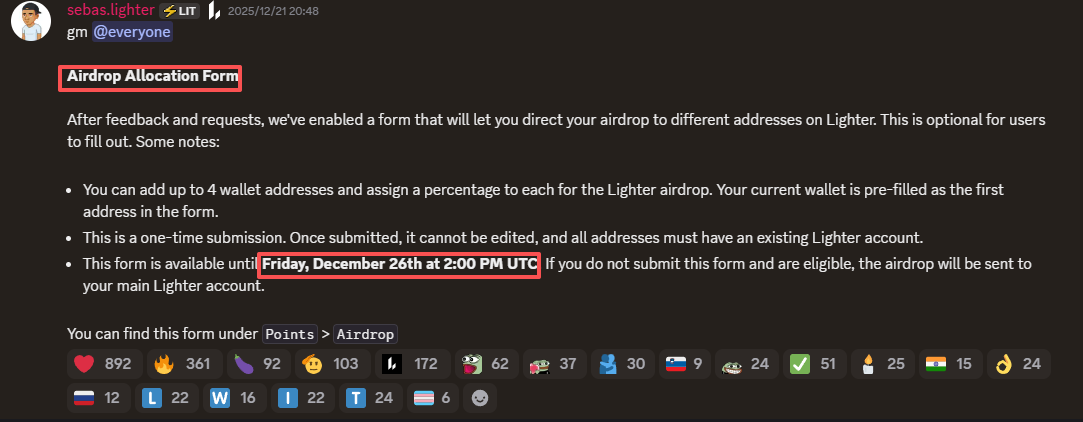
On December 13, Coinbase Markets announced on platform X that Lighter had been added to its listing roadmap; On December 21, Lighter officially announced on Discord, requiring users to complete airdrop address registration by December 26; On December 23, Binance launched Lighter (LIT) perpetual contract pre-market trading. With multiple key milestones landing in quick succession, market expectations for Lighter's imminent Token Generation Event (TGE) have rapidly heated up.
On-chain data further confirms this judgment. On December 20, the Lighter token contract transferred 250 million LIT to a new address (0x98e7769167194A8Cf272B649319676bE84052b5f); This morning, this address has already distributed varying amounts of tokens to 20 addresses, with the highest single transaction being approximately 3.1 million tokens and the lowest about 9,820 tokens. It currently still holds about 230 million LIT. Although the official use of this batch of tokens has not been disclosed, the community widely speculates it may be for airdrop-related distribution.

It is worth noting that 250 million LIT恰好 exactly accounts for 25% of the total token supply,高度 consistent with the community's previous猜测猜测 about "25% allocated for airdrops," further strengthening the market's judgment that Lighter is about to complete its TGE.

Lighter token contract transfers 250 million LIT to a new address

Regarding the timeline expectation, feedback from participants of the previous Lighter Japan AMA suggests the TGE might occur in the window from December 24 to January 1 next year; On the prediction event "When will Lighter conduct its TGE?" on Polymarket, December 29 has the highest probability, currently around 75%.
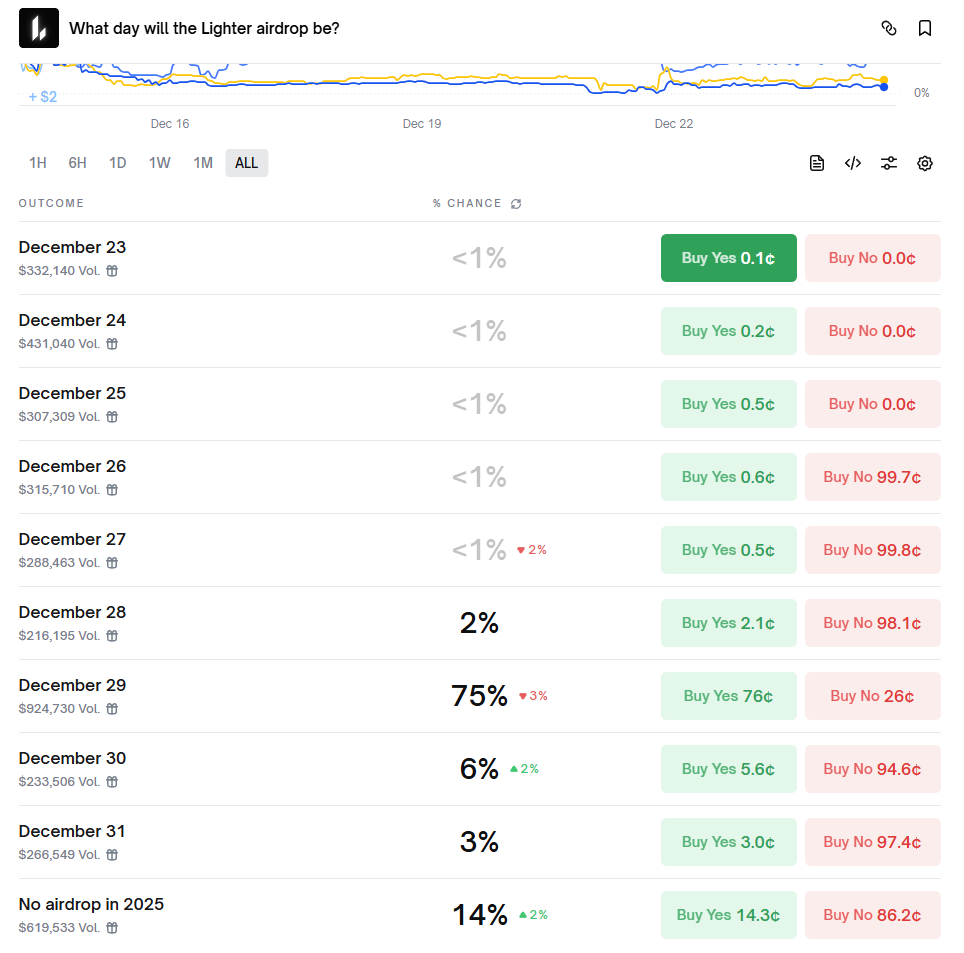
Polymarket prediction event: "On which day will Lighter conduct its TGE?"

Lighter Ranks First in Perp Dex Sector by Perpetual Contract Volume Over Past 30 Days

Lighter is a perpetual contract trading platform built on Ethereum Layer 2 (L2), aiming to combine the speed and liquidity of centralized exchanges (CEX) with the security and transparency of decentralized exchanges (DEX).

According to DeFiLlama data, over the past 30 days, Lighter led the Perp Dex sector with approximately $232.3 billion in perpetual contract trading volume, ahead of Aster ($195.5 billion) and Hyperliquid ($182 billion).

Perp Dex sector perpetual contract trading volume ranking

Furthermore, Lighter's TVL has continued to rise in recent months, currently surpassing $1.4 billion, exceeding Aster's ($1.27 billion).
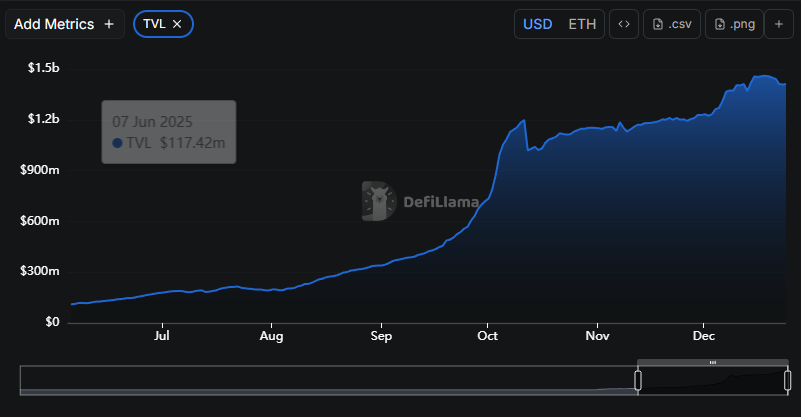
Lighter TVL Data

If Aster's backer is Binance, then Lighter's backer is Ethereum. As Lighter CEO Vladimir Novakovski previously commented on platform X, “Being an L1 is a bug, not a feature.”
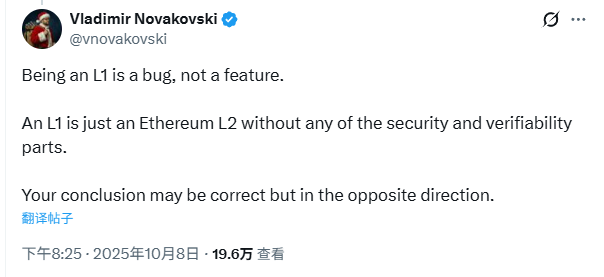
Lighter CEO comments on Lighter's choice of a modular L2 route

Instead of choosing a closed architecture like HyperLiquid's self-built L1, Lighter adopts a core route of "Ethereum-native composability": LLP Tokens can circulate on the mainnet and synergize with DeFi protocols like Aave, thus enjoying a low-cost, low-latency, verifiable execution environment within an open ecosystem. In other words, Lighter's goal is to allow any protocol to reuse its matching engine and capital system. Lighter is not meant to replace Ethereum, but to evolve with Ethereum, becoming the underlying engine for high-performance on-chain finance.

Lighter Valuation and Pre-Market Pricing

Based on Binance's perpetual contract pre-market trading, the LIT price has slowly declined from an initial $3.9 to a current quote of $3.2. At the current price, Lighter's Fully Diluted Valuation (FDV) is approximately $3.2 billion.

If 25% of the total token supply is entirely used for future airdrops, and given a total of 12 million points, then each point corresponds to approximately 20.8 LIT. Estimated at the current pre-market price, each point is worth about $66.

Market Participants' Valuation Range Estimates

Crypto KOL ingalvarez.sol (@ingalvarezsol) predicted Lighter's valuation by combining factors from Polymarket, OTC point prices, and the pre-market LIT token price:

  • $1.5 billion Minimum valuation under pessimistic conditions, corresponding to a token price of ~$1.5;
  • $3–4.2 billion: Bear market benchmark range, corresponding to a token price of ~$3 to $4;
  • $7.5–12.5 billion: Optimistic scenario, corresponding to a token price of ~$7.5 to $12.5;

Another early Lighter user, Chuk (@chuk_xyz), also made predictions based on Lighter's TVL, trading volume, revenue, and other data:

  • Bear Market Range ($1.5B–$4.2B FDV): If the price operates within this range post-TGE, it can be seen as an opportunity zone. The psychological pressure on airdrop holders is lowest, and the risk-reward ratio is clearest.
  • Benchmark Range ($4.2B–$7.5B FDV): If Lighter can stabilize its TVL and maintain a top-tier operational scale, this range can be considered fair value. After the price enters this range, it is suitable to take staged profits to break even while retaining some position.
  • Bull Market Range ($7.5B–$12.5B+ FDV): This range意味着 core catalysts have been fully priced in by the market, including strengthened RWA momentum and consensus formed around the distribution narrative (fintech/broker alignment). This stage is more suitable for continuously reducing positions during the upward trend.

On the Polymarket prediction event "Lighter FDV one day after opening," the probability of exceeding $1 billion FDV is as high as 88%, and the probability of exceeding $2 billion FDV is also 83%.
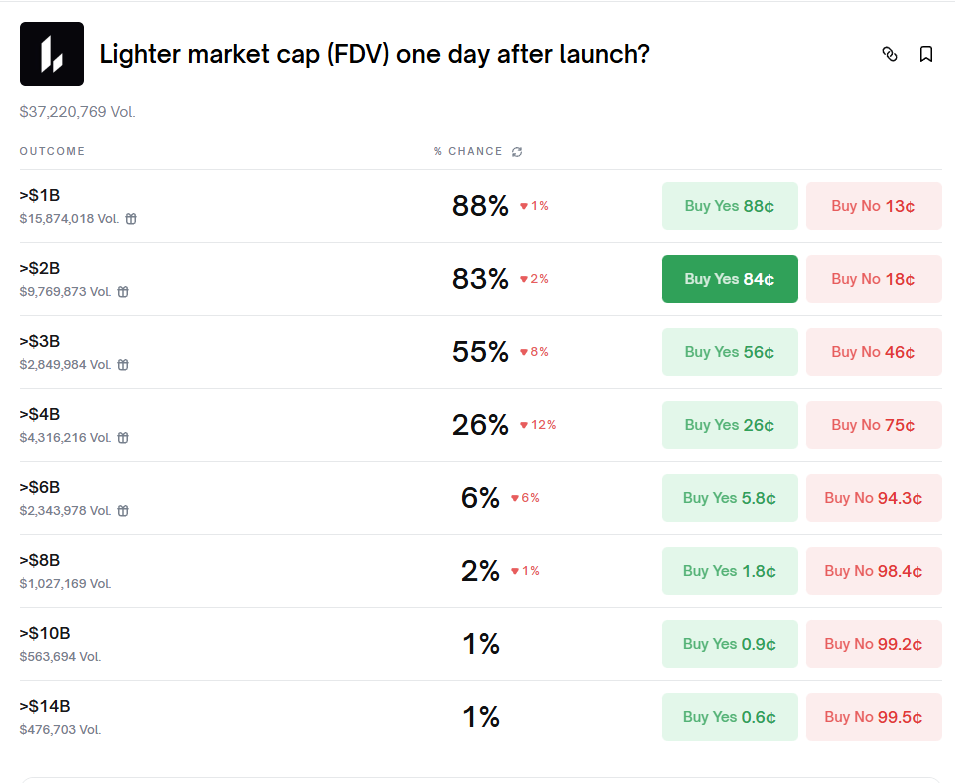
Polymarket event: "Lighter FDV one day after opening"

In summary, the market's minimum expectation for Lighter's opening valuation is an FDV of $1.5 billion, corresponding to a token price of $1.5. Therefore, if the opening price pulls back, $1.5 is an ideal short-term entry price.

Do Not "Celebrate at Halftime," Closely Monitor Official Announcements

Early participants in Lighter interactions must not "celebrate at halftime"; points cannot be considered profit until they are converted into actual LIT tokens. According to the latest announcement from Lighter on their official Discord, "We have entered the final stage of the second season points event. Data analysis is currently underway to remove points obtained by sybil addresses, self-trading, and wash trading. All slashed points (including portions already removed) will be redistributed to the community."

Latest announcement from Lighter on official Discord


Perguntas relacionadas

QWhat is the expected TGE (Token Generation Event) date for Lighter based on market predictions?

ABased on Polymarket predictions, the highest probability (around 75%) is for the TGE to occur on December 29th. Other community feedback suggests a window between December 24th and January 1st.

QWhat is the significance of the 250 million LIT tokens transferred to a new address on December 20th?

AThe transfer of 250 million LIT tokens, which is 25% of the total supply, is widely speculated by the community to be for airdrop distribution, aligning with previous rumors about the airdrop allocation.

QHow does Lighter's trading volume rank in the Perp DEX sector over the past 30 days?

AAccording to DeFiLlama data, Lighter ranked first in the Perp DEX sector for perpetual contract trading volume over the past 30 days, with approximately $232.3 billion, ahead of Aster and Hyperliquid.

QWhat is the current pre-market price of LIT on Binance and what is the corresponding Fully Diluted Valuation (FDV)?

AThe pre-market price of LIT on Binance is currently around $3.2, which corresponds to a Fully Diluted Valuation (FDV) of approximately $3.2 billion.

QWhat is the core architectural philosophy behind Lighter, as stated by its CEO?

ALighter's CEO, Vladimir Novakovski, stated that 'Being an L1 is a bug, not a feature.' Lighter is built as a modular Layer 2 on Ethereum, aiming to combine CEX-like speed and liquidity with DEX-like security and transparency, and to integrate natively with the Ethereum ecosystem.

Leituras Relacionadas

The King of Blind Date Attire in Korea: How SK Hynix Made a Comeback Against Samsung?

In South Korea's dating scene, SK Hynix employees are now highly sought after, a status shift fueled by the company's astronomical profits and employee bonuses, projected to reach up to 6.1 million RMB per person by 2027. This marks a dramatic reversal for the long-time second-place player in memory semiconductors, which has now surpassed its rival Samsung in annual operating profit. The turnaround story began in 2008 when a struggling Hynix, emerging from bankruptcy restructuring, took a risky bet by agreeing to develop High Bandwidth Memory (HBM) with AMD. At the time, HBM had no clear market beyond high-end graphics cards and was a costly, complex technology. Major players like Samsung, pursuing its own HMC technology, declined. For Hynix, with only memory as its core business, it was a gamble born of necessity. The pivotal moment came in 2012 when SK Group Chairman Chey Tae-won acquired Hynix. Defying industry downturns, he invested heavily in R&D and fabrication, sustaining the HBM project through over a decade of commercial uncertainty and internal challenges. A key break occurred around 2016-2017 when Samsung faced production issues supplying HBM2 for Google's TPU, allowing SK Hynix to gain a crucial foothold in the data center market. The AI explosion post-ChatGPT in 2022 was the catalyst, turning HBM into a critical bottleneck for AI accelerators like NVIDIA's GPUs. By 2025, SK Hynix captured 62% of the global HBM market, leaving Samsung at 17%. For the first time, its annual operating profit exceeded Samsung's. Analysts point to the "innovator's dilemma" to explain Samsung's miss: its vast, successful business portfolio made it risk-averse, preventing an all-in bet on the initially niche HBM technology. In contrast, SK Hynix, as a challenger with its back against the wall, had no choice but to commit fully. The story highlights how Korea's chaebol system allows for ultra-long-term bets beyond quarterly pressures. However, SK Hynix's lead isn't guaranteed. Samsung is aggressively catching up on HBM4, and challenges like customer concentration (heavy reliance on NVIDIA) and technical hurdles in advanced packaging remain. The narrative underscores a market truth: the greatest alpha often comes from betting on uncertain, long-term directions others dismiss, much like HBM in 2008.

marsbitHá 6m

The King of Blind Date Attire in Korea: How SK Hynix Made a Comeback Against Samsung?

marsbitHá 6m

Understanding Hash in One Article: The "Browser Miner" on Ethereum

Hash is an Ethereum-based ERC-20 token described as a "browser-minable post-quantum token." Its key features include enabling browser-based GPU mining without specialized hardware, a fixed supply cap of 21 million tokens, immutable and permissionless smart contracts with no team allocation or pre-mining, and an emphasis on post-quantum security using Keccak256 hashing. The mining mechanism is a simplified on-chain proof-of-work where miners solve unique challenges tied to their wallet address. Key design elements prevent answer theft, with epochs resetting every 100 blocks (~20 minutes) and a per-block minting limit. Emission follows a Bitcoin-like halving schedule every 100,000 mints, starting at 100 tokens per mint. Projections suggest all tokens could be mined within approximately 294 days if a target rate of one mint per minute is sustained. Hash emphasizes "post-quantum" security by leveraging hash-based primitives like Keccak256, which are considered more resistant to quantum attacks compared to elliptic-curve cryptography. While not a fully post-quantum asset, it aligns with Ethereum's broader post-quantum research narrative. The project completed its Genesis sale at $0.03 and began trading on Uniswap, with its price reaching around $0.19. The initial circulating supply is small, with 5% sold in Genesis and 5% allocated to liquidity. The majority (47.6% of total supply) is allocated to early-stage mining, leading to a front-loaded emission schedule. This structure, combined with low initial liquidity, makes Hash a high-volatility, high-risk project dependent on sustained miner participation and market demand to absorb new supply.

marsbitHá 19m

Understanding Hash in One Article: The "Browser Miner" on Ethereum

marsbitHá 19m

OpenAI's Largest Internal Wealth Creation: 600 People Cash Out a Total of $6.6 Billion, 75 Take Home the Maximum $30 Million Each

A Wall Street Journal report reveals OpenAI's unprecedented pre-IPO wealth creation. In a single employee stock sale last October, over 600 current and former employees sold shares, collectively cashing out approximately $6.6 billion. Due to high investor demand, the company tripled the individual sale cap to $30 million, with about 75 employees selling the maximum amount. This event represents the largest such transaction in tech industry history for a private company. OpenAI's valuation was $500 billion for this tender offer. Employees with over two years of tenure were eligible, allowing many post-ChatGPT hires their first liquidity event. The company's stock has reportedly grown over 100-fold in seven years. Following a restructuring, employees collectively hold about 26% of OpenAI. The scale of executive wealth is also staggering. In court testimony related to Elon Musk's lawsuit, President and co-founder Greg Brockman confirmed his OpenAI stake is worth around $30 billion. Analysis indicates about 165 current and former employees hold a combined ~$164.9 billion in equity, averaging nearly $1 billion per person in paper wealth. OpenAI's per-employee stock-based compensation is estimated to be 34 times the average of major tech firms before their IPOs. OpenAI continues its rapid ascent, closing a $122 billion funding round at an $852 billion valuation in March. With monthly revenue hitting $2 billion, over 900 million weekly ChatGPT users, and plans for a potential trillion-dollar IPO in late 2026, this wealth-creation engine shows no signs of stopping.

链捕手Há 42m

OpenAI's Largest Internal Wealth Creation: 600 People Cash Out a Total of $6.6 Billion, 75 Take Home the Maximum $30 Million Each

链捕手Há 42m

Trading

Spot
Futuros
活动图片




