Latin America's Payments Landscape Is Not What You Think It Is

链捕手Publicado em 2026-06-21Última atualização em 2026-06-21

Resumo

This report challenges common misconceptions about Latin America's payment landscape, based on over 500 hours of firsthand research. Key findings include: 1) Crypto card transaction volume primarily comes from high-net-worth individuals receiving USDT salaries, not retail spending. 2) QR code payments (e.g., Brazil's Pix, Argentina's Mercado Pago) are the dominant payment method across most emerging markets, not cards. 3) A major untapped opportunity lies in enabling cross-border interoperability between domestic instant payment systems. 4) Payment competition is shifting from customer acquisition to owning the settlement layer (e.g., acquiring banks). 5) Latin America is not a single market; Brazil, Mexico, Argentina, and smaller "forgotten five" countries (e.g., Guatemala, Honduras) have vastly different dynamics. 6) Stablecoin-to-fiat conversion margins are collapsing toward zero, pushing companies to build value-added services on top. 7) Future payment winners will be multi-country brands, not single-corridor specialists. 8) Marketing must target specific user segments (e.g., digital nomads, unbanked immigrants) with tailored messaging, not a generic "Brazilian" audience. 9) Contrary to perception, Latin American regulators are often ahead of the US in creating frameworks for digital assets and instant payments, with clear licensing deadlines. The core takeaway is that the region's payment rules are being rewritten, moving beyond cards and stablecoin arbitrage towards int...

Author: Claudia

Compiled by: Jiahuan, ChainCatcher

The rules of payments in Latin America are being rewritten. 500 hours of on-the-ground investigation. Things most fintech companies haven't seen.

I spent almost a month in Latin America with broken Portuguese and worse Spanish. Over 500 hours on the ground, over 100 hours in the air, speaking with over 100 local users, developers, and more than 10 regulators.

The notes I brought back are different from what most payment professionals on this platform say. Some things even contradict my understanding before the trip.

In Brazil, the airline lost my luggage. In Mexico, a wheel broke off when the bag came down the conveyor belt. Friends kept saying that as an Asian woman traveling alone, this was brave.

But what I really want to say is: Latin Americans are the warmest people I've ever met. Strangers helped me with directions, translation, and fixing my broken luggage. In Peru, a taxi driver waited 20 minutes for me to figure out which hotel I had booked. In São Paulo, a bartender drew me a map on a napkin to direct me to a meeting I was late for.

For every story about Latin America being "dangerous," there should be a story about a stranger walking me to the right taxi. Even when the language didn't connect, the hearts did.

Here's what I learned, some of which I got wrong before this trip.

1. Do Crypto Cards Win on Cashback?

The real transaction volume of crypto cards doesn't come from retail users' high-frequency, small-amount spending, but from high-net-worth clients.

The typical pattern I saw repeatedly in Brazil is: A professional receives salary in USD or USDT (usually from a multinational employer or crypto company), loads it into a crypto card, and then withdraws to a local bank account via Pix when they need Brazilian Reais (BRL).

Whether it's Kast, RedotPay, or any other crypto card, the majority of volume comes from this group, not the person buying a $4 coffee with stablecoins.
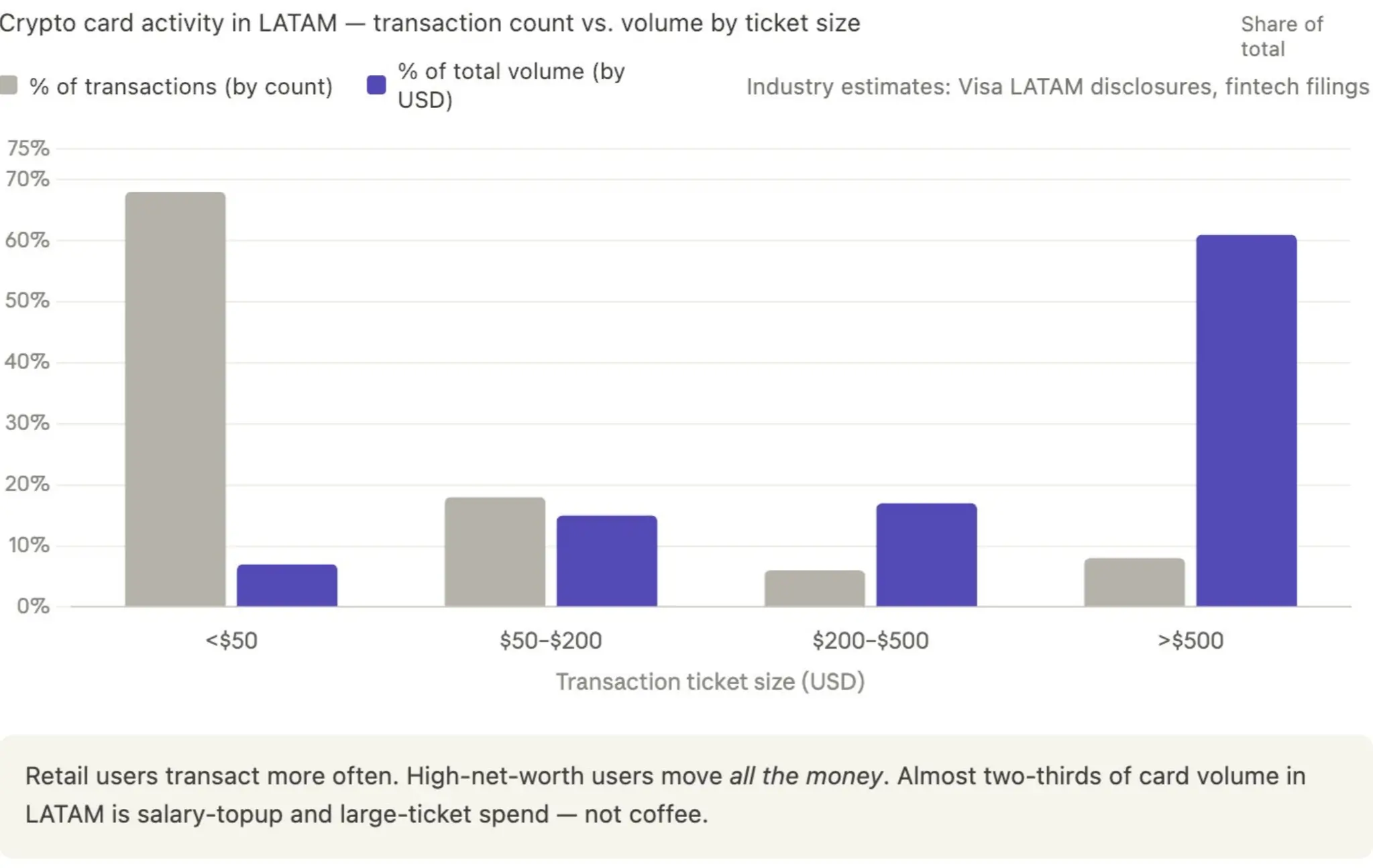
Brazil received about $5 billion in personal inbound remittances in 2024 (Central Bank of Brazil data), with the proportion arriving in stablecoin form rising rapidly, as employers pay in USDC or USDT to avoid FX friction. Latin American crypto card transaction volume is highly concentrated in amounts over $500, which is typical for professional salary top-ups, not retail spending.

2. QR Codes Are Eating the Next Decade

Everyone is competing on issuing cards, on user acquisition. They're missing the structural shift happening underneath.

In emerging markets, QR code payments are quietly taking over the entire payment market. Brazil's Pix now processes over 6 billion transactions monthly. Argentina is covered with Mercado Pago QR codes. Peru has Yape and Plin. Mexico has CoDi. Merchants don't need POS terminals, customers don't need cards.

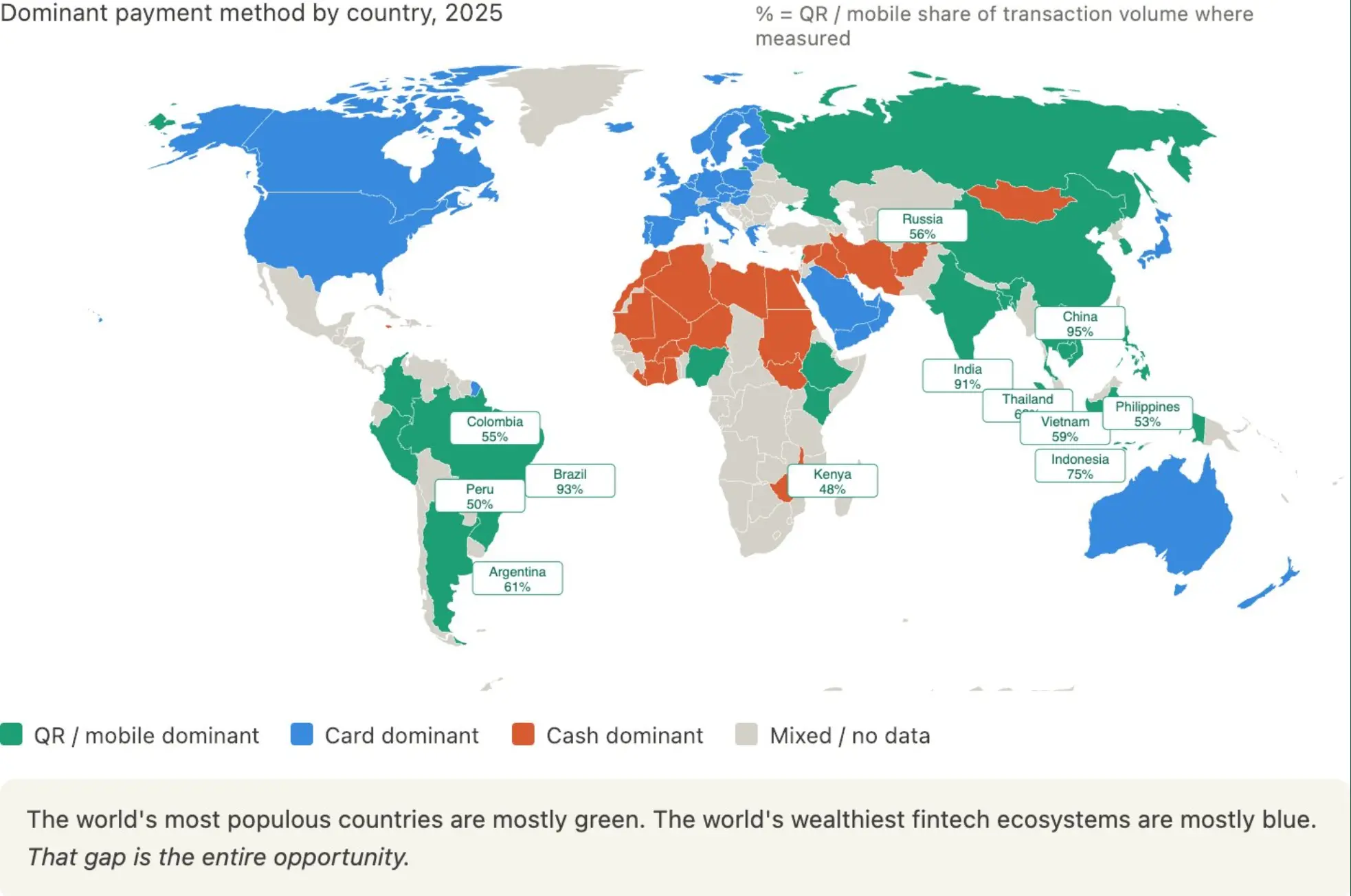
This isn't just a Latin American story. Look at the map of global payment dominance:

→ Brazil: 93% QR code. Pix dominates.
→ China: 95% QR code. Alipay and WeChat Pay have essentially flattened cards.
→ India: 91% QR code. UPI processes more transactions than all US card networks combined.
→ Indonesia: 75%. Thailand: 62%. Argentina: 61%. Vietnam: 59%. Colombia: 55%. Philippines: 53%. Peru: 50%.

Meanwhile, the US, Canada, Western Europe, and Australia remain card-dominated. Most of Africa and the Middle East remain cash-dominated.

One thing most Western fintech practitioners overlook: QR code payments are already the dominant payment method for the majority of the world's population. Card-dominated markets are becoming a shrinking minority, and these are precisely where venture capital, payment company HQs, and most fintech Twitter users are located.

The world's most populous countries are mostly green (QR code), the world's richest fintech ecosystems are mostly blue (cards). This gap is where all the opportunity lies.
Bringing the focus back to Brazil. Pix processed over $3 trillion in transaction volume in 2024, used by about 80% of Brazilian adults. Pix transaction volume already surpassed the sum of credit and debit cards in 2023, and the gap is widening. Mexico's CoDi grew 67% year-over-year in 2024. Argentina's Transferencias 3.0 transaction volume doubled in the same year.
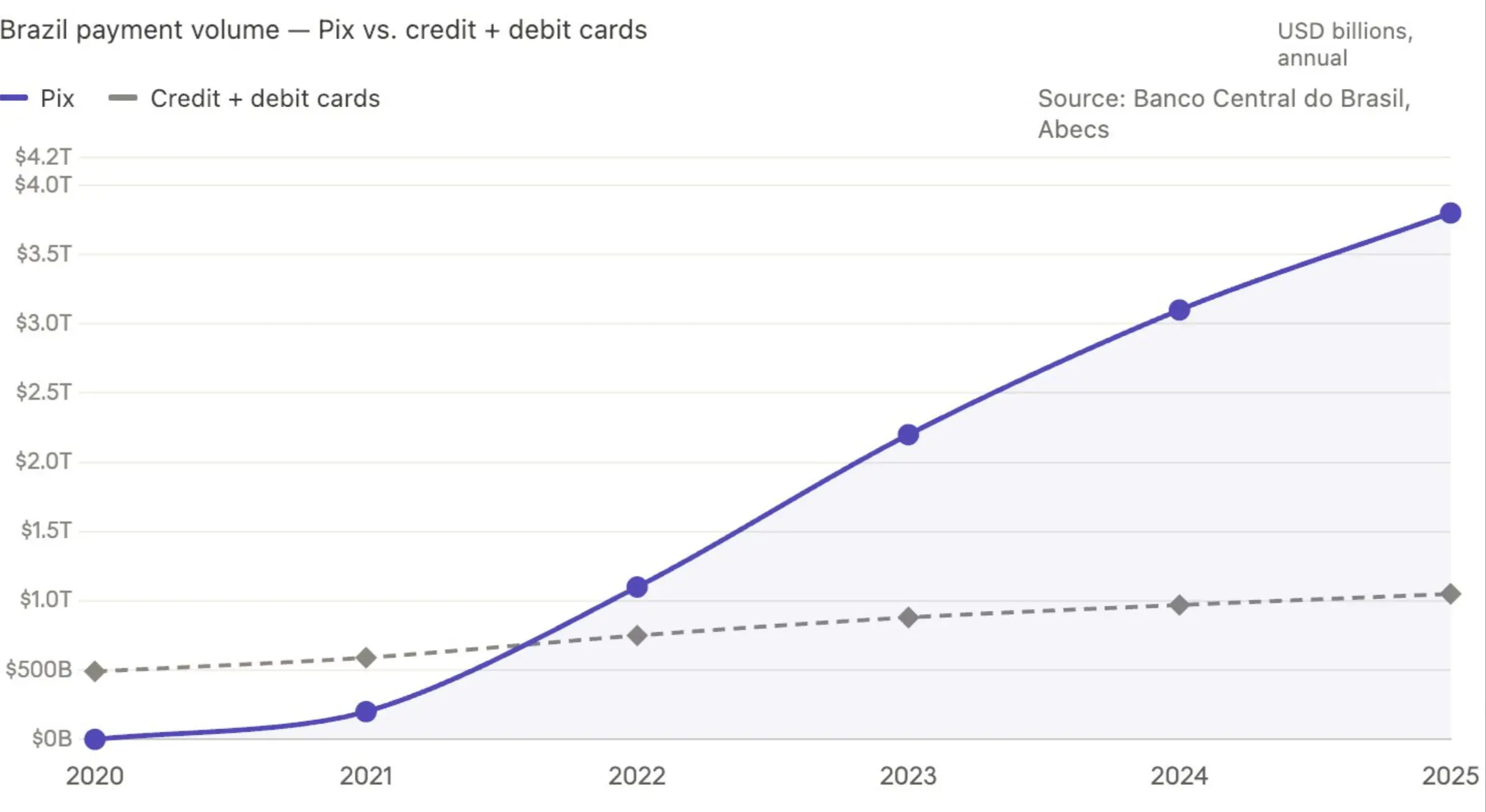
The logic of crypto cards assumes that the Visa and Mastercard card network rails will always be the main settlement layer in emerging markets. But the data says that's no longer the case. And this gap is widening faster than card networks can reinvent themselves.

If you're building a crypto card for emerging market users in 2026, your competitor isn't other crypto cards, but those payment rails that don't require a card at all.

3. The Biggest Unbuilt Opportunity in Payments

Visa and Mastercard unified the fragmentation of card networks, but didn't solve the fragmentation for merchants. Not every small merchant can afford a POS terminal. The cost of acquiring just doesn't make sense for a fruit stand.

QR codes and scan-to-pay solved the "last mile" within each country. Brazil's Pix, Mexico's SPEI, Peru's Yape, each dominates domestically.

But internationally, it's still fragmented. As a foreigner, you effectively have only two choices:

Choice A: Use a Visa or Mastercard to withdraw cash from an ATM. Cost: FX markup, fees, and you can only pay with cash.

Choice B: Download a local app. Link a card, do KYC verification. Cost: 3% to 5% FX loss, takes days, and only works in that one country.

Both paths end the same: you can only pay within that country. Change countries, it all resets, start over.
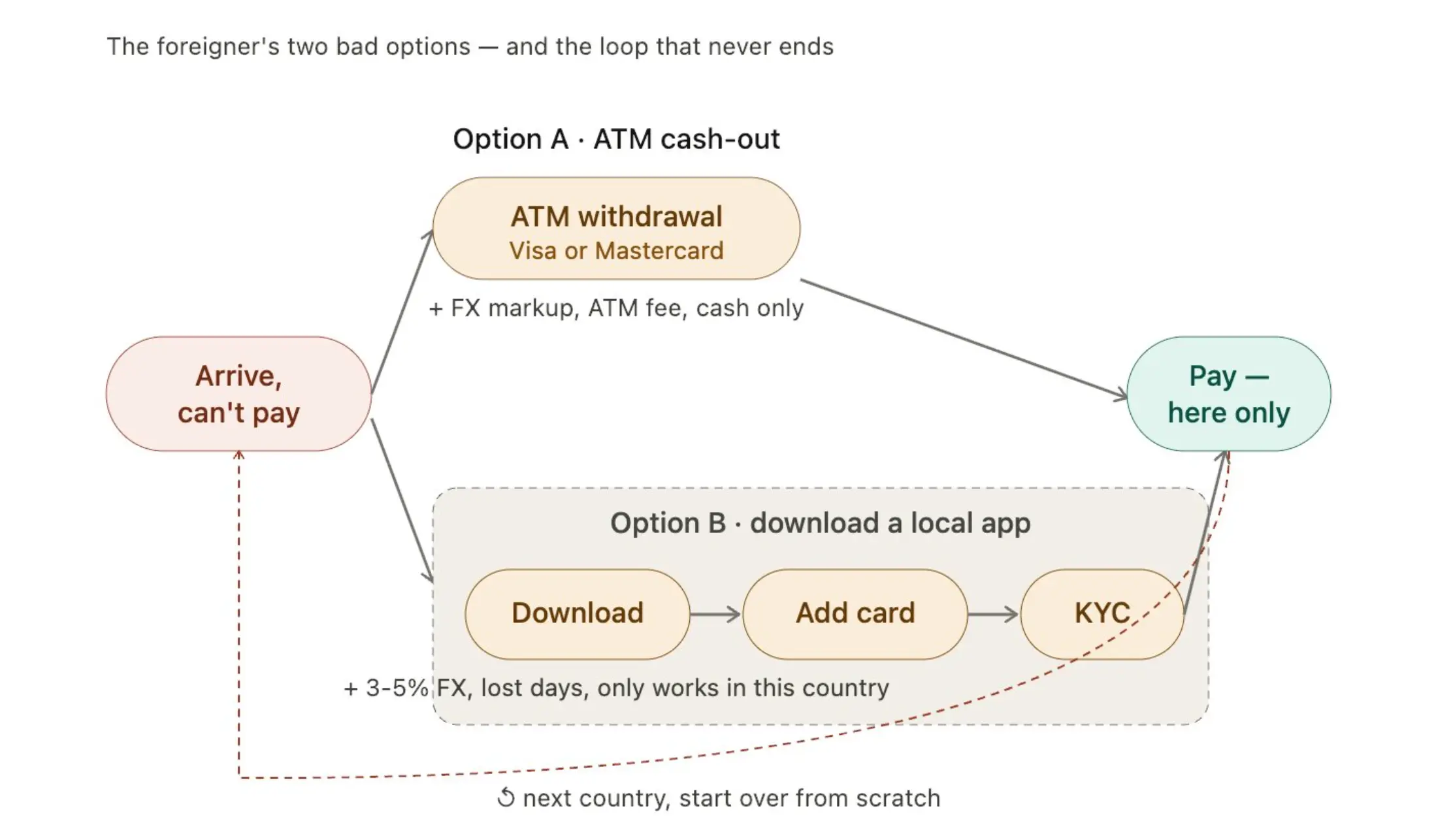
One rainy night, sitting in a bar in Brazil as a foreigner wanting to order an espresso martini, my Pix didn't work. My non-Brazilian wallet couldn't talk to the bar's POS (they only accept local payments). The layer of "international interoperability" between countries' instant payment systems doesn't exist yet.
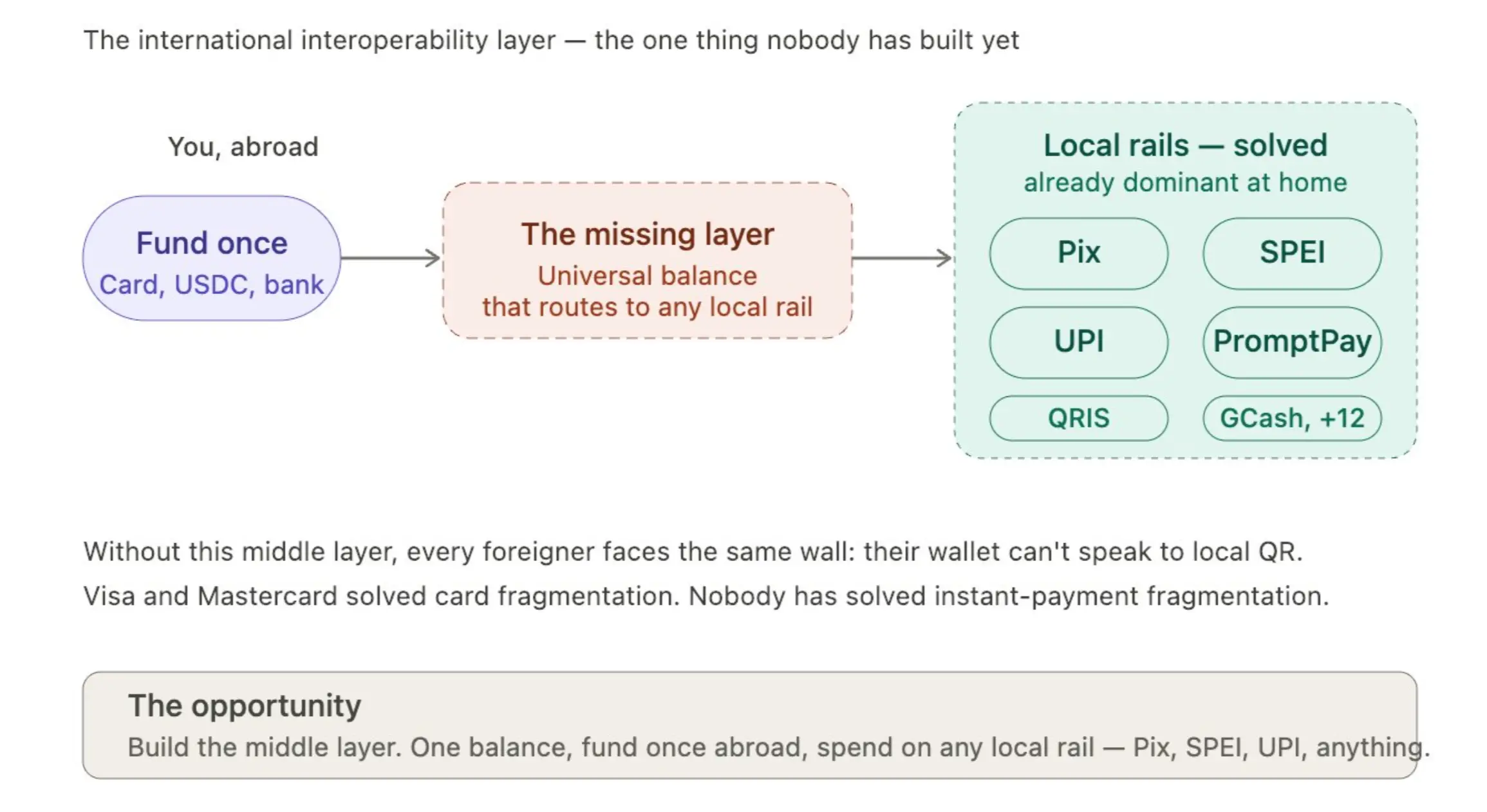
This is one of the biggest unbuilt opportunities in payments.

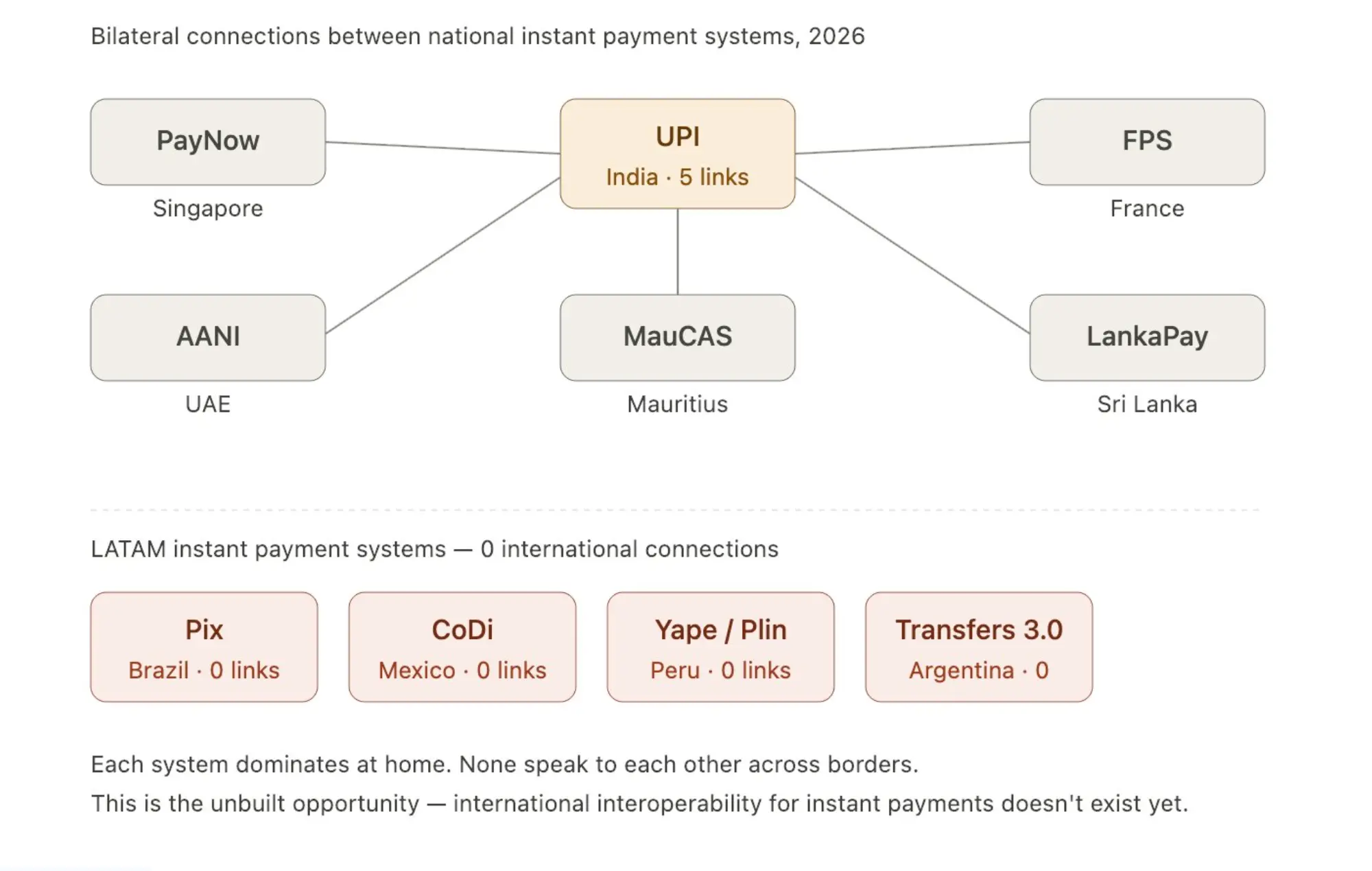
India's UPI already has bilateral connections with Singapore (PayNow), UAE (AANI), France, Sri Lanka, Mauritius. Meanwhile, Latin America's instant payment systems are almost entirely unconnected internationally. The Bank for International Settlements (BIS) Nexus project is working on this, but multilateral interoperability won't happen before 2027.
4. Payment Competition Is No Longer About Acquiring Users, It's About Owning Settlement

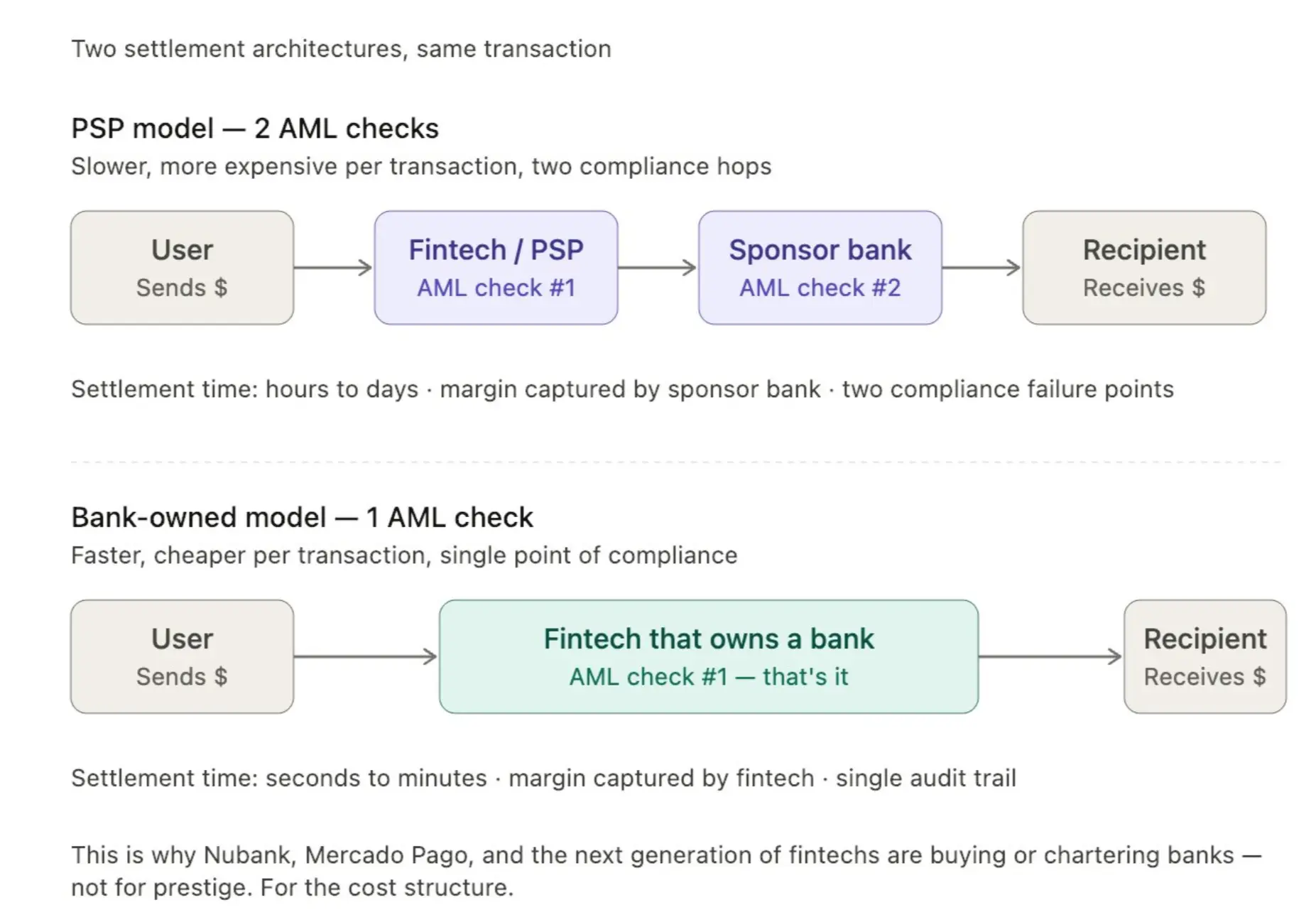
Most companies integrate a PSP (Payment Service Provider), letting the PSP shoulder the compliance and AML burden. At small scale, this model works.

But leading payment companies are now starting to buy banks directly. Why? Because owning a bank means doing AML checks only once per transaction, not twice. Settlement is faster, profits are earned not rented.

Hence you see Nubank's moves into banking, the wave of Brazilian fintechs acquiring small banks, and several stablecoin companies quietly applying for banking licenses.

Brazil now has over 1,400 licensed payment institutions, over 90 chartered banks. The model of "fintech with a banking license" is growing 3x faster than pure-PSP fintechs (Central Bank of Brazil 2024 data). In Mexico, just having an IFPE license is no longer enough; top players are seeking SOFOM or full banking licenses for cost reasons.
5. "Latin America" Is Not One Market

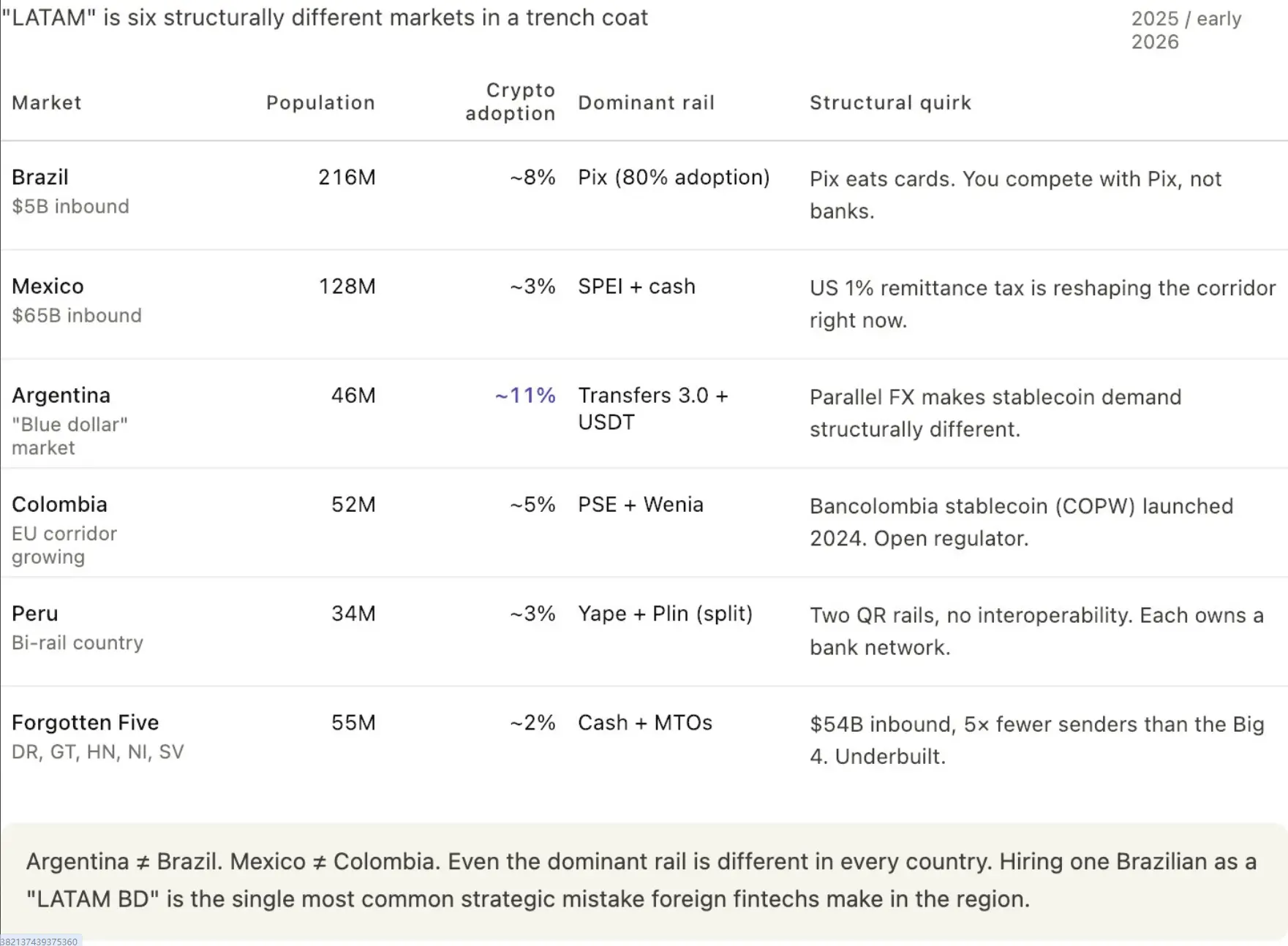
Most companies hire a Brazilian as a "Latin America BD" or community manager. This is a mistake.

Argentina is a big market, the transaction volume there is real. And because of history, culture, and football rivalry, Argentinians and Brazilians don't really get along, sometimes calling each other "monkeys" (both ways). Each country has its own currency logic, its own informal economy patterns, its own diaspora groups, its own history of capital controls.

If you can't tell the difference between Argentina's capital controls, Brazil's parallel exchange rate, and the Mexican peso's free float, you can't do Latin American payments.

Worth noting data: Argentina's population is only 46 million, yet it has over 5 million crypto users (~11% penetration, among the highest globally). Argentina's parallel FX market ("Blue Dollar") creates a structurally different demand for stablecoins than Brazil.

Mexico's remittance flow ($65 billion annually) is the world's second largest, but is being squeezed by both a US 1% remittance tax (passed Summer 2025) and tighter dollar supply from the Mexican central bank.
6. Neobanks Are Pivoting to Become FX

That stablecoin conference held in Mexico City this year was essentially a remittance and FX conference. Money from different countries was flowing cross-border, and that flow is being commoditized, becoming a price war.

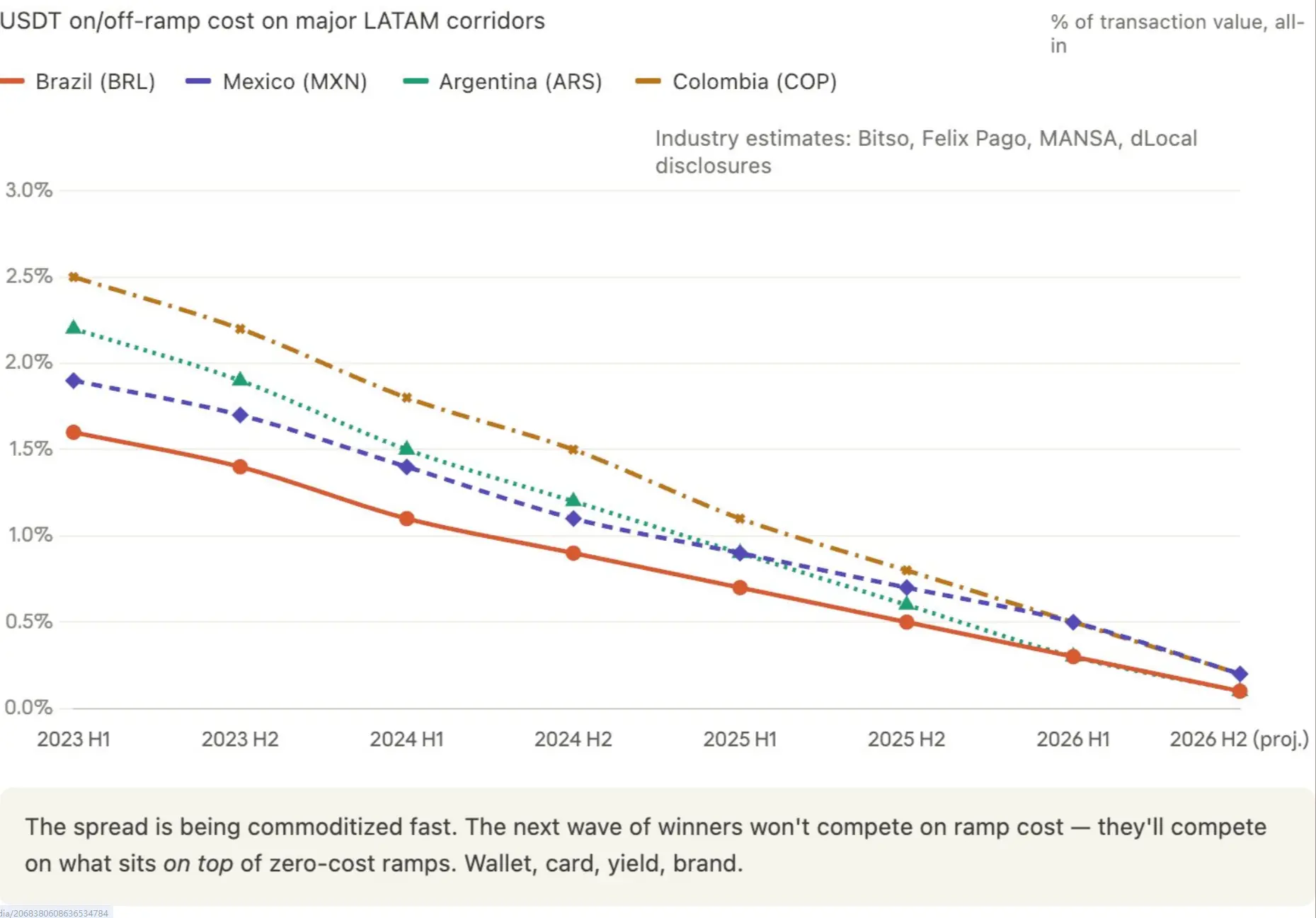
Margins are approaching zero. My prediction: Within the next 6 to 12 months, the cost of converting between USD and USDT will drop to zero on major LatAm corridors. Companies trying to make money on spreads will find themselves squeezed by infrastructure players who treat conversion as a loss leader for bigger products.

From July 2023 to June 2024, stablecoin transaction volume in Latin America was approximately $415 billion (Chainalysis data). Currently, about 71% of LatAm institutions use stablecoins for cross-border payments (Fireblocks 2025 data).

Cross-border stablecoin transfer costs dropped from 1.5% to 2% in 2023 to 0.3% to 0.8% in 2025. Cost compression is accelerating, with Bitso, Felix Pago, and a dozen smaller players racing to drive spreads to zero.
7. Cross-Border Expansion Is the New Frontier

Classic payments advice is: Pick a remittance corridor, go deep. Build relationships, get licenses, lock in merchants, become the default.

This advice is breaking down. VCs are telling me payments have become hard to invest in because of over-localization. Every company goes deep in one country, takes local profits, but then can't get out. They become kings of one corridor but can't be invested in as a cross-regional brand.

The next generation of payment companies needs international brand recognition from day one, with tech stacks that can scale cross-border. This is a generational shift in what fintech considers "good."

Stripe's over $90 billion valuation comes from cross-corridor expansion, not single-corridor depth.

Nubank's expansion to Mexico, Colombia, and now eyeing Argentina is precisely this multi-country play that unlocked its valuation, not just its depth in Brazil.

DollarAPP recently started entering Brazil too. Most down-round financings among LatAm fintechs between 2024 and 2025 happened to companies focused on a single country.

8. Brazil and Mexico Are Red Oceans

I spoke with Piero del Risco about the "Forgotten Five."

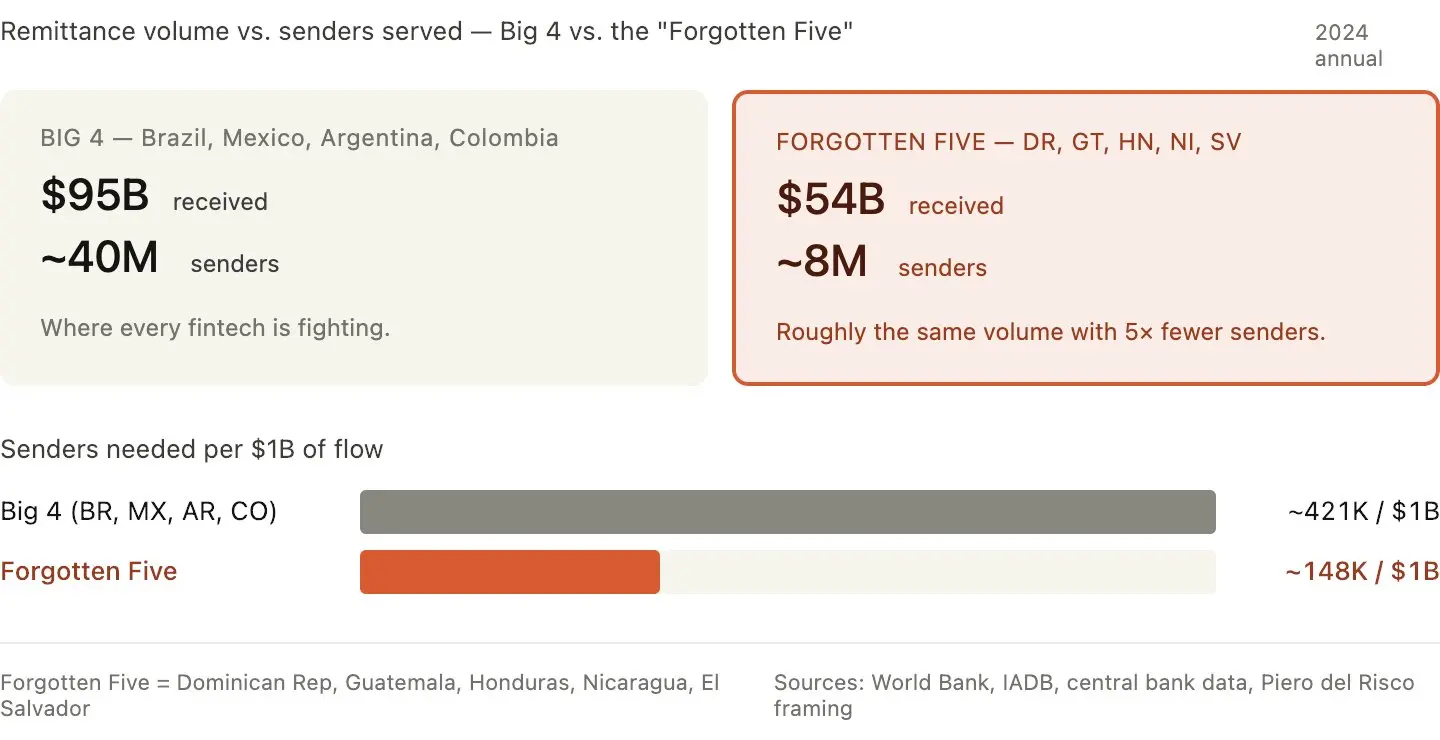
"Think about it: Dominican Republic, Guatemala, Honduras, Nicaragua, and El Salvador collectively receive about $60 billion in remittances. That's roughly equal to the total of Brazil, Mexico, Argentina, and other major markets combined. But serving these 'Forgotten Five' are only 8 million remittance senders, while serving the big markets are 40 million. We moved upstream, becoming program managers in the US, thus gaining a regulatory moat, providing banking services to senders at the top of the funnel, and owning the payment rails in each country downstream."

It's not just these five; there are a few small countries with a small but concentrated group of senders in the US receiving money equal to the entire "big" market. Everyone is fighting for Brazil and Mexico; almost no one is seriously building infrastructure for Guatemala or Honduras. With the same transaction volume, competition density here is 5x lower.

A few other overlooked corridors I'm watching:

Colombia → Europe (Spain, Italy, Netherlands)
Argentina → Bolivia (small but extremely concentrated)
Venezuela → Colombia (largest non-US LatAm corridor)

Guatemala received $20.3 billion in remittances in 2024 (15% of GDP). Other countries: Honduras $9.7b, El Salvador $8.6b, Nicaragua $4.8b, Dominican Republic $10.2b. Total $53.6 billion, about 33% of all LatAm remittances. Their combined population is less than a quarter of Brazil and Mexico's, with almost no fintech competition.

Cost per remittance for the "Forgotten Five" is also higher (6.5% to 8%, vs LatAm average of 6%), meaning more margin to capture.
9. Marketing Budgets Should Be Spent on the Right Places

Take Brazil as an example.

Every fintech pitching "Brazil" treats it as one user group. It's not. This country has at least five different money-flow segments, each requiring a different product, messaging, and payment rail. If you can't draw your user's money flow on a napkin, you're spending your marketing budget on the wrong people.

Here are the five segments I mapped on the ground:
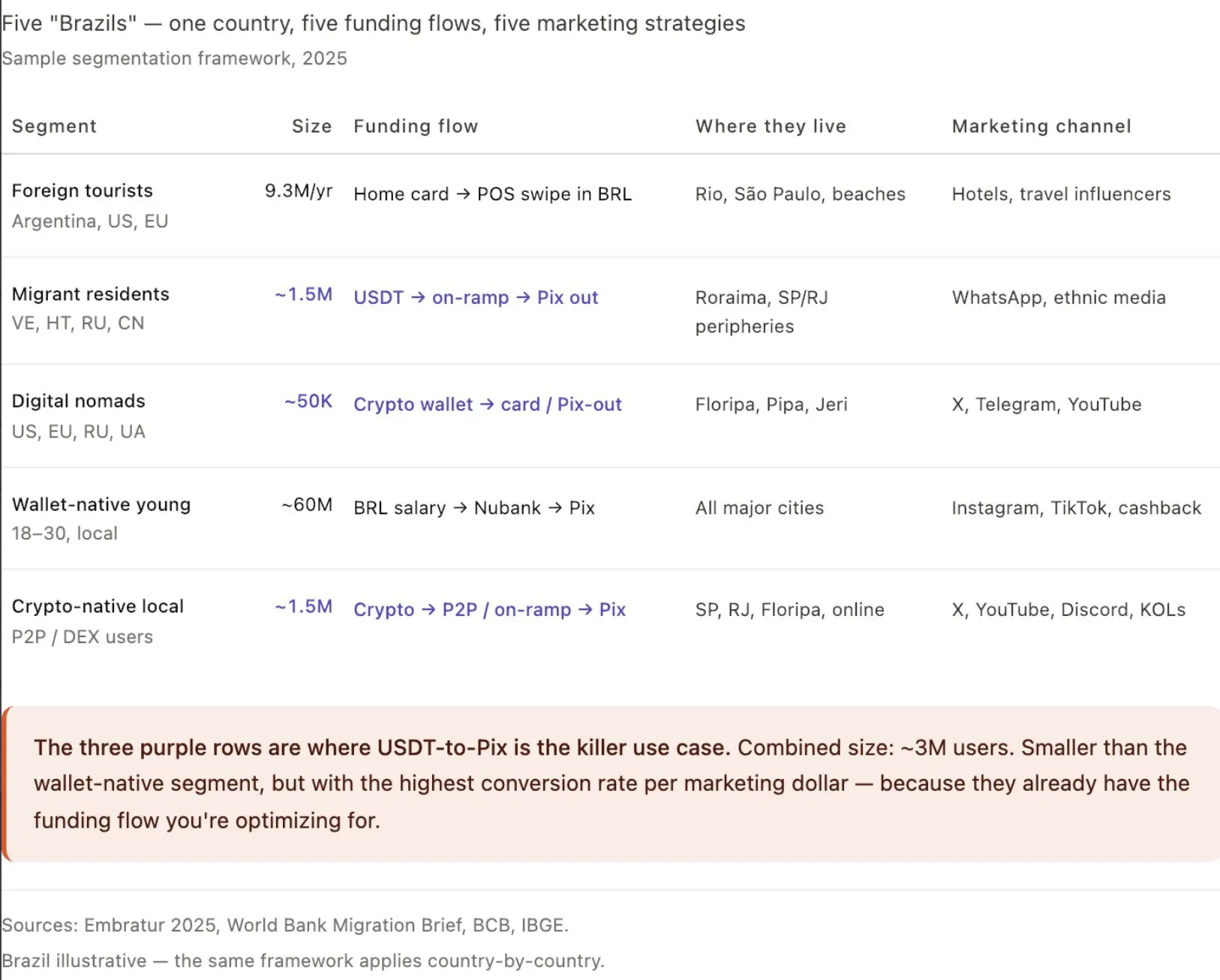
Segment 1: Foreign tourists. 9.3 million people in 2025, total spend $7.9 billion (~$847 per capita).

Main sources: Argentina 3.4 million (price-sensitive, love beaches), Chile 800k (high-value), US 760k (high-spending), followed by Paraguay, Uruguay, France, Portugal, Germany.

Their money flow: home country debit/credit card → swipe on Brazilian POS. They never directly touch BRL.

Effective marketing entry: airport transfers, FX savings vs home bank, one-click payments with no fees for attractions.

Segment 2: Long-term foreign residents without Brazilian bank accounts. Venezuelans (79% of immigrant population in Brazil), Haitians, Bolivians, Russians, Chinese, Syrians, totaling ~1.5 million immigrants. 62% already use digital wallets, not traditional accounts.

Their money flow: international USDT or USD income → conversion → Pix out for BRL spending. This is the highest-value segment for native stablecoin products; USDT to Pix is their killer use case. Zero education cost, direct conversion.

Segment 3: Digital nomads. Concentrated in Florianópolis, Rio, São Paulo, Pipa, Jericoacoara. Mostly Americans, Europeans, Russians, Ukrainians. Income from abroad, often USDT or BTC. Refuse to open Brazilian bank accounts due to bureaucratic hassle.

Money flow: crypto wallet → card spend or Pix out for rent, restaurants, Uber, phone bills. They are not sensitive to FX price, but extremely sensitive to experience. They'll switch providers for one less click.

Segment 4: Brazilian young digital wallet natives. They have "accounts," but with Nubank, Mercado Pago, PicPay, RecargaPay, not Itaú or Bradesco. They don't see themselves as bank customers, but as app users.

Money flow: BRL salary → digital wallet → Pix everywhere. Crypto exposure increasing, but core flow entirely local. Marketing entry is cashback, yield, convenience, not "stablecoin rails."

Segment 5: Crypto-native Brazilians. Hold USDT or BTC, frequent P2P use. Money flow: crypto balance → P2P or conversion → Pix → spending. Brazil has over 1.5 million active crypto users. This is the easiest to convert, but also the smallest.

This is where most fintechs get it wrong: they build one product, run one marketing campaign, targeting all of "Brazil." Result: sky-high CAC because segments 1, 2, 3, 4, 5 require completely different acquisition channels, different messaging, different money rails.

Russian-language YouTube ads targeting digital nomads in Florianópolis have vastly different conversion rates than Portuguese Instagram ads targeting young Brazilians in São Paulo. WhatsApp groups for Venezuelan immigrants in Roraima perform completely differently from US travel influencer partnerships targeting tourists.

After mapping these segments, the framework I use in any Latin American country is:
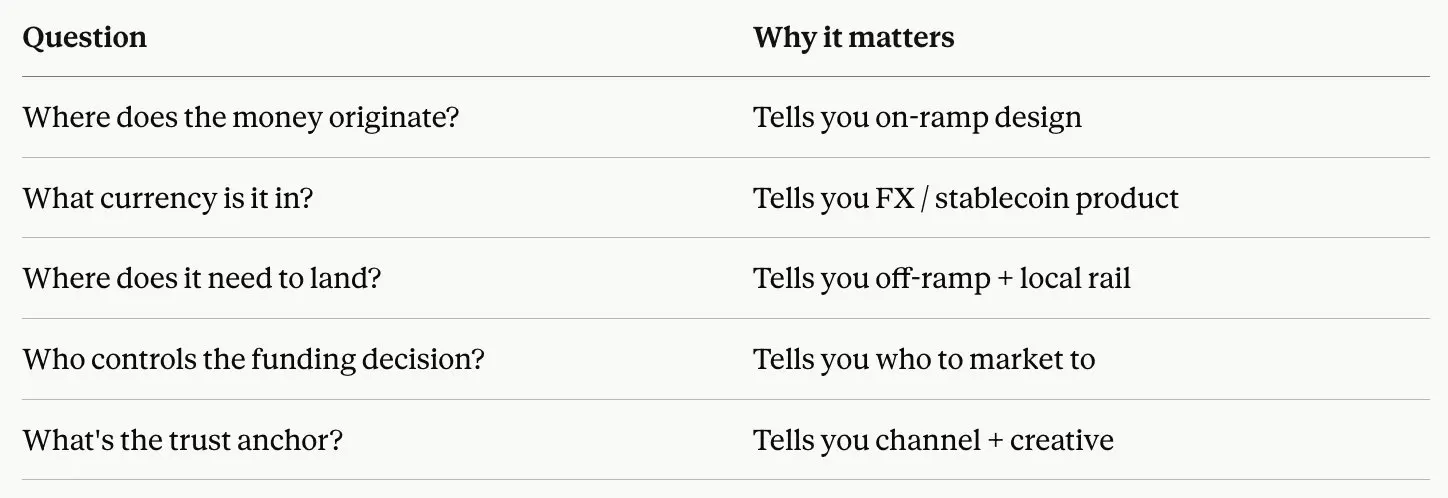
If you can't answer these five questions for each priority segment, you're not ready to spend marketing budget. What you should do is more user research.

The same logic applies to every Latin American country.

This Brazil example can be mapped one-to-one to Mexico (remittance senders from the US, Mexican professionals, US-Mexico cross-border SMEs, crypto-native youth, unbanked rural population), to Argentina (Blue Dollar holders, dollarized salary professionals, crypto-native traders, MercadoPago users, tourist arbitrageurs), and every market in the region.

Don't ask "Should I do Brazil?"

Ask "Which of these five Brazils am I doing?"

That's the only question that turns Latin American expansion into a fundable venture, not a money pit.

10. On Regulation, Latin America Is 5 Years Ahead of the US

Throughout the trip, I spoke with over 10 regulators. The biggest surprise: they aren't phased at all by stablecoins, P2P rails, crypto-fiat interoperability.

The Western narrative about LatAm regulation is "fragmented, slow, behind." But on the ground, it's the opposite. The US is playing catch-up.

Brazil. The central bank built Pix in 18 months and made it free on the payment side—something the Fed is still studying. The crypto regulatory framework is now set: Resolutions 519, 520, 521 issued in November 2025, effective Feb 2, 2026. Hard deadline for existing VASPs to apply for authorization is Oct 30, 2026.

After that, every institution regulated by the Brazilian Central Bank, including every Brazilian bank, every payment processor, every Pix service provider, is prohibited from doing virtual asset business with unlicensed counterparties. Read that sentence again.

This deadline isn't "you need a license," it's "if you don't have a license, every Brazilian bank you work with is legally required to cut ties with you." As of writing, about 4 months left.

Mexico. Mexico passed the Fintech Law in 2018, while the US still has no federal fintech law in 2026. The Mexican Central Bank's IFPE plus remittance licensing framework was built specifically for cross-border digital money flows. The US just passed a 1% federal remittance tax in Summer 2025 (the Big Beautiful Act). Mexican regulators noticed this earlier than US fintech practitioners. Several told me they're adjusting licensing strategy to capture money flows that will circumvent US cash channels.

Colombia. The Financial Superintendency approved Bancolombia's COPW peso stablecoin in 2024, a fully regulated end-to-end commercial bank stablecoin. The Fed hasn't approved a single US bank stablecoin yet.

Argentina. Despite the central bank prohibiting banks from touching crypto in 2022, the new VASP licensing sandbox (launched 2025) is more flexible than New York's BitLicense. Argentine regulators told me directly: "We can't stop dollarization, we can only make it safer." This level of candor is something most US regulators wouldn't have publicly.

Costa Rica and Paraguay. Both are running stablecoin remittance sandboxes, with clearer licensing paths than over 30 US states.

The most surprising part: LatAm regulators aren't trying to slow stablecoin adoption. Several proactively asked me "how can we make it safer for our citizens?" not "how can we stop it?"

This isn't a regulatory environment "behind" the US. It's a regulatory environment ahead of the US; they've moved past the existential debate the US is still stuck in.

If you're doing cross-border in LatAm and still waiting for "regulatory clarity," you've misread the situation. Clarity has been here.

The ambiguity is actually on the US side of the corridor.

In fact, most of these points are the opposite of what I believed before the trip.

The biggest shock for me was point 6. I went to LatAm thinking stablecoins were a structurally high-margin business. The reality seen on the ground is they're already racing to zero.

The winner won't be the one with the best conversion channel, but the one that builds the next layer on top of conversion (wallet, card, yield, brand) the best.

To every taxi driver, bartender, bank manager, and regulator who took the time to explain things to a foreigner with bad Spanish and worse Portuguese.

The wheel on my suitcase will get fixed, eventually.

But what I learned on this trip won't get worn down.

Criptomoedas em alta

Perguntas relacionadas

QAccording to the article, who are the primary users generating most of the transaction volume for crypto cards in Brazil, and what is their typical use case?

AThe primary users are high-net-worth professionals, not retail users making small daily purchases. The typical use case is a professional receiving their salary in USD or USDT (often from multinational or crypto-native employers), loading it onto a crypto card, and then using Pix to withdraw Brazilian Reais (BRL) to a local bank account when needed. The transaction volume is highly concentrated in amounts over $500, which reflects salary top-ups rather than retail spending.

QWhat major structural shift in payment methods is occurring in emerging markets like Latin America, and why does the author believe this challenges the logic of crypto cards?

AThe major structural shift is the widespread adoption and dominance of QR code-based instant payment systems (like Pix in Brazil, UPI in India, Alipay/WeChat Pay in China). These systems are replacing cards as the primary settlement layer. The author argues that this challenges the logic of crypto cards because their business model assumes Visa/Mastercard networks will remain the dominant rails in emerging markets. However, data shows QR-code systems are processing more volume than cards in many countries, and the gap is widening faster than card networks can adapt. Therefore, the real competition for crypto cards in 2026 is not other cards, but these card-less payment rails.

QWhat does the author identify as one of the biggest unbuilt opportunities in the payments space, based on their experience in Brazil?

AThe author identifies the lack of international interoperability between domestic instant payment systems (like Brazil's Pix, Mexico's CoDi, Peru's Yape) as a major unbuilt opportunity. Currently, a foreigner has no seamless way to pay via these local QR-code systems. The opportunity lies in building a layer that connects these fragmented national systems, allowing cross-border payments to flow as easily as domestic ones, bypassing the high fees and friction of traditional card networks or localized app setups.

QWhy are leading payment companies in Latin America starting to acquire banks directly, according to the article?

ALeading payment companies are acquiring banks to move 'up the stack' from being Payment Service Providers (PSPs) to becoming direct settlement entities. Owning a bank means they only need to perform Anti-Money Laundering (AML) checks once per transaction instead of twice (once for themselves and once for their partner bank). This leads to faster settlement and allows them to retain more profit, as they are earning it directly rather than 'renting' infrastructure. This trend is reflected in the faster growth of 'fintechs with banking licenses' compared to pure PSPs.

QHow does the author's view of Latin American regulatory attitudes towards cryptocurrencies and stablecoins differ from common Western narratives?

AThe author argues that contrary to the Western narrative of Latin American regulators being 'fragmented, slow, and behind,' they are actually ahead of the United States by about five years. Regulators in Brazil, Mexico, Colombia, and Argentina have been more proactive and pragmatic. They have implemented specific frameworks for crypto assets (VASP licenses), launched instant payment systems (Pix), and in some cases, approved bank-issued stablecoins. The author notes that these regulators are not trying to slow crypto adoption but are asking, 'How do we make it safer for our citizens?' This represents a more advanced and settled regulatory stance compared to the ongoing debates and lack of federal clarity in the U.S.

Leituras Relacionadas

The Hunter Becomes the Hunted: The Most Profitable MEV Bot Gets Hacked

A well-known and highly profitable Ethereum MEV Bot, Jaredfromsubway.eth, suffered a sophisticated on-chain attack this Saturday, losing over $7.5 million. Analysis by Blockaid and others reveals this was not a conventional phishing or smart contract exploit, but a targeted "counter-MEV honeypot attack." The attacker meticulously laid a trap over several weeks, deploying 66 fake token contracts and liquidity pools disguised as major assets like WETH and USDC. These pools created the illusion of arbitrage opportunities. The MEV Bot's automated system detected these signals, executed trades, and in the process, granted approval permissions to attacker-controlled contracts. These approvals were not revoked, creating a persistent vulnerability. The attacker then exploited this in a single transaction, draining the bot's ETH, USDC, and USDT holdings. Jaredfromsubway.eth is notorious as one of Ethereum's most active and profitable MEV Bots, primarily known for executing "sandwich attacks" to profit from transaction slippage. Estimates suggest it has earned tens of millions in MEV revenue. The incident highlights escalating crypto security threats, demonstrating that even top-tier automated "predators" are vulnerable to novel, logic-based attacks designed to exploit their own operational rules. Following the hack, an unverified X account impersonating Jaredfromsubway.eth emerged, falsely offering a bounty for the return of funds, prompting developer warnings for users to stay vigilant.

marsbitHá 1h

The Hunter Becomes the Hunted: The Most Profitable MEV Bot Gets Hacked

marsbitHá 1h

The Reality of Payments in Latin America Is Not What You Think

The payment landscape in Latin America is undergoing a fundamental shift, driven by on-the-ground realities that challenge common perceptions. Based on over 500 hours of field research across the region, key insights emerge. Firstly, QR code payments, like Brazil's Pix, are becoming the dominant payment method in most emerging markets, overtaking cards. However, these domestic instant payment systems lack international interoperability, creating a significant gap for cross-border users. Secondly, the narrative around crypto cards is often misunderstood; their primary volume comes from high-net-worth professionals using them for salary conversions (e.g., USDT to local currency via Pix), not retail micro-payments. Competition in payments is shifting from customer acquisition to controlling the settlement layer, leading fintechs to acquire banking licenses for efficiency. Thirdly, treating "Latin America" as a single market is a mistake. Countries like Argentina, Brazil, and Mexico have distinct economic realities, user segments, and regulatory approaches. Brazil alone has at least five distinct user segments with different financial flows. Overlooked markets like Guatemala, Honduras, and El Salvador (the "forgotten five") offer high remittance volumes with lower competitive density. Finally, regulation in Latin America is often ahead of the US, with clearer frameworks for digital assets and a pragmatic approach from regulators focused on safety rather than obstruction. The margin on stablecoin forex is rapidly compressing toward zero, meaning future winners will be those building value-added services on top of the infrastructure, not just the cheapest exchange.

marsbitHá 1h

The Reality of Payments in Latin America Is Not What You Think

marsbitHá 1h

Making Music in a Bear Market: The Survival Experiment of a Bitcoin Band

"Orange Pill Jam: A Bitcoin Band's Survival in the Bear Market" Orange Pill Jam is a musical group exploring themes of financial sovereignty and privacy, born from the Bitcoin community. Formed after singer Mermaid performed her song "Dollar Apocalypse" at a 2022 conference, the band creates music intended for both Bitcoin enthusiasts and general audiences. Their creative process involves Mermaid writing lyrics and melodies, which producer/multi-instrumentalist Michi then shapes with a precise, rhythm-focused approach, often demanding numerous retakes to achieve his unique standard of timing. Their songs, like "Cypherpunks' Manifesto" and "Fire of Freedom," tackle concepts of digital privacy, the pitfalls of "free" services, and personal sovereignty, influenced by experiences in places like El Salvador. Despite operating in a crypto bear market with a Copyleft model (offering music for free sharing/remixing and accepting optional Bitcoin donations), they face practical challenges. Their growth is slow on platforms like YouTube and Spotify, which aren't optimized for their niche content. The band also navigates the rise of AI-generated music. While acknowledging AI's efficiency for certain tasks, they believe human creativity occupies a unique space that algorithms cannot replicate—the ability to create new genres and capture intangible rhythmic feeling. For Orange Pill Jam, the core argument for both Bitcoin in a downturn and human artistry in the AI age lies in this irreplaceable, intentional, and imperfectly human creative process. Their project persists as an anti-algorithm experiment, valuing the unquantifiable impact of music over scalable metrics.

marsbitHá 1h

Making Music in a Bear Market: The Survival Experiment of a Bitcoin Band

marsbitHá 1h

Trading

Spot
Futuros

Artigos em Destaque

O que é $S$

Compreender o SPERO: Uma Visão Abrangente Introdução ao SPERO À medida que o panorama da inovação continua a evoluir, o surgimento de tecnologias web3 e projetos de criptomoeda desempenha um papel fundamental na formação do futuro digital. Um projeto que tem atraído atenção neste campo dinâmico é o SPERO, denotado como SPERO,$$s$. Este artigo tem como objetivo reunir e apresentar informações detalhadas sobre o SPERO, para ajudar entusiastas e investidores a compreender as suas bases, objetivos e inovações nos domínios web3 e cripto. O que é o SPERO,$$s$? O SPERO,$$s$ é um projeto único dentro do espaço cripto que procura aproveitar os princípios da descentralização e da tecnologia blockchain para criar um ecossistema que promove o envolvimento, a utilidade e a inclusão financeira. O projeto é concebido para facilitar interações peer-to-peer de novas maneiras, proporcionando aos utilizadores soluções e serviços financeiros inovadores. No seu núcleo, o SPERO,$$s$ visa capacitar indivíduos ao fornecer ferramentas e plataformas que melhoram a experiência do utilizador no espaço das criptomoedas. Isso inclui a possibilidade de métodos de transação mais flexíveis, a promoção de iniciativas impulsionadas pela comunidade e a criação de caminhos para oportunidades financeiras através de aplicações descentralizadas (dApps). A visão subjacente do SPERO,$$s$ gira em torno da inclusão, visando fechar lacunas dentro das finanças tradicionais enquanto aproveita os benefícios da tecnologia blockchain. Quem é o Criador do SPERO,$$s$? A identidade do criador do SPERO,$$s$ permanece algo obscura, uma vez que existem recursos publicamente disponíveis limitados que fornecem informações detalhadas sobre o(s) seu(s) fundador(es). Esta falta de transparência pode resultar do compromisso do projeto com a descentralização—uma ética que muitos projetos web3 partilham, priorizando contribuições coletivas em vez de reconhecimento individual. Ao centrar as discussões em torno da comunidade e dos seus objetivos coletivos, o SPERO,$$s$ incorpora a essência do empoderamento sem destacar indivíduos específicos. Assim, compreender a ética e a missão do SPERO é mais importante do que identificar um criador singular. Quem são os Investidores do SPERO,$$s$? O SPERO,$$s$ é apoiado por uma diversidade de investidores que vão desde capitalistas de risco a investidores-anjo dedicados a promover a inovação no setor cripto. O foco desses investidores geralmente alinha-se com a missão do SPERO—priorizando projetos que prometem avanço tecnológico social, inclusão financeira e governança descentralizada. Essas fundações de investidores estão tipicamente interessadas em projetos que não apenas oferecem produtos inovadores, mas que também contribuem positivamente para a comunidade blockchain e os seus ecossistemas. O apoio desses investidores reforça o SPERO,$$s$ como um concorrente notável no domínio em rápida evolução dos projetos cripto. Como Funciona o SPERO,$$s$? O SPERO,$$s$ emprega uma estrutura multifacetada que o distingue de projetos de criptomoeda convencionais. Aqui estão algumas das características-chave que sublinham a sua singularidade e inovação: Governança Descentralizada: O SPERO,$$s$ integra modelos de governança descentralizada, capacitando os utilizadores a participar ativamente nos processos de tomada de decisão sobre o futuro do projeto. Esta abordagem promove um sentido de propriedade e responsabilidade entre os membros da comunidade. Utilidade do Token: O SPERO,$$s$ utiliza o seu próprio token de criptomoeda, concebido para servir várias funções dentro do ecossistema. Esses tokens permitem transações, recompensas e a facilitação de serviços oferecidos na plataforma, melhorando o envolvimento e a utilidade gerais. Arquitetura em Camadas: A arquitetura técnica do SPERO,$$s$ suporta modularidade e escalabilidade, permitindo a integração contínua de funcionalidades e aplicações adicionais à medida que o projeto evolui. Esta adaptabilidade é fundamental para manter a relevância no panorama cripto em constante mudança. Envolvimento da Comunidade: O projeto enfatiza iniciativas impulsionadas pela comunidade, empregando mecanismos que incentivam a colaboração e o feedback. Ao nutrir uma comunidade forte, o SPERO,$$s$ pode melhor atender às necessidades dos utilizadores e adaptar-se às tendências do mercado. Foco na Inclusão: Ao oferecer taxas de transação baixas e interfaces amigáveis, o SPERO,$$s$ visa atrair uma base de utilizadores diversificada, incluindo indivíduos que anteriormente podem não ter participado no espaço cripto. Este compromisso com a inclusão alinha-se com a sua missão abrangente de empoderamento através da acessibilidade. Cronologia do SPERO,$$s$ Compreender a história de um projeto fornece insights cruciais sobre a sua trajetória de desenvolvimento e marcos. Abaixo está uma cronologia sugerida que mapeia eventos significativos na evolução do SPERO,$$s$: Fase de Conceituação e Ideação: As ideias iniciais que formam a base do SPERO,$$s$ foram concebidas, alinhando-se de perto com os princípios de descentralização e foco na comunidade dentro da indústria blockchain. Lançamento do Whitepaper do Projeto: Após a fase conceitual, um whitepaper abrangente detalhando a visão, os objetivos e a infraestrutura tecnológica do SPERO,$$s$ foi lançado para atrair o interesse e o feedback da comunidade. Construção da Comunidade e Primeiros Envolvimentos: Esforços ativos de divulgação foram feitos para construir uma comunidade de primeiros adotantes e investidores potenciais, facilitando discussões em torno dos objetivos do projeto e angariando apoio. Evento de Geração de Tokens: O SPERO,$$s$ realizou um evento de geração de tokens (TGE) para distribuir os seus tokens nativos a apoiantes iniciais e estabelecer liquidez inicial dentro do ecossistema. Lançamento da dApp Inicial: A primeira aplicação descentralizada (dApp) associada ao SPERO,$$s$ foi lançada, permitindo que os utilizadores interagissem com as funcionalidades principais da plataforma. Desenvolvimento Contínuo e Parcerias: Atualizações e melhorias contínuas nas ofertas do projeto, incluindo parcerias estratégicas com outros players no espaço blockchain, moldaram o SPERO,$$s$ em um jogador competitivo e em evolução no mercado cripto. Conclusão O SPERO,$$s$ é um testemunho do potencial do web3 e das criptomoedas para revolucionar os sistemas financeiros e capacitar indivíduos. Com um compromisso com a governança descentralizada, o envolvimento da comunidade e funcionalidades inovadoras, abre caminho para um panorama financeiro mais inclusivo. Como em qualquer investimento no espaço cripto em rápida evolução, potenciais investidores e utilizadores são incentivados a pesquisar minuciosamente e a envolver-se de forma ponderada com os desenvolvimentos em curso dentro do SPERO,$$s$. O projeto demonstra o espírito inovador da indústria cripto, convidando a uma exploração mais aprofundada das suas inúmeras possibilidades. Embora a jornada do SPERO,$$s$ ainda esteja a desenrolar-se, os seus princípios fundamentais podem, de facto, influenciar o futuro de como interagimos com a tecnologia, as finanças e uns com os outros em ecossistemas digitais interconectados.

72 Visualizações TotaisPublicado em {updateTime}Atualizado em 2024.12.17

O que é $S$

O que é AGENT S

Agent S: O Futuro da Interação Autónoma no Web3 Introdução No panorama em constante evolução do Web3 e das criptomoedas, as inovações estão constantemente a redefinir a forma como os indivíduos interagem com plataformas digitais. Um projeto pioneiro, o Agent S, promete revolucionar a interação humano-computador através do seu framework aberto e agente. Ao abrir caminho para interações autónomas, o Agent S visa simplificar tarefas complexas, oferecendo aplicações transformadoras em inteligência artificial (IA). Esta exploração detalhada irá aprofundar-se nas complexidades do projeto, nas suas características únicas e nas implicações para o domínio das criptomoedas. O que é o Agent S? O Agent S é um framework aberto e agente, especificamente concebido para abordar três desafios fundamentais na automação de tarefas computacionais: Aquisição de Conhecimento Específico de Domínio: O framework aprende inteligentemente a partir de várias fontes de conhecimento externas e experiências internas. Esta abordagem dupla capacita-o a construir um rico repositório de conhecimento específico de domínio, melhorando o seu desempenho na execução de tarefas. Planeamento ao Longo de Longos Horizontes de Tarefas: O Agent S emprega planeamento hierárquico aumentado por experiência, uma abordagem estratégica que facilita a decomposição e execução eficientes de tarefas intrincadas. Esta característica melhora significativamente a sua capacidade de gerir múltiplas subtarefas de forma eficiente e eficaz. Gestão de Interfaces Dinâmicas e Não Uniformes: O projeto introduz a Interface Agente-Computador (ACI), uma solução inovadora que melhora a interação entre agentes e utilizadores. Utilizando Modelos de Linguagem Multimodais de Grande Escala (MLLMs), o Agent S pode navegar e manipular diversas interfaces gráficas de utilizador de forma fluida. Através destas características pioneiras, o Agent S fornece um framework robusto que aborda as complexidades envolvidas na automação da interação humana com máquinas, preparando o terreno para uma infinidade de aplicações em IA e além. Quem é o Criador do Agent S? Embora o conceito de Agent S seja fundamentalmente inovador, informações específicas sobre o seu criador permanecem elusivas. O criador é atualmente desconhecido, o que destaca ou o estágio nascente do projeto ou a escolha estratégica de manter os membros fundadores em anonimato. Independentemente da anonimidade, o foco permanece nas capacidades e no potencial do framework. Quem são os Investidores do Agent S? Como o Agent S é relativamente novo no ecossistema criptográfico, informações detalhadas sobre os seus investidores e financiadores não estão explicitamente documentadas. A falta de informações disponíveis publicamente sobre as fundações de investimento ou organizações que apoiam o projeto levanta questões sobre a sua estrutura de financiamento e roteiro de desenvolvimento. Compreender o apoio é crucial para avaliar a sustentabilidade do projeto e o seu impacto potencial no mercado. Como Funciona o Agent S? No núcleo do Agent S reside uma tecnologia de ponta que lhe permite funcionar eficazmente em diversos ambientes. O seu modelo operacional é construído em torno de várias características-chave: Interação Humano-Computador Semelhante: O framework oferece planeamento avançado em IA, esforçando-se para tornar as interações com computadores mais intuitivas. Ao imitar o comportamento humano na execução de tarefas, promete elevar as experiências dos utilizadores. Memória Narrativa: Utilizada para aproveitar experiências de alto nível, o Agent S utiliza memória narrativa para acompanhar os históricos de tarefas, melhorando assim os seus processos de tomada de decisão. Memória Episódica: Esta característica fornece aos utilizadores orientações passo a passo, permitindo que o framework ofereça suporte contextual à medida que as tarefas se desenrolam. Suporte para OpenACI: Com a capacidade de funcionar localmente, o Agent S permite que os utilizadores mantenham o controlo sobre as suas interações e fluxos de trabalho, alinhando-se com a ética descentralizada do Web3. Fácil Integração com APIs Externas: A sua versatilidade e compatibilidade com várias plataformas de IA garantem que o Agent S possa integrar-se perfeitamente em ecossistemas tecnológicos existentes, tornando-o uma escolha apelativa para desenvolvedores e organizações. Estas funcionalidades contribuem coletivamente para a posição única do Agent S no espaço cripto, à medida que automatiza tarefas complexas e em múltiplos passos com mínima intervenção humana. À medida que o projeto evolui, as suas potenciais aplicações no Web3 podem redefinir a forma como as interações digitais se desenrolam. Cronologia do Agent S O desenvolvimento e os marcos do Agent S podem ser encapsulados numa cronologia que destaca os seus eventos significativos: 27 de Setembro de 2024: O conceito de Agent S foi lançado num artigo de pesquisa abrangente intitulado “Um Framework Agente Aberto que Usa Computadores como um Humano”, mostrando a base para o projeto. 10 de Outubro de 2024: O artigo de pesquisa foi disponibilizado publicamente no arXiv, oferecendo uma exploração aprofundada do framework e da sua avaliação de desempenho com base no benchmark OSWorld. 12 de Outubro de 2024: Uma apresentação em vídeo foi lançada, proporcionando uma visão visual das capacidades e características do Agent S, envolvendo ainda mais potenciais utilizadores e investidores. Estes marcos na cronologia não apenas ilustram o progresso do Agent S, mas também indicam o seu compromisso com a transparência e o envolvimento da comunidade. Pontos-Chave Sobre o Agent S À medida que o framework Agent S continua a evoluir, várias características-chave destacam-se, sublinhando a sua natureza inovadora e potencial: Framework Inovador: Concebido para proporcionar um uso intuitivo de computadores semelhante à interação humana, o Agent S traz uma abordagem nova à automação de tarefas. Interação Autónoma: A capacidade de interagir autonomamente com computadores através de GUI significa um avanço em direção a soluções computacionais mais inteligentes e eficientes. Automação de Tarefas Complexas: Com a sua metodologia robusta, pode automatizar tarefas complexas e em múltiplos passos, tornando os processos mais rápidos e menos propensos a erros. Melhoria Contínua: Os mecanismos de aprendizagem permitem que o Agent S melhore a partir de experiências passadas, aprimorando continuamente o seu desempenho e eficácia. Versatilidade: A sua adaptabilidade em diferentes ambientes operacionais, como OSWorld e WindowsAgentArena, garante que pode servir uma ampla gama de aplicações. À medida que o Agent S se posiciona no panorama do Web3 e das criptomoedas, o seu potencial para melhorar as capacidades de interação e automatizar processos significa um avanço significativo nas tecnologias de IA. Através do seu framework inovador, o Agent S exemplifica o futuro das interações digitais, prometendo uma experiência mais fluida e eficiente para os utilizadores em diversas indústrias. Conclusão O Agent S representa um ousado avanço na união da IA e do Web3, com a capacidade de redefinir a forma como interagimos com a tecnologia. Embora ainda esteja nas suas fases iniciais, as possibilidades para a sua aplicação são vastas e cativantes. Através do seu framework abrangente que aborda desafios críticos, o Agent S visa trazer interações autónomas para o primeiro plano da experiência digital. À medida que avançamos mais profundamente nos domínios das criptomoedas e da descentralização, projetos como o Agent S desempenharão, sem dúvida, um papel crucial na formação do futuro da tecnologia e da colaboração humano-computador.

686 Visualizações TotaisPublicado em {updateTime}Atualizado em 2025.01.14

O que é AGENT S

Como comprar S

Bem-vindo à HTX.com!Tornámos a compra de Sonic (S) simples e conveniente.Segue o nosso guia passo a passo para iniciar a tua jornada no mundo das criptos.Passo 1: cria a tua conta HTXUtiliza o teu e-mail ou número de telefone para te inscreveres numa conta gratuita na HTX.Desfruta de um processo de inscrição sem complicações e desbloqueia todas as funcionalidades.Obter a minha contaPasso 2: vai para Comprar Cripto e escolhe o teu método de pagamentoCartão de crédito/débito: usa o teu visa ou mastercard para comprar Sonic (S) instantaneamente.Saldo: usa os fundos da tua conta HTX para transacionar sem problemas.Terceiros: adicionamos métodos de pagamento populares, como Google Pay e Apple Pay, para aumentar a conveniência.P2P: transaciona diretamente com outros utilizadores na HTX.Mercado de balcão (OTC): oferecemos serviços personalizados e taxas de câmbio competitivas para os traders.Passo 3: armazena teu Sonic (S)Depois de comprar o teu Sonic (S), armazena-o na tua conta HTX.Alternativamente, podes enviá-lo para outro lugar através de transferência blockchain ou usá-lo para transacionar outras criptomoedas.Passo 4: transaciona Sonic (S)Transaciona facilmente Sonic (S) no mercado à vista da HTX.Acede simplesmente à tua conta, seleciona o teu par de trading, executa as tuas transações e monitoriza em tempo real.Oferecemos uma experiência de fácil utilização tanto para principiantes como para traders experientes.

1.3k Visualizações TotaisPublicado em {updateTime}Atualizado em 2026.06.02

Como comprar S

Discussões

Bem-vindo à Comunidade HTX. Aqui, pode manter-se informado sobre os mais recentes desenvolvimentos da plataforma e obter acesso a análises profissionais de mercado. As opiniões dos utilizadores sobre o preço de S (S) são apresentadas abaixo.

活动图片