Dark Pools Prevail, Whales Vanish: How Credible Are Public Market Signals?

marsbitPublicado em 2026-08-07Última atualização em 2026-08-07

Resumo

Institutional cryptocurrency trading is increasingly shifting towards dark pools and over-the-counter (OTC) desks, with data from sFOX showing such venues accounted for 15% of total monthly volume by June, up from negligible levels in April. In July, 77.7% of institutional capital on sFOX's platform was routed through OTC desks, while only 18.4% went to public exchanges. A key driver is institutions' need to conceal large orders to avoid revealing trading patterns, preventing front-running and minimizing price impact. Firms like Jane Street and Citadel use dark pools and order-splitting across multiple venues to execute trades discreetly. This structural shift mirrors earlier developments in equities and forex markets. As a result, public order books now reflect only a fraction of actual market activity, eroding the once-significant advantage retail traders had in tracking large wallets and exchange flows. The proliferation of prime brokers and aggregation platforms is also rapidly closing simple arbitrage opportunities. The market may evolve toward a brokerage model for retail, similar to traditional stocks. Two scenarios emerge: an optimistic one where retail gains from narrower spreads and better order routing, and a pessimistic one where transparency declines faster than benefits trickle down, leaving smaller investors in the dark. Regardless, traders must adapt by not relying solely on exchange volume, comparing total execution costs, and using limit orders in thin marke...

Original Author: Gino Matos

Original Compilation: Saoirse, Foresight News

Data from sFOX shows that cryptocurrency dark pool trading volume continues to climb, growing from negligible levels in April to account for 15% of total monthly volume by June. The firm's July 30th report also noted that 77.7% of institutional capital on its platform was matched through OTC desks, with only 18.4% flowing to public exchanges. In May alone, dark pool transaction volume reached $147 million.

In an interview with CryptoSlate, sFOX's Diana Pires described this as a structural shift, similar to the industry transformation experienced by stock and foreign exchange markets years ago.

Why Institutions Choose Crypto Dark Pools

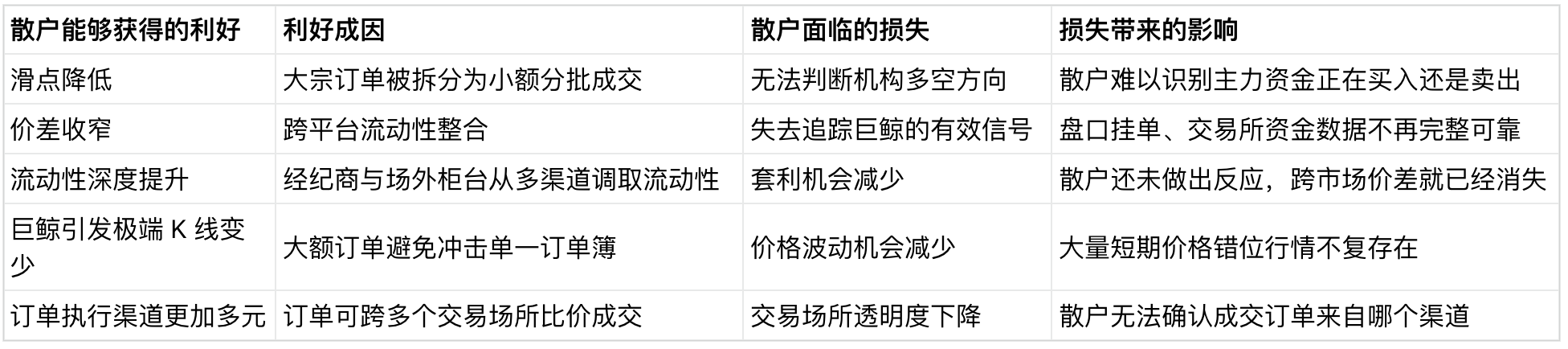
Large orders placed on public order books leave clear footprints. Other traders can identify these trading patterns, execute trades ahead of the order, or push prices in the opposite direction before the order is filled, thereby increasing trading slippage.

Pires gave an example: institutions like Jane Street and Citadel have strong incentives to hide their trading trails. Once trading patterns are identified by the market, other participants will conduct targeted reverse trades.

This is also the fundamental reason why more and more crypto orders are choosing dark pools, OTC desks, and platforms that can route single orders to over a dozen trading venues simultaneously.

sFOX alone is connected to over 40 exchanges and OTC desks, and its institutional clients typically use 14 to 19 of these channels to complete trades each month on average.

OTC desks that receive large orders typically break them down into smaller orders before distributing them to avoid single transactions from causing severe market fluctuations.

Pires summarized the core logic of crypto dark pools as follows: trading platforms privately take on large positions, then split them into small orders to be sent to exchanges; these small orders hardly disturb the order book. She believes that this type of capital inflow into the public market helps deepen the order book and further narrow the bid-ask spread.

In the past, public order books could reflect the vast majority of real market trading activity, but now they only represent a small fraction of it. Quiet exchange order books do not mean institutions are not trading. Large buyers can accumulate positions over weeks without posting any visible buy orders; large sellers can complete significant reductions in holdings without massive sell pressure appearing on the order book.
The Information Advantage of Tracking Whales Is Being Actively Diminished

Bitcoin and crypto traders once had a natural advantage over participants in other markets: everyone could continuously monitor exchange fund balances, large orders on the order book, and large on-chain holdings.

Pires pointed out that dark pools, by design, eliminate this advantage. Trading platforms, OTC desks, and brokers can see the underlying fund flows. This information is protected by regulatory rules and client agreements, preventing retail traders from knowing whether institutions are buying or selling.

Simple cross-market arbitrage opportunities are also disappearing. Information once spread slower than capital flows, allowing investors to buy low on one exchange and sell high on another for profit. Pires stated that as prime brokers and aggregation platforms simultaneously scan dozens of trading venues, completing arbitrage and closing price gaps before retail traders can capture them, such opportunities are shrinking year by year.

She predicts the crypto trading market will eventually evolve towards a structure similar to the stock market: individual investors will no longer connect directly to exchanges but will instead go through brokers, who will seek the best prices across major trading venues on their behalf.

Retail account trading volumes typically struggle to meet the minimum fee tier thresholds set by exchanges, while brokers aggregating massive institutional orders can easily meet them. Pires believes this disparity will continue to drive ordinary traders towards brokers, although this shift won't be mandated by regulation as it was in the stock market.

Two Market Outlook Scenarios

Optimistic Scenario

Order aggregation platforms and mainstream trading venues handle retail orders in the same way they handle institutional orders. Market spreads continue to narrow, slippage decreases further, and instances of large orders piercing thin order books diminish.

Trading opportunities lost from public exchanges shift to other arenas. On-chain and DeFi markets still maintain public data on large holdings, providing channels for traders wanting to speculate on price volatility; regulated, compliant trading markets will exhibit more stable trends.

Pessimistic Scenario

For traders with ordinary capital sizes, the loss of trading transparency outpaces the realization of expected trading optimization benefits. Retail and medium-sized investors completely lose the ability to discern institutional capital movements.

Spread optimization and premium order routing services remain exclusively for large clients with sufficient capital to access prime brokers and aggregation platforms. Public exchange price signals continue to weaken, with participants relying on monitoring exchange order books being the first to feel the change.

Regardless of the market's direction, traders need to adjust their habits: do not treat the trading volume of a single exchange as a reflection of the entire market; compare total trading costs across different channels before referencing exchange-listed fee rates; when order book depth is insufficient, use limit orders as much as possible to guard against market orders impacting prices.

Beneath seemingly calm order books may lurk large-scale institutional trading.

As the crypto market matures and trading experiences continuously optimize, the difficulty of interpreting the market increases. Retail traders encounter fewer sudden price shocks from whales, but they also find it harder to observe the movements of the most influential capital.


Criptomoedas em alta

Perguntas relacionadas

QWhat is the main trend highlighted in the sFOX report regarding cryptocurrency trading?

AThe sFOX report highlights a significant structural shift, showing that dark pool and OTC trading volumes are rising sharply. In April, dark pool volume was negligible, but by June it accounted for 15% of the total monthly volume. In May alone, dark pool transaction volume reached $147 million.

QWhy are institutional players increasingly using crypto dark pools according to the article?

AInstitutions use dark pools to hide their trading patterns. Large orders on public order books leave clear traces, allowing other traders to front-run them or push prices against them before execution, increasing slippage. Dark pools and OTC desks allow them to break large orders into smaller ones executed across multiple venues, minimizing market impact.

QHow does the rise of dark pools affect the information advantage previously held by crypto traders?

AIt actively dismantles that advantage. Dark pools are designed to obscure large trade flows. Information on institutional buying or selling is protected by regulations and client agreements, making it inaccessible to retail traders. Furthermore, opportunities for simple cross-exchange arbitrage are disappearing as prime brokers and aggregators execute trades faster than retail can.

QWhat are the two potential future scenarios for the crypto market outlined in the article?

AThe article outlines one optimistic and one pessimistic scenario. The optimistic scenario envisions benefits like tighter spreads and lower slippage trickling down to retail traders via aggregators. The pessimistic scenario predicts that transparency will erode faster than benefits materialize for retail, leaving them unable to gauge institutional moves, with premium services remaining exclusive to large clients.

QWhat practical adjustments does the article suggest for traders in light of the rising use of dark pools?

ATraders should adjust by: 1) Not treating a single exchange's volume as representative of the whole market. 2) Comparing comprehensive transaction costs across different channels before referencing exchange-listed fees. 3) Using limit orders over market orders when order book depth is insufficient to prevent price impact.

Leituras Relacionadas

a16z Crypto: Marc Andreessen and Chris Dixon Explain Why the 'CLARITY Act' Is Urgently Needed

The CLARITY Act proposes a critical federal regulatory framework for the U.S. crypto market. Currently, a lack of clear rules creates uncertainty, hinders innovation, and leaves consumers exposed. The Act would clearly divide regulatory jurisdiction between the SEC and CFTC, mandate disclosures and insider restrictions for projects, and bring exchanges and other intermediaries under a comprehensive oversight system akin to traditional finance. This clarity is urgently needed as crypto has evolved from a niche interest into a major industry with institutional involvement. Clear, lasting rules would protect consumers by requiring proper audits, custody of client assets, and anti-fraud measures for registered platforms, helping prevent failures like FTX. Regulatory ambiguity currently punishes compliant U.S. firms with high costs while rewarding offshore competitors who bypass rules, creating a race to the bottom. The Act addresses national security by applying existing anti-money laundering rules to crypto intermediaries and distinguishes between legitimate privacy and illicit concealment. It also resolves banking sector concerns by prohibiting interest payments on stablecoin balances while permitting transaction-based rewards. For developers, it establishes liability based on intent and direct assistance to crime, not for unforeseeable downstream misuse of open-source software. Regarding securities law, the Act introduces a risk-based framework. Assets begin under SEC oversight when a network is centralized, transitioning to CFTC commodity regulation if it becomes sufficiently decentralized, with clear definitions to avoid constant litigation. Without the Act, regulatory uncertainty driven by shifting agency interpretations will persist, discouraging long-term investment in the U.S. and pushing development offshore, reducing American oversight and economic leadership. Support for the bipartisan bill comes from lawmakers, law enforcement (like the Fraternal Order of Police), and major financial institutions. Ultimately, the CLARITY Act is essential to establish a stable, sensible regulatory environment that fosters responsible innovation, enhances consumer protection, and ensures U.S. leadership in shaping the future of financial technology.

marsbitHá 45m

a16z Crypto: Marc Andreessen and Chris Dixon Explain Why the 'CLARITY Act' Is Urgently Needed

marsbitHá 45m

Citi's Interpretation: Why Does Citi Still Give SanDisk a Target Price of $2500 After Earnings Report Despite a Significant Stock Price Drop?

Citi maintains a "Buy" rating on SanDisk with a $2500 price target despite a post-earnings stock drop. This target, implying an 85.1% upside from the August 5th close of $1350.50, hinges on the firm's view that SanDisk merits a higher valuation than traditional NAND cyclical stocks. Although SanDisk reported strong Q4 FY26 results with revenue up 51% sequentially and robust full-year data center growth (+437%), its stock fell sharply on August 6th. Investors are concerned about potential NAND price growth moderation and guidance that failed to meet elevated market expectations. Citi's bullish thesis centers on SanDisk's new long-term "New Business Model" (NBM) agreements. These contracts, covering a significant portion of its NAND bit output for FY27 and FY28, represent minimum revenue commitments of approximately $94 billion backed by financial guarantees. This structure aims to increase revenue and cash flow predictability. The report links this visibility to AI data center demand, driven by the expansion of inference workloads requiring more storage. Citi estimates data center storage capacity demand will grow about 35% in CY27. However, the analysis notes long-term contracts cannot eliminate the NAND cycle. Risks include potential oversupply from industry capacity expansion, competition, and macroeconomic headwinds. The $2500 target essentially bets that AI demand and these contracts can reduce earnings volatility enough to support a premium valuation (~11x CY27E EPS). Key factors to watch are the execution of the $94B commitments, pricing mechanisms, actual data center demand, and industry supply dynamics.

marsbitHá 55m

Citi's Interpretation: Why Does Citi Still Give SanDisk a Target Price of $2500 After Earnings Report Despite a Significant Stock Price Drop?

marsbitHá 55m

Trading

Spot

Artigos em Destaque

Como comprar DATA

Bem-vindo à HTX.com!Tornámos a compra de DATA Network (DATA) simples e conveniente.Segue o nosso guia passo a passo para iniciar a tua jornada no mundo das criptos.Passo 1: cria a tua conta HTXUtiliza o teu e-mail ou número de telefone para te inscreveres numa conta gratuita na HTX.Desfruta de um processo de inscrição sem complicações e desbloqueia todas as funcionalidades.Obter a minha contaPasso 2: vai para Comprar Cripto e escolhe o teu método de pagamentoCartão de crédito/débito: usa o teu visa ou mastercard para comprar DATA Network (DATA) instantaneamente.Saldo: usa os fundos da tua conta HTX para transacionar sem problemas.Terceiros: adicionamos métodos de pagamento populares, como Google Pay e Apple Pay, para aumentar a conveniência.P2P: transaciona diretamente com outros utilizadores na HTX.Mercado de balcão (OTC): oferecemos serviços personalizados e taxas de câmbio competitivas para os traders.Passo 3: armazena teu DATA Network (DATA)Depois de comprar o teu DATA Network (DATA), armazena-o na tua conta HTX.Alternativamente, podes enviá-lo para outro lugar através de transferência blockchain ou usá-lo para transacionar outras criptomoedas.Passo 4: transaciona DATA Network (DATA)Transaciona facilmente DATA Network (DATA) no mercado à vista da HTX.Acede simplesmente à tua conta, seleciona o teu par de trading, executa as tuas transações e monitoriza em tempo real.Oferecemos uma experiência de fácil utilização tanto para principiantes como para traders experientes.

367 Visualizações TotaisPublicado em {updateTime}Atualizado em 2026.07.01

Como comprar DATA

Discussões

Bem-vindo à Comunidade HTX. Aqui, pode manter-se informado sobre os mais recentes desenvolvimentos da plataforma e obter acesso a análises profissionais de mercado. As opiniões dos utilizadores sobre o preço de DATA (DATA) são apresentadas abaixo.

活动图片