On August 5th, Citi published a management call-back report, giving SanDisk a 'Buy' rating with a target price of $2500. Based on the closing price of $1350.50 on August 5th used in the report, this corresponds to an expected stock return of 85.1%.
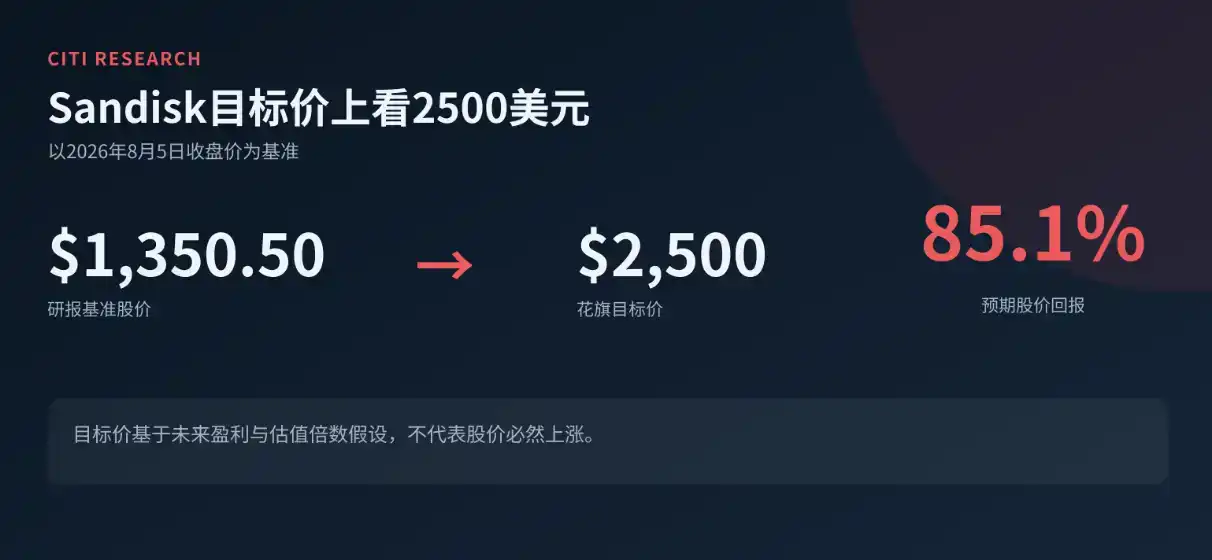
This target price does not guarantee that SanDisk's stock will necessarily rise another 85%. It is based on Citi's assumptions about future earnings and valuation multiples, and the so-called 'upside potential' changes with market prices.
In fact, following the release of strong earnings, SanDisk's stock price did not continue to rise. According to Reuters, the company's stock price fell as much as 13.3% intraday on August 6th to $1178. Market concerns primarily focus on the potential slowdown in NAND price increases and the company's guidance not meeting investors' previously formed higher expectations.
The truly noteworthy aspect of this report is not just the $2500 target price, but Citi's attempt to redefine SanDisk: Can AI data center demand and long-term contracts allow it to command a valuation higher than that of traditional NAND cyclical stocks?
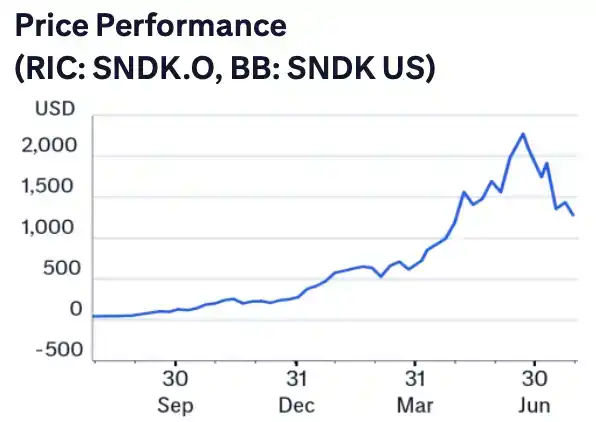
SanDisk's stock performance versus Citi's $2500 target price. Citi set the $2500 target based on SanDisk's August 5th closing price of $1350.50, corresponding to an expected 85.1% stock return. Source: Citi Research
Why Did the Stock Price Drop Sharply Despite Strong Earnings?
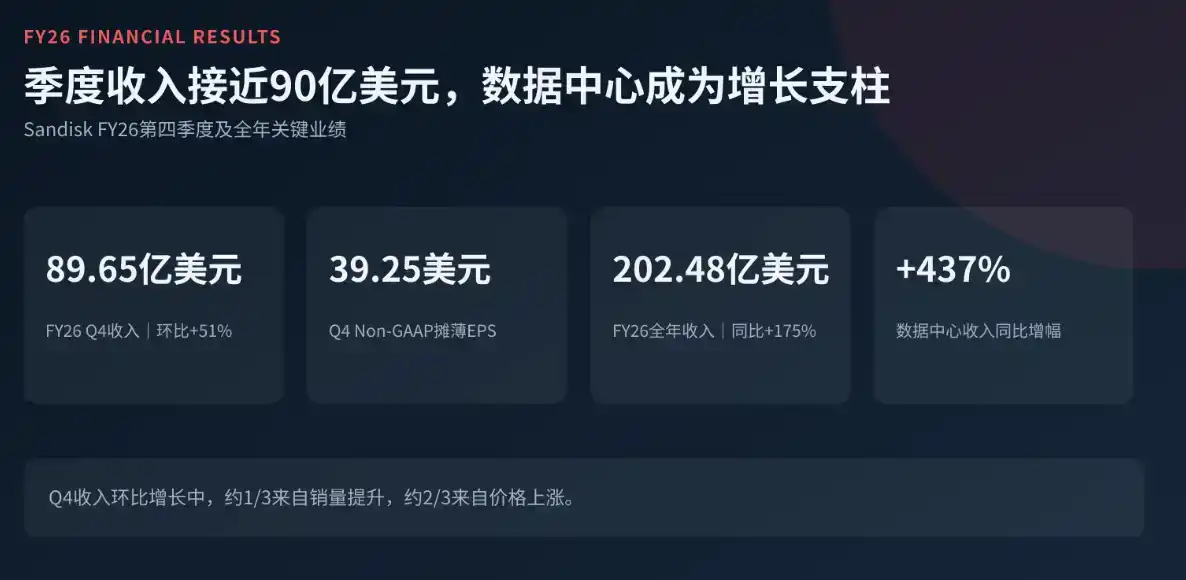
SanDisk reported FY26 Q4 revenue of $8.965 billion, a 51% sequential increase; Non-GAAP diluted EPS was $39.25.
FY26 full-year revenue was $20.248 billion, a 175% year-over-year increase; Data Center business revenue grew 437% year-over-year. The company expects FY27 Q1 revenue to be between $10.3 and $10.8 billion, with Non-GAAP diluted EPS between $44 and $46.
These figures confirm that the Data Center has become a key growth pillar for SanDisk. The company stated that approximately one-third of the sequential revenue growth in Q4 came from volume increases, and about two-thirds from price increases. This indicates that the current performance growth relies on data center demand, product mix improvement, and strong NAND prices.
However, the stock price decline after the earnings report also reflects that the market's expectations have been significantly raised. With SanDisk's stock price having risen substantially beforehand, investors are no longer just concerned about whether AI storage demand is growing, but how long NAND prices can continue to rise and whether profit forecasts can be revised upward again.
The company's guidance for FY27 Q1 revenue, while still strong, failed to meet the higher unofficial expectations of some investors. The potential slowdown in price increase rates has also led the market to reevaluate the sustainability of the current high profit margins.
Why is Citi Willing to Give a Higher Valuation Based on the $94 Billion Long-term Contracts?
Citi's core rationale for its bullish view on SanDisk is the company's so-called 'New Business Model' (NBM) long-term agreements.
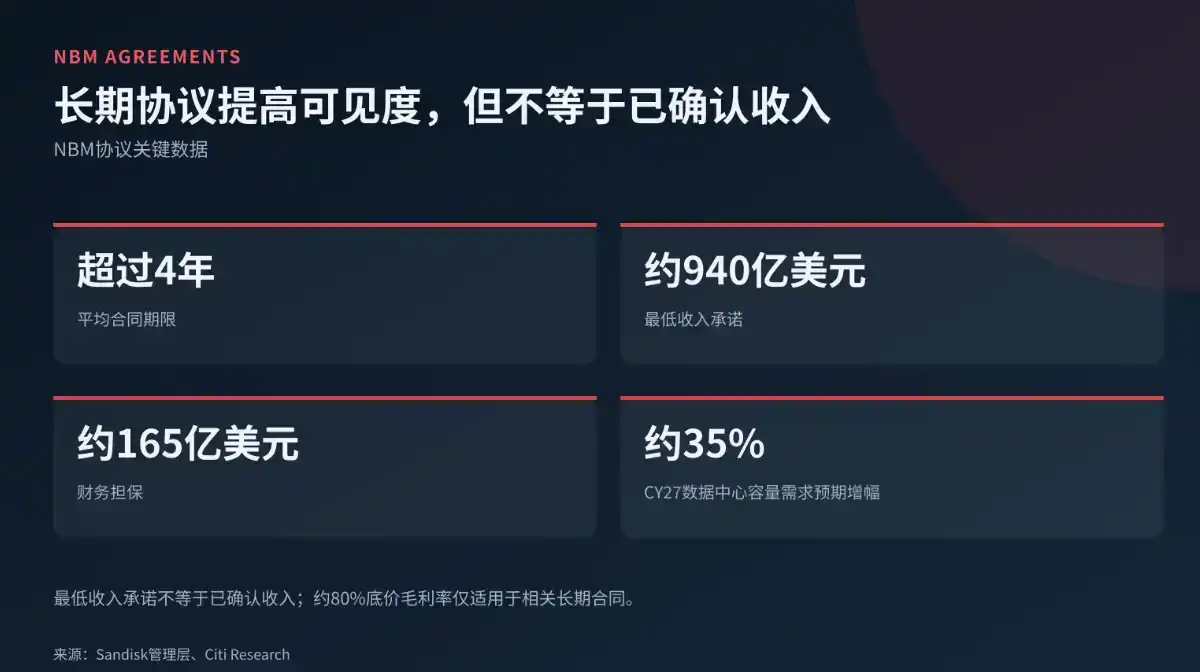
According to management's communication to Citi during the post-earnings call-back, long-term contracts already cover approximately 50% of SanDisk's FY27 bits, and about two-thirds of FY28 bits. 'Bits' here refers to NAND shipment capacity, not revenue share.
The average term of these contracts exceeds four years, corresponding to approximately $94 billion in minimum revenue commitments, with about $16.5 billion in financial guarantees attached.
The report does not disclose specific purchase volumes for different customers, price adjustment mechanisms, or guarantee trigger conditions. Therefore, the $94 billion cannot be directly understood as confirmed accounting revenue. More accurately, subject to normal contract fulfillment, the company has secured significant minimum revenue commitments.
SanDisk's official earnings announcement shows that since announcing five NBM agreements in the April earnings call, the company has signed five more agreements, including three with new customers and two expansions of existing agreements.
Long-term contracts are changing how investors view SanDisk. NAND has historically been a typical cyclical industry: prices rise and profits expand when demand is strong, but subsequent capacity releases can lead to oversupply. The company's revenue and profits are easily impacted by quarterly prices, inventory, and customer purchasing patterns.
Long-term contracts cannot eliminate this cycle but can lock in part of the shipment volume and minimum prices in advance, improving the predictability of future revenue and cash flow.
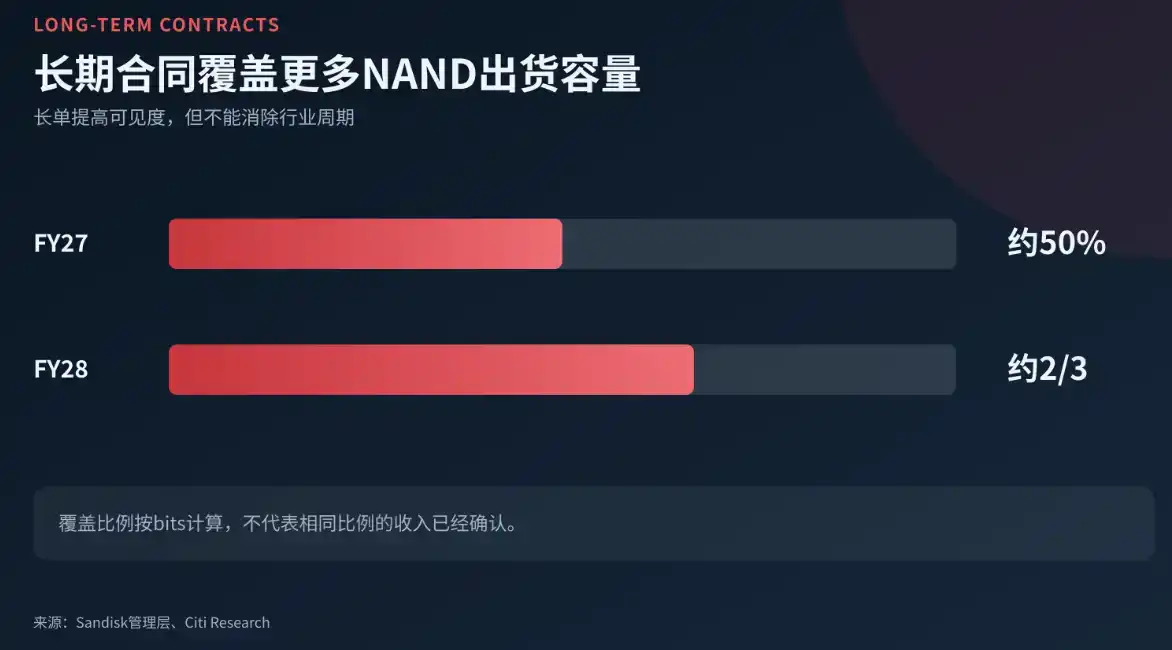
Citi believes this revenue visibility is sufficient to support SanDisk achieving a higher valuation multiple than traditional NAND companies. The report values SanDisk at approximately 11 times CY27E EPS, higher than the median of about 8x for Kioxia and the broader peer range of 6 to 8 times.
Citi's forecast table separately lists SanDisk's FY27 EPS as $222.15 and FY28 EPS as $225.88. Note that FY27 and CY27 are different time frames; the FY27 EPS of $222.15 should not be directly taken as the CY27 EPS used in the target price calculation.
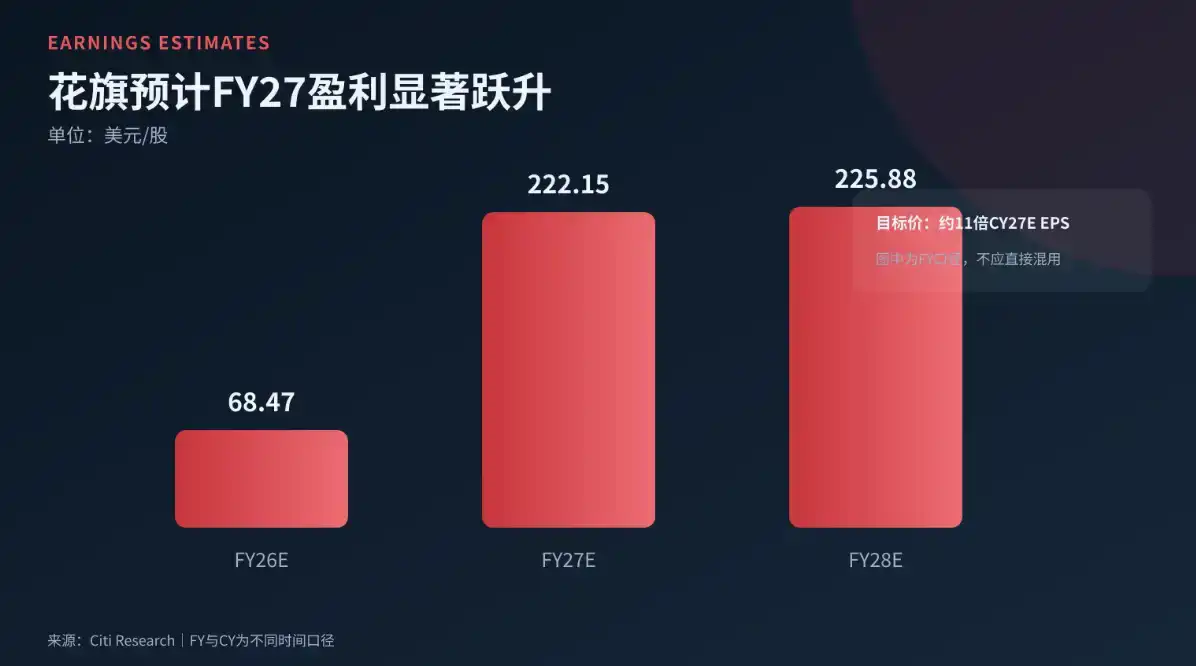
Citi's EPS forecasts for SanDisk. Citi expects SanDisk's FY27 EPS to be $222.15 and FY28 EPS to be $225.88; its $2500 target price uses a valuation of approximately 11 times CY27E EPS. CY and FY timeframes should not be directly mixed. Source: Citi Research
AI Inference Expansion: Data Centers Need More Storage
SanDisk's NAND flash solutions cover SSDs, memory cards, USB drives, portable storage devices, and automotive storage products. However, the market's current focus is on enterprise SSDs, particularly products for cloud providers and data center customers.
Management told Citi that hyperscale cloud providers are expanding their NAND procurement commitments after signing initial agreements, driven primarily by the evolution of AI inference demand and rising cloud capital expenditures.
AI infrastructure isn't just about GPUs and HBM. As inference workloads expand, data centers also need more storage devices to hold models and business data. Enterprise SSDs' advantages in access latency, power consumption, and deployment density mean NAND is also a beneficiary of AI infrastructure expansion.
The Citi report forecasts that CY27 data center storage capacity demand will grow by about 35%. This metric measures exabyte capacity demand, not sales. Actual revenue growth will also be affected by NAND prices, product mix, and customer contract terms.
Management also stated there is currently no indication that customers' difficulties in obtaining DRAM are slowing NAND deployment. If cloud providers delay deployment due to shortages of DRAM, HBM, or other server components, related NAND demand could also be postponed. However, at least during this call-back, SanDisk had not observed this happening.
Long-term Contracts Reduce Earnings Volatility but Cannot Eliminate the NAND Cycle
Beyond shipment volume, the pricing of long-term contracts is also a key factor in Citi's bullish view.
According to management's communication to Citi, the gross margin for these long-term contracts when executed at the floor price is approximately 80%; if market prices exceed the contract floor price, profit margins may receive further support.
This figure is impactful but must be confined to the scope of the long-term contracts. It cannot be interpreted as SanDisk's overall business having a permanent 80% gross margin guarantee, nor does it mean all contracts will be executed under identical price and cost structures.
SanDisk's FY26 Q4 overall gross margin was 84.6%, and the company's guidance for FY27 Q1 gross margin is 83% to 85%. Citi states this guidance reflects business mix and rising SSD component costs, not weakening NAND prices.
The company's current inventory of about 170 days is another variable to watch. Management said the higher inventory is a proactive buffer built to meet long-term contract commitments; rising costs of SSD components like DRAM have also increased inventory value.
Therefore, high inventory cannot be simplistically equated with weak demand, but it's not without risk. If NAND price increases continue to slow, the impact of inventory costs, contract pricing, and delivery timing on profits could be amplified by the market.
The supply side also hasn't disappeared. SanDisk and Kioxia jointly develop and produce NAND wafers through Flash Ventures. Company filings with the SEC show the relevant joint venture arrangement currently extends to 2034, but SanDisk also bears approximately half the fixed costs and corresponding capital investments.
This collaboration provides a long-term supply foundation but does not mean SanDisk has unlimited, cost- and industry-cycle-agnostic capacity.
Citi notes that if underutilized industry capacity is reactivated, supply and demand could turn to surplus relatively quickly; expansion by Chinese manufacturers, price competition, and a deteriorating macroeconomic environment could also impact enterprise SSD demand and profit margins.
Therefore, the $2500 target price is not really betting that the NAND cycle has disappeared, but that AI data center demand and long-term contracts can reduce the quarterly volatility of SanDisk's earnings, allowing it to achieve a valuation higher than traditional cyclical stocks.
Going forward, the market needs to observe four variables: the execution pace of the $94 billion minimum revenue commitments, the contract price adjustment mechanisms, whether data center capacity demand materializes as expected, and whether industry capacity recovers faster than demand.