Original Author: Vaidik Mandloi
Compiled and Organized by: BitpushNews
On a Saturday in August 2025, something happened that should have set every cryptocurrency chat group on the internet ablaze. Bank of America, Citadel Securities, the Depository Trust & Clearing Corporation (DTCC), and Société Générale settled a US Treasury repo transaction over a blockchain in real-time over the weekend.
For context, repo is one of the most fundamental trades in institutional finance: one party sells government bonds to another with an agreement to buy them back the next day, typically to raise short-term overnight cash.
This is the 'plumbing' of the financial system. Banks, hedge funds, and central banks use repo daily to manage liquidity, with trillions of dollars flowing through this market. And this was the first time ever such a transaction was settled atomically, nearly instantaneously on a blockchain, outside of market hours, with participants being some of the world's largest financial institutions.
Eight months later, on April 20, 2026, the Japan Securities Clearing Corporation (JSCC), Mizuho Financial Group, Nomura Holdings, and Digital Asset launched a Proof-of-Concept (PoC) aimed at moving Japanese Government Bond (JGB) collateral onto the Canton Network.
JGBs are one of Asia's most critical financial instruments, with over $9 trillion in circulation, making them the single most widely used collateral asset in the region's institutional markets. When banks and hedge funds across Asia need to collateralize their leveraged positions, JGBs are often the go-to choice. And now, that entire collateral system is moving on-chain.
This is arguably the biggest blockchain news of 2026.
This article will analyze why JGBs are the perfect asset to tokenize first, why Canton Network keeps winning institutional orders while public chains battle for retail traffic, and how exactly 'round-the-clock' collateral settlement changes global trading desks.
Why JGBs? Why Now?
For decades, Japan has tried to make the yen a global reserve currency, a wish that never truly materialized. Even today, the yen accounts for only about 4-6% of global reserves, trailing the US dollar, the euro, and even the pound sterling.
But something unintended happened in the process: Japanese government bonds became one of the fastest-growing collateral assets on the Euroclear Collateral Highway—the infrastructure for moving collateral among the world's large financial institutions. Foreign ownership of JGBs has climbed to about 11.9%, meaning roughly ¥144 trillion is held by institutions outside Japan.
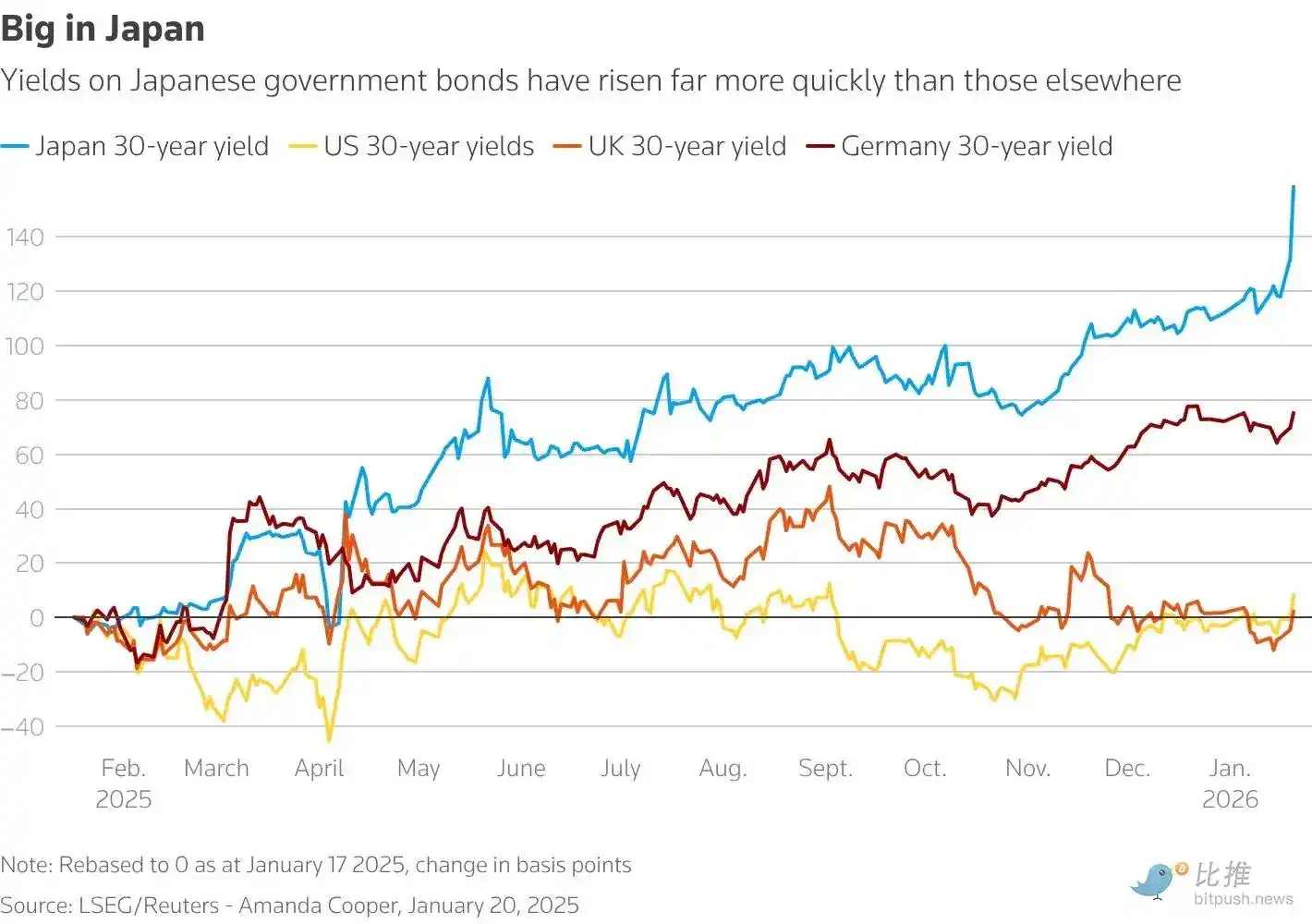
In institutional finance, collateral is everything. Every leveraged position, every derivatives trade, every repo requires high-quality assets as security. Backed by the world's third-largest economy and with virtually no default risk, JGBs are one of the few global assets that qualify. When a hedge fund in Singapore builds a leveraged position, or a bank in London covers a derivatives exposure, JGBs are frequently used as collateral.
Cryptocurrency's most important infrastructure victory is happening inside traditional finance. Without Japan winning the 'currency war,' JGBs have become the operational infrastructure for Asian institutional finance.
The problem is, the entire collateral system operates like it's 1995. Moving JGB collateral between two institutions passes through a layered holding structure: the Bank of Japan (BOJ) at the top, then Hofuri (Japan's securities depository), then a custodian bank, then a sub-custodian. Each layer requires separate reconciliation and operates only during Tokyo business hours (roughly 9 AM to 3 PM JST).
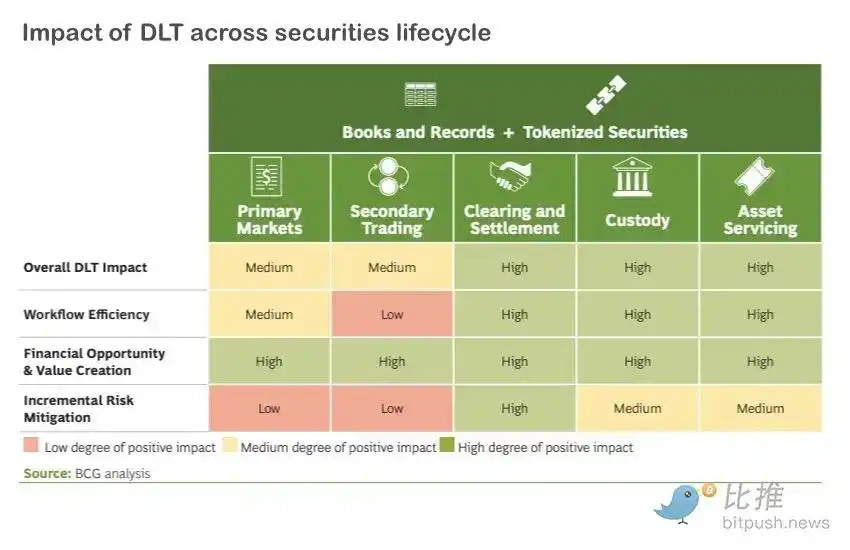
A collateral transfer that should take seconds ends up taking days. During those days, that collateral is 'stuck.' A trading desk in New York needing it at 10 PM has to wait for Tokyo to wake up. A GFMA (Global Financial Markets Association) and BCG study estimates blockchain could unlock $100 billion in trapped collateral globally; for a bank doing $100 billion in daily repo volume, tokenized settlement alone could save $150-300 million annually in operational costs.
Here's something unsettling for Japan: the US is already moving.
DTCC, which custodies $99 trillion in US securities and processes $3.7 quadrillion in annual transactions, partnered with Digital Asset in December 2025 to tokenize US Treasuries on the Canton Network. This means the core of US securities infrastructure is moving towards 24/7 tokenized settlement.
Broadridge is already processing $354 billion in daily tokenized Treasury repo trades on the same network; JPMorgan's Kinexys has processed over $1.5 trillion in cumulative volume through its on-chain payment rail. US Treasuries are rapidly becoming 'always-on, always-movable' collateral assets, while JGBs remain locked in Tokyo's business hours.
If you're a global fund manager needing to post collateral for a margin call at 2 AM, and you can choose between tokenized US Treasuries that settle instantly or JGBs that you have to wait 6 hours for Tokyo to open to move, you choose US Treasuries every time.
Scale that choice across thousands of trading desks, and JGBs risk losing their 'top-tier collateral' status. For a country whose sovereign debt is deeply interwoven into Asia's financial collateral system, this is even an existential issue. The four companies in the JGB on-chain trial used the word 'urgent' in their press release. Given the pace of US infrastructure evolution, it's hard to disagree.
Why Canton Keeps Winning
When Japan's JSCC had to choose a network for JGB collateral, they chose Canton—the same chain DTCC, Broadridge, and JPMorgan are already using. The reason lies in the extremely stringent demands sovereign bond collateral places on a network.
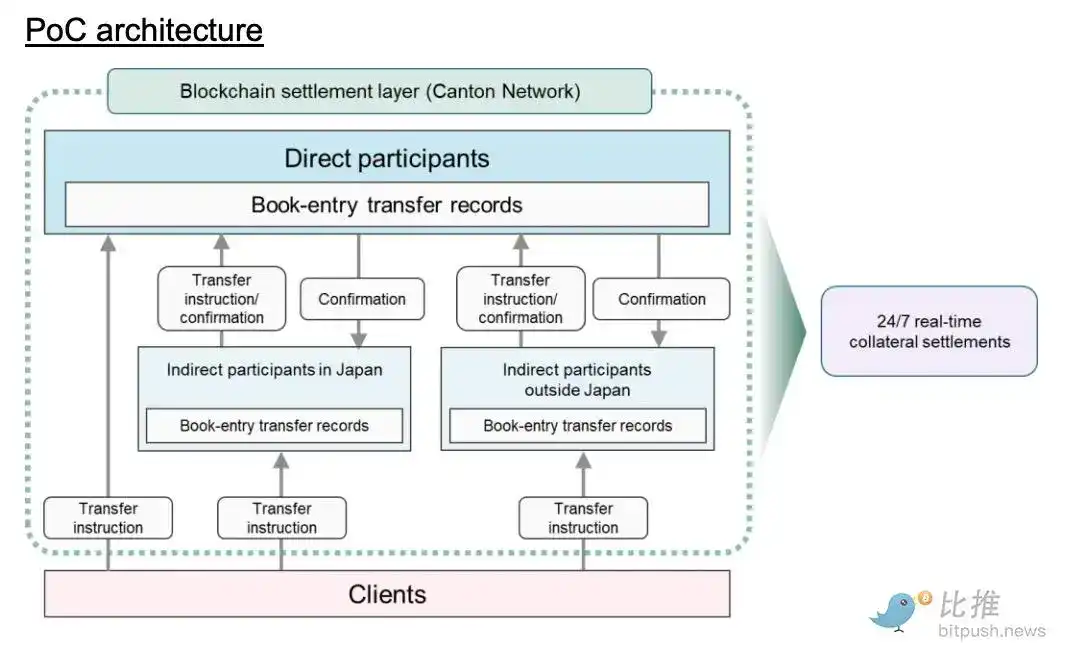
Sovereign bond collateral has a specific set of requirements most blockchains can't meet. When Mizuho Bank transfers JGB collateral to a counterparty in London, the transaction must comply with Japan's Book-Entry Transfer Act. The blockchain record needs to be synchronized at a legal level with Hofuri's official register.
Every party in the transaction (from clearinghouse to custodian to counterparty) can only see data they are authorized to view under Japanese and international securities law. And the entire process requires atomic settlement—the collateral and payment must move at the same instant, or neither moves.
This is an incredibly complex set of constraints. Canton was chosen because its architecture is designed to solve precisely these issues. Each institution runs its own ledger, and cross-institution transactions sync only the data each party is authorized to see. Smart contracts written in Digital Asset's Daml language dictate who can see what and who must authorize each step.
Thus, when JSCC, Mizuho, and Nomura move JGB collateral on Canton, the clearinghouse sees the full picture, Mizuho sees its side, Nomura sees its side, and no one sees anything they shouldn't. Canton is now the only global network enabling three major sovereign bond collateral pools (US Treasuries, Japanese bonds, European bonds) to move across borders, in real-time, 24/7. No other network (public or private) comes close.
What Does 'Round-the-Clock' Collateral Actually Change?
Most coverage of tokenized on-chain settlement stops at 'it's faster.' But speed is just the beginning; the real transformation is in how the system behaves under stress.
Consider what happened in March 2020 during the COVID pandemic. Markets crashed, volatility spiked, and initial margin requirements for equity futures jumped 100% in weeks. Funds unable to meet margin calls were forced to sell assets to raise cash.
But selling assets into a falling market pushes prices lower, triggering more margin calls, forcing more selling. This feedback loop is one of the most dangerous dynamics in finance and nearly broke the system again during the UK LDI pension crisis in September 2022.
How 24/7 tokenized settlement changes this:
- Direct Collateralization: Currently, when facing a margin call, most funds must first sell assets for cash. With on-chain collateral, funds can directly pledge JGBs or US Treasuries to meet requirements without first converting to cash. The 'forced selling spiral' weakens because fewer institutions dump assets into a falling market just for liquidity.
- Solving 'Give-to-Get': In traditional repo, the cash lender sends money first and receives collateral later. During this window, one party is exposed. Banks bake this 'intraday exposure' into their haircuts and funding costs.
- Atomic Execution: With on-chain atomic settlement, both legs of a trade (collateral and cash) move at the same instant. Santander tested this in December 2024, executing $50 million and €50 million in intraday repos on JPMorgan's Kinexys, automatically unwinding them three hours later. Intraday repos, once requiring complex third-party setups or committed credit lines, become routine.
More significantly, in a Canton demo in January 2026, the London Stock Exchange Group (LSEG) brought its Digital Settlement Hub (DiSH) into the trade. DiSH uses tokenized commercial bank deposits as the cash leg, not stablecoins.
This is because banks don't settle billion-dollar trades with USDC—USDC is a private IOU, not 'money good.' DiSH tokens represent actual deposits at regulated banks and can be transferred on-chain 24/7. This solves the cash leg problem, the final piece for institutional adoption. Now, Japan plans to plug JGBs into this same infrastructure.
What This Means
If the JGB trial succeeds, and US Treasuries are already live, with European sovereign bonds also in demos, Canton, in my view, is starting to look like the next SWIFT.
It's a single network becoming the default layer for moving the world's most important collateral across borders. Like SWIFT, once enough institutions join, leaving becomes almost impossible. Network effects compound. Each new sovereign bond class joining benefits existing participants and makes it harder for newcomers to compete.
I think this merits reflection. We in crypto spent years debating decentralization, worrying about single points of failure, building a system no single entity could control the trajectory of. And now, historically the most significant blockchain deployment is converging on a single permissioned network managed by the same institutions that run global finance.
Is this good or bad? It depends on what you believe this is all about. If the goal is to improve capital market efficiency, lower settlement risk, and unlock trillions in trapped collateral, it's working. If the goal was to diminish the power of existing financial institutions, it's doing the opposite—the same gatekeepers are just getting more sophisticated infrastructure.
I don't think that makes it unimportant. Settling government bonds on a blockchain, 24/7, cross-border, atomically, is a genuine upgrade to how global finance operates. But I do think it's worth being honest about what 'kind' of upgrade this is—it's an efficiency revolution: the plumbing is being rebuilt, but the plumbers are the same.