
HYPE climbs 60% as Hyperion delivers 64% Q4 growth – How and why?

ambcryptoPublicado em 2026-03-27Última atualização em 2026-03-27

Resumo

HYPE, the native token of Hyperion—the first publicly-listed DeFi company in the U.S.—surged 60% year-to-date, reaching nearly $40. This growth follows Hyperion's strong Q4 2025 performance, which saw a 64% quarter-over-quarter revenue increase and an 87% rise in adjusted gross profit. The company also reduced core operating expenses by 30%. Hyperion’s success is driven by five business lines, all exceeding internal targets, and its "triple-dip" strategy, which allows HYPE to be used across three income streams simultaneously tripling typical staking yields. The underlying protocol, Hyperliquid, generated approximately $1.51 million in revenue within 24 hours, funding the buyback and burn of 36,745 HYPE tokens. So far, over 42.6 million tokens (worth $1.7 billion) have been permanently removed from circulation, creating persistent buy pressure and deflation tied to real usage. Price appreciation has tracked closely with rising protocol revenue and ongoing token burns, suggesting continued momentum as on-chain activity remains strong.

As the first publicly-listed Hyperliquid [HYPE] DeFi company in the U.S, Hyperion is the center of attention today. Their progress is visible in HYPE’s YTD numbers, with a potentially new model for value creation emerging.

Hyperion DeFi reports Q4 numbers

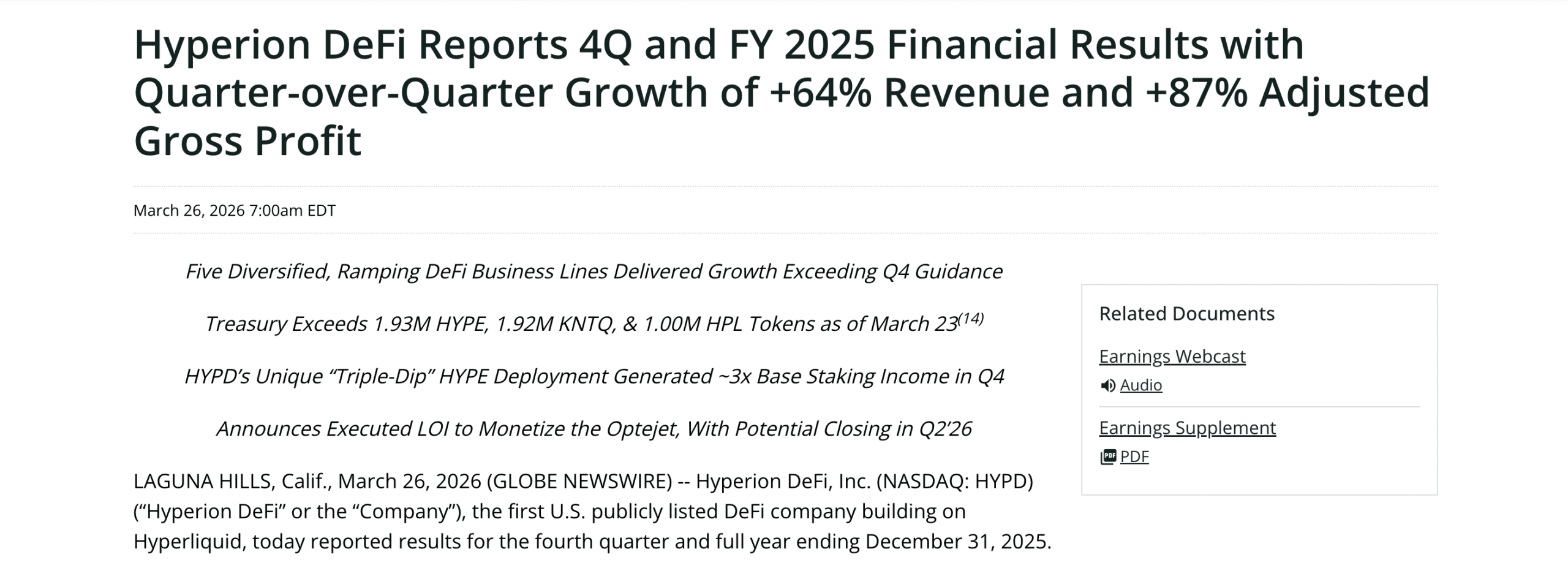
Hyperion recently reported a 64% quarter-over-quarter (QoQ) jump in revenue, alongside an 87% surge in adjusted gross profit! Notably, the company cut core operating expenses by 30% over the same period. They maintained cost control even as they scaled.
Source: HyperionDeFi

Five business lines drove this growth, with each exceeding internal Q4 guidance.

The “triple-dip” strategy also helped this success, by allowing the HYPE token to be used across three income streams at the same time. That essentially brought three times the usual staking yield!

Hyperliquid generates $1.5 million in revenue in 24 hours

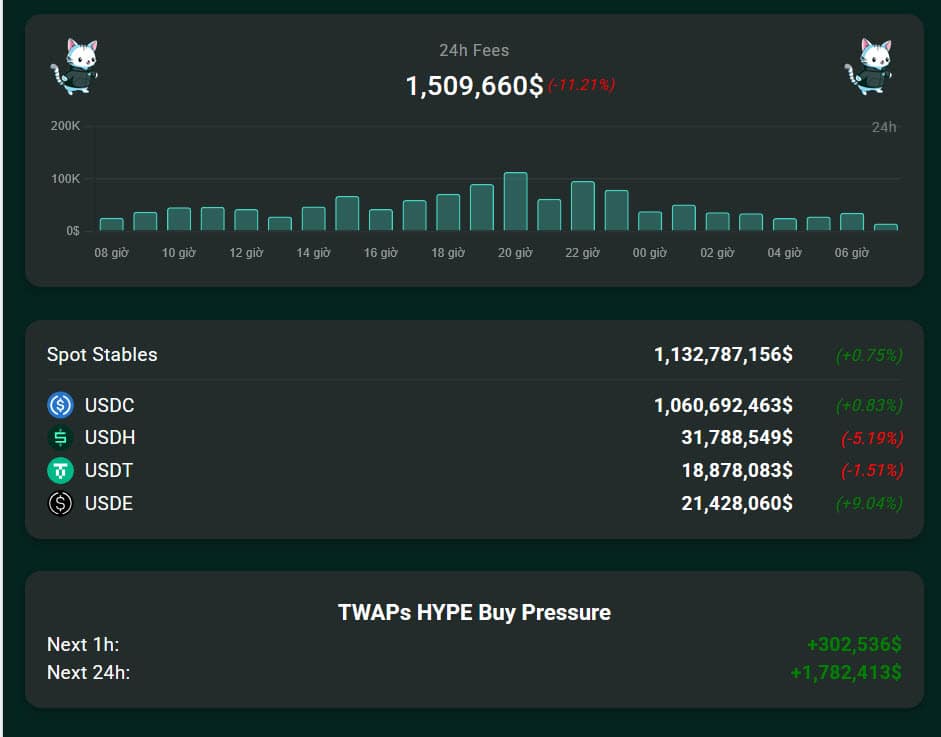
Beyond Hyperion’s strong quarter, the engine driving value is right there in Hyperliquid’s on-chain data. I

n the last 24 hours alone, the protocol saw roughly $1.51 million in revenue. This was directly used to buy back around 36,745 HYPE tokens and remove them from circulation.
Source: X

Every trade and interaction generates fees, funds buybacks, and burns the tokens that were bought back. So far, the protocol has removed over 42.6 million HYPE tokens (valued at $1.7 billion) from supply.

Unlike burn events, the model brings deflation to real usage. This creates a persistent buy pressure that grows with the platform.

HYPE posts 63% YTD gains

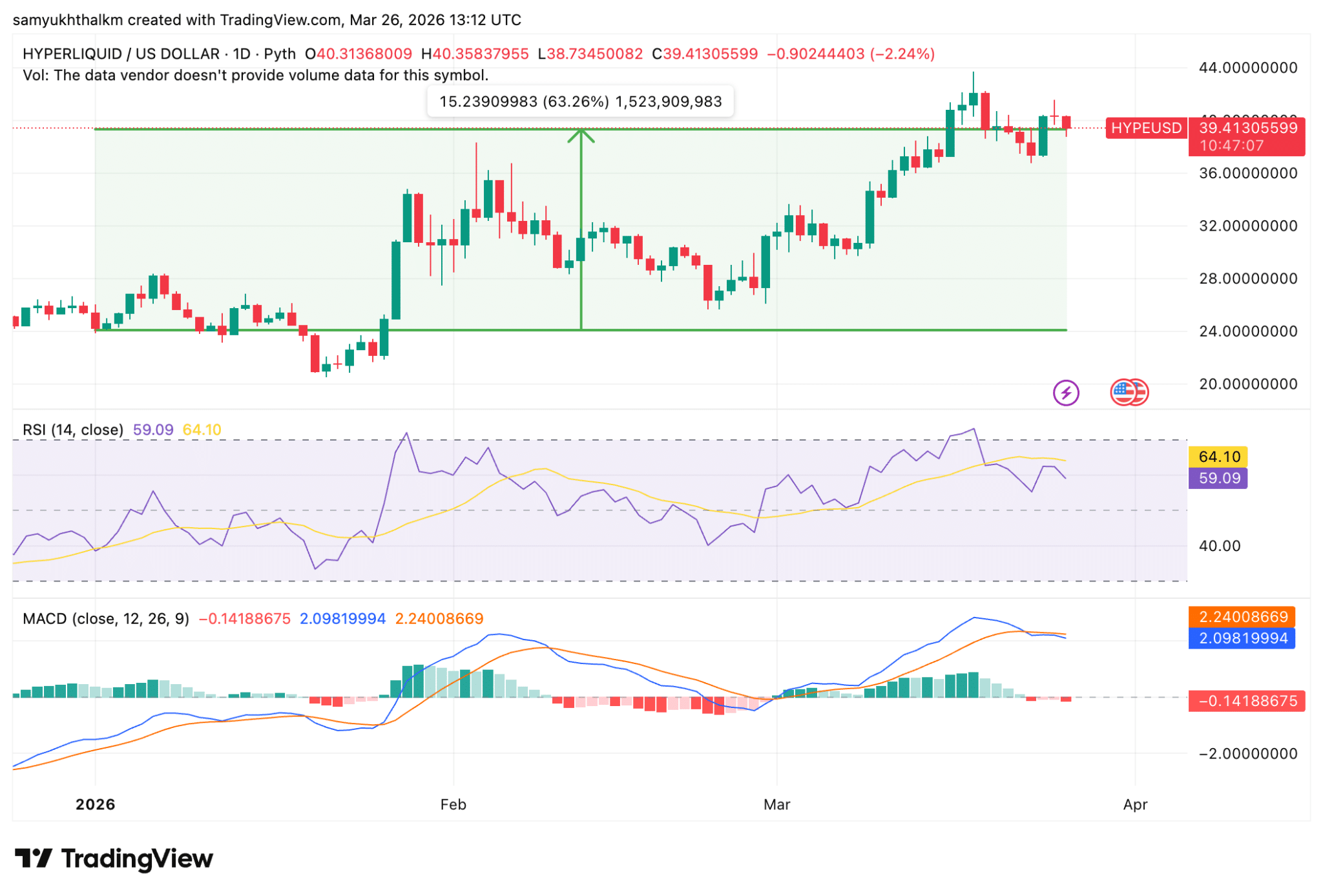
This buyback pressure was visible in the native token’s price action too. At the time of writing, HYPE was up over 60% YTD, going from sub-$25 levels to nearly $40 as seen on the daily chart. Higher lows through March meant buying was steady, while the pace seemed to be rightly elevated.
Source: TradingView

Price expansion has closely tracked rising protocol revenue and consistent token burns. As long as on-chain activity holds, demand and decreasing supply could continue to move in tandem.


Final Summary

  • The first U.S listed DeFi company Hyperion reported 64% revenue growth in Q4 2025 and 87% profits.
  • Hyperliquid’s $1.5M daily revenue is helping buybacks and burns while also pushing the price up over 60% this year.


Perguntas relacionadas

QWhat was the percentage growth in Hyperion's Q4 revenue and adjusted gross profit?

AHyperion reported a 64% quarter-over-quarter (QoQ) jump in revenue and an 87% surge in adjusted gross profit.

QHow much revenue did Hyperliquid generate in the last 24 hours, and what action was taken with it?

AHyperliquid generated roughly $1.51 million in revenue in the last 24 hours, which was used to buy back and remove approximately 36,745 HYPE tokens from circulation.

QWhat is Hyperion's 'triple-dip' strategy and how does it benefit HYPE token holders?

AThe 'triple-dip' strategy allows the HYPE token to be used across three income streams simultaneously, essentially providing three times the usual staking yield for holders.

QHow many HYPE tokens has the protocol removed from supply so far and what is their value?

AThe protocol has removed over 42.6 million HYPE tokens from supply, valued at $1.7 billion.

QWhat is the Year-to-Date (YTD) price performance of HYPE token as mentioned in the article?

AHYPE was up over 60% YTD, rising from sub-$25 levels to nearly $40 at the time of writing.

Leituras Relacionadas

When Doing Cryptocurrency Payment, the First Thing is Licenses, What is the Second?

When launching a crypto payment business, obtaining the necessary licenses is the crucial first step. However, the second, and arguably more critical, step is designing a comprehensive operational framework that forms a coherent business loop. This loop must be clearly understood and executable by all stakeholders: banks, payment partners, exchanges, on-chain analytics providers, regulators, and your internal team. Many projects mistakenly believe a single license permits all operations. Licenses merely grant entry; they don't define how the specific business functions. The real challenge lies in detailing every aspect of the workflow. This involves clarifying the customer base, the flow of fiat and crypto assets, the settlement process, and establishing clear lines of responsibility for risks like AML compliance, sanctions screening, chargebacks, and regulatory inquiries. A robust framework must answer seven core questions: Who are the clients and merchants? Who collects fiat and crypto? Who handles conversion and custody? And who is ultimately accountable for compliance and risk management? Projects often fail not from a lack of licensing, but during due diligence when they cannot convincingly explain these operational details. Therefore, beyond securing licenses, the priority must be constructing a closed-loop system. This system ensures the business model is transparent, risks are managed, responsibilities are delineated, contracts are aligned, and the entire process is comprehensible to partners and regulators. The true competitive edge in crypto payments lies not in acquiring a license quickly, but in integrating licensing, banking, compliance, and operations into a sustainable and executable whole.

marsbitHá 22m

When Doing Cryptocurrency Payment, the First Thing is Licenses, What is the Second?

marsbitHá 22m

Arthur Hayes Analysis: AI Bubble Nears Burst, Crypto Market Faces Short-Term Pressure

Arthur Hayes argues that the current AI market is a bubble poised to burst, which will exert downward pressure on the crypto market in the near term. The core trigger is rising oil prices due to the US-Iran conflict and a blockade of the Strait of Hormuz. Higher energy costs directly increase the operational expenses of AI data centers, squeezing profit margins for companies like Google, Anthropic, and OpenAI. Hayes predicts that persistent inflation from high oil prices will force Trump, in a bid to win the November election, to turn public sentiment against the AI industry. He may propose regulations and taxes on data centers and AI companies to appeal to voters concerned about costs and job displacement. Such political rhetoric could shatter market confidence. Furthermore, the market is unlikely to healthily absorb the massive concurrent IPOs of SpaceX, Anthropic, and OpenAI, which together seek valuations in the trillions. The combination of soaring energy costs, overwhelming equity supply, and negative political pressure will puncture the AI bubble. Hayes notes that nearly all new USD liquidity since 2022 has flowed into AI, leaving crypto like Bitcoin behind. When the AI bubble bursts, liquidity will contract sharply, pulling down all risk assets, including cryptocurrencies. In response, Hayes's fund, Maelstrom, has sold all AI-related stocks and non-core cryptocurrencies. It maintains core positions in Bitcoin and Ethereum while increasing exposure to energy sector equities, betting on rising oil and gas prices. He expects Bitcoin to bottom after the AI-led market decline, before rallying again with future monetary easing.

Foresight NewsHá 36m

Arthur Hayes Analysis: AI Bubble Nears Burst, Crypto Market Faces Short-Term Pressure

Foresight NewsHá 36m

To C, To B, and the Next Big Thing Called To A

After To C and To B, the Next Wave is To A: Serving AI Agents In a recent quarterly earnings call, Meituan's Wang Xing introduced a new concept: To A (To Agent), signifying that future business services will increasingly target AI Agents as primary clients, not just consumers or merchants. This shift implies that internet giants must now consider how to make their services more appealing for AI Agents to recommend, fundamentally altering traditional distribution logic. This "To A era" is prompting an unusual trend of alliances among major tech companies. Unlike previous competitive battles, firms like Meituan, Tencent, JD.com, Huawei, OPPO, and OpenAI are rapidly forming partnerships. The reason is strategic: as AI Agents become the primary user interface, handling tasks from a single command (e.g., "Book a Japanese restaurant for tomorrow"), the risk for platforms is being bypassed entirely. Companies are positioning themselves within this new value chain. Three primary strategies are emerging: 1. **Super-Entry Points + Service Providers:** Platforms like Tencent's Yuanbao, WeChat, and ChatGPT aim to be the first-stop Agent, integrating various services (food delivery, shopping, travel) from partners like Meituan and JD.com. 2. **Apps as Callable Services:** Companies like Meituan, JD.com, and Uber are ensuring their core services remain accessible and callable by external Agents, shifting from front-end apps to back-end capabilities. 3. **System-Level Agent Entry Points:** Smartphone makers (Huawei, Honor, OPPO) are leveraging their OS-level AI assistants to control the initial user command, redistributing it to relevant service apps. While alliances offer mutual benefit—entry points gain service capabilities, and service providers gain traffic—inherent conflicts of interest exist. A dominant Agent platform could eventually attempt to connect directly with suppliers (restaurants, hotels), bypassing current aggregators like Meituan or Ctrip. Other unresolved challenges include the potential for Agent recommendations to become a new form of paid ranking and unclear accountability for faulty recommendations. The current rush to form alliances is a defensive move by service providers to secure their position before the landscape solidifies. In this To A-driven restructuring, the greatest risk is not losing the race but failing to hear the starting gun.

marsbitHá 45m

To C, To B, and the Next Big Thing Called To A

marsbitHá 45m

The More Lifelike the Robot, the More Terrifying? Unveiling the 'Uncanny Valley Effect' in the Era of Humanoid Robots

As humanoid robots become increasingly lifelike, they confront a significant psychological barrier known as the "Uncanny Valley Effect," a concept proposed by Japanese roboticist Masahiro Mori in 1970. This phenomenon describes a dip in human comfort and acceptance when robots appear almost, but not perfectly, human. Minor imperfections in facial expressions, eye movements, or skin texture trigger a subconscious sense of unease, as the brain detects something trying, yet failing, to mimic a person. Examples range from the controversial human-like robot Sophia to animated characters in films like *The Polar Express*. The effect poses a key design challenge for robotics companies. Some, like Boston Dynamics, avoid it entirely by creating highly capable but visibly mechanical robots. Others, like Hanson Robotics, push for greater human likeness despite the risk. For consumer robots, especially in homes, most manufacturers opt for stylized or clearly mechanical designs to ensure broader acceptance. While the Uncanny Valley remains a powerful force, its impact may diminish over time through technological advancements that achieve near-perfect realism or through generational familiarity as people grow accustomed to interacting with humanoid machines. Ultimately, navigating this psychological frontier requires as much understanding of human perception as of robotics technology itself.

marsbitHá 45m

The More Lifelike the Robot, the More Terrifying? Unveiling the 'Uncanny Valley Effect' in the Era of Humanoid Robots

marsbitHá 45m

Trading

Spot
Futuros

Artigos em Destaque

Como comprar HYPE

Bem-vindo à HTX.com!Tornámos a compra de Hyperliquid (HYPE) simples e conveniente.Segue o nosso guia passo a passo para iniciar a tua jornada no mundo das criptos.Passo 1: cria a tua conta HTXUtiliza o teu e-mail ou número de telefone para te inscreveres numa conta gratuita na HTX.Desfruta de um processo de inscrição sem complicações e desbloqueia todas as funcionalidades.Obter a minha contaPasso 2: vai para Comprar Cripto e escolhe o teu método de pagamentoCartão de crédito/débito: usa o teu visa ou mastercard para comprar Hyperliquid (HYPE) instantaneamente.Saldo: usa os fundos da tua conta HTX para transacionar sem problemas.Terceiros: adicionamos métodos de pagamento populares, como Google Pay e Apple Pay, para aumentar a conveniência.P2P: transaciona diretamente com outros utilizadores na HTX.Mercado de balcão (OTC): oferecemos serviços personalizados e taxas de câmbio competitivas para os traders.Passo 3: armazena teu Hyperliquid (HYPE)Depois de comprar o teu Hyperliquid (HYPE), armazena-o na tua conta HTX.Alternativamente, podes enviá-lo para outro lugar através de transferência blockchain ou usá-lo para transacionar outras criptomoedas.Passo 4: transaciona Hyperliquid (HYPE)Transaciona facilmente Hyperliquid (HYPE) no mercado à vista da HTX.Acede simplesmente à tua conta, seleciona o teu par de trading, executa as tuas transações e monitoriza em tempo real.Oferecemos uma experiência de fácil utilização tanto para principiantes como para traders experientes.

296 Visualizações TotaisPublicado em {updateTime}Atualizado em 2026.06.02

Como comprar HYPE

Discussões

Bem-vindo à Comunidade HTX. Aqui, pode manter-se informado sobre os mais recentes desenvolvimentos da plataforma e obter acesso a análises profissionais de mercado. As opiniões dos utilizadores sobre o preço de HYPE (HYPE) são apresentadas abaixo.

活动图片