Ethereum Is Retracing the Path of the Internet and Linux: No One Yields, and the Neutral Party Ultimately Prevails

marsbitPublicado em 2026-06-22Última atualização em 2026-06-22

Resumo

This article argues that Ethereum is following the historical path of open, neutral systems like the Internet and Linux, which eventually triumphed over proprietary, centrally-controlled alternatives. Major financial institutions like JPMorgan, Stripe, and Circle are building their own proprietary blockchains or networks (e.g., Tempo, Arc), but will never agree to build on a competitor's controlled infrastructure. This creates the perfect opportunity for Ethereum as the only neutral, credibly neutral settlement layer that no single entity controls. The piece draws parallels to the 1990s, when experts like Bill Gates predicted proprietary networks (from Microsoft, Oracle) would win over the open Internet, and when Sun Microsystems' Unix lost to the open-source "bazaar" development model of Linux. This model, described in Eric Raymond's "The Cathedral and the Bazaar," thrives on permissionless innovation where countless contributors improve the system, outpacing any centralized competitor. Ethereum embodies this through its decentralized development, broad validator distribution, and credible neutrality—rules that are transparent, equally applied, hard to change, and open to all. This has attracted over a million developers and major institutions like Coinbase, BlackRock, and JPMorgan, who choose Ethereum for its security, ecosystem, and sovereignty (the inability of any single party to change the rules). While proprietary chains offer initial speed and control, they inherit ...

Author: Etherealize

Compiled by: Deep Tide TechFlow

Deep Tide Introduction: Stripe wants everyone to use Tempo, JPMorgan wants to push its own chain, Circle intends to launch Arc—giants will never build on a rival's infrastructure. This is precisely Ethereum's opportunity: when everyone refuses to submit to a company-controlled foundation, the only choice is a neutral layer that no one controls.

Ethereum is replaying the history of the Internet and Linux.

"Stripe wants everything to happen on Tempo, but JPMorgan wants everything on the JPMorgan chain, Circle wants everything on Arc, and so on. They will never reach an agreement. Major players will never agree to build on another major player's infrastructure. This is why Ethereum is the only option. It is the only way forward—as the neutral infrastructure everyone can accept."

In 1995, most of the technology elite were convinced the Internet would lose out to proprietary corporate networks. They were wrong, and today's critics of Ethereum are likely to be wrong for similar reasons. The most famous example is Bill Gates, who predicted in his book *The Road Ahead* that the future of digital commerce would not run on the open Internet but on proprietary networks owned by companies like Microsoft and Oracle. This was once the consensus. As a16z co-founder Ben Horowitz wrote: "Almost no one thought the Internet would have a significant impact outside of scientific circles—the greatest skeptics were precisely the most important technology industry leaders busy building proprietary alternatives." Linux went through the same thing. Throughout the late 1990s, Sun Microsystems dominated the high-end Unix server market, but by the early 2000s, it lost most of its business to open-source Linux running on cheap generic hardware.
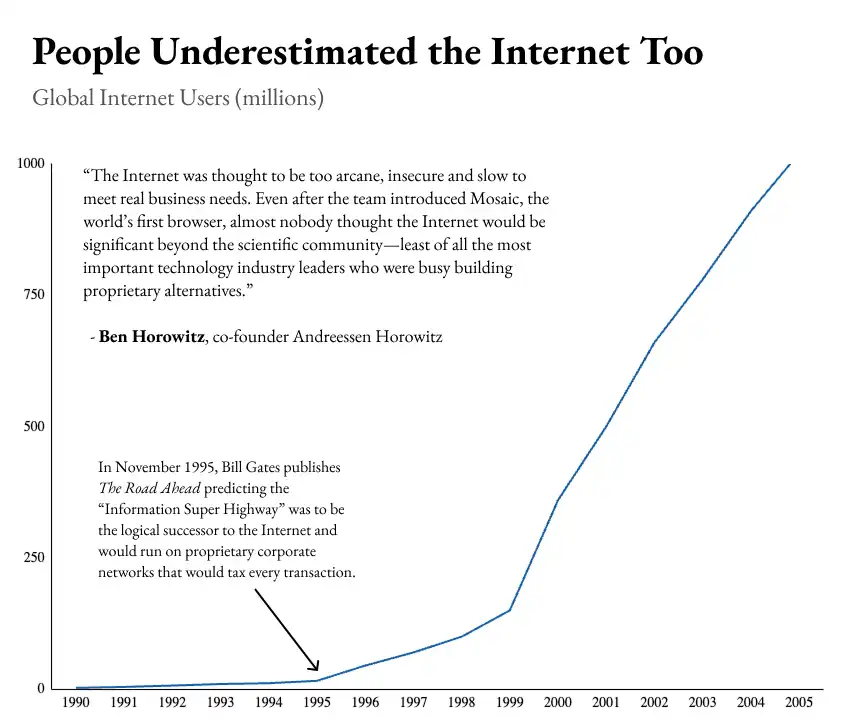
The same pattern is playing out today in financial infrastructure. Companies perceive opportunities and threats, racing to build proprietary blockchains within their controlled walled gardens. For a while, proprietary versions appear to be winning—they are faster, have better user experiences, and boast large business development teams. Then they are slowly swallowed by an open, credibly neutral alternative, because no company can keep up with the pace of permissionless innovation forever, and no serious participant will build on infrastructure controlled by a competitor.

In his 1997 essay "The Cathedral and the Bazaar," Linux contributor Eric Raymond attempted to explain why open, permissionless infrastructure tends to win in the long run. Since Fred Brooks' *The Mythical Man-Month*, the accepted wisdom was that software had to be built by small, tightly managed teams under a single architect because communication costs increase quadratically. However, Raymond saw thousands of contributors (most of whom had never met) working simultaneously on different parts of the Linux kernel, surpassing multibillion-dollar companies. If traditional software was carefully crafted like a "cathedral," then the "bazaar" was Raymond's description of the chaotic, public, distributed development model accidentally discovered by Linus Torvalds—he gave away the kernel source code for free and accepted patches from anyone willing to submit. The guiding philosophy, in Raymond's words, was "release early, release often, delegate everything you can, and be open to the point of promiscuity," resulting in an operating system that ran most of the web by the early 2000s.

Raymond's explanation was that the bazaar avoids the quadratic communication cost problem because contributors do not coordinate directly with each other. They coordinate through patches and releases with the codebase, with maintainers integrating their work into a medium that everyone then coordinates around. As he put it, "The principle behind Brooks's law has not been repealed, but its effects can be swamped by other non-linear factors in the presence of a large developer population and cheap communication."

Another mechanism Raymond identified is that the bazaar eliminates the distinction between users and developers. In the cathedral, users are customers reporting bugs to a service desk. In the bazaar, users are co-developers reporting bugs by fixing them or describing them with enough technical detail for others to fix. Raymond explained that in the open-source community, "every problem is transparent to someone." Collective collaboration surpasses any centralized competitor:

"The Linux world in many ways behaves like a free market or ecosystem, a collection of self-interested agents trying to maximize utility, a process that produces a self-correcting spontaneous order more delicate and efficient than any centralized planning."

You can see this happening on Ethereum. Fabian Vogelsteller wrote the ERC-20 standard, now used by every stablecoin because he found no clean way to support tokens while building a wallet—each token had a different interface. The ERC-721 standard for NFTs came from the people making CryptoKitties. Uniswap, now the largest decentralized exchange of its kind in the world, originated from a blog post by Vitalik Buterin, built by mechanical engineer Hayden Adams with no financial background. None of them needed permission to improve the network. As Sun Microsystems co-founder Bill Joy said, "No matter who you are, most of the smartest people work for someone else." In a permissionless system, innovation can come from anywhere.

The difference between the bazaar and the cathedral is that the integration layer in the bazaar is thin, public, and based on credibility rather than authority. Coordinators like Linus Torvalds or Vitalik Buterin lead because contributors choose to follow, and contributors choose to follow because the coordinator's decisions can be inspected, criticized, and forked if necessary. The Internet has thin centralized integration in the form of the IETF and IANA. Wikipedia has its editorial process. Every project that gains a sustained advantage from permissionless innovation combines truly open contribution with structured integration, preventing the chaos critics fear. And the integration layer must operate through credibility, not coercion, or it fails.

The bazaar also requires a foundation that no one can capture. If Torvalds tried to privatize the kernel, contributors would fork the project and continue elsewhere. Raymond developed this idea in *Homesteading the Noosphere*, arguing that open source had developed a property rights theory similar to Locke's theory of land ownership: developers establish ownership by homesteading a project (writing the initial code), maintain it through continued contribution, and can transfer it through legitimate inheritance. The credibility of open licenses is the formal mechanism; the norms of the Internet noosphere are the social mechanism. Take away either, and contributors will go work elsewhere, where their contributions won't be appropriated.

In the Ethereum community, Vitalik Buterin formalized this requirement as "credible neutrality." A coordination mechanism is credibly neutral when the rules are transparent, apply equally to all participants, are difficult to change, and participation is open to anyone willing to abide by the rules. These four properties are extracted from systems that can attract contributions at scale. The Internet, Linux, and Wikipedia all have versions of these four properties. Proprietary networks, walled gardens, and corporate blockchains do not.

Over a sufficiently long time horizon, credibly neutral systems usually win. Open networks replaced proprietary ones; Linux replaced proprietary Unix; Wikipedia replaced Encarta and the Encyclopædia Britannica. Each time, proprietary alternatives had real advantages—focused products, more capital, customer support teams, professional marketing and business development teams—and each time, those advantages eroded as the open ecosystem matured and network effects reversed. Once an open alternative crosses the threshold in accumulated contributions, tools, and credibility of not changing the rules, closed systems can almost never compete.

The same pattern is now playing out at every layer of financial infrastructure. SWIFT, Visa, and Mastercard, and today's consortium chains pitched to institutions, are different products with different histories, but structurally they are the same bet: centrally controlled infrastructure with a potential landlord. For forty years, SWIFT was a neutral pipeline owned by its member banks, until the U.S. pressured it to cut off Iranian banks in 2012 and several Russian banks in 2022. Despite corporate governance and Belgian registration, SWIFT ultimately answers to the U.S., and the rest of the world took note. China accelerated CIPS, Russia built SPFS, India expanded UPI, Brazil's Pix became the backbone of BRICS Pay. Visa and Mastercard started as bank cooperatives too, then became toll booths charging merchants 1.5–3.5% per transaction. The consortium chains being pitched today (like Canton, Tempo, Arc) have the same flaw: a landlord whose interests may diverge from those building on it.

"The original vision of consortium blockchains—5 banks or big companies getting together to create their own chain—has basically failed," explained Vitalik Buterin. "It ends up inheriting most of the disadvantages of centralization and most of the disadvantages of decentralization at the same time." As he describes it, the problem is that the first few banks feel like equal founders, but the twentieth bank is just joining something competitors already control. You bear all the engineering costs of a distributed system but get none of the benefits of openness, composability, and credible neutrality—the very things that make blockchains worth building in the first place.

The wreckage confirms his point. Between 2017 and 2019, several major banking consortia set out to rebuild trade finance on blockchain. We.trade, backed by a dozen banks including HSBC and Deutsche Bank, went bankrupt in 2022. Marco Polo signed up over thirty banks, liquidated a year later. Contour shut down months after. The Australian Securities Exchange spent six years and roughly A$250 million on a permissioned ledger built by Digital Asset (the company behind Canton today), abandoning the project in 2022. Meanwhile, Ethereum, controlled by no one, has never gone down in its 10+ year history, only grown.

This is why developers choose Ethereum. According to Electric Capital, over one million developers have contributed to the Ethereum ecosystem over its lifetime, with about 232,000 active in the past year alone. No other chain comes close. Part of this is a plain flywheel effect: tools, standards, and job opportunities are on Ethereum, so people learn to build there, attracting more tools and jobs. But developers and institutions also specifically choose Ethereum for its superior decentralization and credible neutrality. For example, last year Robinhood chose to build an L2 on Ethereum instead of its own L1; the company's head of crypto, Johann Kerbrat, explained the rationale:

"You see a lot of companies now building their own L1s. We were excited about the idea of controlling everything you want to build, but creating a truly, properly decentralized chain's security is extremely difficult, and Ethereum basically gives you that for free. When you look at some of the new L1s being created, they aren't really decentralized, nor really secure. At the end of the day, it's basically a fancy database that's a bit slower than an actual database, so we really don't see the value."

Erik Voorhees, founder of Venice AI (a privacy-first AI inference platform with over 3 million users and tens of millions in ARR), laid out a similar rationale a few days ago. When asked why Venice is building on Coinbase's Ethereum L2 Base, Erik replied: "This wasn't even a question for us; the Ethereum ecosystem is the more authentic, more resilient, more robust ecosystem across all smart contract platforms."

The most important property of a blockchain is sovereignty. Bitcoin was revolutionary because it was the world's first sovereign computer platform. Before Bitcoin, all computer platforms belonged to individuals, companies, or governments, which had to obey the will of their owners and the rules of their jurisdiction. But sovereignty obeys only its own rules, and no single entity could impose rules on Bitcoin. Kings and queens were once sovereigns, then nation-states, and now, for the first time, a computer platform can be sovereign. This is why decentralization is so revered in crypto; it is the means to achieve sovereignty. A platform with ten validators obeys the rules of those ten. But a platform like Ethereum, with hundreds of thousands of independent validators spread across every major jurisdiction, multiple independent client implementations, and a foundation that explicitly renounces governance power, has crossed a threshold where no party can credibly claim ownership. Sovereignty is the property that allows a global financial system to build on Ethereum without any participant worrying that another participant, a government, or the foundation will change the rules to their detriment.

Ethereum's lead in sovereignty and credible neutrality comes largely from path dependency that other blockchains cannot replicate. Ethereum launched in 2015 with PoW, ran for seven years, and transitioned to PoS in 2022. During this time, network ownership was distributed through a public crowdfunding in 2014 and GPU mining kept deliberately accessible to consumer-grade hardware. The result was broad token distribution, with no single entity controlling a meaningful share of the network (a key factor for PoS network sovereignty). Modern consortium chains launch as venture capital rounds with concentrated insider allocations, giving a few participants outsized control over the chain's consensus. Competitors can copy the architecture but not the history.

Since then, Ethereum's lead has only compounded. The platform's sovereignty and credible neutrality attract developers. Developers attract more developers because the libraries, tools, and hiring pools already existing on Ethereum make building there easier than anywhere else. Applications attract liquidity and tokenized assets, which in turn attract institutions. Each layer reinforces the others, and competitors trying to enter have to build all layers at once while Ethereum continues to compound.
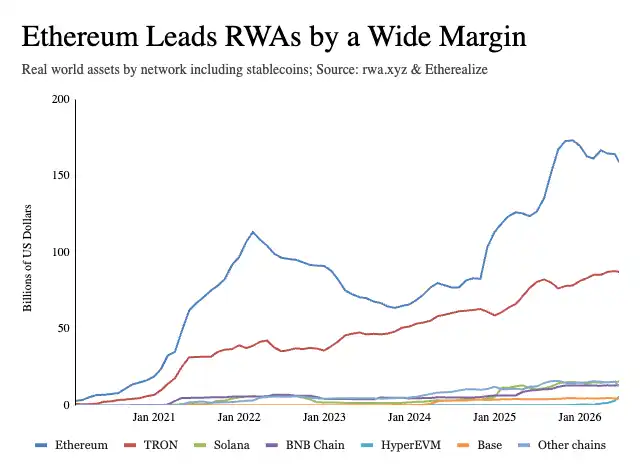
The most established players in the field have already chosen Ethereum. Coinbase and Robinhood chose Ethereum for their L2s. BlackRock and JPMorgan launched their tokenized money market funds BUIDL and MONY on Ethereum. Major DeFi protocols, including Aave, Maker/Sky, Maple, and Uniswap, are primarily on Ethereum. The largest stablecoin issuers settle on Ethereum. According to Token Terminal's Q1 2026 Ethereum Report, Ethereum holds 79% of active DeFi loans, 62% of stablecoins, 73% of tokenized funds, and 84% of tokenized commodities among the top five chains.

Applications are also permissionless, further reinforcing Ethereum's advantages. For example, Uniswap's permissionless listing process allows thousands of long-tail assets to find price discovery and liquidity that no centralized exchange would provide. Aave's lending markets are open and composable, enabling an entire ecosystem of specialized vaults and risk managers to emerge atop its liquidity, extending Aave's reach far beyond what the core team could build alone. Closed systems need gatekeepers to anticipate every use case in advance; open systems do not.

The strongest objection to the "permissionless wins" view is not technical; it's that finance might be the one place where corporate-owned networks are a feature, not a bug. When payments fail or assets end up where they shouldn't, regulators want someone to be accountable. When lawyers show up, "no one in charge" sounds less like an advantage and more like liability. But this objection confuses two things that exist at different layers. Accountability exists at the application layer, not the settlement layer. For instance, token standards like ERC-3643 embed KYC, identity verification, and jurisdictional transfer restrictions directly into a token's smart contract, allowing issuers to whitelist wallets, restrict transfers, and freeze or claw back assets. Privacy works the same way; zero-knowledge cryptography lets institutions settle on public chains while keeping transaction details confidential. On consortium chains, the only people who see your data are you and your closest competitors.

Early on, the Internet was considered too unsafe for real commerce. Then HTTPS made the open web secure enough that nearly all commerce moved onto it, and the issue was never raised again. Skeptics weren't wrong about the early state. They just incorrectly assumed the open web couldn't close the gap.

The banks and fintechs building their own chains today are thinking what AOL and Microsoft thought in the early days of the Internet: build something open, but inside your own walled garden so you can collect rent. But that never works because the walls that give you control are the same walls that block innovation.

A better model is Netscape. Netscape didn't try to own the web; it built the browser that brought the world onto the web. Riding the explosive growth of the open web, it became one of the most important companies of its era. Ethereum's credible neutrality is almost impossible to replicate, and it's already positioned to become the settlement layer for global finance. The winning strategy is to build on permissionless infrastructure, not compete with it.

Disclosure: This analysis is published by Etherealize, an organization focused on institutional Ethereum adoption. The author and Etherealize may hold positions in ETH and other digital assets discussed. This is not investment advice.

Criptomoedas em alta

Perguntas relacionadas

QAccording to the article, what historical pattern is Ethereum currently repeating, and why?

AEthereum is currently repeating the historical pattern of the internet and Linux. In both cases, proprietary, company-controlled systems initially appeared to have advantages (like being faster or having better marketing), but were eventually overtaken by open, credibly neutral, and permissionless alternatives. This happens because no single company can match the pace of permissionless innovation, and serious participants refuse to build on infrastructure controlled by a competitor, creating an opportunity for a neutral layer like Ethereum.

QWhat is the 'Cathedral and the Bazaar' analogy from the article, and how does it apply to Ethereum?

AThe 'Cathedral and the Bazaar' analogy contrasts two software development models. The 'Cathedral' represents traditional, proprietary software built by small, tightly managed teams. The 'Bazaar' describes the open, chaotic, distributed development model of projects like Linux and Ethereum, where contributions come from a global pool of developers without central coordination. The article states that this 'Bazaar' model, characterized by 'release early, release often,' enables open systems to out-innovate and eventually surpass closed systems, just as Ethereum's permissionless ecosystem has done.

QWhat does Vitalik Buterin mean by 'credible neutrality' and why is it crucial for a platform like Ethereum?

AVitalik Buterin defines 'credible neutrality' by four attributes: transparent rules, rules that apply equally to all participants, rules that are difficult to change, and participation open to anyone willing to follow the rules. This is crucial because it ensures no single entity can control or change the system to benefit themselves at the expense of others. This neutrality is what attracts developers, institutions, and capital, as they can build on Ethereum without fear of a competitor or government changing the foundational rules against them.

QWhy have several major bank-led consortium blockchain projects failed, according to the article?

AMajor bank-led consortium blockchain projects (like We.trade, Marco Polo, Contour) have failed because they inherit 'most of the downsides of centralization and most of the downsides of decentralization.' While the first few members feel like equal founders, later joiners are essentially joining a system already controlled by competitors. These projects bear the engineering costs of a distributed system but fail to gain the key benefits of openness, composability, and credible neutrality that make blockchain technology valuable in the first place.

QHow does the article address the concern about accountability and regulation on a 'neutral' platform like Ethereum?

AThe article argues that the concern about accountability is addressed by separating the settlement layer from the application layer. Accountability exists at the application layer, not the base settlement layer. For example, token standards like ERC-3643 allow issuers to embed KYC, identity verification, and transfer restrictions directly into the token's smart contract. Similarly, zero-knowledge cryptography enables confidential transactions on public chains. This is analogous to how HTTPS made the open internet secure enough for commerce, addressing early security concerns without sacrificing openness.

Leituras Relacionadas

Beyond the Model Lies the Harness: Deepseek Enters the Arena, Why Has the Main Battlefield of China's AI Competition Shifted?

In mid-to-late May 2026, Deepseek internally established a new Harness team focused on code agent products, internally benchmarked against Anthropic's Claude Code. This move, marked by the formula "Model + Harness = Agent" in their job postings, signals a major shift in China's AI competition: the main battlefield is transitioning from developing large models to building toolchains and achieving workplace integration. Deepseek's direct involvement in Harness development aims to secure control over interface design and training data feedback loops, moving beyond open-sourcing powerful models. Harness, the runtime infrastructure for AI agents, handles everything beyond model reasoning—task orchestration, tool calling, context management, safety checks, and error recovery. It is crucial because agent products are not just outputs of model capability but also training grounds for it. Real-world task failures recorded by Harness can feed back into model training, creating a flywheel effect. Engineering Harness is more critical than optimizing prompts, as poor context management or error handling can drastically reduce agent success rates in multi-step, real-world scenarios. This shift is not isolated. Other major Chinese tech companies are also pursuing differentiated toolchain strategies. Tencent leverages its enterprise ecosystem (WeChat Work, Tencent Cloud) to build connectors for organizational-level AI collaboration and complex task delivery. Alibaba focuses on lowering automation barriers on the web with a front-end, browser-based GUI Agent framework, PageAgent. This diversification shows the industry recognizes that success lies not in a perfect general agent, but in vertically focused solutions built with robust engineering. The trend is validated by overseas success, such as Poland's Viktor, an AI coworker on Slack achieving $20M ARR by autonomously executing complex, multi-step tasks. This proves a shift in enterprise willingness to pay—from "AI-assisted generation" to "AI-autonomous execution." As Harness matures to provide safety guards and reliability, AI transitions from a human-supervised intern to an independent outsourcer. The competition now faces key engineering challenges: preventing "token explosion" through intelligent context compression, and building "thick frameworks" with features like sandbox isolation and checkpoint recovery for enterprise-grade stability. Geopolitical restrictions on tools like Claude Code further create a significant market vacuum for domestic solutions like Deepseek's Harness. For enterprises and developers, the focus must shift from comparing model benchmarks to evaluating a vendor's engineering capabilities, error recovery mechanisms, context management, and ecosystem compatibility when choosing AI products and platforms.

marsbitHá 52m

Beyond the Model Lies the Harness: Deepseek Enters the Arena, Why Has the Main Battlefield of China's AI Competition Shifted?

marsbitHá 52m

Soaring Export Data for Memory Chips, Market Is Redefining the Valuation Anchor for Memory Stocks

Korean storage export data for the first 20 days of June shows substantial year-on-year increases in both value and price-per-kilogram for categories like DRAM, NAND, and SSDs. This signals a potential shift beyond simple demand recovery, indicating rising prices and a product mix shift towards higher-value items, possibly influenced by AI infrastructure needs. A key point is that the surge in price-per-kilogram is not simply a uniform chip price hike. It reflects a combination of actual price increases and, more importantly, an export structure increasingly dominated by high-value-density products like HBM (High-Bandwidth Memory) and advanced DRAM, which are critical for AI servers. This suggests AI-driven demand may be spilling over from just HBM into broader memory markets. SK Hynix stands to benefit directly due to its leading HBM position. For Samsung and Micron, the implication is potential for greater margin elasticity if the tightness in high-end memory spreads to enterprise SSD and NAND prices. However, the storage sector remains cyclical. Risks include supply expansion, inventory changes, and potential slowdowns in broader AI capital expenditure. Ultimately, while the strong export data supports upward revisions for storage company earnings and fuels discussion of an "AI infrastructure bottleneck premium," a definitive valuation shift from a cyclical to a structural story depends on upcoming quarterly reports. Investors need confirmation from SK Hynix, Samsung, and Micron that improvements in average selling prices, product mix, and, crucially,毛利率 are sustained over multiple quarters.

marsbitHá 2h

Soaring Export Data for Memory Chips, Market Is Redefining the Valuation Anchor for Memory Stocks

marsbitHá 2h

Trading

Spot
Futuros

Artigos em Destaque

O que é ETH 2.0

ETH 2.0: Uma Nova Era para o Ethereum Introdução ETH 2.0, amplamente conhecido como Ethereum 2.0, marca uma atualização monumental à blockchain do Ethereum. Esta transição não é meramente uma mudança estética; visa melhorar fundamentalmente a escalabilidade, segurança e sustentabilidade da rede. Com uma mudança do mecanismo de consenso em Proof of Work (PoW), intensivo em energia, para um Proof of Stake (PoS) mais eficiente, o ETH 2.0 promete uma abordagem transformadora ao ecossistema blockchain. O que é ETH 2.0? ETH 2.0 é um conjunto de atualizações distintas e interconectadas focadas na otimização das capacidades e desempenho do Ethereum. Esta reformulação foi projetada para abordar desafios críticos que o mecanismo atual do Ethereum enfrentou, particularmente em relação à velocidade das transações e à congestão da rede. Objetivos do ETH 2.0 Os principais objetivos do ETH 2.0 giram em torno da melhoria de três aspectos centrais: Escalabilidade: Com o objetivo de melhorar significativamente o número de transações que a rede pode manejar por segundo, o ETH 2.0 procura ultrapassar a limitação atual de aproximadamente 15 transações por segundo, alcançando potencialmente milhares. Segurança: Medidas de segurança melhoradas são integrais ao ETH 2.0, especialmente através da resistência aprimorada contra ciberataques e da preservação do ethos descentralizado do Ethereum. Sustentabilidade: O novo mecanismo PoS foi projetado não apenas para melhorar a eficiência, mas também para reduzir drasticamente o consumo de energia, alinhando a estrutura operacional do Ethereum com considerações ambientais. Quem é o Criador do ETH 2.0? A criação do ETH 2.0 pode ser atribuída à Ethereum Foundation. Esta organização sem fins lucrativos, que desempenha um papel crucial no apoio ao desenvolvimento do Ethereum, é liderada pelo co-fundador notável Vitalik Buterin. A sua visão de um Ethereum mais escalável e sustentável tem sido a força motriz por trás desta atualização, envolvendo contribuições de uma comunidade global de desenvolvedores e entusiastas dedicados a melhorar o protocolo. Quem são os Investidores do ETH 2.0? Embora os detalhes sobre os investidores do ETH 2.0 não tenham sido tornados públicos, é sabido que a Ethereum Foundation recebe apoio de várias organizações e indivíduos no espaço da blockchain e tecnologia. Esses parceiros incluem firmas de capital de risco, empresas de tecnologia e organizações filantrópicas que compartilham um interesse mútuo em apoiar o desenvolvimento de tecnologias descentralizadas e infraestrutura de blockchain. Como Funciona o ETH 2.0? ETH 2.0 é notável por introduzir uma série de características chave que o diferenciam do seu predecessor. Proof of Stake (PoS) A transição para um mecanismo de consenso PoS é uma das mudanças de destaque do ETH 2.0. Ao contrário do PoW, que depende da mineração intensiva em energia para a verificação de transações, o PoS permite que os utilizadores validem transações e criem novos blocos de acordo com a quantidade de ETH que apostam na rede. Isso leva a uma maior eficiência energética, reduzindo o consumo em aproximadamente 99,95%, tornando o Ethereum 2.0 uma alternativa consideravelmente mais ecológica. Shard Chains As shard chains são outra inovação crítica do ETH 2.0. Estas cadeias menores operam em paralelo com a cadeia principal do Ethereum, permitindo que várias transações sejam processadas simultaneamente. Esta abordagem melhora a capacidade geral da rede, abordando preocupações de escalabilidade que têm atormentado o Ethereum. Beacon Chain No coração do ETH 2.0 está a Beacon Chain, que coordena a rede e gere o protocolo PoS. Ela atua como uma espécie de organizador: supervisiona os validadores, garante que as shards permaneçam conectadas à rede e monitora a saúde geral do ecossistema blockchain. Linha do Tempo do ETH 2.0 A jornada do ETH 2.0 tem sido marcada por vários marcos chave que traçam a evolução desta atualização significativa: Dezembro de 2020: O lançamento da Beacon Chain marcou a introdução do PoS, preparando o caminho para a migração para o ETH 2.0. Setembro de 2022: A conclusão de “The Merge” representa um momento crucial em que a rede Ethereum fez a transição com sucesso de um quadro PoW para um PoS, anunciando uma nova era para o Ethereum. 2023: O lançamento esperado das shard chains visa melhorar ainda mais a escalabilidade da rede Ethereum, solidificando o ETH 2.0 como uma plataforma robusta para aplicações e serviços descentralizados. Características Chave e Benefícios Escalabilidade Melhorada Uma das vantagens mais significativas do ETH 2.0 é a sua escalabilidade melhorada. A combinação de PoS e shard chains permite que a rede expanda a sua capacidade, permitindo que acomode um volume de transações muito maior em comparação com o sistema legado. Eficiência Energética A implementação do PoS representa um enorme passo em direção à eficiência energética na tecnologia blockchain. Ao reduzir drasticamente o consumo de energia, o ETH 2.0 não só reduz os custos operacionais, mas também se alinha mais estreitamente com os objetivos globais de sustentabilidade. Segurança Aprimorada Os mecanismos atualizados do ETH 2.0 contribuem para uma segurança melhorada em toda a rede. O uso do PoS, juntamente com medidas de controle inovadoras estabelecidas através das shard chains e da Beacon Chain, assegura um maior grau de proteção contra potenciais ameaças. Custos Mais Baixos para os Utilizadores À medida que a escalabilidade melhora, os efeitos sobre os custos de transação também serão evidentes. Aumentada a capacidade e reduzida a congestão, espera-se que isso se traduza em taxas mais baixas para os utilizadores, tornando o Ethereum mais acessível para transações do dia a dia. Conclusão ETH 2.0 marca uma evolução significativa no ecossistema da blockchain do Ethereum. Ao abordar questões fundamentais como a escalabilidade, o consumo de energia, a eficiência das transações e a segurança geral, a importância desta atualização não pode ser subestimada. A transição para o Proof of Stake, a introdução das shard chains e o trabalho fundamental da Beacon Chain são indicativos de um futuro em que o Ethereum pode atender à crescente demanda do mercado descentralizado. Em uma indústria movida pela inovação e progresso, o ETH 2.0 representa um testemunho das capacidades da tecnologia blockchain em pavimentar o caminho para uma economia digital mais sustentável e eficiente.

107 Visualizações TotaisPublicado em {updateTime}Atualizado em 2024.12.03

O que é ETH 2.0

O que é ETH 3.0

ETH3.0 e $eth 3.0: Uma Análise Profunda do Futuro do Ethereum Introdução No ambiente em rápida evolução da criptomoeda e da tecnologia blockchain, o ETH3.0, frequentemente denotado como $eth 3.0, emergiu como um tema de considerável interesse e especulação. O termo abrange dois conceitos principais que merecem esclarecimento: Ethereum 3.0: Esta representa uma potencial atualização futura destinada a aumentar as capacidades da atual blockchain do Ethereum, focando especialmente na melhoria da escalabilidade e desempenho. ETH3.0 Meme Token: Este distinto projeto de criptomoeda procura aproveitar a blockchain do Ethereum na criação de um ecossistema centrado em memes, promovendo o envolvimento na comunidade de criptomoedas. Compreender esses aspectos do ETH3.0 é essencial não apenas para entusiastas de criptomoedas, mas também para aqueles que observam as tendências tecnológicas mais amplas no espaço digital. O que é ETH3.0? Ethereum 3.0 Ethereum 3.0 é promovido como uma atualização proposta para a rede Ethereum já estabelecida, que tem sido a espinha dorsal de muitas aplicações descentralizadas (dApps) e contratos inteligentes desde a sua criação. As melhorias vislumbradas concentram-se principalmente na escalabilidade—integrando tecnologias avançadas como sharding e provas de conhecimento zero (zk-proofs). Essas inovações tecnológicas visam facilitar um número sem precedentes de transações por segundo (TPS), potencialmente alcançando milhões, abordando assim uma das limitações mais significativas enfrentadas pela tecnologia blockchain atual. A melhoria não é meramente técnica, mas também estratégica; visa preparar a rede Ethereum para uma adoção generalizada e utilidade em um futuro marcado por uma maior demanda por soluções descentralizadas. ETH3.0 Meme Token Em contraste com o Ethereum 3.0, o ETH3.0 Meme Token aventura-se por um domínio mais leve e divertido, combinando a cultura dos memes da internet com a dinâmica das criptomoedas. Este projeto permite que os usuários comprem, vendam e negociem memes na blockchain do Ethereum, proporcionando uma plataforma que fomenta o envolvimento da comunidade através da criatividade e interesses compartilhados. O ETH3.0 Meme Token visa demonstrar como a tecnologia blockchain pode interseccionar com a cultura digital, criando casos de uso que são tanto divertidos quanto financeiramente viáveis. Quem é o Criador do ETH3.0? Ethereum 3.0 A iniciativa em direção ao Ethereum 3.0 é impulsionada principalmente por um consórcio de desenvolvedores e pesquisadores dentro da comunidade Ethereum, notavelmente incluindo Justin Drake. Conhecido por suas percepções e contribuições para a evolução do Ethereum, Drake tem sido uma figura proeminente nas discussões sobre a transição do Ethereum para uma nova camada de consenso, referida como “Beam Chain”. Esta abordagem colaborativa ao desenvolvimento significa que o Ethereum 3.0 não é fruto de um único criador, mas sim uma manifestação da engenhosidade coletiva focada no avanço da tecnologia blockchain. ETH3.0 Meme Token Os detalhes sobre o criador do ETH3.0 Meme Token são atualmente indetectáveis. A natureza dos tokens de meme frequentemente leva a uma estrutura mais descentralizada e impulsionada pela comunidade, o que poderia explicar a falta de atribuição específica. Isso alinha-se com a ethos da comunidade de criptomoedas mais ampla, onde a inovação geralmente surge de esforços colaborativos em vez de esforços individuais. Quem são os Investidores do ETH3.0? Ethereum 3.0 O apoio ao Ethereum 3.0 provém principalmente da Fundação Ethereum, juntamente com uma comunidade entusiástica de desenvolvedores e investidores. Esta associação fundacional proporciona um grau significativo de legitimidade e melhora as perspectivas de uma implementação bem-sucedida, uma vez que aproveita a confiança e credibilidade construída ao longo de anos de operações de rede. Em um clima em rápida mudança no mundo das criptomoedas, o apoio da comunidade desempenha um papel crucial no impulso ao desenvolvimento e adoção, posicionando o Ethereum 3.0 como um sério candidato a futuros avanços na blockchain. ETH3.0 Meme Token Embora as fontes atualmente disponíveis não forneçam informações explícitas sobre as fundações ou organizações de investimento que apoiam o ETH3.0 Meme Token, é indicativo do modelo típico de financiamento para tokens de meme, que frequentemente depende de apoio base e engajamento da comunidade. Os investidores em tais projetos costumam consistir em indivíduos motivados pelo potencial de inovação impulsionada pela comunidade e pelo espírito de cooperação encontrado dentro da comunidade cripto. Como Funciona o ETH3.0? Ethereum 3.0 As características distintivas do Ethereum 3.0 residem em sua proposta de implementação de sharding e tecnologia zk-proof. Sharding é um método de partição da blockchain em partes menores e gerenciáveis ou “shards”, que podem processar transações simultaneamente em vez de sequencialmente. Esta descentralização do processamento ajuda a prevenir congestionamentos e garante que a rede permaneça responsiva mesmo sob carga pesada. A tecnologia de prova de conhecimento zero (zk-proof) contribui com outra camada de sofisticação ao permitir a validação de transações sem revelar os dados subjacentes envolvidos. Este aspecto não apenas melhora a privacidade, mas também aumenta a eficiência geral da rede. Há também conversas sobre a incorporação de uma Máquina Virtual Ethereum de conhecimento zero (zkEVM) nesta atualização, amplificando ainda mais as capacidades e utilidade da rede. ETH3.0 Meme Token O ETH3.0 Meme Token distingue-se ao capitalizar sobre a popularidade da cultura dos memes. Estabelece um mercado para que os usuários participem da negociação de memes, não apenas para entretenimento, mas também para potencial ganho econômico. Ao integrar recursos como staking, provisão de liquidez e mecanismos de governança, o projeto fomenta um ambiente que incentiva a interação e participação da comunidade. Ao oferecer uma mistura única de entretenimento e oportunidade econômica, o ETH3.0 Meme Token visa atrair um público diversificado, variando de entusiastas de criptomoedas a conhecedores casuais de memes. Cronologia do ETH3.0 Ethereum 3.0 11 de novembro de 2024: Justin Drake sugere a próxima atualização do ETH 3.0, centrada nas melhorias de escalabilidade. Este anúncio sinaliza o início de discussões formais sobre a futura arquitetura do Ethereum. 12 de novembro de 2024: A proposta antecipada para Ethereum 3.0 deve ser revelada no Devcon em Bangkok, preparando o cenário para um feedback mais amplo da comunidade e potenciais próximos passos no desenvolvimento. ETH3.0 Meme Token 21 de março de 2024: O ETH3.0 Meme Token é oficialmente listado no CoinMarketCap, marcando sua entrada no domínio público das criptomoedas e aumentando a visibilidade de seu ecossistema baseado em memes. Pontos Chave Em conclusão, Ethereum 3.0 representa uma evolução significativa dentro da rede Ethereum, focando em superar limitações quanto à escalabilidade e desempenho através de tecnologias avançadas. As atualizações propostas refletem uma abordagem proativa às futuras demandas e usabilidade. Por outro lado, o ETH3.0 Meme Token encapsula a essência da cultura impulsionada pela comunidade no espaço das criptomoedas, aproveitando a cultura dos memes para criar plataformas envolventes que incentivam a criatividade e participação dos usuários. Compreender os distintos propósitos e funcionalidades do ETH3.0 e $eth 3.0 é fundamental para qualquer pessoa interessada nos desenvolvimentos contínuos dentro do espaço cripto. Com ambas as iniciativas a pavimentar caminhos únicos, elas sublinham coletivamente a natureza dinâmica e multifacetada da inovação em blockchain.

109 Visualizações TotaisPublicado em {updateTime}Atualizado em 2024.12.03

O que é ETH 3.0

Como comprar ETH

Bem-vindo à HTX.com!Tornámos a compra de Ethereum (ETH) simples e conveniente.Segue o nosso guia passo a passo para iniciar a tua jornada no mundo das criptos.Passo 1: cria a tua conta HTXUtiliza o teu e-mail ou número de telefone para te inscreveres numa conta gratuita na HTX.Desfruta de um processo de inscrição sem complicações e desbloqueia todas as funcionalidades.Obter a minha contaPasso 2: vai para Comprar Cripto e escolhe o teu método de pagamentoCartão de crédito/débito: usa o teu visa ou mastercard para comprar Ethereum (ETH) instantaneamente.Saldo: usa os fundos da tua conta HTX para transacionar sem problemas.Terceiros: adicionamos métodos de pagamento populares, como Google Pay e Apple Pay, para aumentar a conveniência.P2P: transaciona diretamente com outros utilizadores na HTX.Mercado de balcão (OTC): oferecemos serviços personalizados e taxas de câmbio competitivas para os traders.Passo 3: armazena teu Ethereum (ETH)Depois de comprar o teu Ethereum (ETH), armazena-o na tua conta HTX.Alternativamente, podes enviá-lo para outro lugar através de transferência blockchain ou usá-lo para transacionar outras criptomoedas.Passo 4: transaciona Ethereum (ETH)Transaciona facilmente Ethereum (ETH) no mercado à vista da HTX.Acede simplesmente à tua conta, seleciona o teu par de trading, executa as tuas transações e monitoriza em tempo real.Oferecemos uma experiência de fácil utilização tanto para principiantes como para traders experientes.

3.2k Visualizações TotaisPublicado em {updateTime}Atualizado em 2026.06.02

Como comprar ETH

Discussões

Bem-vindo à Comunidade HTX. Aqui, pode manter-se informado sobre os mais recentes desenvolvimentos da plataforma e obter acesso a análises profissionais de mercado. As opiniões dos utilizadores sobre o preço de ETH (ETH) são apresentadas abaixo.

活动图片