ETH Breaks Below $1,900! Behind the 22% Plunge, Vitalik's 'Five-Year Austerity' Strategy

marsbitPublicado em 2026-02-24Última atualização em 2026-02-24

Resumo

Ethereum (ETH) has experienced a sharp decline, falling below $1,900 and dropping over 22% from recent highs. This downturn is driven by a combination of liquidity outflows and shifting market expectations. Key factors include significant net redemptions from U.S. spot Ethereum ETFs, large-scale selling by whale addresses (1.43 million ETH sold in two weeks), and substantial personal sales by co-founder Vitalik Buterin. In response, the Ethereum Foundation has announced a five-year "moderate austerity" strategy to ensure long-term financial sustainability and continued development of core technology. Buterin is personally funding certain public goods projects to reduce the Foundation’s financial burden. Despite price pressure, Ethereum’s network performance has improved, with TPS reaching a record high due to the Fusaka upgrade. However, centralization risks in block building remain. The upcoming Glamsterdam upgrade aims to address this with ePBS (enshrined Proposer-Builder Separation) to reduce dominance by a few large players and reshape MEV economics. Additionally, regulatory pressure is mounting with the EU’s MiCA regulation set to take effect in July 2026, increasing compliance costs and affecting DeFi and liquidity providers. Ethereum is currently in a phase of short-term volatility and structural adjustment, balancing capital outflows against long-term technical and governance improvements.

Author: Max.s

The current cryptocurrency market is undergoing a severe structural adjustment. According to the latest trading data (as shown on the chart, ETH/USDT has fallen to around $1,847.84, with a clear recent unilateral downward trend), Ethereum (ETH) is experiencing a deep correction driven by both capital flows and market expectations.
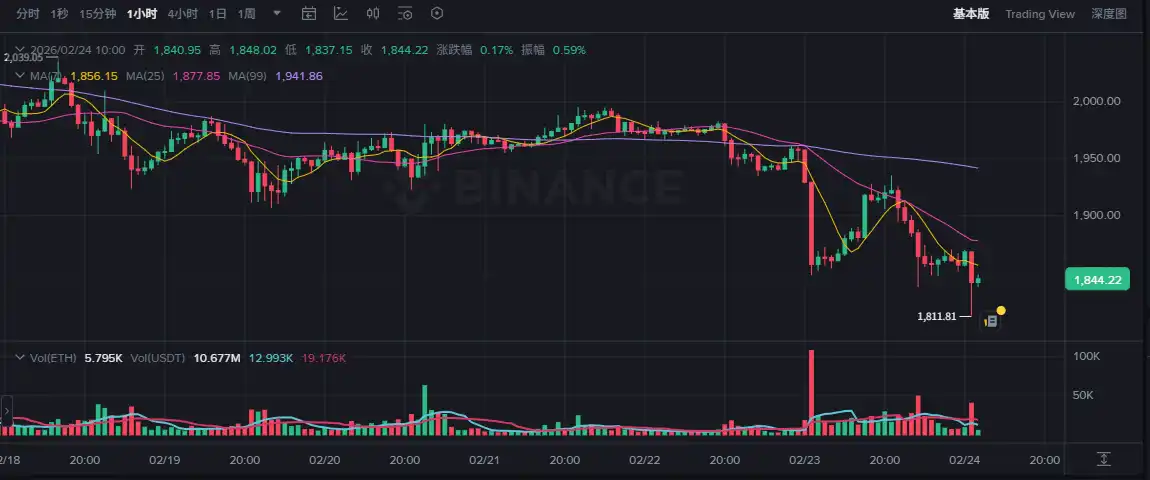
Looking back at the price movement in February 2026, ETH plummeted from above $2,360 to the $1,825 range in a short period, a drop of over 22.7%. Behind the surface of the price decline lies a comprehensive restructuring of the Ethereum network in terms of technical upgrades, organizational structure, and regulatory environment. For institutional investors and financial professionals, looking beyond short-term price fluctuations and understanding the transformation of Ethereum's underlying asset logic is the core issue at hand.

The most immediate pressure facing Ethereum currently comes from the continuous withdrawal of liquidity. This capital outflow is not a single event but a resonance of multiple sources of capital.

Net Redemptions in Spot ETFs: Risk aversion among institutional investors has significantly increased. For example, on January 29, 2026, U.S. spot Ethereum ETFs recorded a single-day net outflow of $155.7 million. Among them, Fidelity's FETH saw a net outflow of $59.2 million, BlackRock's ETHA had a net outflow of $54.9 million, and Grayscale's two funds also recorded outflows in the tens of millions of dollars. This indicates that traditional Wall Street capital is systematically reducing its exposure to Ethereum.

Concentrated Selling by Early Holders: On-chain data shows that whale accounts sold approximately 1.43 million ETH within just two weeks.

Founder's Sell-Off: This month, Ethereum co-founder Vitalik Buterin sold over 8,800 ETH, cashing out approximately $18.45 million. In traditional financial markets, intensive selling by core management is often seen as a major bearish signal, further exacerbating market panic.
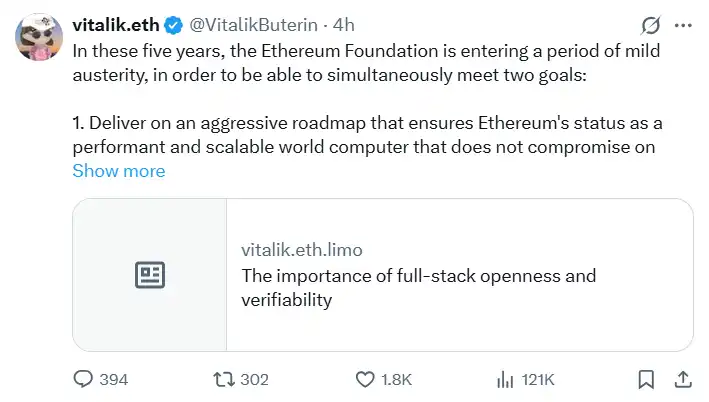
Facing the market's winter, the Ethereum Foundation (EF) has made a defensive shift in its financial strategy. Vitalik Buterin announced that the foundation will enter a five-year period of "moderate austerity."

From a corporate finance perspective, this is a classic cash flow management strategy. Its core objectives are twofold: first, to ensure the foundation can continue to fund the development of Ethereum's core underlying technology in the future, avoiding threats to its independence due to excessive resource consumption; second, to ensure that Ethereum's ambitious roadmap as a high-performance "world computer" is delivered on schedule.

To support this strategy, Vitalik himself proactively severed the funding dependence of some "special projects" on the foundation. He chose to extract 16,384 ETH and use decentralized staking yields to self-fund research and development for public goods such as open-source software, hardware, and privacy protection projects. This approach of internalizing peripheral R&D expenses and focusing on core business marks a move toward maturity and restraint in Ethereum's capital operations.

While the price is under pressure, Ethereum's technical fundamentals have shown remarkable resilience, even exhibiting a rare phenomenon of "price-volume divergence." Recently, the Ethereum network's TPS (transactions per second) reached a historic high of 75,862, far exceeding the previous peak of 58,786.
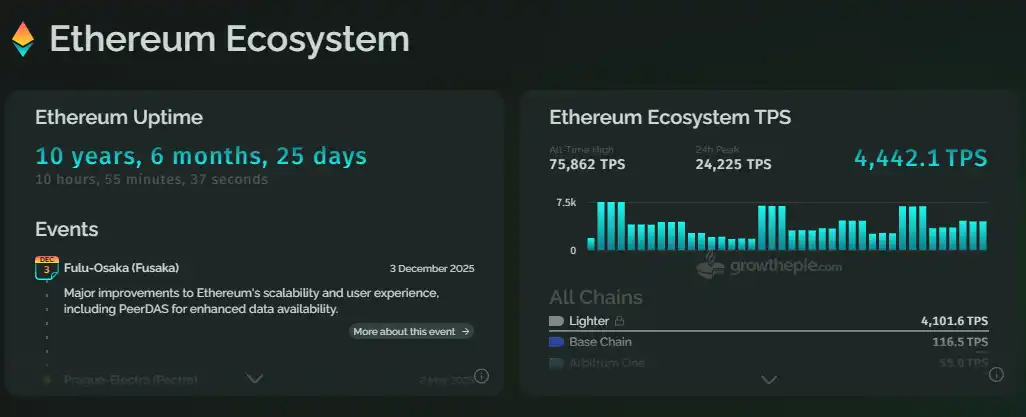
This is largely due to the Fusaka upgrade deployed last December. This upgrade introduced the PeerDAS mechanism, significantly expanding the data throughput of Layer 2 networks. However, with the explosion in data capacity, new systemic risks are emerging. Vitalik pointed out that because current block builders still need to download complete data, the network faces serious centralization risks.

To address this hidden danger, Ethereum plans to launch the Glamsterdam upgrade in 2026, which is essentially a bottom-up reform targeting internal oligopolies within the network.

ePBS Mechanism Reshapes Profit Distribution: The core of this upgrade is ePBS (in-protocol proposer-builder separation). It forcibly incorporates the block-building process into the protocol's底层, standardizing the bidding process and weakening the absolute dominance of the current few external builders over the market.

Preventing Rent-Seeking by Giants: For financial professionals, this means Ethereum is proactively intervening in its internal MEV (Maximal Extractable Value) market structure, breaking down the technical barriers of leading capital, and reconstructing the underlying logic of staking yields.

In addition to the internal structural pains, the Ethereum ecosystem also faces the impending regulatory hammer. The EU's MiCA (Markets in Crypto-Assets) regulation, set to take full effect on July 1, 2026, requires all crypto businesses operating within the EU to meet strict compliance standards.

The implementation of this regulation will directly impact the vast number of DeFi protocols, liquidity providers, and related derivative markets on the Ethereum chain that lack the backing of traditional corporate entities. The sharp rise in compliance costs and the early withdrawal of some non-compliant funds are the deep-seated macro reasons behind the recent sustained bleeding in the spot market.

Ethereum is in a period of divergence: on one side, there is the ruthless selling by short-term capital and the pre-pricing of strict regulations; on the other, there is the robust expansion of technical infrastructure and a self-driven revolution against internal monopolies. This is a typical "deleveraging" process, trading short-term pain for long-term systemic stability.


Perguntas relacionadas

QWhat is the main reason for the recent sharp decline in Ethereum's price, according to the article?

AThe main reason is a dual pressure from capital outflows and shifting expectations, including massive net redemptions from spot ETFs, concentrated selling by early large holders, and sell-offs by founders, all contributing to a 22.7% drop.

QWhat strategic shift did Vitalik Buterin announce for the Ethereum Foundation in response to market conditions?

AVitalik Buterin announced that the Ethereum Foundation will enter a five-year 'mild austerity' phase to ensure sustainable funding for core technology development and maintain independence while focusing on Ethereum's ambitious roadmap.

QHow did the recent Fusaka upgrade impact Ethereum's network performance?

AThe Fusaka upgrade, deployed last December, introduced the PeerDAS mechanism, which significantly increased data throughput for Layer 2 networks, pushing Ethereum's TPS to a new high of 75,862.

QWhat is the purpose of the upcoming Glamsterdam upgrade for Ethereum?

AThe Glamsterdam upgrade aims to address centralization risks by implementing ePBS (in-protocol proposer-builder separation) to reform the block building process, reduce dominance by a few external builders, and restructure the MEV market to prevent oligopoly.

QWhat regulatory challenge is the Ethereum ecosystem facing in 2026, as mentioned in the article?

AThe Ethereum ecosystem is facing the EU's MiCA (Markets in Crypto-Assets) regulation, set to take full effect on July 1, 2026, which imposes strict compliance standards on crypto firms operating in the EU, potentially impacting DeFi protocols and liquidity providers.

Leituras Relacionadas

Gary Yang: Agent Economy and AI Submicroeconomics

**Title:** Agent Economy and AI Sub-Microeconomics - Gary Yang **Summary:** Following the AI singularity, the pace of evolution has accelerated rapidly, creating new generational disparities in technological advancement globally. While many regions are still grappling with single-agent bottlenecks, Silicon Valley has moved ahead into the next dimension: the Agent Economy and A2A ecosystems. The article outlines six key areas of this emerging paradigm: 1. **AI Payment Competition & H2A Bottlenecks:** A fierce battle for AI Agent payment protocol standards is underway (e.g., MPP, x402). However, most current efforts remain Human-to-Agent (H2A), essentially grafting AI onto traditional human-centric commerce, which creates a non-AI-native bottleneck. The true potential lies in Agent-to-Agent (A2A) autonomous economies. 2. **Agent Economy & the Inevitable A2A Trend:** The Agent Economy is defined by autonomous AI Agents creating, exchanging, and capitalizing value as independent economic actors. The A2A ecosystem describes their interactions. This represents the next major investment frontier, akin to the early days of e-commerce or DeFi, but with faster iteration and an AI-native, efficiency-first perspective that often diverges from human needs. 3. **AI Protocol vs. Crypto Protocol:** AI Protocols are the foundational rules for Agent interaction in an open network (communication, discovery, collaboration), akin to the governance and economic laws of the AI world. Currently, they focus on communication and weak boundaries, unlike Crypto Protocols which emphasize asset rights and clear ownership. While they appear different due to political-economic factors and legacy system constraints, their eventual convergence into a unified Digital Protocol system is seen as inevitable, driven by first principles. 4. **AI Agent Sub-Microeconomics & Biological Analogy:** AI Agent economics differ fundamentally from human economics: higher frequency/lower value transactions, energy/value direct correlation, efficiency-driven (not emotional) decisions, task-oriented (not consumption-oriented) behavior, and near-zero organizational/communication costs. A powerful analogy frames the Agent economy as a biological system: the LLM is the nucleus, the Agent harness is the cytoplasm, the Agent itself is a cell, its communication protocol is the cell membrane, and external tools (Skills, Prompts) are the extracellular environment. 5. **The Inevitability of AIFi & FinChip:** AIFi (AI Finance) represents the financial system where AI-native value within the Agent economy is tokenized and exchanged. Unlike TradFi/DeFi where value resides *in* finance, in AIFi, value originates *in* AI, and finance becomes its form. This shift is enabled by Agents taking over value discovery. FinChip (Financial Chip) is introduced as a key infrastructure—a fusion of AI autonomy and crypto smart contracts—forming intelligent financial assets to power the future A2A economy. 6. **AI-Native as a Paradigm Shift:** Adopting AI is not akin to "Internet+". It requires AI-Native thinking—designing systems based on first principles, the shortest energy-value path, and maximum efficiency. This abstract, counter-intuitive logic poses a significant, ongoing challenge for all practitioners, as effective, generalized upgrade methodologies will be slow to emerge in this rapidly evolving landscape.

链捕手Há 23m

Gary Yang: Agent Economy and AI Submicroeconomics

链捕手Há 23m

From 'The Big Short' to San Francisco: The Revelry and Dizziness Within the AI Bubble

From "The Big Short" to San Francisco: The Frenzy and Dizziness in the AI Bubble The article captures the intense, frenetic atmosphere in San Francisco, the epicenter of the current AI boom. Drawing a parallel to the "smell of money" from *The Big Short*, the author observes a city gripped by a singular status game centered entirely on AI and technology. This manifests in a palpable, caffeine-fueled anxiety ("people are shaking"), rampant comparison using vanity metrics like funding rounds, and pervasive "Big Bubble Behavior." The piece explores the city's stark contrasts: its dystopian streets versus beautiful vistas, and the disconnect between the doomsday concerns of some AI researchers and the optimistic, growth-focused "GTM" teams. It critiques the obsession with "math genius" founders as the new ticket to outsized returns, akin to scouting sports prodigies. Referencing economic historian Carlota Perez's "frenzy phase" and Karl Polanyi's "double movement," the author frames the boom as a period where financial speculation detaches from fundamentals, with society potentially becoming subordinate to a new economic force driven by "geniuses in data centers." Ultimately, while acknowledging the unprecedented wealth creation and party-like energy, the article concludes with cautionary advice: when the music is playing, you should dance, but don't get drunk. The core reminder is to stay grounded, avoid distorted judgment, and maintain perspective amidst the euphoria.

marsbitHá 24m

From 'The Big Short' to San Francisco: The Revelry and Dizziness Within the AI Bubble

marsbitHá 24m

Is AI Creating a New Class of 'Information Poor'?

AI is generating a new kind of "information poverty." The core issue isn't that AI denies answers to the poor; it's that it provides abundant, cheap, and plausible-sounding answers to everyone. This availability shifts the true scarcity from obtaining answers to possessing the **judgment to evaluate them** and the access to turn them into real-world opportunities. New information poverty thus describes those who have AI tools and outputs, but lack the complementary skills, authorization, and contextual experience to critically assess and act on them. Research reveals a multi-layered divide: access to AI is stratified by income and platform design (e.g., premium vs. free, embedded tools). In workplaces, usage heavily favors higher-paid, more experienced, or formally trained employees, with AI often automating entry-level tasks that were traditional stepping stones. Crucially, the heaviest users are often mid-career professionals whose existing expertise allows them to effectively judge and leverage AI outputs, while novices risk over-relying on them without building judgment. While controlled experiments show AI can significantly boost low-skilled workers' performance, real-world adoption and benefit are constrained by unequal social and organizational structures. Historically, general-purpose technologies first reward those with existing complementary capital. AI, by affecting judgment-based work, may accelerate and deepen this initial inequality gap, even if it narrows over decades. The danger lies in the illusion of competence it creates, potentially stunting the very critical thinking needed in an era where judgment is paramount.

marsbitHá 58m

Is AI Creating a New Class of 'Information Poor'?

marsbitHá 58m

Jensen Huang 'Saves' South Korean Stock Market: Locks In SK Hynix Memory, Chip Shortage to Continue

On June 5th, South Korea's stock market experienced a sharp decline, with major chipmakers like Samsung and SK Hynix dropping nearly 10%. Amidst the turmoil, NVIDIA CEO Jensen Huang's visit to Seoul played a dramatic role in boosting market sentiment. Following a dinner meeting with SK Group Chairman Chey Tae-won and SK Hynix CEO Kwak Noh-Jung, Huang confirmed that NVIDIA's new Vera CPU will utilize SK Hynix DRAM. The companies announced a multi-year technical partnership to co-develop next-generation memory for NVIDIA's AI infrastructure, covering products from data centers to personal AI and robotics. This collaboration extends beyond memory supply. SK Hynix is integrating NVIDIA's AI and Omniverse platform into its own semiconductor design and manufacturing processes, including computational lithography and creating digital twins of its fabrication plants for autonomous operation. While strengthening ties with SK Hynix, NVIDIA is diversifying its supply chain for the upcoming HBM4 memory, with Samsung, SK Hynix, and Micron all certified as suppliers for its Vera Rubin platform. Despite this, Huang warned that the global chip shortage, driven by relentless demand from AI factory construction, is expected to persist for several years across the entire supply chain. His visit underscores NVIDIA's systematic effort to deepen integration with South Korea's broader tech industry.

marsbitHá 1h

Jensen Huang 'Saves' South Korean Stock Market: Locks In SK Hynix Memory, Chip Shortage to Continue

marsbitHá 1h

Nasdaq Plunges 4.2% in a Single Day: Does "Black Friday" Burst the U.S. Stock Market Bubble?

The Nasdaq plunged 4.18% on June 5, 2026, its worst single-day drop in over a year, as a much stronger-than-expected US jobs report triggered fears of economic overheating and delayed Federal Reserve interest rate cuts. The selloff, centered on high-valuation tech and AI stocks like Nvidia and Broadcom, spread across major indices. The article examines whether this signals a market top. The strong May non-farm payrolls data, nearly double expectations, pushed bond yields higher, directly hurting rate-sensitive tech stocks. This exposed vulnerabilities in the crowded AI trade, where valuations had soared on narratives of infinite growth, despite emerging signs of slowing order momentum and corporate AI monetization challenges. Prior to the drop, market indicators flashed warning signs: historically high valuations (e.g., Shiller CAPE ratio near 39.5), extreme bullish sentiment, and high levels of leverage. Technical charts showed key support levels being breached. Wall Street is divided on the outlook. Bears, citing risks of "stagflation" and AI bubble comparisons to the dot-com era, warn of a potential significant correction. Bulls view the drop as a healthy correction within a bull market, underpinned by a strong economy and expected corporate earnings growth of around 7% in 2026. The immediate future hinges on upcoming key events: the May CPI inflation data and the mid-June FOMC meeting. Their outcomes will critically shape market expectations for the Fed's rate path. The article concludes that conditions for a major market top are aligning, marking a fragile transition from narrative-driven gains to a phase demanding validation from macroeconomic data and corporate fundamentals. Caution is advised.

marsbitHá 1h

Nasdaq Plunges 4.2% in a Single Day: Does "Black Friday" Burst the U.S. Stock Market Bubble?

marsbitHá 1h

Trading

Spot
Futuros
活动图片