CLARITY Deliberation Suddenly Postponed: Why Is the Industry So Divided?

marsbitPublicado em 2026-01-15Última atualização em 2026-01-15

Resumo

The U.S. Senate Banking Committee has unexpectedly postponed the markup hearing for the cryptocurrency market structure bill, CLARITY, originally scheduled for January 15. The delay follows significant industry division, notably after Coinbase publicly opposed the current version of the bill, calling it "worse than the status quo." CLARITY aims to clarify digital asset classification and define regulatory roles between the SEC and CFTC, intending to establish a clear federal framework for crypto markets. However, key industry players are split: while Coinbase argues the bill’s flaws—such as restrictions on DeFi, stablecoin yields, and excessive disclosure requirements—make it unacceptable, other firms like a16z, Kraken, and Circle support moving forward with the current text, despite acknowledging its imperfections, to avoid prolonged regulatory uncertainty. Major concerns include prohibitions on stablecoin rewards, overly burdensome disclosure rules for token issuers, potential overreach into DeFi developer activities, and barriers to institutional adoption. The debate reflects a strategic divide between firms seeking immediate progress with a flawed bill and those demanding substantial revisions before advancing. The bill’s future remains uncertain as stakeholders continue to shape its provisions.

Original | Odaily Planet Daily (@OdailyChina)

Author | Azuma (@azuma_eth)
On January 15th, Beijing time, the cryptocurrency market structure bill (CLARITY), which was about to undergo its first Senate deliberation, suddenly encountered a change — American journalist Eleanor Terrett, who has long tracked cryptocurrency legislative progress, revealed that due to the market controversy triggered by Coinbase's sudden opposition to CLARITY, the U.S. Senate Banking Committee has canceled the CLARITY deliberation hearing (markup) originally scheduled for 10:00 AM EST on January 15th (11:00 PM tonight Beijing time). The new deliberation time has not yet been determined.
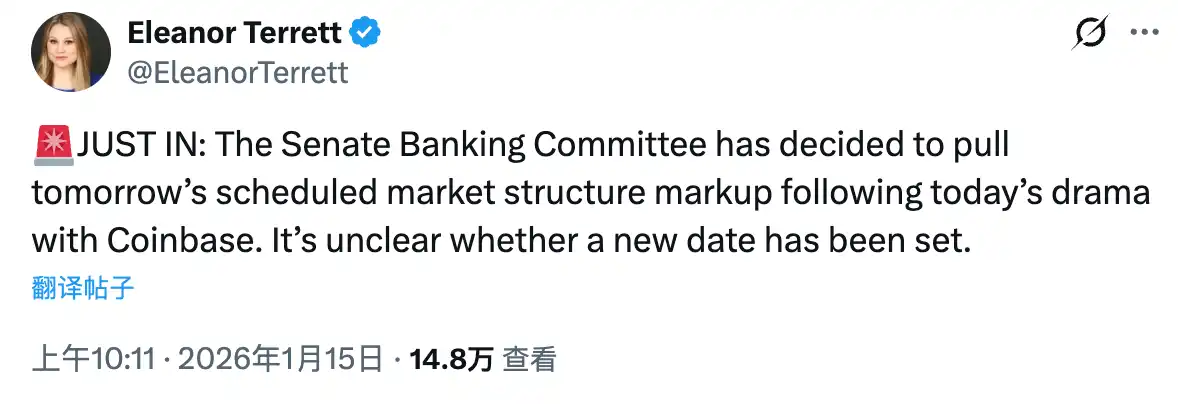
  • Odaily Note: Regarding the deliberation of CLARITY, the Senate Agriculture Committee (the main oversight committee for the CFTC) had also planned to deliberate concurrently with the Senate Banking Committee (the main oversight committee for the SEC) on January 15th. However, the Senate Agriculture Committee subsequently postponed its deliberation to January 27th first. The Senate Banking Committee was still preparing according to the original schedule, but it suddenly postponed the deliberation this morning just as it was approaching.

CLARITY Introduction (Skip if Familiar)

Last week, we detailed the content, significance, and progress of the CLARITY bill in the article "The Biggest Variable for the Crypto Market Outlook: Can the CLARITY Bill Pass the Senate?"

In short, CLARITY aims to clearly distinguish the classification of digital assets, divide the regulatory responsibilities of the U.S. Securities and Exchange Commission (SEC) and the Commodity Futures Trading Commission (CFTC), and thereby establish a clear, functional federal regulatory framework for the U.S. digital asset market, solving the long-standing problems of regulatory ambiguity and inconsistent enforcement.

For practitioners, the implementation of CLARITY will mean a substantive shift in the regulatory environment. In the future, there will be a more predictable compliance path. Market participants will be able to clearly know which activities, products, and transactions fall under regulatory purview, thereby reducing long-term regulatory uncertainty, litigation risks, and regulatory friction, and attracting more innovators and traditional financial institutions to enter the market.

For cryptocurrencies themselves, the implementation of CLARITY is expected to promote cryptocurrencies to become "an asset class more easily allocated by traditional capital." By resolving institutional uncertainty, it allows long-term capital that was previously unable to enter to obtain compliant entry paths, thereby raising the valuation floor of the entire market.

Severe Industry Division

Clearly, the cryptocurrency industry places great hope for the future regulatory environment on CLARITY. However, on the eve of the deliberation, major representative companies have expressed截然不同的 attitudes.

This morning, Coinbase, an important force in cryptocurrency legislative lobbying, clearly stated its opposition to the current version of the CLARITY bill.
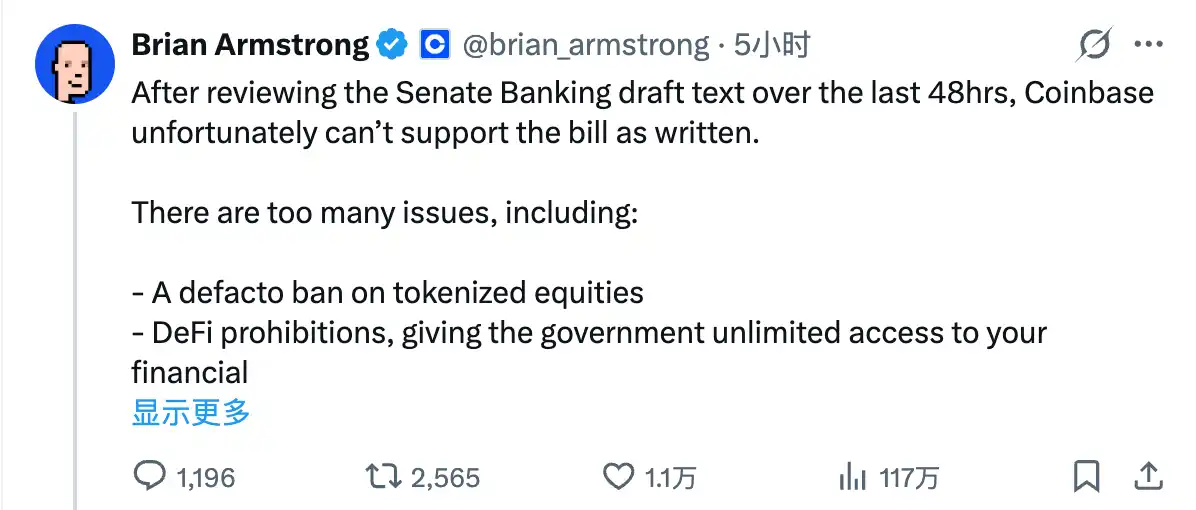
Coinbase founder Brian Armstrong posted, stating that the bill in its current text is worse than the status quo, and it's better to have no bill than a bad bill — "The bill has major problems with DeFi and stablecoin yields. Some clauses may grant the government unlimited access to personal financial records, harm user privacy, and potentially stifle stablecoin reward mechanisms."

At the same time, other industry representative companies such as a16z, Circle, Kraken, and Ripple expressed their support for the current version of CLARITY.

a16z's star partner Chris Dixon (a main promoter of the Web3 narrative) explained: "Crypto developers need clear rules...... Essentially, this bill is meant to achieve that. It's not perfect and will need some revisions before it becomes law, but if we want the U.S. to remain the best place in the world to build the crypto future, now is the time to advance CLARITY."

Kraken co-CEO Arjun Sethi explained that legislating around market structure is inherently complex, and friction is inevitable. The existence of遗留问题 doesn't mean the effort has failed, but rather that we are working on the hardest tasks...... Giving up now would only lock in uncertainty, leaving U.S. companies operating in a模糊 environment while the rest of the world moves forward.

Where Exactly Are the Defects in the Current Version of the Bill?

From the statements of the various parties above, it can be seen that whether it is Coinbase, which firmly opposes, or a16z and Kraken, which have暂时选择了支持, both sides have a common point in their attitude towards the current version of CLARITY, namely, they both recognize that the current version of the bill is not perfect and has certain defects — the difference is that Coinbase has chosen a more radical抵制, directly定性 it as a "bad bill," while a16z and Kraken have chosen more conservative measures, using more moderate terms like "not perfect" and "legacy issues" in their wording.

In fact,分歧 surrounding CLARITY has long existed — after the bill passed the House of Representatives on July 17th last year, it was originally planned to be deliberated by the Senate in the middle of last year, but was then pushed to October, then to the end of last year, then to 2026, and now it seems it will have to be postponed again......

As we mentioned in the previous article, the分歧 surrounding CLARITY mainly focus on DeFi regulation, stablecoin yields, and ethical规范 concerning the Trump family.

Regarding the ethical issues related to the Trump family, one of the industry's most active lawyers, Variant Chief Legal Officer Jake Chervinsky, explained that although many Democrats have stated they will vote against CLARITY if restrictions are not imposed on this, because ethical issues do not fall under the jurisdiction of the Senate Banking Committee, the deliberation hearing cannot discuss this issue, so this分歧 is not the current focus of controversy.

  • Odaily Note: This issue will definitely be a key point of attack for Democratic senators during the full Senate deliberation in the future.

As for the other core分歧, Jake Chervinsky broke them down into five more detailed points, as follows.

Point 1: Stablecoin Yield Issue

The GENIUS Act passed last year prohibited interest-bearing stablecoins, a compromise made to gain banking industry support, at the cost of stifling an entire category of innovative products.

But now, the banking industry is still dissatisfied with this clause and is trying to overturn it in CLARITY. This is because GENIUS stipulated that stablecoin issuers must not pay holders any form of interest or yield, but it did not restrict third parties from providing yields or rewards. However, Article 404 of the current CLARITY also prohibits third parties from providing yields. If the current version of the bill passes, holding stablecoins would not yield any收益 or rewards; incentives could only be obtained through payment behaviors.

Jake Chervinsky criticized that restricting stablecoin yields or rewards lacks reasonable policy basis. This would only harm U.S. consumer interests, the international status of the U.S. dollar, and U.S. national security. The reason banks strongly request this change is that large banks profit over $360 billion annually from payment and deposit services, and interest-bearing stablecoins directly threaten these profits.

Point 2: Security Tokenization

Last year, SEC Chairman Paul Atkins (Odaily Note: likely a reference to a previous initiative or a misattribution; Gary Gensler is the current SEC Chairman) launched the Project Crypto plan, aimed at upgrading the financial system by migrating it onto the chain. However, Article 505 of CLARITY seems to prevent the achievement of this goal by depriving it of the power to treat crypto assets fairly.

Paul Atkins emphasized "innovation exemptions," but Article 505 states that no securities regulatory requirements can be exempted or modified simply because a security is issued on-chain, nor can anyone be exempted from registration obligations based on this reason.

Point 3: Token Issuance

This is perhaps the most important part of CLARITY, providing a clear path for builders to issue tokens without worrying about SEC enforcement for issuing "unregistered securities."

Title 1 of CLARITY covers this path. It is clear, but not simple or cheap. Title 1 requires many projects to make信息披露, which is good in theory, but the devil is in the details — Title 1 includes extremely burdensome, nearly equity-level disclosure requirements, not much different from listed companies — including audited financial statements, etc. This system suits mature companies but is不适合 for startups.

This is just one of many details. Title 1 also requires builders to obtain SEC approval for each token;信息披露 obligations must continue long after issuance; the public fundraising cap is $200 million, etc.

Compared to this, creators might as well issue overseas or simply issue stocks.

Point 4: Developer Protection

Developers of non-custodial software are not money transmitters and should not bear user KYC obligations at all — this should be uncontroversial.

However, Title 3 of CLARITY多次暗示 regulatory agencies may extend their monitoring reach into the DeFi领域. These clauses must be deleted or amended.

Point 5: Institutional Access

Regulated financial institutions have always been reluctant to venture into DeFi due to compliance concerns.

Article 308 of CLARITY hoped to solve this problem but made a mistake on a key point — it imposes additional burdens on institutions, making it even more likely to scare them away from DeFi than the current situation.

The Radicals and the Conservatives

Based on Jake Chervinsky's breakdown of the core issues in the current version of the CLARITY bill above, it's easy to understand why Coinbase, a16z, Kraken, etc., all agree — this is not a perfect bill.

Faced with a bill containing hidden pitfalls, as representatives of the cryptocurrency industry, Coinbase, a16z, and Kraken actually have consistent fundamental interests, but differ in their strategies for争取利益.

Coinbase has chosen a more radical confrontational stance. Its core logic is that if CLARITY is passed with those industry-unfriendly clauses, even if只是模糊表述, they could be infinitely amplified at the enforcement level, forming long-term suppression of innovation. As for the subsequent cost of amending the law and political resistance, it might be far higher than the cost of continuing to endure the current regulatory uncertainty.

a16z, Kraken, Circle, and other institutions have adopted a more conservative, more "realistic" strategy. In their view, the biggest problem with the long stagnation of U.S. crypto regulation is not "the rules aren't good enough," but that there are no rules at all. Even if CLARITY has flaws, it at least provides a legislative starting point that can be revised,博弈, and gradually perfected. Once CLARITY is formally implemented, the U.S. crypto industry will for the first time have a unified federal framework. Subsequently, repairing specific clauses will反而 have more operational space.

There is no simple right or wrong here. The core of the contradiction lies in whether the bill should be advanced in its current version and how much compromise cost should be paid for it. This is also not some "industry infighting." The unified demand of both sides is to make CLARITY better; they have just chosen different博弈策略.

As Jake Chervinsky said: "For better or worse, this text will undergo significant changes before it becomes law. Let's hope it evolves for the better."


Perguntas relacionadas

QWhy was the CLARITY Act markup hearing in the U.S. Senate Banking Committee suddenly postponed?

AThe hearing was postponed due to market controversy sparked by Coinbase's sudden opposition to the current version of the CLARITY Act. The new markup time has not yet been determined.

QWhat is the primary purpose of the CLARITY Act?

AThe CLARITY Act aims to clearly classify digital assets and delineate the regulatory responsibilities between the SEC and CFTC, establishing a clear and functional federal regulatory framework for the U.S. digital asset market.

QWhat are the key points of disagreement that Coinbase has with the current version of the CLARITY Act?

ACoinbase opposes the current version due to significant problems with DeFi and stablecoin yield provisions. They argue it gives the government unlimited access to personal financial records, harms user privacy, and could stifle stablecoin reward mechanisms.

QDespite its flaws, why do some companies like a16z and Kraken support moving forward with the current CLARITY Act?

AThey support it because they believe it provides a starting point for clear federal rules. They acknowledge it's not perfect and needs amendments, but argue that having some framework is better than the current regulatory uncertainty, which hinders U.S. companies while other regions advance.

QAccording to Jake Chervinsky's analysis, what is a major flaw in Title I of the CLARITY Act concerning token issuance?

AA major flaw in Title I is that it imposes extremely burdensome, near-equity-level disclosure requirements (like audited financial statements) that are suitable for mature companies but are too costly and complex for startup projects, making it an impractical path for token issuance.

Leituras Relacionadas

Weekly Editor's Picks (0725-0731)

Weekly Editor's Picks (0725-0731) provides a curated selection of deep analysis, filtering out market noise. Key themes from this week include: **Macro & Policy:** The Federal Reserve's upcoming meeting is marked by high uncertainty, balancing cooling inflation data against persistent price pressures. Meanwhile, the U.S. crypto regulatory Clarity Act faces critical political hurdles, with its 2026 passage probability seen as low. **Investing & Crypto:** Analysis suggests long-term crypto success depends on conviction through volatile cycles, focusing on assets like Bitcoin and core smart contract platforms. A trend noted is the increasing similarity between global equity markets (especially tech) and crypto, driven by narrative and leverage. Several major crypto protocols show strong revenue growth, but this isn't always translating to token price appreciation due to sell pressure and structural factors. **AI & Semiconductors:** Nvidia's rising credit default swap rates signal market concern over AI infrastructure financing risks. The storage sector experienced volatility as markets began pricing in potential 2027 oversupply. Despite a record profitable quarter, SK Hynix's results were deemed "below expectations," reflecting heightened investor demands for future growth visibility. **Markets & DeFi:** TradeXYZ demonstrated remarkable accuracy in pre-market pricing for a major A股 listing. The token ONDO saw gains, linked to its growing role in the on-chain tokenized stock ecosystem. **Ethereum:** Post-Pectra upgrade, a major structural shift is underway as Lido begins migrating millions of ETH to new validator architectures designed for capital efficiency. **Also Highlighted:** Butian's bullish stock market move; OpenAI's Altman promising major advances; Samsung and SK Hynix securing large AI chip deals; Apple reaching a $5T market cap; and ongoing discussions around exchange security following Poolin's bankruptcy case.

marsbitHá 16m

Weekly Editor's Picks (0725-0731)

marsbitHá 16m

Low Investment Isn't Apple's Immunity Pass

While Meta and Google face investor scrutiny over ballooning AI capital expenditures, Apple's minimal AI investment has paradoxically become a strength. Its market cap recently reclaimed the global top spot, surpassing $5 trillion. The irony is deep: Apple's own AI efforts have lagged, with "Apple Intelligence" delayed and core talent lost, forcing reliance on partners like Google Gemini and Alibaba's Qianwen. Its Q3 FY2026 (Q2 CY) earnings initially seemed stellar. Revenue hit $109.4B (up 16% YoY), with iPhone and Mac sales, growing 22% and 29% respectively, driving most of the growth. However, the stock fell over 8% post-earnings. The primary concern was a weaker Q4 revenue growth forecast of 9-11%, below expectations, due to looming supply chain constraints. Apple is feeling the indirect cost of the AI boom. Soaring memory and chip prices, fueled by massive data center investments from Microsoft, Amazon, and others, are forcing Apple to raise Mac and iPad prices significantly. The upcoming iPhone launch is also expected to see substantial price hikes. Despite avoiding heavy AI infrastructure spending—its capital expenditures are actually down 28%—Apple cannot escape the industry-wide supply and cost pressures. While Apple's operating cash flow remains robust, its substantial R&D spending (up 32% YoY) has yet to yield major AI breakthroughs. As Tim Cook prepares to step down as CEO, Apple faces a challenging transition: balancing its premium hardware success against the strategic and cost pressures of the AI era it has so far cautiously navigated.

marsbitHá 1h

Low Investment Isn't Apple's Immunity Pass

marsbitHá 1h

PA Graphics Explanation | One Chart to Understand the Major Web3 Events in August 2026

**PANews Crypto Calendar: Key Web3 Events in August 2026** PANews introduces its revamped crypto calendar, featuring comprehensive coverage, flexible filtering, and easy export options. The market in August will be shaped by multiple key events across macroeconomics, regulation, tokenomics, and project developments: * **Macro & Policy:** Key US economic data releases (July Non-Farm Payrolls, CPI), the Federal Reserve meeting minutes, and the Jackson Hole Economic Symposium will be in focus. On the regulatory front, the US Senate plans to release a new draft of the *CLARITY Act*, while the EU's expanded crypto ban against Belarus comes into effect. * **Token Unlocks:** Significant token unlocks are scheduled for assets including ENA, AVAX, CONX, ZRO, and KAITO, which may influence market volatility. * **Project Updates & Shutdowns:** Several services, including Exchange Art, Ctrl Wallet, Zapper, NFTfi, and Summer.fi, are set to cease operations or undergo major adjustments. Users are advised to manage their assets accordingly. * **Corporate Activity:** Q2 earnings reports from companies like SpaceX, Circle, and Nvidia are due. Unitree Robotics will initiate its IPO subscription on the STAR Market, and Moonshot AI plans to begin a Pre-IPO financing round. * **Industry Events:** Major conferences such as Bitcoin Asia 2026 and the 2026 Digital Expo will take place. The overarching market narrative for August will revolve around macroeconomic expectations, regulatory developments, token unlock schedules, and ongoing industry consolidation.

marsbitHá 1h

PA Graphics Explanation | One Chart to Understand the Major Web3 Events in August 2026

marsbitHá 1h

Wall Street's Most Famous 'Cassandra' Now Has His Sights Set on Nvidia

Michael Burry, the famed "Big Short" investor, has once again captured Wall Street's attention with a series of short positions against major tech and semiconductor stocks, most notably Nvidia. In late June and July, through his "Cassandra Unchained" newsletter, Burry disclosed short bets against Nvidia, Tesla, Applied Materials, Caterpillar, the SOXX semiconductor ETF, and later, Micron Technology. His core thesis revolves around potential distortions in the AI infrastructure boom, specifically questioning whether extended depreciation schedules (e.g., 6 years vs. a realistic 2-3 years for AI chips) by cloud giants like Microsoft and Google artificially inflate profits. He also raises concerns about possible "off-balance-sheet circular financing," where chip demand might be propped up by vendor-backed funding to clients. Nvidia's stock experienced volatility following these disclosures, briefly dipping but largely holding near Burry's reported entry points, leaving his positions roughly flat or slightly underwater as of late July. This move is part of a pattern for Burry, whose track record since his legendary 2008 bet is mixed. He has faced notable losses, such as on Tesla in 2021, while scoring on broader market turns like the 2020 pandemic crash. His methodology focuses intensely on free cash flow and scrutinizing original financial documents to spot overvaluation and structural risks, but it often struggles with timing the market. The article contrasts Burry's stance with other prominent investors. Steve Eisman, another "Big Short" figure, is not shorting Nvidia, citing strong fundamentals but expressing nervousness about sustainability. Jim Chanos agrees with the broad "accounting mismatch" concern—comparing it to the dot-com bubble—but targets financial leverage in private equity firms rather than the chip stocks themselves. While Nvidia's short interest remains relatively low at 1.3-1.4% of float, the massive stock size means absolute short losses have been significant, exceeding $5 billion earlier this year. The piece concludes that for ordinary investors, the key takeaway is not replicating specific short bets but learning from the critical frameworks these investors use: questioning rosy accounting, identifying structural vulnerabilities, and maintaining skepticism during market euphoria, even if pinpointing the exact catalyst for a downturn remains elusive.

marsbitHá 1h

Wall Street's Most Famous 'Cassandra' Now Has His Sights Set on Nvidia

marsbitHá 1h

Weekly Selection丨Epic Stock Market Volatility, Changxin Tech's IPO Reshapes Storage Landscape, Saylor Aims to Re-Anchor STRC Around September 8th

PANews Weekly Digest: Market Turmoil, Tech Breakthroughs, and Crypto Developments. The week saw significant volatility across global markets. South Korea's KOSPI index experienced extreme turbulence, including multiple trading halts, largely driven by sharp declines in AI hardware stocks like SK Hynix. In contrast, China's Changxin Xinqiao (CXC) achieved a landmark IPO with a market cap surpassing 4 trillion yuan, marking a major success for the domestic DRAM industry after a decade of losses. In the crypto and Web3 space, several key narratives emerged. AI is driving demand for new infrastructure, with projects like AI agent wallets and programmable payments gaining traction, attracting interest from firms like Coinbase. The Bitcoin mining sector is pivoting, with companies like MARA focusing on energy management as electricity becomes a core AI-era asset. Meanwhile, the RWA (Real World Assets) sector faces a "utilization puzzle," with hundreds of billions in on-chain assets remaining dormant. Notable market movements included a historic single-day surge of over 17% for the KOSPI index and a significant migration of $16.5 billion in staked ETH within the Lido ecosystem. Michael Saylor announced a target to re-peg the STRC stablecoin around September 8th. Other highlights include discussions on Ethereum's ambitious 2030 roadmap for scaling and privacy, analysis showing high protocol revenues not always translating to token price gains, and warnings from Citi about potential extreme commodity price shocks by late 2026.

marsbitHá 1h

Weekly Selection丨Epic Stock Market Volatility, Changxin Tech's IPO Reshapes Storage Landscape, Saylor Aims to Re-Anchor STRC Around September 8th

marsbitHá 1h

Trading

Spot
活动图片




