Brokerage Giant Charles Schwab Rolls Out Spot Crypto Trading To Retail Investors

bitcoinistPublicado em 2026-05-14Última atualização em 2026-05-14

Resumo

Charles Schwab has officially launched its spot crypto trading platform, Schwab Crypto, to a select group of retail investors in the US, excluding New York and Louisiana. The service allows direct trading of Bitcoin (BTC) and Ethereum (ETH) with a 75-basis-point fee, linked to clients' brokerage accounts. Schwab Premier Bank will serve as custodian, with Paxos handling trade execution. The firm plans to add more assets and transfer capabilities. This move expands Schwab's offerings beyond indirect crypto investment products. It follows a trend of major institutions entering the space, as Morgan Stanley also recently launched a crypto trading pilot on its E*Trade platform with a 50-basis-point fee, aiming for wider rollout later this year.

Brokerage and banking firm Charles Schwab officially began rolling out its crypto trading platform to retail clients in the US, joining the list of traditional financial institutions expanding their digital asset offering.

Schwab Launches Spot Trading For BTC, ETH

On Tuesday, the $11.7 trillion brokerage giant Charles Schwab revealed that it officially launched its spot digital asset trading platform, Schwab Crypto, to a select group of retail customers.

According to the X announcement, the first group of clients can trade Bitcoin (BTC) and Ethereum (ETH) directly on its platform alongside their other digital asset-related investment products.

The crypto trading platform is available in all US states, excluding New York and Louisiana, and will charge a 75-basis-point fee on the dollar value of each trade, which is among the lowest in the industry.

Last month, the firm revealed the platform would be introduced in phases, starting with an internal employee pilot, moving to a client waitlist, and then opening to eligible customers throughout the rest of 2026.

As reported by Bitcoinist, the company explained that Schwab clients will maintain separate accounts under the new platform, which will be linked directly to their brokerage accounts.

Notably, Charles Schwab Premier Bank (CSPB) will serve as the custodian for customers’ assets, handling safekeeping and record-keeping. Meanwhile, blockchain infrastructure provider Paxos will handle trade execution and sub-custody, using a federally overseen trust model and enterprise-grade technology

The brokerage giant also revealed plans to add additional digital assets to the platform and introduce transfer capabilities for both deposits and withdrawals, allowing clients with existing digital asset investments to bring them to Schwab alongside their other accounts.

Jonathan Craig, Head of Retail Investing at Charles Schwab, previously noted that with Schwab Crypto, the firm seeks to allow clients who want direct access to the asset class to benefit from the service, educational resources, and research tools they expect from the company.

Traditional Institutions Expand Crypto Offerings

This move marks a major expansion from Schwab’s previous digital asset-related offerings, which included indirect exposure to investments through spot crypto Exchange-traded products (ETPs), futures, options on spot crypto ETPs, crypto-related ETFs, and mutual funds that invest in the broader digital asset ecosystem. Schwab clients hold approximately 20% of spot crypto ETPs, the firm noted.

Moreover, the launch comes as major banks and brokerages race to add digital‐asset products and integrate crypto into mainstream investing, with several firms expanding retail digital asset offerings in recent years.

Last week, Wall Street behemoth Morgan Stanley also launched a crypto trading pilot on its E*Trade platform to a limited number of users, seeking to challenge major players, including Schwab, with competitive pricing.

The banking giant is charging E*Trade users a 50-basis-point fee on the transaction value, placing its prices below Robinhood’s 95 basis points, Coinbase’s 60 basis points, and Schwab’s 75 basis points.

While the pilot is currently available only to a limited group, Morgan Stanley expects to expand access to all of E*Trade’s 8.6 million clients later this year. The bank’s executives are reportedly preparing an offering to directly convert digital assets into shares of ETPs without selling the assets, and planning to add the ability to trade tokenized equities in the second half of 2026.

Jed Finn, Morgan Stanley’s head of wealth management, affirmed that the launch is “much bigger than trading crypto at a cheaper rate,” explaining that their strategy is “disintermediating the disintermediators.”
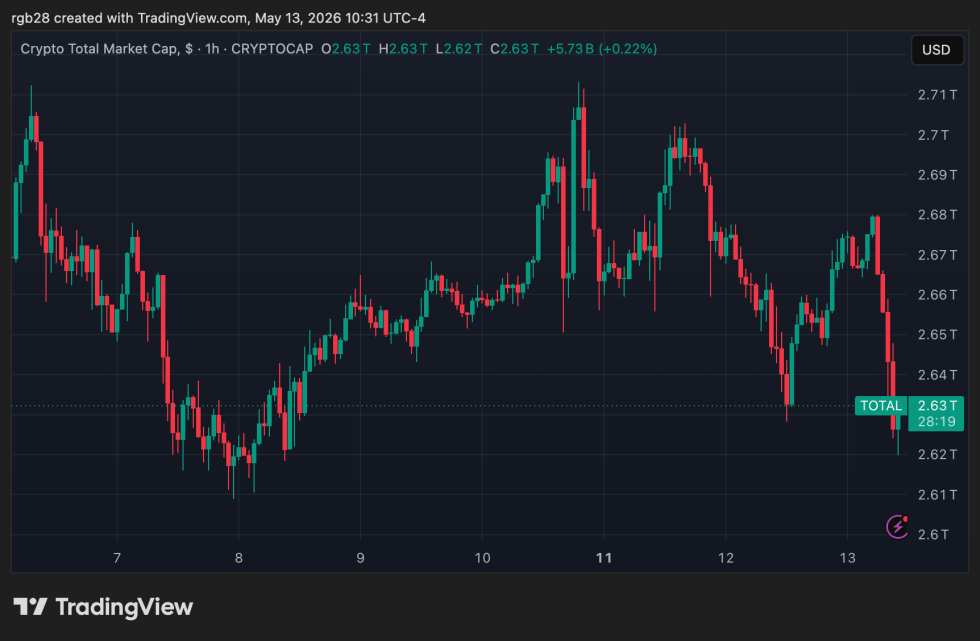
The total crypto market capitalization is at $2.63 trillion in the one-week chart. Source: TOTAL on TradingView


Perguntas relacionadas

QWhat is the name of the new crypto trading platform launched by Charles Schwab and which two major cryptocurrencies can users trade on it?

AThe new platform is called Schwab Crypto. Users can trade Bitcoin (BTC) and Ethereum (ETH) directly on the platform.

QWhat is the trading fee charged by Charles Schwab on its Schwab Crypto platform, and how does it compare to competitors like Coinbase and Morgan Stanley?

ACharles Schwab charges a 75-basis-point (0.75%) fee on the dollar value of each trade on Schwab Crypto. This is higher than Morgan Stanley's 50 basis points but lower than Coinbase's 60 basis points for its users.

QWhat two US states are currently excluded from accessing the Schwab Crypto platform?

AThe Schwab Crypto platform is available in all US states, excluding New York and Louisiana.

QWhat are the roles of Charles Schwab Premier Bank (CSPB) and Paxos in the operation of the Schwab Crypto platform?

ACharles Schwab Premier Bank (CSPB) serves as the custodian for customers' assets, handling safekeeping and record-keeping. Blockchain infrastructure provider Paxos handles trade execution and sub-custody.

QWhat is the stated strategic goal of Morgan Stanley's crypto launch on E*Trade, according to Jed Finn, its head of wealth management?

AJed Finn stated that the launch is 'much bigger than trading crypto at a cheaper rate,' explaining that their strategy is 'disintermediating the disintermediators.'

Leituras Relacionadas

Who Will Define the Rules of the AI Era? Anthropic Discusses the 2028 US-China AI Landscape

This article, based on Anthropic's analysis, outlines the intensifying systemic competition between the U.S./allies and China for AI leadership by 2028. It argues that access to advanced computing power ("compute") is the critical bottleneck, where the U.S. currently holds a significant advantage through chip export controls and allied innovation. However, China's AI labs remain competitive by exploiting policy loopholes—via chip smuggling, overseas data center access, and "model distillation" attacks to copy U.S. model capabilities—keeping them close to the frontier. The piece presents two contrasting scenarios for 2028. In the first, decisive U.S. action to tighten compute controls and curb distillation locks in a 12-24 month AI capability lead, cementing democratic influence over global AI norms, security, and economic infrastructure. In the second, policy inaction allows China to achieve near-parity through continued access to U.S. technology, enabling Beijing to promote its AI stack globally and integrate advanced AI into its military and governance systems, altering the strategic balance. Anthropic contends that maintaining a decisive U.S. lead is essential for shaping safe AI development and governance. The core recommendation is for U.S. policymakers to urgently close compute and model access loopholes while promoting global adoption of the U.S. AI technology stack to secure a lasting strategic advantage.

marsbitHá 53m

Who Will Define the Rules of the AI Era? Anthropic Discusses the 2028 US-China AI Landscape

marsbitHá 53m

“Why Didn’t You Buy 2x Long SK Hynix?”

The article discusses the immense popularity of the "2x Long SK Hynix ETF" (07709.HK) in Hong Kong, which became the world's largest single-stock leveraged ETF by May 2026. Launched in October 2025, the ETF's net value soared over 1000% in seven months, significantly outperforming the 324% gain of SK Hynix's underlying stock, driven by the AI boom and a critical shift in industry demand from computing power to memory. It highlights the mechanics and risks of daily-rebalanced leveraged ETFs. In a smooth bullish market, they generate amplified returns, but during volatile periods—exemplified by market swings during geopolitical tensions in the Strait of Hormuz in March-April 2026—they suffer severe "volatility decay," where choppy price action can cause losses far exceeding twice the drop of the underlying asset. The piece frames SK Hynix, as NVIDIA's primary HBM supplier, within the classic cycle of the memory chip industry—a commoditized sector prone to boom-and-bust cycles of shortage, price hikes, overcapacity, and crashes. While current AI-driven demand and high margins (Q1 2026毛利率~79%) create a "super cycle," the article questions its sustainability. It warns that extreme profits will inevitably tempt competitors like Samsung and Micron to ramp up HBM production, potentially eroding scarcity. Furthermore, the entire narrative remains tethered to the massive AI capital expenditure of tech giants. In conclusion, the ETF's trajectory symbolizes the accelerated, all-in nature of the current AI revolution, where timeframes are compressed and market moves are extreme. However, it also underscores that while industry trends define ultimate returns, macro-geopolitical risks dictate the volatile and uncertain path to get there.

marsbitHá 55m

“Why Didn’t You Buy 2x Long SK Hynix?”

marsbitHá 55m

a16z Crypto: A Guide to the CLARITY Act for Crypto Entrepreneurs

The CLARITY Act, a bipartisan crypto market structure bill, has advanced through the Senate Banking Committee, marking a potential historic shift in U.S. digital asset regulation. For years, a lack of clear rules has stifled innovation, pushed development overseas, and exposed consumers to risk. This bill aims to establish a comprehensive framework, providing long-needed regulatory clarity for blockchain networks and digital assets. It builds upon previous legislative efforts like FIT21 and the House version of CLARITY, which gained strong bipartisan support. CLARITY is crucial because it recognizes that blockchain networks are fundamentally different from traditional companies. Networks operate through decentralized, shared rules rather than centralized control. Applying corporate legal frameworks to networks forces them into a centralized model, concentrating power and value. In contrast, decentralized blockchain networks can function as user-owned public infrastructure, distributing value more equitably among participants. The bill seeks to enable the safe launch of networks in the U.S., clarify regulatory jurisdiction between the SEC and CFTC, oversee crypto exchanges, and enhance consumer protections. Its passage would align U.S. law with the nature of decentralized technology, allowing builders to operate transparently and fund projects domestically without structural compromises due to regulatory uncertainty. Similar to the positive impact seen after the stablecoin-focused GENIUS Act, CLARITY could unlock a new wave of innovation, helping the U.S. reclaim leadership in the crypto space while combating fraud and abuse.

链捕手Há 1h

a16z Crypto: A Guide to the CLARITY Act for Crypto Entrepreneurs

链捕手Há 1h

Trading

Spot
Futuros
活动图片