Ethereum is struggling to reclaim higher price levels as persistent resistance continues to cap upside momentum. After repeated failed recovery attempts, ETH remains locked in a fragile structure that reflects broader uncertainty across the crypto market. While analyst opinions remain divided on the near-term outlook, a growing majority are increasingly vocal about the risk of a broader bear market emerging in 2026, citing weakening momentum, deteriorating sentiment, and fading liquidity as key warning signs.
Against this uneasy backdrop, on-chain activity has drawn renewed attention. Data tracked by Arkham shows that a high-profile Bitcoin OG — known for correctly shorting the market during the sharp sell-off on October 10 — has made a significant move involving a substantial Ethereum position. The scale and timing of this activity have not gone unnoticed, particularly given the trader’s track record and influence on market sentiment.
The transaction has fueled speculation about intent. Some market participants interpret the move as a defensive repositioning amid rising downside risk, while others view it as a calculated adjustment ahead of heightened volatility. Regardless of interpretation, large transfers from well-known entities tend to carry signaling value, especially when they occur during periods of technical fragility.
As Ethereum remains pinned below key resistance levels, the market is now watching closely to see whether this on-chain development foreshadows renewed selling pressure or signals a more complex shift in positioning. With sentiment already strained, the coming sessions may prove pivotal for Ethereum’s medium-term direction.
Ethereum Whale Transfer Sparks Positioning Speculation
On-chain data shared by Lookonchain has flagged a significant move by the so-called Bitcoin OG, a trader known for managing a massive $717 million long exposure across Bitcoin, Ethereum, and Solana. The wallet associated with this entity has deposited 100,000 ETH, worth roughly $292 million, into Binance, immediately drawing attention from both investors and analysts.
Given the size of the transfer and the trader’s prior market influence, the transaction is widely viewed as a potential signal rather than a routine activity.
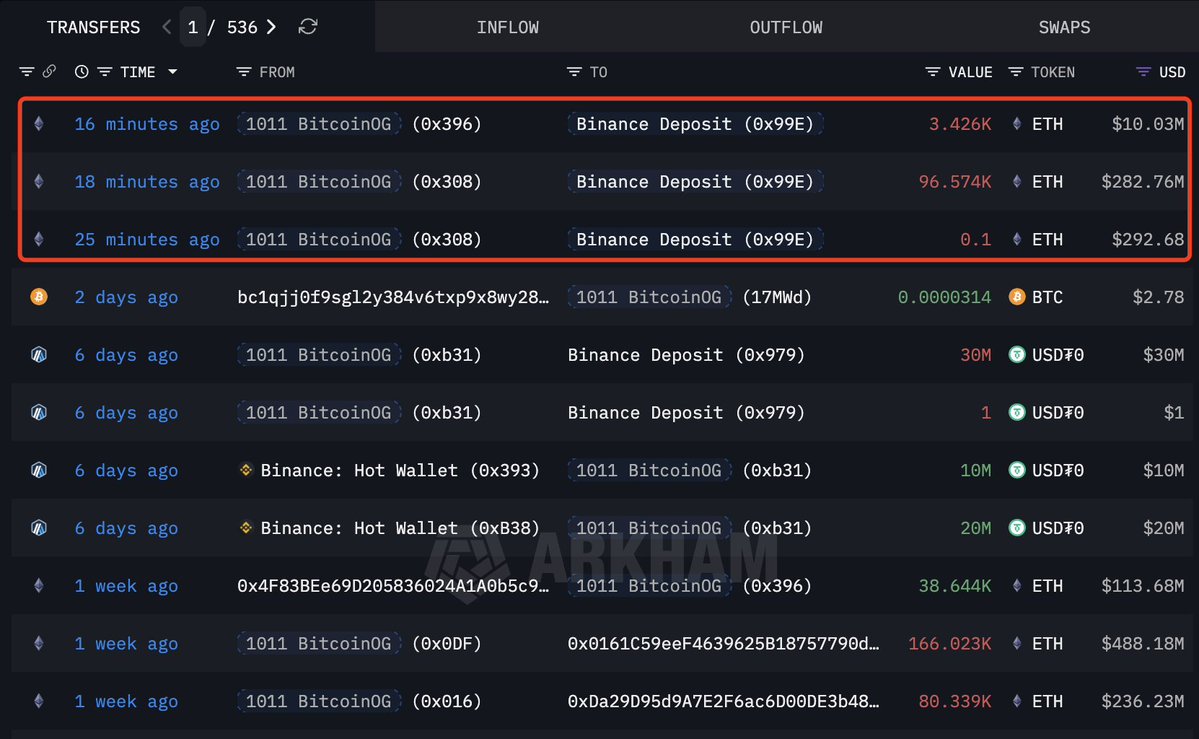
Several scenarios stand out as the most plausible explanations. The most straightforward is risk management. Moving ETH onto an exchange allows the holder to reduce exposure, either by selling spot ETH or by opening hedges through derivatives to protect an existing long portfolio amid heightened volatility. Another possibility is collateral management. Large traders often transfer assets to exchanges to support margin requirements or rebalance leverage, especially during periods of declining prices.
Less bearish interpretations also remain on the table. The deposit could be part of a short-term tactical trade, enabling rapid execution without signaling an intention to fully unwind the position. In some cases, large holders move assets between custodians or exchanges for operational reasons, though the timing makes this less likely.
Ultimately, the deposit does not confirm outright selling. However, it does suggest that the trader is actively managing risk. As Ethereum remains under technical pressure, markets will be watching closely to see whether this ETH transfer precedes further distribution or proves to be a temporary adjustment within a broader long-term strategy.