Author: Claude, Deep Tide TechFlow
Deep Tide Introduction: On April 23, Tether cooperated with OFAC and U.S. law enforcement agencies to freeze a total of 344 million USDT in two wallets on the Tron chain, setting a historical record for the largest single freeze. This action, occurring against the backdrop of intensified enforcement of Iran sanctions and criticism of Circle's ineffective freezing after the Drift Protocol's $285 million hack, has once again pushed the 'one-click freeze authority' of stablecoin issuers into the spotlight of public opinion. Tether has cumulatively frozen over $4.4 billion in assets, but its approximately $189 billion in circulation has never undergone a comprehensive audit.
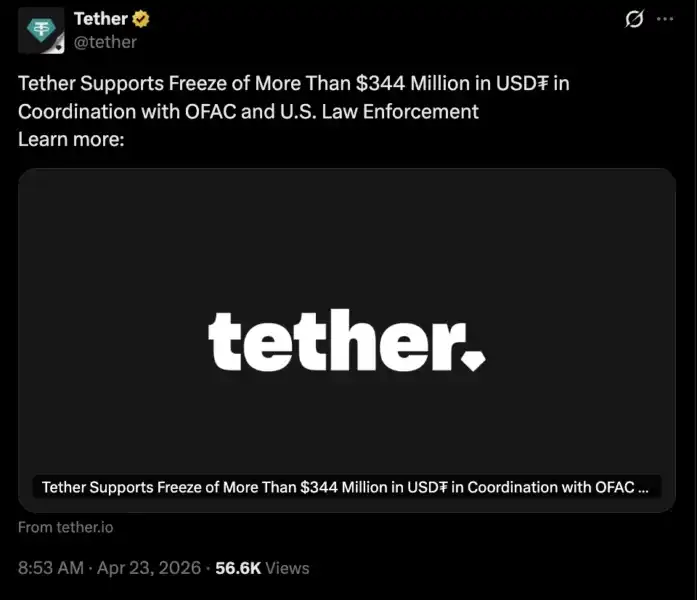
The largest single compliance freeze in stablecoin history has been implemented.
On April 23, Tether issued a statement confirming it had cooperated with the U.S. Department of the Treasury's Office of Foreign Assets Control (OFAC) and multiple law enforcement agencies to freeze USDT in two wallet addresses on the Tron chain, totaling over $344 million. Blockchain security company PeckShield first identified the two blacklisted addresses on-chain: TNiq9...QZH81 held approximately $212.9 million, and TTiDL...pjSr9 held approximately $131.3 million.
Tether stated that the freezing action was based on intelligence shared by U.S. authorities, involving sanctions evasion, criminal networks, or other illegal activities, but did not disclose the specific subjects of the investigation or the nature of the case. Blockchain analysis company AMLbot claimed these two addresses had appeared in documents related to scams, with one linked to a forged $75 billion contract and another involving a Bitcoin-for-USDT scam promising 10% instant returns.
Largest Single Freeze in History, Nearly Double the Previous Record
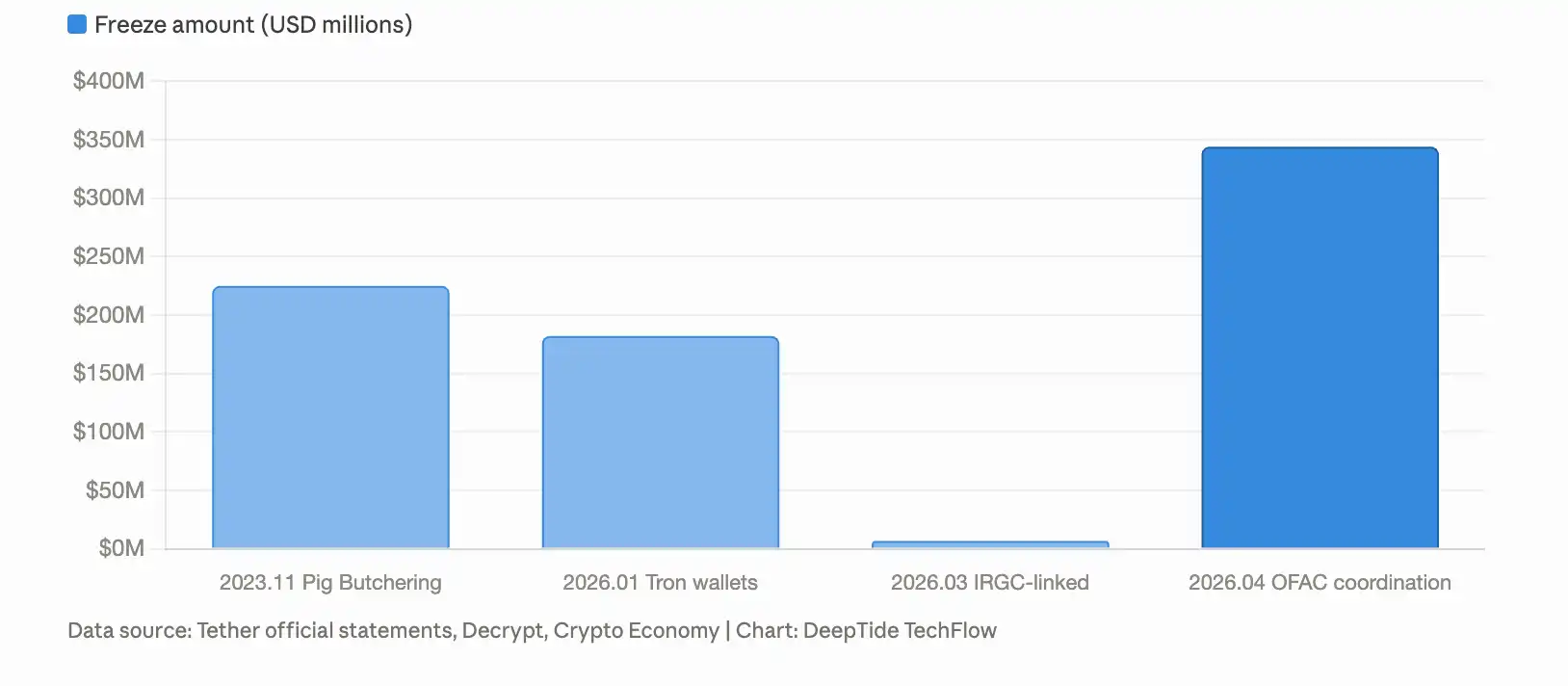
This is the largest single freeze action on record for Tether, nearly double the $182 million freeze in January of this year.
Tether CEO Paolo Ardoino stated in the declaration that USDT is not a safe haven for illegal activities, and when credible links to sanctioned entities or criminal networks are found, the company takes immediate action. He also subtly referenced competitor Circle's slow response in the Drift Protocol incident, saying, 'Recent events have shown that when platforms fail to act swiftly, law enforcement breaks down, users are exposed, and trust is lost.'
According to data disclosed by Tether, the company currently cooperates with over 340 law enforcement agencies in 65 countries, has assisted in over 2,300 cases, and has cumulatively frozen assets exceeding $4.4 billion, of which $2.1 billion is directly related to U.S. law enforcement. Previous large-scale freezes include: approximately $225 million frozen in November 2023 (related to investigations into human trafficking and pig-butchering scams in Southeast Asia), and approximately $182 million frozen in January 2026 (five Tron wallets).
Sanctions Background: Iran, Drug Networks, and OFAC Enforcement Escalation
According to The CC Press, this freeze was executed under OFAC's Iran-related sanctions framework. This timing is significant.
On the same day (April 23), the U.S. Treasury Department announced sanctions against 23 individuals and entities linked to the Sinaloa drug cartel, involving a complex supply chain network procuring fentanyl and methamphetamine precursor chemicals from Asia. Although this sanctions action is not the same case as the Tether freeze, both point to the same policy direction: the U.S. is comprehensively escalating its enforcement of sanctions through cryptocurrency channels.
Regarding Iran, the scale of using USDT to evade sanctions has expanded dramatically in recent years. According to a TRM Labs investigative report cited by The Block in January this year, two UK-registered exchanges, Zedcex and Zedxion, actually provided financial channels for the IRGC (Islamic Revolutionary Guard Corps), processing approximately $1 billion in transactions between 2023 and 2025, 56% of which were IRGC-related transactions, almost all settled using USDT on the Tron chain. IRGC-related transaction volume surged from $24 million in 2023 to $619 million in 2024.
U.S. Senator Richard Blumenthal has publicly called Tether a 'key money laundering tool' for the IRGC, sanctioned Iranian banks, and Iranian weapons manufacturers. In March of this year, Tether also froze $6.76 million USDT linked to networks associated with the IRGC and the Houthis.
Community Questions 'Your Coins Were Never Yours'
However, there is still controversy surrounding the specific attribution of this $344 million freeze.
According to on-chain analysis published by @asvanevik (Nansen CEO Alex Svanevik) on platform X, the network involved with the frozen addresses has been operating since 2021, had fund interactions with the Turkish exchange Paribu, but had only about $1.5 million in transaction records with known IRGC wallets, accounting for 0.4% of the total frozen amount. Svanevik assessed the credibility of attributing this network to the IRGC at 40%-50%.
Meanwhile, the crypto community's reaction is clearly divided.
Crypto media TFTC directly wrote: 'Tether one-click froze $344 million. Your stablecoin was never your stablecoin.' The media used this event as a counterexample to Bitcoin's uncensorable nature, emphasizing that Bitcoin has no issuer, no compliance desk, and no intermediary that can freeze balances.
On-chain data supports the realistic basis for this concern. The USDT smart contract has a built-in blacklist function on every supported chain. Once an address is blacklisted, the related tokens, even if visible on-chain, cannot be transferred, exchanged, or redeemed. To date, Tether has frozen over $3.3 billion USDT across more than 7,000 wallets.
On the other hand, the regulatory faction believes this precisely proves that stablecoins can become effective compliance infrastructure. Unlike cash, every transaction on a public chain is traceable, and the issuer's freezing capability provides law enforcement with speed and precision unattainable by traditional finance.
Between regulatory compliance and the ideal of decentralization, stablecoins are moving towards an increasingly clear hybrid model:
Centralized control rights operating on decentralized infrastructure.