Author: Max.s
A man who lost 90 billion dollars decides to start a project that doesn't involve spending money.
You read that right.
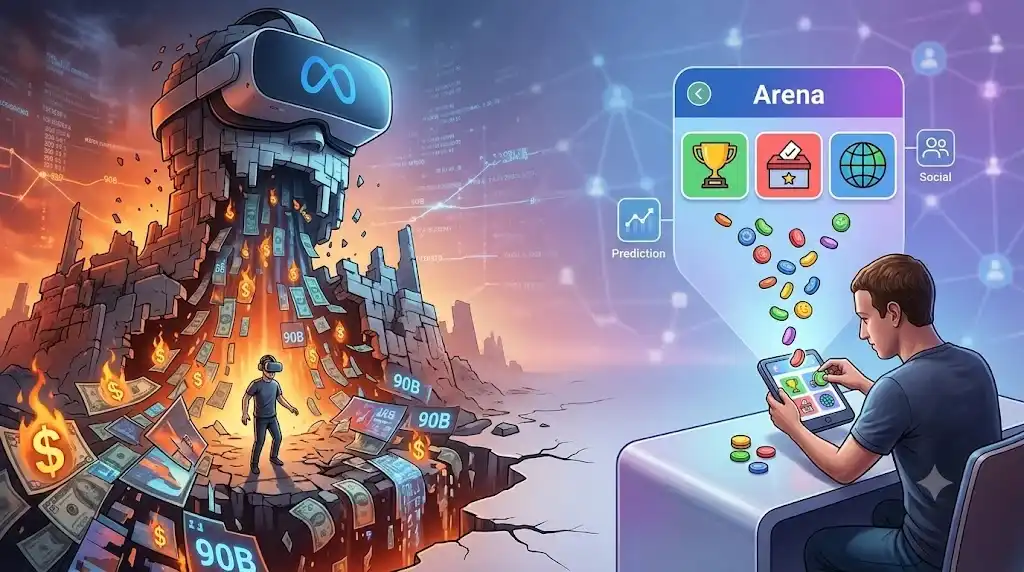
Just yesterday, The New York Times reported that Zuckerberg is personally leading the development of a prediction market app called Arena — users can bet on the outcomes of elections, sports, and major international events, but the chips are points. Not dollars, not USDC, but 'fun beans'.
That's right! The kind you don't feel bad about losing all night in mahjong.
What Lessons Can 90 Billion Dollars Buy?
First, let's review Meta's "Chronology of Burning Money."
In 2021, Zuckerberg renamed Facebook to Meta, announcing plans to build the metaverse. His Reality Labs division began spending lavishly — VR headsets, the virtual social platform Horizon Worlds, immersive office spaces...
And the result?
Horizon Worlds' monthly active users once fell below 200,000, failing to even reach its initial goal of 500,000. It lost 17.7 billion dollars in 2024 and 19.2 billion dollars in 2025, with cumulative losses approaching 90 billion dollars. 90 billion. That's enough money to buy several Polymarkets.
And Meta itself admitted that its loss scale for 2026 would be "in line with 2025."
In other words, before even filling this bottomless pit of the metaverse, Zuckerberg is already eagerly digging a new hole next to it.
From "Changing the World" to "Copying Others' Homework"
Interestingly, this isn't Meta's first attempt at prediction markets.
During the early days of the pandemic in 2020, Meta launched a crowdsourced prediction app called Forecast, allowing users to guess the course of current events. The result? It was quietly taken down in 2022.
Back then, Polymarket wasn't hot yet, Kalshi hadn't won its lawsuit against the CFTC, and the entire prediction market's annual trading volume was less than 50 billion dollars.
Now? In 2026, the industry's trading volume has surpassed 130 billion dollars, Kalshi's valuation is hitting 40 billion dollars, and Polymarket's valuation is 9-15 billion dollars.
Others made the cake bigger, and Zuckerberg smells it and comes running.
Does this playbook sound familiar? Snapchat launches Stories → Instagram launches Stories. TikTok popularizes short videos → Meta launches Reels. Twitter is still breathing → Meta launches Threads.
Every time it's: You get hot, I copy it, I crush you with 3.5 billion users worth of traffic.
Most of the time, this tactic works. But prediction markets are not short videos, nor are they ephemeral stories.
The Soul of a Prediction Market is "Real Money"
Let me explain why this is so absurd.
Prediction markets can forecast accurately because participants are betting their own money. You think seriously only when it hurts, you tell the truth only when you lose. Prices reflect probabilities because every dollar is a vote cast with real money.
Now Meta says: We're going to make a prediction market, but we won't let users spend real money.
This is like opening a Michelin-starred restaurant where all the dishes are made of air. The decor is luxurious, the menu is exquisite, customers come in droves — but everyone is just chewing on air.
Predictions without the constraint of real money aren't predictions; they're votes.
And the internet is never short on votes. Comment sections on Weibo vote every day, WeChat Moments are full of predictions every day — have you ever seen an accurate probability calculated from "likes"?
Zuckerberg, of course, knows this. The real purpose of the points system isn't to make predictions, but to bypass regulation.
In April 2026, the CFTC initiated the first-ever insider trading lawsuit in prediction market history — a US military officer profited on Polymarket using classified intelligence. The regulatory winds are already clear.
So Arena uses points. In the eyes of the law, this is a "game." In the eyes of the product, this is "social." In the eyes of prediction markets — this is an empty shell with its soul sucked out.
The Most Expensive "Toe-Dip"
Let's put the two most glaring numbers together:
Reality Labs cumulative losses: 90 billion dollars
Arena's starting design: A points game where you can't spend real money
A company that burned through 90 billion dollars on hardware and content turns around and creates a "zero-financial-risk" social toy.
This isn't "learning a lesson"; this is a cat that got scalded by boiling water — now it's even afraid to touch lukewarm water.
The lesson from the metaverse is crystal clear: the cost of creating a new track out of thin air is extremely high. But Zuckerberg's takeaway seems to be: Then I won't create a new track, I'll just copy one that others have already proven.
The problem is, the premise of others' success is real money. Polymarket made its name in the 2024 election because every dollar was a vote with real money. Kalshi could raise money from Morgan Stanley because of its CFTC license and years of federal litigation.
These things, no matter how much traffic you have, cannot be replicated.
3.56 billion daily active users is indeed terrifying. But if those 3.56 billion people come to Arena and cast a bunch of "fun bean predictions" with points, then what?
The predicted probabilities are inaccurate → Users find it boring → Engagement drops → Zuckerberg says "it's an experimental project" → Quietly taken down.
The script is exactly the same as Forecast.
Maybe Zuck Just Doesn't Care About Accurate Predictions
Finally, let's consider a "contrarian view" — what if we've got it wrong?
Maybe Zuckerberg never intended to build a real prediction market. Maybe Arena's goal is simply to be a hot-topic social platform: users come here not to make money, but to see what others think, argue with friends, and show off their "prediction accuracy."
In essence, it's no different from arguing on Weibo, just with an added scoring system.
In this logic, points aren't a defect; they're by design. Real money would actually scare away ordinary users. What Meta wants isn't financial depth; it's user time.
If this path works, Kalshi and Polymarket might actually benefit — Meta introduces the concept of "prediction" to billions who have never touched financial derivatives. A small portion of them might think, "Points aren't exciting enough, I want to play with real money," and then flow to licensed platforms.
Meta grows the pie, and the professional platforms eat it.
This is probably the outcome everyone doesn't want to see, but the one most likely to happen.
So the question is: Do you think Zuckerberg has finally gotten smart this time, or is he just repeating past mistakes in a cheaper way?