No Bull Market for BTC Without STRC Re-pegging

Odaily星球日报Publicado em 2026-06-26Última atualização em 2026-06-26

Resumo

Summary: The sustained de-pegging of MicroStrategy's (MSTR) Strategy Preferred Shares (STRC) poses a severe threat to Bitcoin (BTC) and could prevent a bull market. STRC, designed to trade near a $100 target, has plunged to around $75, effectively shutting down MicroStrategy's cheapest and most efficient funding channel. This channel was critical for its "raise funds, buy BTC" business model. More critically, MicroStrategy now faces a massive cash outflow from these preferred shares. With approximately $10.49 billion of STRC outstanding at an 11.5% dividend yield, the annual cash obligation exceeds $1.2 billion. Combined with other preferred shares, the total annual payout nears $1.7 billion, depleting its current ~$1.4 billion cash reserve within a year. To address this, MicroStrategy is increasingly relying on common stock (MSTR) offerings via its ATM program. However, recent sales show most raised capital is now used to bolster cash reserves rather than buy more Bitcoin. This dilutes the key metric of BTC per share for common stockholders, eroding the foundation of its premium valuation. If STRC cannot re-peg, this costly dilution may continue. Worse, if cash pressure intensifies, selling Bitcoin becomes a real risk. As the largest corporate BTC holder (~847,363 BTC), any significant sales could crash the market. Thus, MicroStrategy is transforming from BTC's most reliable institutional buyer into a major potential seller, casting a significant shadow over Bitcoin's pri...

Original | Odaily Planet Daily(@OdailyChina)

Author|Azuma(@azuma_eth)

The "de-pegging" situation of MicroStrategy's preferred stock STRC continues to intensify.

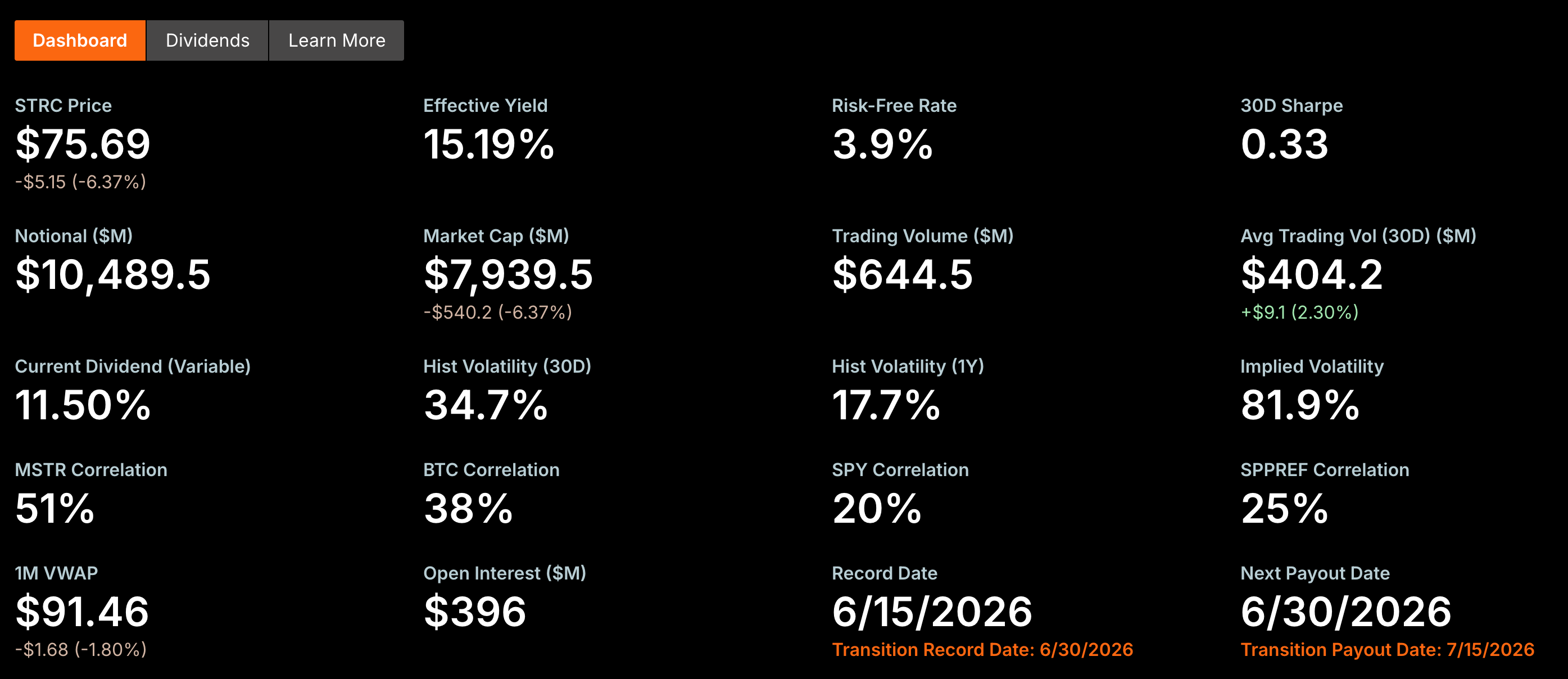
During yesterday's U.S. stock market session, STRC broke below the 80 mark for the first time, hitting a low of $73.62 at one point. Although it rebounded slightly at the close, the price was still only $75.69, nearly 25% "de-pegged" from the target par value of $100.

Last week, we wrote an article about STRC's de-pegging titled "STRC De-pegged by 11%, Can MicroStrategy's Perpetual Motion Machine Keep Running?", focusing on the reasons for STRC's de-pegging and briefly describing the potential future impacts.

However, based on community discussions, it seems many readers still don't fully understand just how dire the consequences of STRC's continued de-pegging are, so we decided to write another article to break down this issue.

MicroStrategy's Most Important Funding Channel Has Failed

What exactly is STRC? In a nutshell, this is MicroStrategy's cheapest and most efficient funding channel.

The essence of MicroStrategy's business model is to continuously raise funds from the market to accumulate more BTC, then raise more funds, and accumulate more BTC. This is a cycle that must keep running. MicroStrategy's high valuation, to a large extent, stems from the market's belief in its ability to continuously raise funds and buy BTC. As long as its fundraising ability exists, it can keep expanding its BTC holdings; and the growing BTC holdings, in turn, further support market expectations for its future fundraising capabilities.

Over the past few years, MicroStrategy has tried almost all fundraising methods—issuing common stock, convertible bonds, various types of preferred stock—and continuously invested the raised funds into BTC. Among all these fundraising instruments, STRC was once considered by the market to be the closest to "perfect," and Michael Saylor's proudest creation. Saylor once boasted that "STRC is a product designed by AI, humans couldn't have designed this."

As preferred stock, STRC's advantages are very clear. Issuing common stock could dilute existing shareholders' equity; issuing convertible bonds would burden the company with future debt repayment obligations; but STRC, as perpetual preferred stock, has no maturity date, does not dilute common shareholders, and only requires fixed dividend payments. For MicroStrategy and Saylor, this was almost the lowest-cost, most efficient way to raise funds.

From its inception, STRC was designed as a product pegged to $100. MicroStrategy's idea was to keep STRC trading around $100 long-term by dynamically adjusting the dividend rate (sounds a bit like an algorithmic stablecoin, doesn't it?). As long as the secondary market could maintain this price, the company could continuously issue new STRC close to par value, raising new funds to keep buying Bitcoin.

That is to say, STRC's core value lies in its continuous, never-ending fundraising capability, but this capability is premised on its price staying near the target par value. As STRC continues to de-peg, this funding channel has essentially been blocked. Because for any investor, if they can buy the same STRC in the secondary market for only $75, they would not participate in the company's new preferred stock issuance at a price close to $100.

For MicroStrategy, it must either keep increasing the dividend rate to attract funds (proven to have limited appeal), or accept the lower fundraising efficiency of discounted issuance (which actively breaks the original target par value). Either way, it means this funding machine is starting to experience increasing friction.

The Funding Tool Has Turned into a Cash Flow Burden

If it were just a temporary failure of fundraising ability, that might be one thing. The bigger problem is that STRC requires MicroStrategy to pay out substantial cash dividends continuously.

According to the latest official data disclosed by MicroStrategy, the current issuance size of STRC has reached approximately $10.49 billion, with a current dividend rate of 11.5%. This means that STRC alone corresponds to a cash dividend payment obligation of over $1.2 billion per year. Adding other preferred stocks like STRD, STRK, STRF issued by MicroStrategy, this number climbs further to about $1.7 billion.
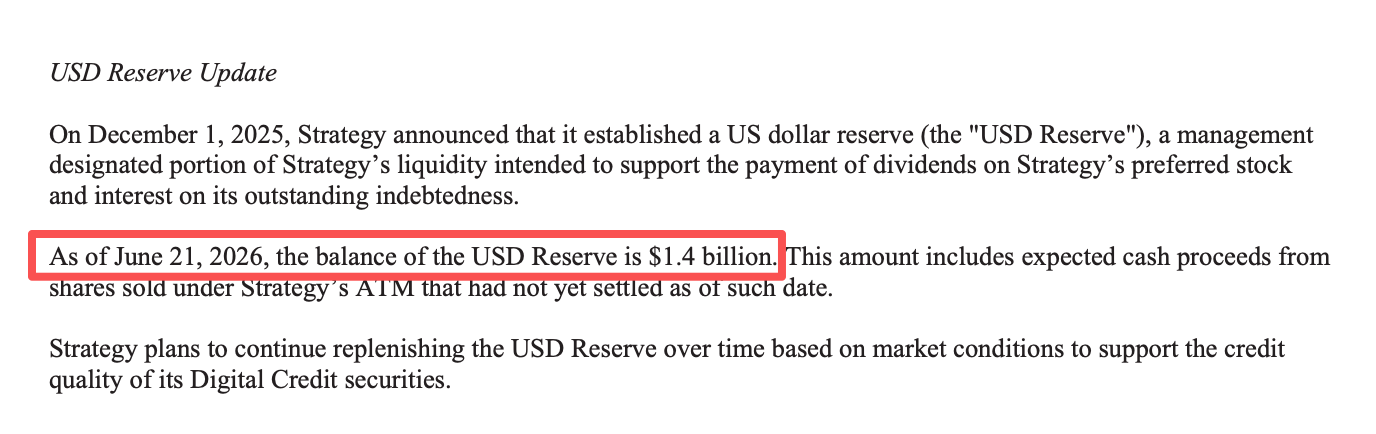
In the common stock issuance filing on June 21 (note, it's common stock, we'll discuss this in detail later), MicroStrategy disclosed that the company's cash reserves are approximately $1.4 billion. Based on this cash reserve level, MicroStrategy's book cash can cover less than a year of preferred stock dividend payments.
Breaking the Deadlock Requires Money, But Where Does the Money Come From?

Whether to sustain its own business model or to escape the current severe cash flow situation and avoid dividend payment default (more urgent now), MicroStrategy needs more funds. Theoretically, only three main "money-making" paths remain before MicroStrategy.

First, issuing common stock.

This is currently the most direct and mature method of financing. Through the ATM (At-the-Market Offering) program, MicroStrategy can continuously sell MSTR common stock to the market to raise funds.

However, common stock financing is not without cost. Continuous issuance means the number of outstanding shares keeps increasing. If the growth rate of BTC purchased with newly raised funds cannot outpace the share expansion rate, the growth of BTC per share will slow down, and common shareholders will face continuous dilution — note this point, it's important later.

Second, issuing more debt.

Over the past few years, MicroStrategy has repeatedly raised funds through debt instruments like convertible bonds, which were also an important funding source for its early large-scale BTC accumulation.

However, as preferred stock issuance expands and fixed cash outflows continue to increase, the market has started paying more attention to MicroStrategy's liquidity and debt repayment ability. In the current funding environment, if the company issues bonds again, investors will likely demand higher risk premiums, meaning financing costs will be significantly higher than in the past.

More importantly, bonds are different from preferred or common stock; their interest payments and principal repayments are rigid obligations. Against the backdrop of continuously declining cash reserves and increasing dividend payouts, further expanding debt will undoubtedly加重 the company's financial burden and also compress future fundraising space.

Third, selling BTC.

From a financial perspective, this is the fastest way to replenish cash reserves. MicroStrategy must have considered this path. The company stated on its official X account regarding dividend payment pressure: "When considering its massive Bitcoin reserves, it is sufficient to cover 32 years of dividend payments."

But for MicroStrategy, this is also an extremely risky choice. Earlier this month, MicroStrategy sold some of its Bitcoin holdings for the first time. Although the sale was only 32 BTC, and the official statement packaged it as an "active market desensitization test," mentioning that "more will be bought back later," it still caused a short-term market dip.

As the largest single holder of Bitcoin in the market, MicroStrategy's moves can easily trigger chain reactions. If it increases sales volume in the future, it will undoubtedly have a huge impact on the already fragile BTC price. If BTC declines further, MicroStrategy's so-called "reserves" would also shrink rapidly.

In summary, under the current circumstances, every feasible funding channel for MicroStrategy comes at a higher cost than before.

Has MicroStrategy Made Its Choice?

Based on MicroStrategy's latest moves, aside from hinting at possibly selling BTC, the company seems to have already chosen which path to take.

Since June, MicroStrategy has relied on its common stock ATM (At-the-Market Offering) program for three consecutive weeks to raise funds. The latest round (June 22) is particularly typical.
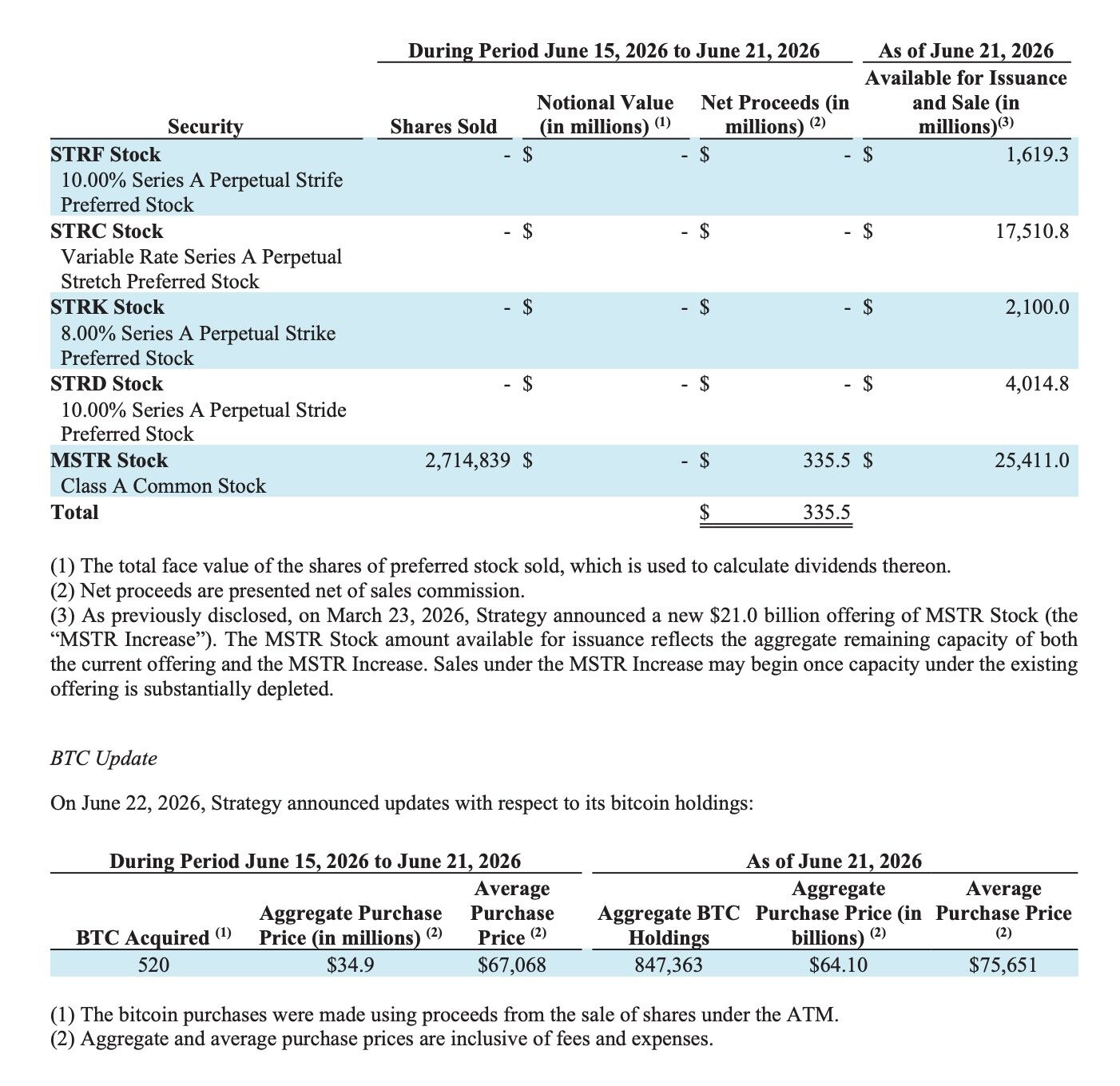
According to MicroStrategy's latest 8-K filing, the company sold a total of 2,714,839 shares of MSTR common stock within a week, raising $335.5 million in total. However, that same week, MicroStrategy only bought 520 BTC, spending a total of $34.9 million, with an average purchase price of about $67,068. In other words, out of the $335.5 million raised, only about one-tenth was actually used to continue accumulating BTC. The remaining funds were mainly used to replenish the company's cash flow reserves, increasing cash from about $1.1 billion to the current approximately $1.4 billion.

That seems somewhat effective? But there's another trap here.

For MSTR common shareholders, the most critical information to monitor is: for every new common share issued, how much BTC can ultimately be bought back with the funds raised, and is it enough to cover the BTC equity corresponding to this share? If the new fundraising can buy back more BTC than the amount originally corresponding to this share, then common shareholders' equity is actually increased; conversely, if the funds raised buy back less BTC than the amount corresponding to the new shares' BTC equity, then common shareholders experience dilution.

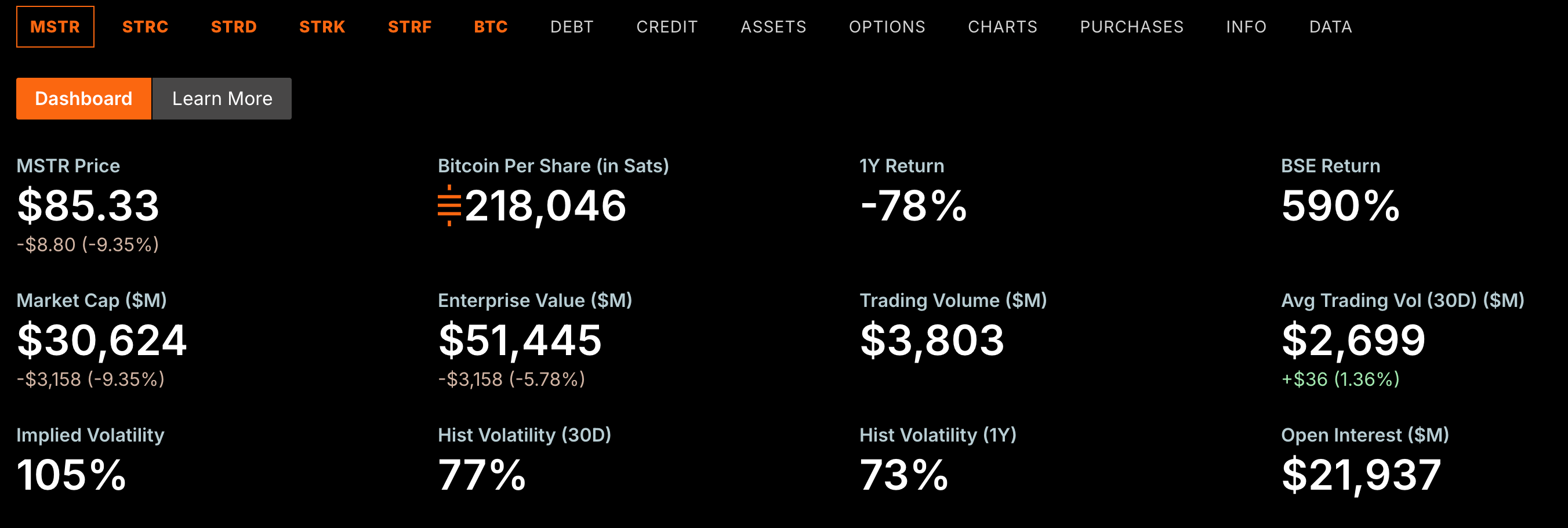
Clearly, MicroStrategy's recent common stock issuance has come at the cost of diluting common shareholder equity. MicroStrategy's official data also shows that the BTC per MSTR share has dropped from a peak of 220,900 Sats to 218,046 Sats.
This is the biggest limitation of common stock financing. For most listed companies, issuing common stock is just one of many financing methods; but for MicroStrategy, common stock is part of its business model itself.

Over the past few years, the reason MicroStrategy has been able to grow continuously is essentially by relying on the continuous operation of the "Raise Funds ➡️ Buy BTC ➡️ Consolidate Market Expectations ➡️ Raise Funds Again ➡️ Buy More BTC..." flywheel. The market's core expectation for MicroStrategy is its ability to continuously create more BTC equity for common shareholders, not dilution.

However, when MicroStrategy has to rely increasingly on common stock financing to replenish cash reserves rather than continue accumulating BTC, the operating logic of this flywheel changes. While in the short term, common stock financing can indeed alleviate MicroStrategy's cash pressure, it can hardly become a long-term solution to replace STRC.

Once common stock financing continuously erodes BTC per share equity, the foundation upon which MSTR's high premium relies may also be challenged, and this is precisely the core competitive advantage of MicroStrategy's entire business model.

What Will Happen to BTC?

Over the past few years, MicroStrategy has become the most important marginal buyer in the BTC market (arguably without the "one of"). To date, MicroStrategy has accumulated holdings of 847,363 BTC, accounting for about 4% of BTC's current circulating supply, worth over $50.7 billion. The market had long grown accustomed to Saylor's massive, unwavering weekly purchases.

But now, this situation is changing. MicroStrategy can still raise funds through common stock issuance, but most of the funds no longer flow into BTC; instead, they are prioritized for replenishing cash reserves. This means that under the same fundraising scale, the new buying pressure actually entering the BTC market is decreasing.

More disadvantageously, this situation may persist. If STRC cannot re-peg long-term, preferred stock financing remains blocked, MicroStrategy will have to rely long-term on common stock financing to maintain cash flow, possibly even further compressing the proportion of funds used for BTC accumulation. For the BTC market, this means the past's most stable and certain institutional buying pressure will no longer grow as consistently as it did in previous years.

But more alarmingly, if common stock issuance excessively dilutes MSTR shareholder equity, MicroStrategy may have to consider the other funding channel — selling BTC.

From weakened new buying pressure to the emergence of potential selling pressure, today's MicroStrategy is no longer BTC's biggest marginal buyer, but a giant sword hanging over BTC.


Criptomoedas em alta

Perguntas relacionadas

QWhat is STRC, and why is it considered the most important financing channel for MicroStrategy?

ASTRC is a series of preferred stock issued by MicroStrategy. It is considered the company's cheapest and most efficient financing channel because, as a perpetual preferred stock, it has no maturity date, does not dilute common shareholders, and only requires payment of fixed dividends. This structure allows MicroStrategy to raise capital at a low cost to continuously purchase Bitcoin, which is central to its business model.

QWhat are the main consequences of STRC's persistent de-pegging from its $100 target?

AThe persistent de-pegging of STRC from its $100 target severely impairs MicroStrategy's ability to issue new preferred shares at or near par value, effectively blocking this crucial financing channel. More critically, it turns STRC from a financing tool into a significant cash flow burden, as the company is obligated to pay over $1.2 billion annually in cash dividends on STRC alone, straining its liquidity.

QWhat three main options does MicroStrategy have to raise funds in the current situation, and what are their drawbacks?

A1. Issue common stock (MSTR): This dilutes common shareholders and erodes the key metric of Bitcoin per share if the new capital doesn't buy enough BTC to offset the dilution. 2. Issue more debt: Likely requires higher risk premiums (higher cost) and adds rigid interest payment obligations, further straining cash flow. 3. Sell Bitcoin: This directly contradicts the company's core investment thesis, risks triggering negative market sentiment and price declines for BTC, and depletes its primary asset.

QHow has the purpose of MicroStrategy's recent common stock (MSTR) issuance changed, and what negative side effect has this caused?

ARecently, the purpose of MicroStrategy's common stock issuances has shifted. Instead of primarily using the raised funds to buy more Bitcoin, a large portion (around 90% in the latest example) is now being used to replenish the company's cash reserves to cover its dividend obligations. This has caused the dilution of common shareholder equity, as evidenced by the decline in the key metric of Bitcoin per MSTR share from 220,900 satoshis to 218,046 satoshis.

QAccording to the article, how has MicroStrategy's role in the Bitcoin market changed, and what potential future risk does it pose?

AMicroStrategy has transitioned from being the most stable and significant marginal buyer in the Bitcoin market to becoming a potential source of selling pressure or 'a giant sword hanging over BTC.' Its new common stock issuances contribute less fresh buying pressure for BTC, and if its financial situation worsens, the company might be forced to sell its Bitcoin holdings to raise cash, which could negatively impact the market.

Leituras Relacionadas

How to Detect AI-Generated Videos? A Review of Dynamic, Traceable, and Explainable Detection Systems

**How to Detect AI-Generated Videos: A Survey on Dynamic, Traceable, and Explainable Detection Systems** With rapid advances in AI video generation (e.g., Sora, Veo), creating highly realistic, multi-minute videos is now possible, widening the gap with detection research. Current AI video detection, often limited to unreliable binary classifications, is insufficient. This survey, accepted at ACL 2026, reframes the goal as **"factual fidelity verification"**—checking if a video's content (who, when, where, what) aligns with the real world perceptually and cognitively. It categorizes AI-generated videos into three paradigms: **Local Manipulation Videos (LMV**, e.g., face swaps), **Audio-Visual Editing (AVE**, e.g., lip-syncing), and **Generative Video Synthesis (GVS**, fully synthetic videos like Sora's). Detection challenges evolve from visual artifacts in LMV to multi-modal inconsistencies in AVE and higher-level world knowledge violations in GVS. The core proposal is a **Vision-Language Dual-View framework** with four hierarchical layers: 1. **Layer 1 (Intrinsic Visual Cues):** Analyzes low-level signal statistics, noise patterns, and physiological signals. 2. **Layer 2 (Spatiotemporal Consistency):** Checks for temporal coherence in object motion and scene dynamics. 3. **Layer 3 (Cross-Modal Consistency):** Verifies alignment between video, audio, and text within the video. 4. **Layer 4 (Language-Guided World-Level Reasoning):** Uses external knowledge, facts, and physical laws to judge semantic plausibility and factual correctness. The survey traces a shift in detection focus from lower layers (1 & 2) toward higher, language-involved layers (3 & 4). It also reviews evolving evaluation metrics and datasets tailored for each video paradigm. The conclusion advocates for a **dynamic, evidence-first detection system** that moves beyond simple classification. Future trustworthy detection requires combining visual evidence (from CV) with semantic reasoning and explanation (from NLP & multimodal AI), ultimately creating traceable and explainable judgments about a video's adherence to real-world constraints.

marsbitHá 13m

How to Detect AI-Generated Videos? A Review of Dynamic, Traceable, and Explainable Detection Systems

marsbitHá 13m

It Turns Out the First Real-World Application of AI x Crypto is in Security Auditing

The article explores the surprising trend where AI's first major impact on crypto has been in security auditing, not in areas like trading or analytics. It details how AI-powered tools are dramatically lowering the barrier to finding smart contract vulnerabilities, enabling attackers to scan thousands of contracts and execute exploits within minutes. This has rendered traditional, manually-produced audit reports with their month-long validity periods increasingly obsolete, creating a critical "structural crack" in the old security model. Cases like Drift Protocol and KelpDAO show that even extensively audited protocols can be hacked through social engineering, operational flaws, or infrastructure misconfigurations beyond pure code review. Attackers are also using AI to find and exploit vulnerabilities in years-old, deployed contracts. Notably, OpenZeppelin's co-founder has expressed a grim view that "all DeFi is insecure" due to AI's asymmetric advantage. In response, the audit industry is undergoing a fundamental shift. While there's a short-term spike in defensive re-audits, the long-term business model is changing. Firms are developing AI-assisted systems and moving from one-time report deliveries towards embedded, continuous services like real-time monitoring and formal verification. Examples include AI tools uncovering critical, previously missed vulnerabilities in heavily audited protocols like Curve Finance and Zcash. The conclusion is that security must become a continuous investment, not a one-time checkbox, and audit firms must rapidly evolve their tools and service models to survive.

marsbitHá 19m

It Turns Out the First Real-World Application of AI x Crypto is in Security Auditing

marsbitHá 19m

Never expected that the first tangible application of AI x Crypto is in security auditing

Unexpectedly, the initial major application of AI in the Crypto sphere has turned out to be security auditing. In 2026, DeFi has faced significant security challenges, with 121 hacking incidents resulting in approximately $942 million in losses. While AI was expected to first impact areas like quantitative trading, its initial breakthrough has instead transformed security auditing by drastically lowering the cost and skill barrier for finding smart contract vulnerabilities. The traditional audit model is facing obsolescence. Advanced AI models, such as Claude Mythos, enable attackers to scan thousands of contracts and identify vulnerability patterns at scale, compressing the time from discovery to execution to mere minutes. This renders the month-long validity of traditional audit reports ineffective. Notably, attacks now frequently target well-audited, established protocols by exploiting business logic flaws, operational security weaknesses, and even years-old historical contracts, demonstrating that old audit reports offer zero protection. This pressure is forcing a fundamental shift in the industry. In the short term, a wave of defensive re-auditing is occurring, driven by projects seeking to meet new AI-era security standards and regulatory requirements. In the long run, audit firms' business models are diverging. The one-time report delivery model is declining in value, as evidenced by platforms like Code4rena shutting down. Leading firms are now pivoting towards AI-powered defense, integrating continuous monitoring, real-time on-chain risk detection, and embedding security directly into the development phase, as seen with tools like OpenZeppelin's Skills system. Ultimately, the era of "audit once, secure forever" is over. Security must become a continuous, embedded infrastructure investment for projects. For audit companies, survival depends on proactively transforming from traditional service providers into platforms offering AI-native, ongoing security solutions.

链捕手Há 27m

Never expected that the first tangible application of AI x Crypto is in security auditing

链捕手Há 27m

Trading

Spot

Artigos em Destaque

O que é BITCOIN

Compreender o HarryPotterObamaSonic10Inu (ERC-20) e a Sua Posição no Espaço Cripto Nos últimos anos, o mercado de criptomoedas assistiu a um aumento na popularidade das moedas meme, cativando não apenas os traders, mas também aqueles que procuram envolvimento comunitário e valor de entretenimento. Entre estes tokens únicos está o HarryPotterObamaSonic10Inu (ERC-20), um projeto intrigante que mistura referências culturais no tecido das criptomoedas. Este artigo explora os principais aspetos do HarryPotterObamaSonic10Inu, examinando os seus mecanismos, a sua ética orientada pela comunidade e o seu envolvimento com o vasto panorama cripto. O que é o HarryPotterObamaSonic10Inu (ERC-20)? Como o nome sugere, o HarryPotterObamaSonic10Inu é uma moeda meme construída na blockchain Ethereum, classificada sob o padrão ERC-20. Ao contrário das criptomoedas tradicionais, que podem enfatizar a utilidade prática ou o potencial de investimento, este token prospera no valor de entretenimento e na força da sua comunidade. O projeto visa promover um ambiente onde utilizadores envolvidos possam reunir-se, partilhar ideias e participar em atividades inspiradas por diversos fenómenos culturais. Uma característica notável do HarryPotterObamaSonic10Inu é a zero taxa sobre transações. Este elemento atraente visa encorajar a negociação e o envolvimento da comunidade, isento de encargos adicionais que podem desencorajar os traders de pequena escala. A oferta total da moeda está fixada em mil milhões de tokens, uma cifra que marca a sua intenção de manter uma circulação substancial dentro da comunidade. Criador do HarryPotterObamaSonic10Inu (ERC-20) As origens do HarryPotterObamaSonic10Inu estão um pouco envoltas em mistério; os detalhes sobre o criador permanecem desconhecidos. O desenvolvimento deste token carece de uma equipa identificável ou de um plano explícito, o que não é raro no setor das moedas meme. Em vez disso, o projeto surgiu de forma orgânica, com o seu progresso a depender fortemente do entusiasmo e da participação da sua comunidade. Investidores do HarryPotterObamaSonic10Inu (ERC-20) No que diz respeito a investimentos externos e apoios, o HarryPotterObamaSonic10Inu também permanece ambíguo. O token não lista quaisquer fundações de investimento conhecidas ou apoio organizacional significativo. Em vez disso, o “sangue vital” do projeto é a sua comunidade de base, que informa o seu crescimento e sustentabilidade através da ação coletiva e do envolvimento no espaço cripto. Como Funciona o HarryPotterObamaSonic10Inu (ERC-20)? Como uma moeda meme, o HarryPotterObamaSonic10Inu opera principalmente fora dos quadros tradicionais que muitas vezes governam o valor dos ativos. Existem vários aspetos distintivos que definem como o projeto funciona: Transações Sem Taxas: Sem taxas sobre transações, os utilizadores podem comprar e vender o token livremente, sem a preocupação de custos ocultos. Envolvimento da Comunidade: O projeto prospera na interação da comunidade, aproveitando plataformas de redes sociais para criar entusiasmo e facilitar a participação. Discussões, partilha de conteúdo e envolvimento são elementos cruciais que ajudam a expandir o seu alcance e a fomentar a lealdade entre os apoiantes. Sem Utilidade Prática: Deve ser notado que o HarryPotterObamaSonic10Inu não oferece utilidade concreta dentro do ecossistema financeiro. Em vez disso, é classificado como um token principalmente para entretenimento e atividades comunitárias. Referência Cultural: O token incorpora de forma inteligente elementos da cultura popular para atrair interesse, conectando-se tanto com entusiastas de memes como com seguidores de criptomoedas. HarryPotterObamaSonic10Inu exemplifica como as moedas meme operam de forma diferente de projetos de criptomoedas mais tradicionais, entrando no mercado como construções sociais inovadoras em vez de ativos utilitários. Linha do Tempo do HarryPotterObamaSonic10Inu (ERC-20) A história do HarryPotterObamaSonic10Inu é marcada por vários marcos notáveis: Criação: O token surgiu de um meme viral, capturando a imaginação de muitos entusiastas de criptomoedas. Datas específicas de criação não estão disponíveis, sublinhando a sua ascensão orgânica. Listagem em Exchanges: O HarryPotterObamaSonic10Inu conseguiu entrar em várias exchanges, permitindo um acesso e negociação mais fáceis pela comunidade. Iniciativas de Envolvimento da Comunidade: Atividades contínuas direcionadas a melhorar a interação comunitária, incluindo concursos, campanhas em redes sociais e geração de conteúdo por fãs e defensores. Planos de Expansão Futura: O roteiro do projeto inclui o lançamento de uma coleção de NFTs, mercadorias e um site de eCommerce relacionado aos seus temas culturais, envolvendo ainda mais a comunidade e tentando adicionar mais dimensões ao seu ecossistema. Pontos-Chave sobre o HarryPotterObamaSonic10Inu (ERC-20) Natureza Orientada pela Comunidade: O projeto prioriza a contribuição coletiva e a criatividade, assegurando que o envolvimento dos utilizadores está na vanguarda do seu desenvolvimento. Classificação como Moeda Meme: Representa o epítome da criptomoeda baseada em entretenimento, destacando-se dos veículos de investimento tradicionais. Sem Afiliação Direta com o Bitcoin: Apesar da semelhança no nome do ticker, o HarryPotterObamaSonic10Inu é distinto e não tem qualquer relação com o Bitcoin ou outras criptomoedas estabelecidas. Foco na Colaboração: O HarryPotterObamaSonic10Inu é projetado para criar um espaço de colaboração e partilha de histórias entre os seus detentores, proporcionando uma via para a criatividade e o fortalecimento da comunidade. Perspectivas Futuras: A ambição de expandir além da sua premissa inicial para NFTs e mercadorias delineia um caminho para o projeto potencialmente entrar em avenidas mais mainstream dentro da cultura digital. À medida que as moedas meme continuam a capturar a imaginação da comunidade cripto, HarryPotterObamaSonic10Inu (ERC-20) destaca-se devido aos seus laços culturais e abordagem centrada na comunidade. Embora possa não se encaixar no molde típico de um token orientado para utilidade, a sua essência reside na alegria e camaradagem fomentadas entre os seus apoiantes, destacando a natureza em evolução das criptomoedas em uma era cada vez mais digital. À medida que o projeto continua a desenvolver-se, será importante observar como as dinâmicas comunitárias influenciam a sua trajetória no panorama em constante mudança da tecnologia blockchain.

1.7k Visualizações TotaisPublicado em {updateTime}Atualizado em 2024.12.03

O que é BITCOIN

Como comprar BTC

Bem-vindo à HTX.com!Tornámos a compra de Bitcoin (BTC) simples e conveniente.Segue o nosso guia passo a passo para iniciar a tua jornada no mundo das criptos.Passo 1: cria a tua conta HTXUtiliza o teu e-mail ou número de telefone para te inscreveres numa conta gratuita na HTX.Desfruta de um processo de inscrição sem complicações e desbloqueia todas as funcionalidades.Obter a minha contaPasso 2: vai para Comprar Cripto e escolhe o teu método de pagamentoCartão de crédito/débito: usa o teu visa ou mastercard para comprar Bitcoin (BTC) instantaneamente.Saldo: usa os fundos da tua conta HTX para transacionar sem problemas.Terceiros: adicionamos métodos de pagamento populares, como Google Pay e Apple Pay, para aumentar a conveniência.P2P: transaciona diretamente com outros utilizadores na HTX.Mercado de balcão (OTC): oferecemos serviços personalizados e taxas de câmbio competitivas para os traders.Passo 3: armazena teu Bitcoin (BTC)Depois de comprar o teu Bitcoin (BTC), armazena-o na tua conta HTX.Alternativamente, podes enviá-lo para outro lugar através de transferência blockchain ou usá-lo para transacionar outras criptomoedas.Passo 4: transaciona Bitcoin (BTC)Transaciona facilmente Bitcoin (BTC) no mercado à vista da HTX.Acede simplesmente à tua conta, seleciona o teu par de trading, executa as tuas transações e monitoriza em tempo real.Oferecemos uma experiência de fácil utilização tanto para principiantes como para traders experientes.

4.2k Visualizações TotaisPublicado em {updateTime}Atualizado em 2026.06.02

Como comprar BTC

O que é $BITCOIN

OURO DIGITAL ($BITCOIN): Uma Análise Abrangente Introdução ao OURO DIGITAL ($BITCOIN) OURO DIGITAL ($BITCOIN) é um projeto baseado em blockchain que opera na rede Solana, com o objetivo de combinar as características dos metais preciosos tradicionais com a inovação das tecnologias descentralizadas. Embora partilhe um nome com o Bitcoin, frequentemente referido como “ouro digital” devido à sua percepção como uma reserva de valor, o OURO DIGITAL é um token separado projetado para criar um ecossistema único dentro da paisagem Web3. O seu objetivo é posicionar-se como um ativo digital alternativo viável, embora os detalhes sobre as suas aplicações e funcionalidades ainda estejam em desenvolvimento. O que é o OURO DIGITAL ($BITCOIN)? OURO DIGITAL ($BITCOIN) é um token de criptomoeda explicitamente projetado para uso na blockchain Solana. Em contraste com o Bitcoin, que fornece um papel amplamente reconhecido como armazenamento de valor, este token parece focar em aplicações e características mais amplas. Aspectos notáveis incluem: Infraestrutura Blockchain: O token é construído na blockchain Solana, conhecida pela sua capacidade de lidar com transações de alta velocidade e baixo custo. Dinâmicas de Oferta: O OURO DIGITAL tem um fornecimento máximo limitado a 100 quatrilhões de tokens (100P $BITCOIN), embora os detalhes sobre o seu fornecimento circulante ainda não tenham sido divulgados. Utilidade: Embora as funcionalidades precisas não estejam explicitamente delineadas, existem indicações de que o token poderia ser utilizado para várias aplicações, potencialmente envolvendo aplicações descentralizadas (dApps) ou estratégias de tokenização de ativos. Quem é o Criador do OURO DIGITAL ($BITCOIN)? Neste momento, a identidade dos criadores e da equipa de desenvolvimento por trás do OURO DIGITAL ($BITCOIN) permanece desconhecida. Esta situação é típica entre muitos projetos inovadores no espaço da blockchain, particularmente aqueles alinhados com finanças descentralizadas e fenómenos de moedas meme. Embora tal anonimato possa fomentar uma cultura orientada pela comunidade, intensifica as preocupações sobre governança e responsabilidade. Quem são os Investidores do OURO DIGITAL ($BITCOIN)? As informações disponíveis indicam que o OURO DIGITAL ($BITCOIN) não tem apoiantes institucionais conhecidos ou investimentos proeminentes de capital de risco. O projeto parece operar num modelo peer-to-peer focado no apoio e adoção da comunidade, em vez de rotas de financiamento tradicionais. A sua atividade e liquidez estão principalmente situadas em exchanges descentralizadas (DEXs), como a PumpSwap, em vez de plataformas de negociação centralizadas estabelecidas, destacando ainda mais a sua abordagem de base. Como Funciona o OURO DIGITAL ($BITCOIN) A mecânica operacional do OURO DIGITAL ($BITCOIN) pode ser elaborada com base no seu design de blockchain e nas características da rede: Mecanismo de Consenso: Ao aproveitar o exclusivo proof-of-history (PoH) da Solana combinado com um modelo de proof-of-stake (PoS), o projeto assegura uma validação eficiente das transações, contribuindo para o alto desempenho da rede. Tokenomics: Embora mecanismos deflacionários específicos não tenham sido extensivamente detalhados, o vasto fornecimento máximo de tokens implica que pode atender a microtransações ou casos de uso de nicho que ainda estão por definir. Interoperabilidade: Existe o potencial para integração com o ecossistema mais amplo da Solana, incluindo várias plataformas de finanças descentralizadas (DeFi). No entanto, os detalhes sobre integrações específicas permanecem não especificados. Cronologia de Eventos Chave Aqui está uma cronologia que destaca marcos significativos relacionados ao OURO DIGITAL ($BITCOIN): 2023: O lançamento inicial do token ocorre na blockchain Solana, marcado pelo seu endereço de contrato. 2024: O OURO DIGITAL ganha visibilidade ao tornar-se disponível para negociação em exchanges descentralizadas como a PumpSwap, permitindo que os utilizadores o negociem contra SOL. 2025: O projeto testemunha atividade de negociação esporádica e potencial interesse em envolvimentos liderados pela comunidade, embora não tenham sido documentadas parcerias ou avanços técnicos notáveis até ao momento. Análise Crítica Forças Escalabilidade: A infraestrutura subjacente da Solana suporta altos volumes de transações, o que pode aumentar a utilidade do $BITCOIN em vários cenários de transação. Acessibilidade: O potencial preço de negociação baixo por token pode atrair investidores de retalho, facilitando uma participação mais ampla devido a oportunidades de propriedade fracionada. Riscos Falta de Transparência: A ausência de apoiantes, desenvolvedores ou um processo de auditoria publicamente conhecidos pode gerar ceticismo em relação à sustentabilidade e confiabilidade do projeto. Volatilidade do Mercado: A atividade de negociação depende fortemente do comportamento especulativo, o que pode resultar em volatilidade significativa dos preços e incerteza para os investidores. Conclusão O OURO DIGITAL ($BITCOIN) surge como um projeto intrigante, mas ambíguo, dentro do ecossistema em rápida evolução da Solana. Embora tente aproveitar a narrativa do “ouro digital”, a sua divergência do papel estabelecido do Bitcoin como reserva de valor sublinha a necessidade de uma diferenciação mais clara da sua utilidade pretendida e estrutura de governança. A aceitação e adoção futuras dependerão provavelmente da abordagem da atual opacidade e da definição mais explícita das suas estratégias operacionais e económicas. Nota: Este relatório abrange informações sintetizadas disponíveis até outubro de 2023, e desenvolvimentos podem ter ocorrido além do período de pesquisa.

102 Visualizações TotaisPublicado em {updateTime}Atualizado em 2025.05.13

O que é $BITCOIN

Discussões

Bem-vindo à Comunidade HTX. Aqui, pode manter-se informado sobre os mais recentes desenvolvimentos da plataforma e obter acesso a análises profissionais de mercado. As opiniões dos utilizadores sobre o preço de BTC (BTC) são apresentadas abaixo.

活动图片












