2026-08-12 Quarta

Notícias de cripto - Página 525

Mantenha-se a par do mercado de cripto. Notícias em tempo real, análises, preços, histórias em alta e análise de especialistas — tudo num só lugar.

Token Packages Are Here, Are Telecom Operators in a Hurry?

Major Chinese telecom operators are launching token-based AI computing packages, sparking public debate and highlighting a strategic shift amid slowing traditional revenue growth. In May, Shanghai Telecom introduced token plans (e.g., 9.9 RMB for 10 million tokens), quickly followed by nationwide offerings from China Telecom, China Mobile, and China Unicom. While priced higher than major AI firms like DeepSeek, these packages allow users to access multiple AI models via API using their phone bills, similar to purchasing universal mobile data. The move reflects operators' anxiety as traditional voice, SMS, and data services stagnate. With revenue growth hitting multi-year lows in 2025, AI and computing power represent a critical new frontier. However, current C端 offerings, such as AI photo editing or virtual pets, are seen as non-essential and highlight operators' role as "pipes" or integrators rather than creators of compelling AI products. Beyond consumer packages, operators aim to become key infrastructure players in China’s national computing power network. They position themselves as the "power grid" delivering AI算力, leveraging their vast network of base stations to ensure low-latency, reliable coverage, especially for applications like autonomous driving. This infrastructure role, coupled with unified national调度, could make算力 a ubiquitous utility, driving new consumption scenarios even if mass adoption of token packages remains uncertain.

marsbit05/22 10:15

Token Packages Are Here, Are Telecom Operators in a Hurry?

marsbit05/22 10:15

The Five Value Logics Behind Enterprises Selling Bitcoin

"Five Value Logics Behind Corporate Bitcoin Sell-offs" Recent news of Strategy company considering selling part of its bitcoin holdings to meet operational goals sparked market discussions, challenging its previous "never sell" stance. While long-term holding aligns with crypto investment philosophy, selling bitcoin can be a rational corporate decision aimed at maximizing shareholder value, unlike personal sales for life improvements. For instance, in Q1 2026, miners sold 25,376 BTC to fund a pivot into AI, deeming it a higher-return investment. For treasury-holding firms like Strategy, selling bitcoin can create value through five key logics: 1. **Increasing Bitcoin Per Share:** The core metric is bitcoin per share. If a company's stock trades below its bitcoin asset value, selling BTC to buy back shares can increase this ratio, as the reduction in shares outstanding outweighs the BTC sold. Similarly, using BTC proceeds to cover fixed costs like dividends during stock undervaluation minimizes the dilution of bitcoin per share. 2. **Optimizing Capital Structure & Lowering Financing Costs:** Credit ratings significantly influence financing costs. Rating agencies like S&P value cash reserves. By selling bitcoin to boost cash, companies can meet capital market expectations, secure better ratings, and issue debt at lower costs. Reducing debt through BTC sales also improves the appeal of preferred stock. Lower interest rates compound over time, boosting profits. 3. **Legitimate Tax Planning:** The US currently has no wash-sale rules for bitcoin. Companies can sell to realize a book loss, immediately repurchase at a lower cost basis, and use the loss to offset taxes—a strategy Strategy used in 2022's bear market. This can be combined with stock buybacks or debt repayment for multiple benefits. 4. **Dispelling Market FUD (Fear, Uncertainty, Doubt):** Negative narratives claim large corporate BTC sales could crash the market or invalidate the treasury model. A controlled sale (e.g., 50,000 BTC) without causing major market or stock price volatility could debunk such myths, helping the market accept bitcoin as a corporate asset. This reason is the most subjective of the five. 5. **Buying Back Preferred Stock at a Discount:** This lesser-known strategy involves repurchasing a company's own floating-rate preferred stock when it trades significantly below its par value. For example, if a $100-par security like STRC trades at $82, selling bitcoin to buy it back yields an $18 per-share, tax-free profit. Price drops may occur due to leveraged trading cascades, unrelated to BTC's price. Repurchasing avoids future increased dividend costs. In conclusion, corporate bitcoin sales should not be automatically viewed as bearish. In many scenarios, they protect the interests of the company and its shareholders. Bitcoin's monetary properties offer flexible capital allocation; using the asset rationally unlocks its maximum value.

marsbit05/22 10:15

The Five Value Logics Behind Enterprises Selling Bitcoin

marsbit05/22 10:15

I Tested with $10,000: Zero Wear, 8% APY, and Earn Points (Full Tutorial + Screenshots Included)

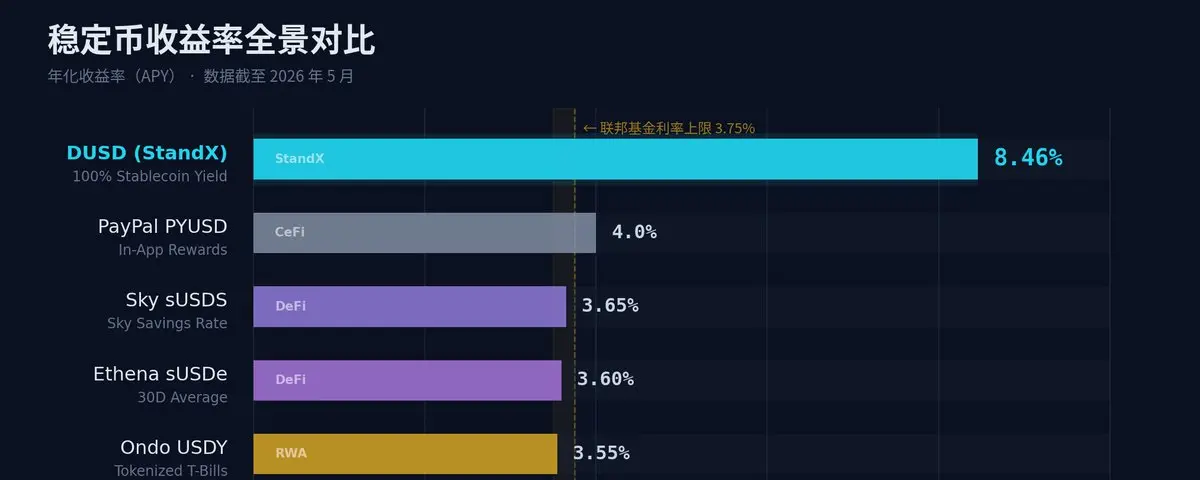
**Title:** My $10,000 Real-World Test: Zero Wear-and-Tear, ~8% APY, Plus Earning Points (Full Guide + Screenshots Included) **Summary:** This article details a personal experiment with $10,000 on the StandX platform to verify its advertised ~8% APY for its stablecoin, DUSD, while earning trading points. The author created two accounts, each depositing $5,000 worth of DUSD, and used StandX's unique "Block Trade" feature to open perfectly offsetting long and short BTC positions (2x leverage each). This neutralized directional market risk. **Key Results (Over 8 Days):** * **Total Profit:** $16.91 (~7.8% annualized). * **Zero Net Directional P&L:** BTC price movements canceled out. * **Zero Wear-and-Tear:** No losses from fees, slippage, or gas from frequent trading. * **Points Earned:** 380+ trading points. **Source of the ~8.46% APY:** The yield is composed of three layers, all paid in DUSD (real USD value, not governance tokens): 1. **DUSD Base (~1.27%):** Derived from funding rates (similar to Ethena's USDe). 2. **SIP-2 Position Boost (~2.27%):** A protocol revenue-sharing mechanism. Users providing liquidity (via open positions) earn a share of platform trading fees. Leverage acts as a multiplier on this yield. 3. **SIP-3 Universal Fee Share (~4.92%):** A portion of all platform trading fees is distributed to *every* DUSD holder, regardless of whether they trade. **Sustainability Claim:** The author argues this yield is more sustainable than pure funding-rate models (e.g., Ethena) because over 7% of it comes from transaction fees (SIP-2 + SIP-3), which are less dependent on market cycles. **Step-by-Step Strategy:** A concise 3-step guide is provided for replicating the zero-risk strategy using two wallets and StandX's Block Trade to create matched long/short positions. **Risk Disclosures:** The article notes standard DeFi risks: smart contract vulnerability and yield fluctuation (Base yield varies with funding rates; SIP-2/3 yields depend on platform trading volume). **Author's Note:** The author discloses their role in Growth at StandX. The piece is presented as personal testing and analysis, not investment advice.

链捕手05/22 09:41

I Tested with $10,000: Zero Wear, 8% APY, and Earn Points (Full Tutorial + Screenshots Included)

链捕手05/22 09:41

Senior Analyst Dialogue: What Powell's Departure and Warsh's Appointment Mean for Crypto?

The podcast episode "Powell Is Out, Warsh Is In: What It Means for Crypto" features an analysis by Noelle Acheson on the macro-economic landscape and its implications for crypto. Key discussion points include: * **Equity-Bond Divergence:** Acheson highlights a significant and growing disconnect between stock and bond markets. While bond yields rise globally, signaling tighter financial conditions, equities are driven by AI-related hype and speculation, reminiscent of the 1999 dot-com bubble. * **'Bliss Trade' and Systemic Fragility:** The discussion explores the concept of a structural, cross-party government expectation to provide fiscal support ("Bliss Trade"), which underpins risk asset valuations and carries its own systemic vulnerabilities. * **Inflation Outlook:** Acheson argues that inflation is not meaningfully declining, citing core CPI stagnation and attributing the trend to de-globalization, tariffs, and geopolitical tensions like the Strait of Hormuz crisis. * **Powell's Legacy:** Powell's tenure receives mixed marks. While his defense of Fed independence is noted, he is also criticized for overseeing the "de-banking" of crypto firms in 2023 and initially misjudging inflation. * **Outlook for Warsh:** Expectations for the incoming Fed Chair, Kevin Warsh, are measured. While he may aim to reduce Fed balance sheet size and forward guidance, market realities and the FOMC will likely constrain his ability to enact significant policy shifts, particularly rate cuts. * **Crypto as a Macro Asset:** Bitcoin's role is framed as a hedge against currency debasement, benefiting from expectations of monetary stimulus. However, its maturation as a macro asset means it now competes with other high-volatility investments like AI stocks, potentially limiting near-term price catalysts. * **Market Structure & Tokenization:** The potential Clarity Act is seen as more beneficial for assets like Ethereum than Bitcoin, which already has relative regulatory clarity. Concerns are raised about "innovation exemptions" for tokenization if they enable third-party derivatives that encourage pure speculation over capital formation. In conclusion, the analysis suggests crypto markets lack a near-term positive catalyst and are caught between competing macro narratives, with significant underlying fragilities in traditional markets.

marsbit05/22 09:29

Senior Analyst Dialogue: What Powell's Departure and Warsh's Appointment Mean for Crypto?

marsbit05/22 09:29

Wall Street Giants Vie for GPU Futures, Crypto Market Already in Early Skirmish

Wall Street giants CME and ICE are racing to launch GPU futures, marking a pivotal shift as computing power transforms from a critical IT resource into a tradable financial asset. In mid-May, both exchanges announced plans for futures contracts tied to GPU compute pricing indices, aiming to establish a benchmark and provide hedging tools for the volatile, trillion-dollar AI compute market. ICE partnered with data provider Ornn for a broad index covering enterprise and consumer GPUs, while CME teamed with Silicon Data to focus on an H100 leasing index with cash settlement. This push for financialization addresses a key industry pain point: the lack of risk management tools in a market dominated by a few cloud providers, where prices are opaque and highly unstable. Proponents argue futures will help large cloud operators and AI labs lock in costs and manage investment risk. However, challenges remain, including the intangible nature of compute, high market concentration, and the potential for leveraged speculation to exacerbate price swings and resource inequality. Notably, the crypto market has moved faster. Platforms like Architect Financial have already launched perpetual contracts tied to compute indices, leveraging DeFi's agility to create a parallel, global market. As Wall Street awaits regulatory approval, the race to define and control the pricing of "21st-century oil" is accelerating both in traditional and decentralized finance.

marsbit05/22 07:42

Wall Street Giants Vie for GPU Futures, Crypto Market Already in Early Skirmish

marsbit05/22 07:42

Bitcoin Becomes a National Strategic Asset? U.S. Congressman Proposes Annual Purchase of 200,000 BTC, Locked for 20 Years Without Sale

U.S. Representative Nick Begich (R-Alaska) introduced the "American Reserve Modernization Act" (ARMA) on May 21, aiming to codify a strategic Bitcoin reserve into law. Building on a prior executive order, the bill seeks to establish a permanent national Bitcoin reserve managed by the Treasury Department. The proposed legislation would authorize the Treasury to acquire up to 200,000 Bitcoin annually for five years, targeting a total reserve of 1 million Bitcoin, roughly 5% of the total supply. All acquired Bitcoin would be locked and held for at least 20 years. Representative Begich likened Bitcoin's role in crypto to gold's in precious metals, calling it the dominant store of value in its asset class. The U.S. government currently holds approximately 328,000 Bitcoin, largely from law enforcement seizures, but lacks a coherent management strategy for these assets. Co-sponsors emphasized the urgency of addressing this gap. This move coincides with a wave of crypto-friendly legislation in Washington, including recent bipartisan committee approval of a major digital asset market structure bill. Concurrently, the Treasury has intensified crackdowns on illicit crypto finance, seizing hundreds of millions in assets, further highlighting the need for a comprehensive digital asset strategy. The White House has indicated that operational details for the strategic Bitcoin reserve are forthcoming, with key legal hurdles reportedly cleared.

marsbit05/22 07:09

Bitcoin Becomes a National Strategic Asset? U.S. Congressman Proposes Annual Purchase of 200,000 BTC, Locked for 20 Years Without Sale

marsbit05/22 07:09

Blockchain Capital Partner: The Structure of On-Chain Two-Tier Capital Is Still in the Early Stages of Value Discovery

Spencer Bogart, a general partner at Blockchain Capital, argues that the on-chain economy possesses unique features like programmability, composability, and global distribution, fostering an open and fast-paced innovation ecosystem. However, these very features create challenges for large, fiduciarily-responsible institutional capital, which requires robust risk assessment frameworks often difficult in a permissionless and adversarial environment. The proposed solution is the emergence of a two-tiered capital structure. The first, permissionless layer remains the crucible for innovation, where protocols are built, tested, and hardened with real capital. The second, "institutional" layer consists of chains (L1s, L2s, etc.) that, while based on similar code, incorporate risk-management features like the ability to pause or freeze transactions in extreme scenarios, making them suitable for large-scale institutional deployment. The synergy between these layers is key. Protocols proven resilient in the open, permissionless environment can then scale to the institutional layer, accessing deeper capital pools. This creates a lifecycle: build and launch permissionlessly, test and prove robustness publicly, then expand to an institutional-grade chain for scaled adoption. This architecture allows the open, experimental side to continue driving innovation with crypto-native capital, while the institutional layer provides the liquidity, stability, and trust required for mainstream adoption. The major challenge identified is the "cold start" problem: aligning where institutional capital prefers to go with where the most proven applications and network effects currently reside. How this dynamic resolves—whether through protocol migration, new protocol builds, or institutional adaptation—will be crucial to watch. Overall, this evolving structure aims to combine the strengths of open innovation and institutional depth within a shared on-chain ecosystem.

链捕手05/22 06:13

Blockchain Capital Partner: The Structure of On-Chain Two-Tier Capital Is Still in the Early Stages of Value Discovery

链捕手05/22 06:13

活动图片