Abstract
This week, we focus on the following events: 1) FTX Collapse Leaves Total Crypto Market Cap Under $800B, Close to 2022 Low; 2) Sports Fan Tokens Rally Ahead of FIFA World Cup, Defying Crypto Market Gloom; 3) Bahamas Securities Regulator Says It Ordered FTX Crypto Transferred to Government Wallets.
Project Analysis: BAYC, owned by Yuga Labs, seems to have been going downhill since the release of “Otherdeed for Otherside” in early May. According to NFTGO data, the market value of BAYC has dropped from US$4.298 billion at the end of April to US$1.435 billion, a drop of 66.6%, and the floor price has also fallen from the highest point of 145ETH. On November 15, it once fell to 50ETH. The drop was as high as 28%. Here we will talk about the reason for the new fall wave of the BAYC.
Table of Contents
1. Industry overview 3
I. Overall market trend 3
II.NFT 5
III.DeFi 7
IV.Layer 2 8
2. Market news (Source: Coindesk) 9
I. Industry news 9
II. Investment and Financing 10
III. Supervision 11
3. BAYC Price Fall Event 14
I. BAYC Price Performance 14
II. The Reason of BAYC Price Fall 15
III. How Franklin Arbitrages? 16
IV. Will it cause BAYC’s serial liquidation? 17
V. Will BendDAO run out of funds this time like last time? 18
1. Industry overview
I. Overall market trend
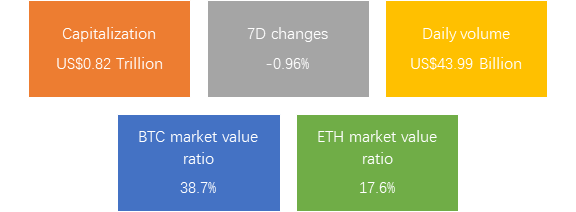
Figure 1. Overall market data
Source: CoinMarketCap
The global cryptocurrency market’s market cap this week decreased slightly, currently with a market cap of $823,192,259,441. Bitcoin is currently trading at US$16,533, continuing weeks below $20,000, still recovering from the FTX collapse and the related damages. Meanwhile, Ethereum, the second largest cryptocurrency, is currently trading at US$1,176, also suffer from the same trend and going to the lowest point. Most of the other top 10 tokens, were the tokens involved in the series of events recently, like Serum or Trust Wallet. Among them, most of them are decreasing, with Chiliz (CHZ) decreased the most at 14.6%. SONM increased with an incredible trend by 893.86%. Below is a graph for BTC and Inverted RRP, RRP is an instrument used by the Fed to suck out liquidity from the markets by attracting investments from the markets themselves. The Inverted RRP may indicate sell-offs in equity markets (SPX/IXIC/Bitcoin) when it decreases, and vice versa.
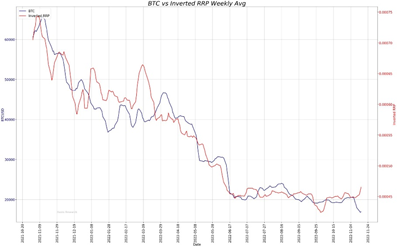
Figure 2. BTC vs. Inverted RRP
Source: Huobi Research
Rank DeFi 7d change
1 FTX Token 0.46%
2 Solana -0.22%
3 Cronos -4.05%
4 Bitcoin -0.27%
5 Terra Classic -3.62%
6 Trust Wallet Token -6.85%
7 Polygon -4.59%
8 Serum 37.82%
9 SONM (BEP-20) 893.86%
10 Chiliz -14.60%
Table 1. Last week's hot currencies
Source: CoinMarketCap
II.NFT
Rank Name Volume 7d Est. Market Cap
1 Bored Ape Yacht Club 3,935.88 ETH 678,463.71 ETH
2 CryptoPunks 3,872.23 ETH 667,492.33 ETH
3 Mutant Ape Yacht Club 2,152.46 ETH 224,804.26 ETH
4 Otherdeed for Otherside 2,022.16 ETH 222,215 ETH
5 CLONE X 911.37 ETH 177,023.81 ETH
6 Azuki 591.47 ETH 128,579.9 ETH
7 Doodles 402.92 ETH 62,956.17 ETH
8 Moonbirds 353.68 ETH 82,251.31 ETH
9 Genuine Undead 317.98 ETH 5,566.52 ETH
10 Bored Ape Kennel Club 314.29 ETH 41,914.62 ETH
Table 2. NFT Collections Listed By Sales Volume (7d)
Source: CoinMarketCap
The NFT market last week saw a decrease of 31.58%, with a market cap of US $2,363,974,841.54 this week. The 7-day sales volume changed by 1.16% to $24,823,245.66 and total sales went down by 10.68%, to 37,981. Overall, this was a harsh week for NFT because of the aftermath of FTX collapse and its related damages. This week the top 10 NFT brands on Coinmarketcap are all familiar brands which has entered this list before, except the tenth, Bored Ape Kennel Club with a Market Cap of 41914.62 ETH (related to the BAYC family); and the brand Moonbird has the biggest change at 0.09%, while all the other top 10 brands have a change less than 0.1%.
Rank Platform Chain Floor Price (ETH) Weekly volume (ETH) Whale sales
1 Bored Ape Yacht Club Ethereum 58.18 11.46K 110
2 Mutant Ape Yacht Club Ethereum 11.3 5.18K 90
3 Otherdeed for Otherside Ethereum 1.2 4.82K 101
4 CryptoPunks Ethereum 65.45 4.01K 166
5 Azuki Ethereum 10 2.79K 37
6 CLONE X - X TAKASHI MURAKAMI Ethereum 8.75 2.22K 58
7 Art Blocks Ethereum 0.049 2.06K 118
8 RarePass: Genesis Ethereum 22 1.23K 2
9 ENS: Ethereum Name Service Ethereum 0 982.27 158
10 KPR Ethereum 0.318 892.72 8
Table 3. Top trending collections on NFTGO (by weekly volume)
Source: NFTGO
III.DeFi
Rank DeFi TVL in billions US$
1 MakerDAO (MKR) $6.57b
2 Lido (LDO) $5.67b
3 AAVE (Aave) $4.17b
4 Uniswap (UNI) $3.74b
5 Curve (CRV) $3.74b
6 JustLend (JST) $2.8b
7 PancakeSwap (CAKE) $2.51b
8 Convex Finance (CVX) $2.24b
9 Compound (COMP) $1.74b
10 Instadapp (INST) $1.65b
Table 4. DeFi market TVL ranking
Source: DefiLlama
IV.Layer 2
1. Rank Layer2 TVL in US$ Market Share
1 Arbitrum One $2.27 B 52.42%
2 Optimism $1.25 B 28.99%
3 dYdX $387 M 8.94%
4 Metis Andromeda $95.87 M 2.21%
5 Loopring $86.96 M 2.01%
6 Immutable X $63.17 M 1.46%
7 zkSync $51.98 M 1.20%
8 ZKSpace $34.36 M 0.79%
9 Boba Network $20.75 M 0.48%
10 rhino.fi $18.68 M 0.43%
Table 5. Layer2 protocols ranking and market share
Source: l2beat
2. Market news (Source: Coindesk)
I. Industry news
FTX Collapse Leaves Total Crypto Market Cap Under $800B, Close to 2022 Low
With investor confidence in cryptocurrencies ebbing as a result of the collapse of Sam Bankman-Fried’s FTX exchange, the total market capitalization of digital assets has fallen this month below $800 billion, a level not seen since early 2021, according to data from TradingView.
The latest wave of turmoil in digital-asset markets shaved some $183 billion from the industry market cap. The figure dropped to $736 billion on Nov. 9, the lowest since January 2021.
The decline came as the FTX drama sent prices for bitcoin and other cryptocurrencies into a fresh tailspin. Bitcoin (BTC), the largest cryptocurrency, fell 22% during the seven days through Nov. 13, its worst weekly performance in five months.
Bitcoin now makes up $319 billion worth of the entire cryptocurrency market's capitalization. At the peak of the bull market about a year ago, when bitcoin reached its all-time high around $69,000, its market value was north of $1 trillion.
‘Grayscale Discount’ Widens to Record 43% as FTX Contagion Spreads
Shares of the Grayscale Bitcoin Trust (GBTC), the world’s largest publicly traded crypto fund, are trading at a new record discount of 43% relative to the price of the underlying bitcoin (BTC).
Crypto analysts are speculating as to the reason, but the added pressure comes after Genesis Global Capital, an arm of Digital Currency Group (DCG), owner of Grayscale Investments, which manages GBTC, announced this week that it would halt customer withdrawals from its lending unit – stemming from the fallout from the collapse of Sam Bankman-Fried’s FTX crypto empire. (CoinDesk is an independent subsidiary of Digital Currency Group, known as DCG.)
Grayscale Investments reassured investors on Wednesday that the Genesis was “not a counterparty or service provider for any Grayscale product,” and that Grayscale products would “continue to operate business as usual.”
The GBTC shares have not traded at a premium to the underlying bitcoin since March 2021, according to data from Coinglass, and the discount has widened this year along with distress in crypto markets and the U.S. Securities and Exchange Commission refusal to allow a conversion of the fund into an exchange-traded fund.
El Salvador's President Nayib Bukele and Tron's Justin Sun to Buy One Bitcoin Every Day
Bitcoin-holder El Salvador President Nayib Bukele and Justin Sun, the founder of the Tron cryptocurrency network and Grenada's ambassador, have decided to accumulate bitcoin at a pace of 1 BTC per day.
"We are buying one #Bitcoin every day starting tomorrow," Bukele tweeted late Wednesday. Soon after, Sun announced a similar plan, mimicking Bukele's accumulation strategy.
The strategy of purchasing bitcoin on a set schedule instead in reaction to market movements is known as dollar cost averaging (DCA). The advantage of DCA is that it removes the emotional component of decision-making and you end up paying less in dollar terms for the investment over the long run than you would spend while timing the market.
II. Investment and Financing
Sports Fan Tokens Rally Ahead of FIFA World Cup, Defying Crypto Market Gloom
Through the doom and gloom of FTX-stricken crypto markets, sports fan tokens are basking in a fresh wave of hype ahead of the FIFA World Cup 2022, which starts Sunday.
The native token of the Chiliz blockchain (CHZ), which powers the largest sports fan token creator platform Socios.com, has surged 11% in the past 24 hours.
Fan tokens for the national soccer teams of Portugal (POR) and Argentina (ARG), both major contenders to win the Cup, “will be the cherries on top during the World Cup,” the research team of crypto exchange Huobi wrote in a report Thursday.
Bank of America Downgrades Crypto Exchange Coinbase to Neutral in FTX Aftermath
Crypto exchange Coinbase (COIN) is now faced with a number of new headwinds because of the collapse of rival FTX, Bank of America said Friday, as it downgraded its rating on the stock to neutral from buy.
The bank also slashed its price target to $50 from $77. The shares were up marginally in premarket action to $49.23, but are down nearly 30% since the start of the month.
While BofA is confident that Coinbase is not another FTX, that doesn't “make the company immune from the broader fallout in the crypto market.”
The analyst team sees three potential headwinds: Dampened trading activity thanks to weaker confidence in crypto, delayed regulatory clarity and the possibility that contagion leads to an even wider fallout for the industry," analysts from Bank of America wrote.
Crypto Exchange Gemini Suffers $485M Rush of Outflows Amid Contagion Fears
Gemini, a crypto exchange and custodian founded by the Winklevoss brothers, has suffered a rush of withdrawals as crypto firms wrestle with the reverberations of the FTX-Alameda bankruptcy and subsequent contagion within the digital asset industry.
Data by blockchain intelligence platform Nansen shows that Gemini saw $485 million in net outflows in the past 24 hours, the largest among crypto exchanges. Outflows totaled $563 million, and were offset by only $78 million in inflows. In the past seven days, Gemini experienced a total of $682 million net outflows – the difference of $866 million of inflows and $1.55 billion of outflows provided by Nansen – suggesting that most of the withdrawals have occurred on Wednesday.
III. Supervision
Bahamas Securities Regulator Says It Ordered FTX Crypto Transferred to Government Wallets
The Securities Commission of the Bahamas announced Thursday that it ordered the contents of FTX's crypto wallets to be transferred to government-controlled wallets on the previous Saturday.
In a press release, the commission said it made the order under existing authorities that allow for it to take action if it needs to protect clients or their funds.
"The Securities Commission of The Bahamas ('the Commission'), in the exercise of its powers as regulator acting under the authority of an Order made by the Supreme Court of The Bahamas, took the action of directing the transfer of all digital assets of FTX Digital Markets Ltd. ('FDM') to a digital wallet controlled by the Commission, for safekeeping," the release said. "Urgent interim regulatory action was necessary to protect the interests of clients and creditors of FDM."
It's unclear why the commission made the announcement five days after placing the order. It's also unclear whether and when exactly these transfers may have occurred. SCB Executive Director Christina Rolle did not answer a phone call.
FTX filed for bankruptcy on Friday, Nov. 11, in a chaotic filing which mistakenly labeled a number of companies not part of the FTX umbrella as also filing for bankruptcy. On the evening of Nov. 11 and into the early hours of Nov. 12, the company appeared to be hacked, with hundreds of millions of dollars worth of crypto flowing out of FTX's wallets. Some of these transactions were tied to profane comments about former FTX CEO Sam Bankman-Fried.
House Subcommittee Chair Calls For Documents as Part of FTX Collapse Probe
"FTX's customers, former employees, and the public deserve answers," wrote Representative Raja Krishnamoorthi in a Friday letter to former FTX CEO Samuel Bankman-Fried and current FTX CEO John J. Ray III.
“[The subcommittee] is seeking detailed information on the significant liquidity issues faced by FTX, the company’s abrupt decision to declare bankruptcy, and the potential impact of these actions on customers who used your exchange,” Krishnamoorthi continued.
He also pressed FTX to fully comply with a Aug 30 document request by his committee.
Krishnamoorthi's action comes on the heels of the House Financial Services Committee's announcement that a hearing about FTX's collapse will be held next month. Across Capital Hill, Senators Elizabeth Warren (D-Mass.) and Richard Durbin (D-Ill.) have also sent their own letter to FTX asking for answers about its finances.
Ohio Investment Manager Arrested for Allegedly Running a $10M Cryptocurrency Ponzi Scheme
Rathnakishore Giri, a 27-year-old investment manager living in New Albany, Ohio, was arrested on Friday on criminal charges for alleging running a cryptocurrency investment scam that raised at least $10 million from investors, according to a Department of Justice press release.
Giri allegedly misled investor by promoting himself as an expert cryptocurrency trader with a specialty in bitcoin derivatives. According to the indictment, Giri falsely promised investors lucrative returns on the money they invested with him, with no risk to principal. In reality, he used funds from previous investors to pay off new investors in a classic Ponzi scheme set-up.
Giri is charged with five counts of wire fraud and faces a maximum penalty of 20 years in prior on each count if convicted.
In August, the U.S. Commodities Futures and Trading Commission (CFTC) issued a cease-and-desist order against Giri and his two companies, alleging he cheated investors out of more than $12 million and seeking to get Giri to pay back his investors. The CFTC charged that Giri used investors’ money to fund a lavish lifestyle of private jets, yacht rentals and more.
3. BAYC Price Fall Event
I. BAYC Price Performance
The fall in the floor price of BAYC is closely related to the BendDAO, an NFT mortgage lending platform. The NFT series with the highest collateral value in BendDAO is BAYC. Currently, BAYC accounts for 65.7% of the total collateral value of BendDAO.
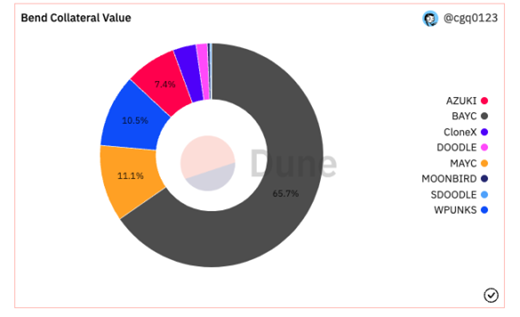
Figure 3: BendDAO Collateral Value
Source: Dune analytics
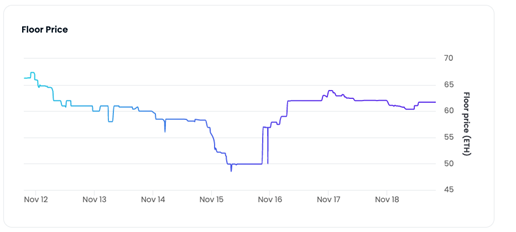
Figure 4: Floor Price of BAYC
Source: Opensea
As the leading NFT, BAYC has always been at a high price (even if it is now worth 66,000 US dollars based on the floor price of 52ETH), in the crypto bear market, almost all NFTs have fallen to varying degrees, and BAYC holders want to sell and cash out, So it caused the floor price to drop, which is a very reasonable explanation.
However, the transaction data on November 16 was unusual: the floor price fell below 50ETH (a significant drop can be seen from the K-line chart of the floor price above), the 24-hour drop reached 8.55%, and the transaction volume surged beyond 2700ETH.
About the mechanism of BendDAO, you can check the previous report: https://research.huobi.com/#/ArticleDetails?id=308
II. The Reason of BAYC Price Fall
Due to the drop in the floor price, the BAYC mortgaged in the NFT lending platform BendDAO directly triggered the liquidation auction process, and a large number of BAYC were on the verge of triggering the liquidation auction.
At this time, it was discovered that someone "manipulated" the floor price to trigger BendDAO to trigger the auction liquidation. What is even more surprising is that the "big short" behind this scene is Franklin, the seventh largest holder of BAYC.
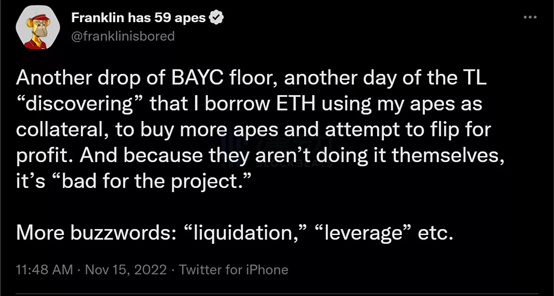
Figure 5: Aptos candle chart
Source: Franklin’s Twitter
Franklin is for arbitrage, not for sale.
Franklin has been implementing this strategy for a long time. Even when the market of BAYC is not good and falls, he can get very considerable profits. There is no need to be overly FUD, because the fatal point is not "falling" but "no acceptance". At present, neither the transaction of BAYC nor the liquidation auction bidding of BendDAO has shown any obvious stagnation.
III. How Franklin Arbitrages?
Franklin is a big monkey. Before today, he held 58 BAYCs, making him the seventh largest holder. The abundant NFT holdings gave him room to implement this strategy.
First of all, Franklin listed a bunch of BAYC at a price near the floor price, and then received a few lower offers and sold a few of them. In the recent turmoil, this wave of operations looks like a "clearance sale". The surge in pending orders caused panic among other holders, and a lower price than his pending orders appeared, further pushing down the floor price. After BendDAO’s oracle fed the price, the low floor price triggered BendDAO’s liquidation.
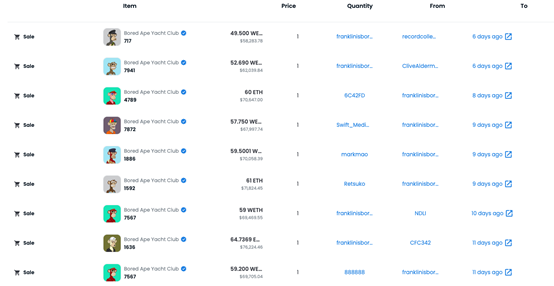
Figure 6: Franklin’s Activities
Source: Opensea
Then, he put his 14 BAYC in BendDAO for collateral loans. Taking this loan and the ETH obtained by selling the above 4 BAYCs, he bid on the 7 BAYCs that are being auctioned and liquidated on BendDAO in the price range of 43.8 - 44.3 ETH.
Next, there are three situations that can satisfy him:
• The borrower repays more than half of the debt within 24 hours of the start of the auction liquidation. At this time, as the first bidder, the borrower can receive a reward of 5% of the total debt paid by the borrower. (Based on 45E debt, the bounty is 2.25E)
• The borrower failed to pay off the debt, Franklin won the auction and successfully completed buying low and selling high. (That is, the 44E auction is successful, and then go to the secondary market to sell at the floor price of 50E)
• Borrower defaults, Franklin doesn't win the auction and can either close or keep hitting the floor until Scenario 2 is done.
If the floor price has fallen below 44E by the time he succeeds at 44E, a loss will occur, but this is less likely.
The core is: not to be obsessed with the price of BAYC, and at the same time get additional rewards
In essence, Franklin’s strategy does not take the price of BAYC into consideration. He believes that the 4 low-priced Offers he received were sold at a good price. Not only can he get the “first bidding reward” on BendDAO, but he can also participate in the liquidation After the auction is completed, sell low and buy high. But if BAYC's floor price cannot rebound, his strategy will not work.
IV. Will it cause BAYC’s serial liquidation?
In my opinion, it cannot cause BAYC’s serial liquidation.
In DeFi, it is often caused by bad news that the prices of mainstream digital assets such as Bitcoin and Ethereum have fallen, resulting in the insolvency and liquidation of mortgage assets in some DeFi ecosystems. The liquidation and sell-off process triggered a further decline in mainstream digital assets, which also caused more assets to be liquidated due to insolvency, and this reciprocation led to "serial liquidation" of digital assets.
The NFT lending market is different from the DeFi market when it is liquidated, mainly due to BendDAO's oracle mechanism.
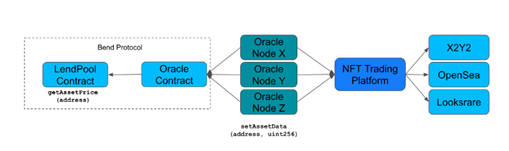
Figure 7: BendDAO’s Oracle Mechanism
Source: BendDAO
Bend protocol uses NFT floor price from OpenSea, X2Y2 and LooksRare as data of price feeding for NFT collateral. Bend protocol only supports the bluechip NFT asset's floor price for price feeding on-chain. Bluechip NFT's floor price is not easily manipulated. Besides that bend protocol calculate TWAP of floor price to filter the price fluctuation from OpenSea, X2Y2 and LooksRare marketplaces. In other words, the transaction price of BendDAO's liquidation auction will not be fed to itself.
In the long run, if the liquidation auction is not completed in time, it may have an impact on the market outlook.
Different from the last run on BendDAO, the current "first bid reward" helps to digest the liquidation auction, which means that no one will buy it. However, when a large number of BAYC triggers the liquidation auction on The price of the market floor price is traded, and the same strategy is repeatedly sold for arbitrage, which may cause a further drop in the floor price and trigger more liquidation auctions.
Worse, if the floor price quickly falls below the debt of the borrower, there will be no room for arbitrage, which may keep BAYCs in a state of no redemption or auction. In the long run, BendDAO may form a network similar to OpenSea and others. The pending order wall of the NFT trading platform reduces the liquidity of other NFT trading platforms, causing the floor price of the secondary market to fall further, entering a vicious circle.
V. Will BendDAO run out of funds this time like last time?
This report describes in detail the problems that occurred with BendDAO in August:
https://research.huobi.com/#/ArticleDetails?id=308
It can be seen from the report at that time that at that time, the poor performance of the entire NFT market caused the floor price to fall, which led to the lack of confidence of NFT traders; the small amount of bad debts at the beginning of the crisis were not resolved in time, resulting in the subsequent liquidity of the lending pool. Provider's panic stampede.
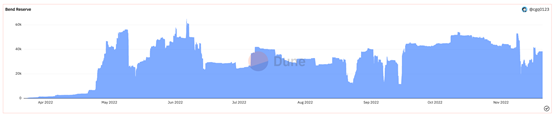
Figure 8: BendDAO’s Reserve
Source: Dune Analytics
But this time, only BAYC had a relatively serious liquidation auction phenomenon, and after that incident, BendDAO made improvements in the mechanism, making adjustments to the liquidation threshold, auction cycle, bidding restrictions, and base interest rates. The display page in the UI interface that may cause misunderstanding and panic has been improved. Now one of the key points of selling arbitrage "first bid reward" is also one of the improved measures.
Summary: The last run was an inevitable problem caused by the market and the BendDAO mechanism, and this BAYC large-scale liquidation auction seems to be caused only by Franklin wanting to sell arbitrage. One person caused a batch of BAYC liquidation, and other blue-chip NFT The performance is good and there is no short-term sharp drop, and the BendDAO reserves are in good condition, so there will be no serious run on the event like the last time.
About Huobi Research Institute
Huobi Blockchain Application Research Institute (referred to as "Huobi Research Institute") was established in April 2016. Since March 2018, it has been committed to comprehensively expanding the research and exploration of various fields of blockchain. As the research object, the research goal is to accelerate the research and development of blockchain technology, promote the application of the blockchain industry, and promote the ecological optimization of the blockchain industry. The main research content includes industry trends, technology paths, application innovations in the blockchain field, Model exploration, etc. Based on the principles of public welfare, rigor and innovation, Huobi Research Institute will carry out extensive and in-depth cooperation with governments, enterprises, universities and other institutions through various forms to build a research platform covering the complete industrial chain of the blockchain. Industry professionals provide a solid theoretical basis and trend judgments to promote the healthy and sustainable development of the entire blockchain industry.
Contact us:
Website: http://research.huobi.com
Email: research@huobi.com
Twitter https://twitter.com/Huobi_Research
Telegram: https://t.me/HuobiResearchOfficial
Medium: https://medium.com/huobi-research
Disclaimer
1. The author of this report and his organization do not have any relationship that affects the objectivity, independence, and fairness of the report with other third parties involved in this report.
2. The information and data cited in this report are from compliance channels. The sources of the information and data are considered reliable by the author, and necessary verifications have been made for their authenticity, accuracy and completeness, but the author makes no guarantee for their authenticity, accuracy or completeness.
3. The content of the report is for reference only, and the facts and opinions in the report do not constitute business, investment and other related recommendations. The author does not assume any responsibility for the losses caused by the use of the contents of this report, unless clearly stipulated by laws and regulations. Readers should not only make business and investment decisions based on this report, nor should they lose their ability to make independent judgments based on this report.
4. The information, opinions and inferences contained in this report only reflect the judgments of the researchers on the date of finalizing this report. In the future, based on industry changes and data and information updates, there is the possibility of updates of opinions and judgments.
5. The copyright of this report is only owned by Huobi Blockchain Research Institute. If you need to quote the content of this report, please indicate the source. If you need a large amount of references, please inform in advance (see "About Huobi Blockchain Research Institute" for contact information) and use it within the allowed scope. Under no circumstances shall this report be quoted, deleted or modified contrary to the original intent.