LayerZero tăng 20%: Liệu đòn bẩy tăng có kích hoạt bẫy tăng giá ZRO?

ambcryptoPublicado em 2026-04-08Última atualização em 2026-04-08

Resumo

LayerZero (ZRO) đã tăng 20% lên $2.07 với khối lượng giao dịch tăng 125.62%, phản ánh hoạt động thị trường mạnh mẽ. Tuy nhiên, đà tăng này diễn ra không ổn định và gặp phải vùng kháng cự quan trọng $2.11–$2.31, nơi áp lực bán xuất hiện sớm. Chỉ báo MACD và Parabolic SAR cho thấy tín hiệu tích cực nhưng chưa xác nhận hoàn toàn. Open Interest tăng 25.27% và Funding Rate chuyển dương, cho thấy đòn bẩy cao và kỳ vọng tăng giá đang gia tăng. Điều này làm giá nhạy cảm hơn với biến động. Nếu ZRO vượt $2.31, đà tăng có thể tiếp tục; ngược lại, nếu bị từ chối, giá có thể điều chỉnh về vùng hỗ trợ $1.77. Rủi ro hiện tại là một đợt điều chỉnh mạnh do định vị đòn bẩy quá mức.

LayerZero [ZRO] đã tăng 20% lên $2.07 khi khối lượng giao dịch tăng 125.62% lên $87.79 triệu, phản ánh hoạt động thị trường mạnh mẽ trong đợt tăng giá.

Tuy nhiên, đợt tăng giá này diễn ra thông qua những đợt đẩy mạnh lên thay vì tiến triển ổn định, cho thấy giá phản ứng mạnh mẽ với các đợt bùng nổ nhu cầu. Hành vi này tạo ra áp lực lớn hơn lên giá gần vùng kháng cự, nơi các phản ứng thường gia tăng khi các lợi ích đối lập bắt đầu xuất hiện.

Khi đợt di chuyển tiến triển, giá ZRO bắt đầu phản ứng nhanh hơn với các mức giá gần đó, phản ánh sự chuyển dịch sang định vị ngắn hạn thay vì tích lũy bền vững.

Người bán ZRO phản ứng trước khi kháng cự bị phá vỡ hoàn toàn

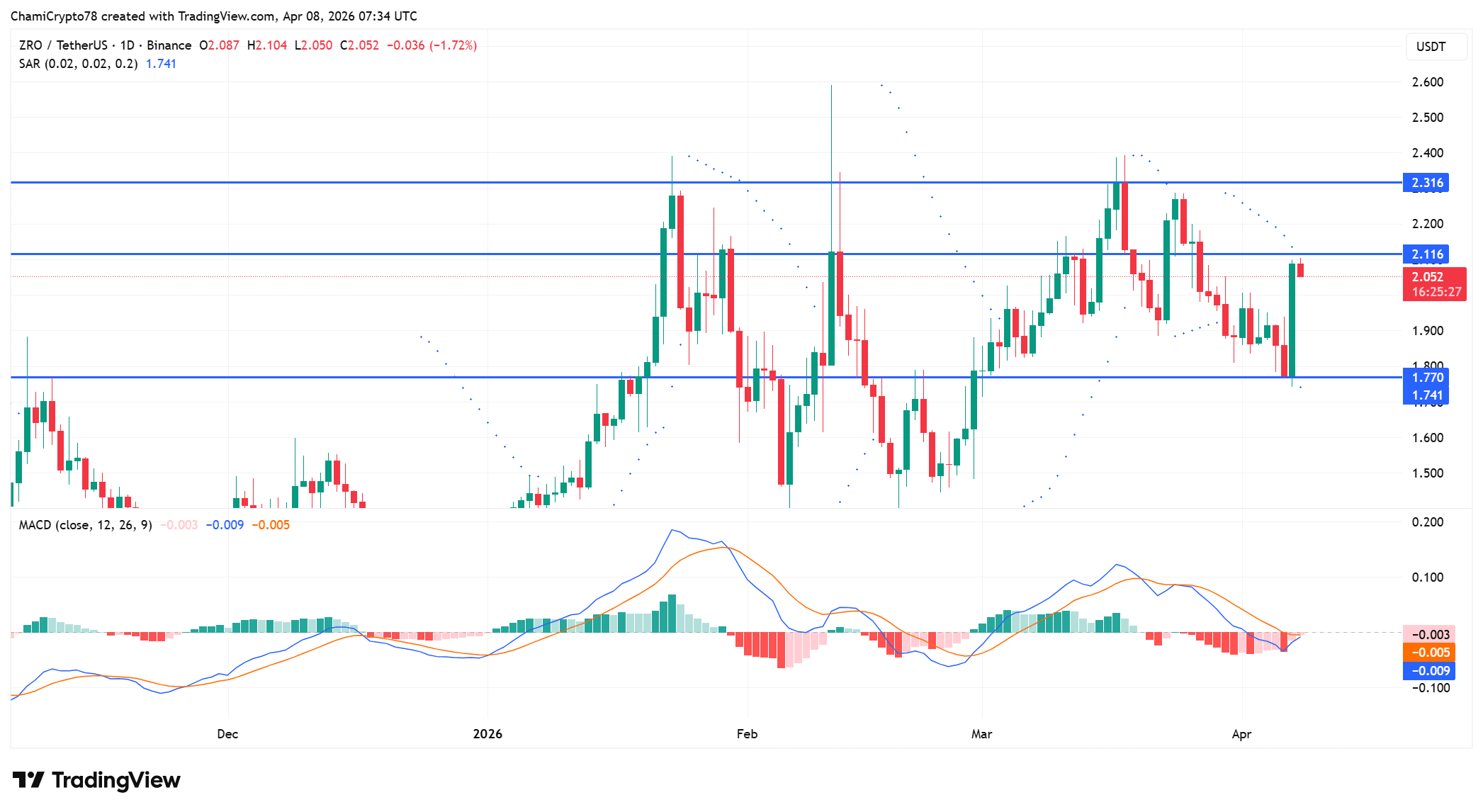
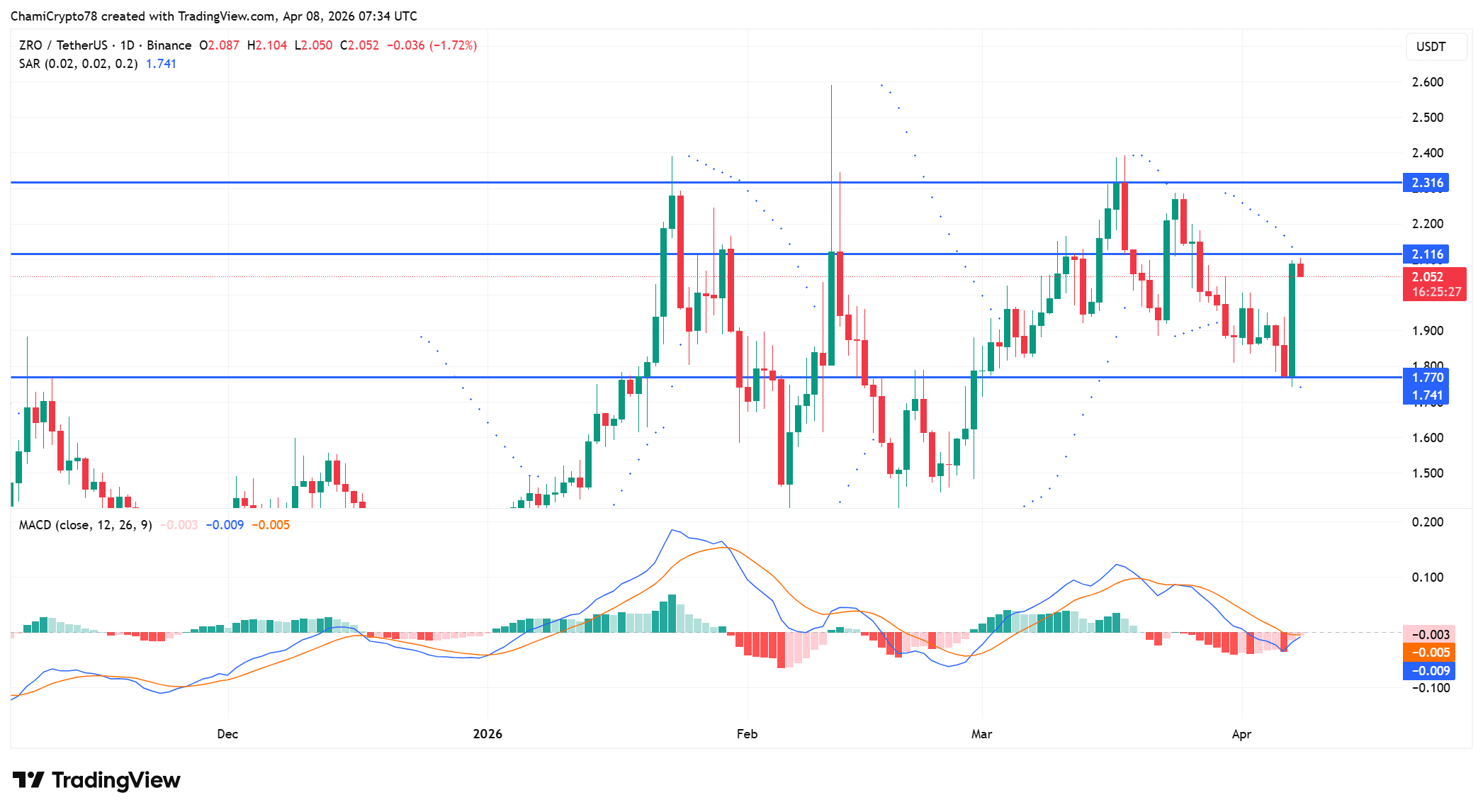
Khi đợt tăng giá mở rộng, ZRO di chuyển về phía vùng kháng cự quan trọng giữa $2.11 và $2.31. Giá giữ được hỗ trợ ở mức $1.77, vốn đóng vai trò là nền tảng vững chắc trong suốt đợt di chuyển.

Tuy nhiên, giá đã đối mặt với sự từ chối xung quanh vùng $2.05–$2.11 trước khi chạm đến biên giới phía trên. Phản ứng sớm này cho thấy những người bán đã bắt đầu phòng thủ ở các mức giá cao hơn. Kết quả là, cấu trúc phản ánh sự nén chặt hơn là sự tiếp diễn, với giá thắt chặt dưới vùng kháng cự.

Một thiết lập như vậy làm tăng áp lực lên cả hai phía, vì người mua đòi hỏi sự theo sau mạnh mẽ hơn, trong khi người bán cố gắng duy trì quyền kiểm soát gần vùng cung.

Tại thời điểm biên tập, đường MACD tiếp cận đường tín hiệu nhưng không cắt qua, trong khi giá giữ trên các mức đáy cao gần đây, cho thấy áp lực giảm giá giảm. Đến lượt nó, Parabolic SAR lật xuống dưới giá, phù hợp với sự thay đổi hướng ngắn hạn sau khi phục hồi.

Tuy nhiên, những tín hiệu này vẫn chỉ là chuyển tiếp, vì giá tiếp tục giao dịch dưới một vùng kháng cự chính.
Nguồn: TradingView

Đòn bẩy gia tăng khi trader đuổi theo đợt di chuyển

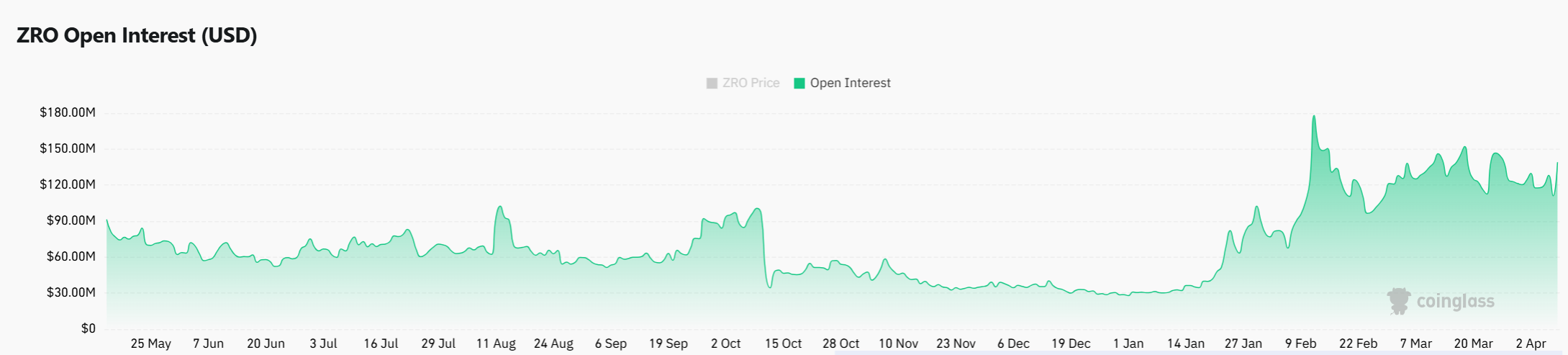
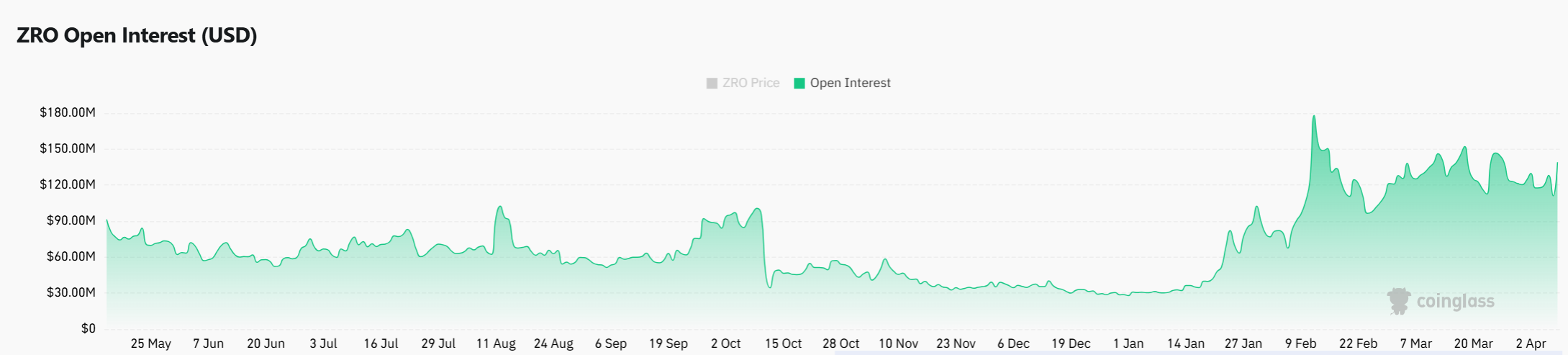
Open Interest (OI) - Lợi nhuận mở tăng 25.27% lên $138.25 triệu tính đến thời điểm viết bài, cho thấy các trader đã tăng mức độ phơi nhiễm đòn bẩy trong đợt tăng giá. Mức tăng này cho thấy những người tham gia đã vào các vị thế một cách mạnh mẽ khi giá di chuyển cao hơn.

Khi việc định vị mở rộng, giá trở nên nhạy cảm hơn với những thay đổi đột ngột, vì các giao dịch sử dụng đòn bẩy phản ứng nhanh chóng dưới áp lực. Đến lượt nó, cấu trúc bắt đầu phản ánh động lực định vị hơn là nhu cầu thuần túy từ giao ngay.

Sự thay đổi này cho thấy sự tham gia đầu cơ đã tăng lên, điều thường khuếch đại cả chuyển động đi lên và các phản ứng đi xuống tùy thuộc vào cách giá hành xử tại vùng kháng cự.
Nguồn: CoinGlass

Khuynh hướng mua ZRO gia tăng khi tâm lý thay đổi

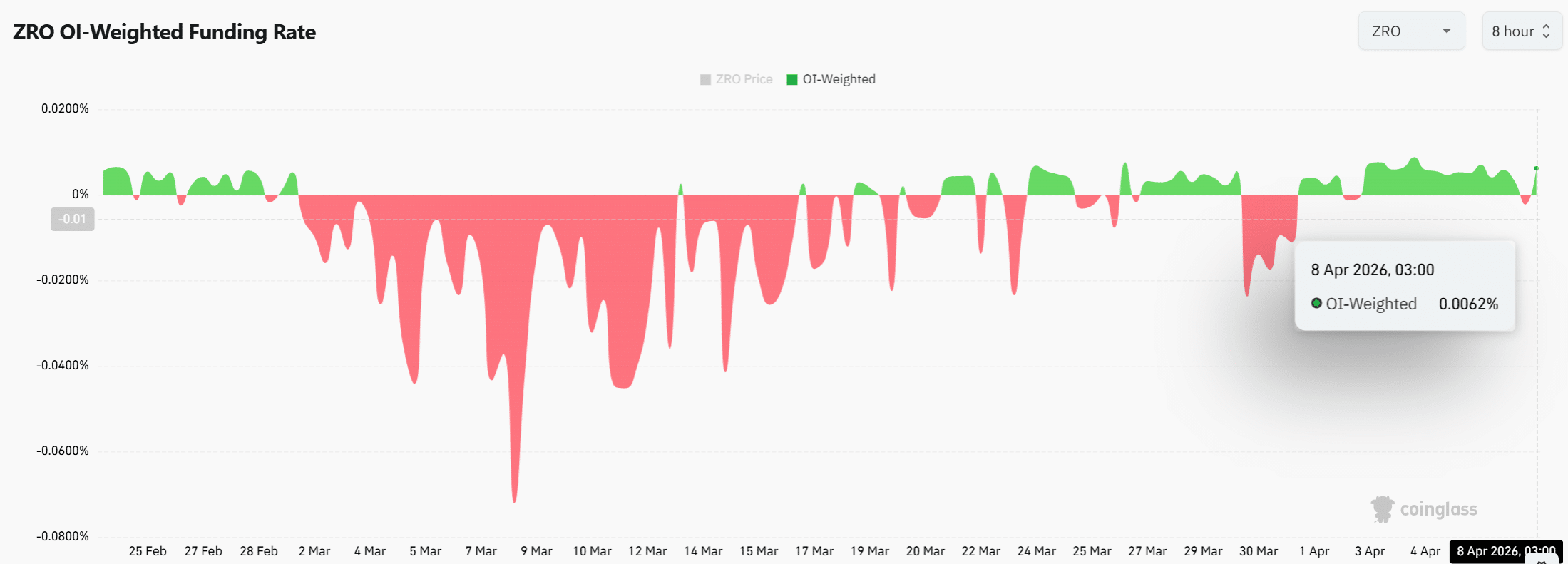
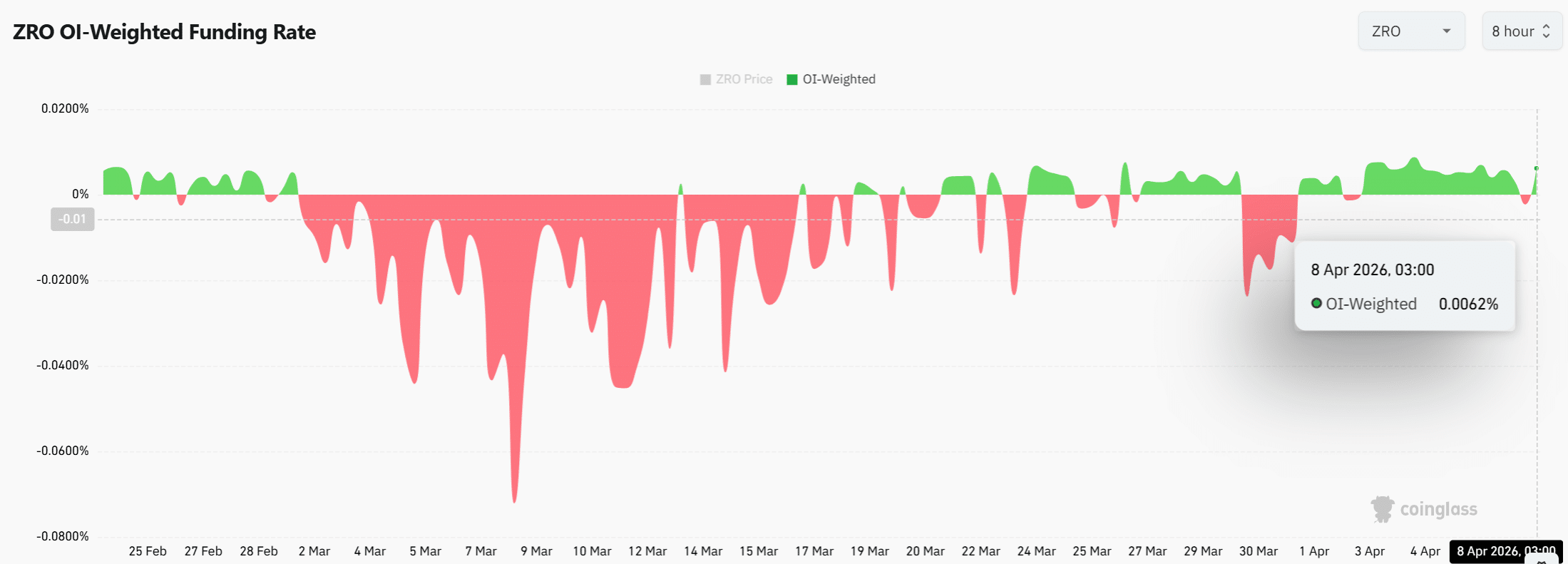
Tại thời điểm biên tập, Funding Rates - Tỷ lệ tài trợ chuyển sang dương, với Tỷ lệ Tài trợ Tính theo Trọng số OI đạt khoảng 0.0062%, cho thấy các vị thế mua chiếm ưu thế trong đợt di chuyển. Sự thay đổi này cho thấy các trader ngày càng định vị cho xu hướng tăng tiếp theo.

Tuy nhiên, funding dương cũng có nghĩa là các vị thế mua phải trả phí để duy trì, điều này thường xảy ra khi việc định vị trở nên quá đông. Khi sự mất cân bằng này phát triển, hành vi giá trở nên phụ thuộc nhiều hơn vào áp lực tăng liên tục.

Nếu giá chậm lại gần vùng kháng cự, các vị thế mua có khả năng sẽ phản ứng nhanh chóng, làm tăng nguy cơ của một đợt di chuyển định vị lại mạnh.
Nguồn: CoinGlass

Đợt tăng giá của ZRO thu hút sự tham gia mạnh mẽ, tuy nhiên giá đã gặp phải kháng cự trước khi xác nhận sự tiếp diễn.

Các chỉ báo cho thấy điều kiện được cải thiện mà không có sự xác nhận đầy đủ, trong khi OI tăng và funding dương chỉ ra sự phụ thuộc ngày càng nhiều vào đòn bẩy. Nếu giá phá vỡ $2.31, sự tiếp diễn sẽ theo sau; tuy nhiên, sự từ chối ở mức này sẽ làm tăng nguy cơ một đợt pullback về vùng hỗ trợ $1.77.


Tóm tắt Cuối cùng

  • Đợt tăng giá ZRO cho thấy sự tham gia mạnh mẽ, nhưng kháng cự vẫn tiếp diễn, hạn chế sự theo sau đi lên.
  • Đòn bẩy gia tăng và funding dương làm tăng nguy cơ các phản ứng mạnh gần vùng kháng cự.

Criptomoedas em alta

Perguntas relacionadas

QGiá của LayerZero (ZRO) đã tăng bao nhiêu phần trăm và đạt mức giá nào trong đợt tăng giá gần đây?

AGiá của LayerZero (ZRO) đã tăng 20% và đạt mức 2,07 USD.

QVùng kháng cự quan trọng mà giá ZRO đang tiếp cận nằm trong khoảng giá nào?

AVùng kháng cự quan trọng nằm trong khoảng từ 2,11 USD đến 2,31 USD.

QChỉ báo nào cho thấy áp lực giảm giá đã giảm bớt và đường Parabolic SAR đã lật sang dưới giá?

AChỉ báo MACD cho thấy áp lực giảm giá đã giảm bớt, và đường Parabolic SAR đã lật sang dưới giá, phù hợp với sự thay đổi hướng ngắn hạn sau khi giá phục hồi.

QOpen Interest (OI) và tỷ lệ Funding thay đổi như thế nào, và điều này cho thấy điều gì về tâm lý thị trường?

AOpen Interest (OI) tăng 25,27% lên 138,25 triệu USD, cho thấy các nhà giao dịch đang tăng mức độ tiếp xúc đòn bẩy. Tỷ lệ Funding chuyển sang dương, ở mức khoảng 0,0062%, cho thấy các vị thế mua dài hạn chiếm ưu thế và tâm lý thị trường đang lạc quan, nhưng đồng thời cũng làm tăng rủi ro nếu giá không duy trì được đà tăng.

QTheo bài viết, điều kiện nào cần xảy ra để đợt tăng giá của ZRO có thể tiếp tục, và nguy cơ nào có thể xảy ra nếu điều kiện đó không được đáp ứng?

AĐể đợt tăng giá tiếp tục, giá ZRO cần phá vỡ mức kháng cự tại 2,31 USD. Nếu giá bị từ chối tại mức này, nguy cơ điều chỉnh giảm trở lại vùng hỗ trợ quanh 1,77 USD sẽ tăng lên.

Leituras Relacionadas

a16z: From Companies to DAOs, DUNA May Become the Next Generation Organizational Form

This article, "From Companies to DAOs: How DUNA Could Become the Next Organizational Form," traces the 500-year evolution of business collaboration. It begins with medieval structures like the *commenda* and Florentine *compagnia*, which exposed partners to personal risk. The modern corporation, exemplified by the Dutch East India Company (VOC), was a revolutionary leap, enabling large-scale, capital-intensive ventures by offering limited liability and reducing coordination costs. However, corporations introduced new challenges like principal-agent problems and bureaucratic overhead. The piece argues that software and internet-native protocols are now reducing these traditional overheads. Decentralized Autonomous Organizations (DAOs) emerged as a new model for coordination without centralized management. Yet, DAOs face a significant legal vacuum: they lack legal recognition, leaving members exposed to unlimited personal liability, and their tokens are vulnerable to being classified as securities under unclear regulations (e.g., the Howey Test). This has forced projects into suboptimal workarounds like offshore foundations. The article identifies the Decentralized Unincorporated Nonprofit Association (DUNA) as a potential solution. Recently legalized in states like Wyoming, the DUNA provides a legal wrapper for decentralized networks. It grants key protections—legal personality, limited liability, and perpetual existence—to a group without imposing a traditional hierarchical management structure. This allows token-holder communities to govern, hold assets, and contract as a single legal entity, aligning with their decentralized nature. While DUNA doesn't solve all governance challenges or magically resolve securities law questions, it represents a crucial step. It fills the legal recognition gap, offering a native legal form for internet-scale, decentralized collaboration and extending the separation of personal risk from organizational venture into a new domain.

marsbitHá 40m

a16z: From Companies to DAOs, DUNA May Become the Next Generation Organizational Form

marsbitHá 40m

2026 Mid-Year Report On-Chain RWA: Tokenized Stock Market Cap Doubles in a Year, But 90% of Rights Are Hollow Shells

The 2026 Mid-Year Report on On-Chain RWA highlights a significant growth in tokenized stock market capitalization, which nearly doubled from $951 million in March to $1.89 billion by July. However, the report reveals a fundamental contradiction in this "layer 2.5" ecosystem: products with the strongest legal foundation (like regulated U.S. infrastructure) lack liquidity and distribution, while freely tradable offshored wrapper products often lack substantive ownership rights. The increase is driven largely by a few products (SECZ, FGRS, STRCx) and platforms (Ondo, xStocks, Securitize collectively hold over 85% share). While distributed value across networks like Ethereum, Solana, and BNB Chain has grown, the market remains fragmented. Products referencing the same underlying asset (e.g., Apple stock) are distinct legal liabilities with different intermediaries and jurisdictional rules, offering varying degrees of legal claim. The report cautions that headline numbers are misleading, as they reflect changes in distributed token value—driven by issuance, conversions, and price movements—not pure investor inflows. True "canonical shares" with legal ownership, wide wallet distribution, institutional liquidity, and independent on-chain price discovery do not yet exist at scale. Tokenized treasuries show stronger product-market fit, and ETFs may be easier to scale than single stocks. The core takeaway is a trade-off: legal certainty versus liquidity and composability.

marsbitHá 1h

2026 Mid-Year Report On-Chain RWA: Tokenized Stock Market Cap Doubles in a Year, But 90% of Rights Are Hollow Shells

marsbitHá 1h

Coldcard Hardware Wallet Hacked: 594 Bitcoin Withdrawn in 25 Minutes

The Coldcard hardware wallet has been compromised, with hackers stealing approximately 594.5 Bitcoin (~$40 million) from 500 addresses in just 25 minutes. The root cause was a critical software bug, undetected for five years, which disabled the device's secure chip for generating true random numbers. This led to the creation of private keys based on predictable data like the processor's serial number, drastically reducing cryptographic security. The attackers exploited this offline by brute-forcing possible seed phrases, finding active addresses on the public ledger, and signing transactions. Initially, Coinkite (Coldcard's maker) claimed only older models were at risk but later admitted all devices running the compromised firmware were vulnerable. CEO Rodolphe Novak (NVK) apologized but ruled out financial compensation for affected users. To secure funds, owners must urgently update their firmware to specific safe versions, generate a completely new seed phrase on the updated device, and transfer all assets to new addresses created with that new seed. While a BIP-39 passphrase can help, it does not replace this migration process. Other Coinkite products like TAPSIGNER were not affected. This incident underscores that even specialized hardware requires rigorous, independent code audits, especially for cryptographic functions. It parallels past failures, like a 2006 OpenSSL bug in Debian, and raises questions about whether automated code analysis can ever fully replace human scrutiny in critical security areas.

cryptonews.ruHá 3h

Coldcard Hardware Wallet Hacked: 594 Bitcoin Withdrawn in 25 Minutes

cryptonews.ruHá 3h

Trading

Spot

Artigos em Destaque

Como comprar ZRO

Bem-vindo à HTX.com!Tornámos a compra de LayerZero (ZRO) simples e conveniente.Segue o nosso guia passo a passo para iniciar a tua jornada no mundo das criptos.Passo 1: cria a tua conta HTXUtiliza o teu e-mail ou número de telefone para te inscreveres numa conta gratuita na HTX.Desfruta de um processo de inscrição sem complicações e desbloqueia todas as funcionalidades.Obter a minha contaPasso 2: vai para Comprar Cripto e escolhe o teu método de pagamentoCartão de crédito/débito: usa o teu visa ou mastercard para comprar LayerZero (ZRO) instantaneamente.Saldo: usa os fundos da tua conta HTX para transacionar sem problemas.Terceiros: adicionamos métodos de pagamento populares, como Google Pay e Apple Pay, para aumentar a conveniência.P2P: transaciona diretamente com outros utilizadores na HTX.Mercado de balcão (OTC): oferecemos serviços personalizados e taxas de câmbio competitivas para os traders.Passo 3: armazena teu LayerZero (ZRO)Depois de comprar o teu LayerZero (ZRO), armazena-o na tua conta HTX.Alternativamente, podes enviá-lo para outro lugar através de transferência blockchain ou usá-lo para transacionar outras criptomoedas.Passo 4: transaciona LayerZero (ZRO)Transaciona facilmente LayerZero (ZRO) no mercado à vista da HTX.Acede simplesmente à tua conta, seleciona o teu par de trading, executa as tuas transações e monitoriza em tempo real.Oferecemos uma experiência de fácil utilização tanto para principiantes como para traders experientes.

263 Visualizações TotaisPublicado em {updateTime}Atualizado em 2026.06.02

Como comprar ZRO

Discussões

Bem-vindo à Comunidade HTX. Aqui, pode manter-se informado sobre os mais recentes desenvolvimentos da plataforma e obter acesso a análises profissionais de mercado. As opiniões dos utilizadores sobre o preço de ZRO (ZRO) são apresentadas abaixo.

活动图片