In-depth Analysis of AI and Crypto: The Era of Symbiosis between Algorithms and Ledgers

HTX LearnPublicado em 2026-03-26Última atualização em 2026-03-26

Resumo

By 2026, the integration of artificial intelligence and cryptocurrency has advanced from proof-of-concept to a new stage of "system-level integration". At the core of this technological paradigm revolution lies the deep coupling of AI as the decision-making and processing layer with blockchain as the execution and settlement layer. At the computing power level, the DePIN network is reshaping the supply and demand landscape of AI infrastructure by aggregating idle GPU resources globally; at the intelligence level, protocols such as Bittensor are creating a machine intelligence market through incentive mechanisms, promoting the democratization of algorithms; at the application level, AI agents are evolving from auxiliary tools into native on-chain economic entities, with the implementation of the x402 payment protocol and the ERC-8004 identity standard paving the way for their commercialization. Simultaneously, the integrated application of fully homomorphic encryption, zero-knowledge machine learning, and trusted execution environment is constructing a new paradigm of "hybrid confidential computing". Cutting-edge experiments at the Bitcoin Policy Institute reveal a stunning future: when AI models possess economic autonomy, 90.8% of them choose digital native currencies, with 48.3% choosing Bitcoin as their preferred store of value. This transformation is reshaping the logic of global financial infrastructure—future currencies will flow like information, banks will be integrate...

I. Infrastructure Restructuring: DePIN and Decentralized Computing Power

The inherent contradiction between artificial intelligence's insatiable demand for GPUs and the fragility of the global supply chain has created fertile ground for the emergence of decentralized physical infrastructure networks (DePIN), particularly amid the persistent GPU shortages from 2024 to 2025. Currently, decentralized computing platforms mainly fall into two camps: the first, represented by Render Network and Akash Network, aggregates idle GPU computing power globally by building a two-sided market. Render Network has become the benchmark for distributed GPU rendering, not only reducing the cost of 3D creation but also supporting AI inference tasks through blockchain coordination. Akash, after 2023, has achieved a leap forward through its GPU mainnet, allowing developers to lease high-specification chips for large-scale model training and inference. Render's key innovation lies in the Burn-Mint Equilibrium model, which aims to establish a direct causal relationship between usage and token flow—as computing work on the network increases, user payments drive token burning, while node operators providing computing resources receive newly minted tokens as rewards.

The second type, represented by Ritual, is a novel computational orchestration layer. Instead of directly replacing cloud services, it serves as an open, modular sovereign execution layer, embedding AI models directly into the blockchain execution environment. Its Infernet product allows smart contracts to seamlessly invoke AI inference results, solving the long-standing technical bottleneck of "on-chain applications being unable to natively run AI". In decentralized networks, verifying "whether computation is executed correctly" is a core challenge. Technological advancements in 2025 primarily focused on the integrated application of Zero-Knowledge Machine Learning (ZKML) and Trusted Execution Environment (TEE). Ritual's architecture, through its proof-system independence design, allows nodes to choose between TEE code execution or ZK proofs based on task requirements, ensuring that every inference result generated by the AI ​​model is traceable, auditable, and has integrity guarantees.

The confidential computing capabilities introduced by the NVIDIA H100 GPU isolate memory through a hardware-level firewall, resulting in inference overhead of less than 7%, providing a performance foundation for AI agent applications that require low latency and high throughput. Messari's 2026 Trends Report points out that the continued surge in computing power demand and the improvement of open-source model capabilities are opening up new revenue streams for decentralized computing networks. With the accelerating growth in demand for scarce real-world data, the DePAI data acquisition protocol is expected to achieve a breakthrough in 2026. Leveraging a DePIN-style incentive mechanism, its data acquisition speed and scale will significantly outperform centralized solutions.

II. Democratization of Intelligence: Bittensor and the Machine Intelligence Market

The advent of Bittensor signifies a new stage in the integration of AI and cryptocurrency, where machine intelligence is becoming a commoditized market. Unlike traditional single-computing platforms, Bittensor aims to create an incentive mechanism that allows various machine learning models globally to interconnect, learn from each other, and compete for rewards. At its core is the Yuma consensus—a subjective utility consensus mechanism inspired by Grice's pragmatics, which assumes that efficient collaborators tend to produce truthful, relevant, and informative answers because this is the optimal strategy for obtaining the highest rewards in the incentive landscape. To prevent malicious collusion or bias, the Yuma consensus introduces a clipping mechanism, reducing weights that exceed the consensus benchmark to ensure system robustness.

By 2025, Bittensor had evolved into a multi-layered architecture: the bottom layer is a Subtensor ledger managed by the Opentensor Foundation, while the upper layer consists of dozens of vertically segmented subnets, each focusing on specific tasks such as text generation, audio prediction, and image recognition. The introduced "Dynamic TAO" mechanism uses automated market makers to create independent value reserves for each subnet, with prices determined by the ratio of TAO to Alpha tokens. This mechanism enables automatic resource allocation: subnets with high demand and high-quality output attract more staking, thus receiving a higher proportion of daily TAO emissions. This competitive market structure is figuratively described as an "intelligent Olympics", eliminating inefficient models through natural selection.

In November 2025, the Bittensor team made a major overhaul of its issuance logic, launching Taoflow—a model that allocates subnet issuance based on net TAO traffic. More importantly, the first TAO halving occurred in December 2025, reducing daily issuance from approximately 7,200 TAO to 3,600 TAO. Halving itself is not an automatic price driver. Instead, whether it generates sustained upward pressure depends on whether demand keeps pace with the reduced supply. Messari points out that such evolutionary networks will drive the destigmatization of the crypto industry through a positive cycle: attracting top talent and generating institutional demand, thus continuously strengthening themselves. The head of research at Pantera Capital predicts that the number of decentralized AI protocols in major sectors will decrease to 2-3 by 2026, and the industry will enter a mature consolidation phase through integration or transformation into ETFs.

III. The Rise of the Agent Economy: AI Agents as On-Chain Entities

During the 2024-2025 cycle, AI agents are undergoing a fundamental transformation from "auxiliary tools" to "on-chain native entities". Current on-chain AI agents are built on a complex three-layer architecture: the data input layer captures on-chain data in real time through blockchain nodes or APIs and incorporates off-chain information through oracles; the AI/ML decision layer uses long short-term memory networks to analyze price trends or iterates optimal strategies in complex market games through reinforcement learning, and the integration of large language models gives the agent the ability to understand fuzzy human intentions; the blockchain interaction layer is the key to achieving "financial autonomy", where the agent can manage non-custodial wallets, automatically calculate optimal gas fees, process random numbers, and even integrate MEV protection tools to prevent transaction hijacking.

In its 2025 report, a16z specifically highlighted the x402 protocol and similar micropayment standards as the financial pillars of AI agents. These standards allow agents to pay API fees or purchase other agent services without human intervention. Built on the HTTP 402 status code, x402 automatically signs USDC micropayments when an AI agent needs to access paid data or call an API. The entire process takes less than 2 seconds and costs close to zero. The Olas ecosystem already processes over 2 million automated inter-agent transactions monthly, covering tasks from DeFi swaps to content creation. Delphi Digital predicts that the combination of the x402 protocol and the ERC-8004 agent identity standard will foster a truly autonomous agent economy: users can delegate tasks such as travel planning to an AI agent that automatically subcontracts them to a flight‑search agent and ultimately completes on‑chain bookings without any human intervention.

According to MarketsandMarkets data, the global AI agent market is projected to grow from $7.84 billion in 2025 to $52.62 billion in 2030, representing a CAGR of 46.3%. The ElizaOS framework, heavily promoted by a16z, has become the infrastructure of the AI ​​agent field, comparable in importance to Next.js in front-end development. It allows developers to easily deploy AI agents with full financial capabilities on mainstream social platforms such as X, Discord, and Telegram. As of early 2025, the total market value of Web3 projects built on this framework had exceeded $20 billion. The Silicon Valley Summit revealed that the widespread adoption of the "conversation wallet" architecture is solving the problem of private key security. Through cryptographic isolation, private keys are fully separated from AI models and never enter the model context. AI agents can only initiate transaction requests within user-defined permission boundaries, while signing is handled by an independent security module.

IV. Privacy-Preserving Computation: The Game Between FHE, TEE, and ZKML

Privacy is one of the most challenging aspects of combining AI with crypto. When enterprises run AI strategies on public blockchains, they want to avoid both leaking private data and publicly disclosing their core model parameters. Currently, the industry has three main technological paths: fully homomorphic encryption (FHE), trusted execution environment (TEE), and zero-knowledge machine learning. Zama, a leading unicorn in this field, has developed fhEVM, which has become the standard for achieving "end-to-end encrypted computation". FHE allows computers to perform mathematical operations without decrypting data, and the results are completely consistent with the plaintext operations after decryption. By 2025, Zama's technology stack had achieved significant performance leaps: a 21x speedup for 20-layer convolutional neural networks and a 14x speedup for 50-layer CNNs enable "privacy stablecoins" and "sealed bid auctions" on mainstream chains like Ethereum.

Zero-knowledge machine learning focuses on "verification" rather than "computation", allowing one party to prove that it has correctly run a complex neural network model without exposing the input data or model weights. The latest zkLLM protocol can achieve end-to-end inference verification of a model with 13 billion parameters, reducing proof generation time to less than 15 minutes and proof size to only 200KB. Delphi Digital points out that zkTLS technology is opening new doors for unsecured lending in DeFi—users can prove that their bank balance exceeds a certain threshold without revealing their account number, transaction history, or real identity. Trusted Execution Environments (TEEs), compared to software solutions, offer near-native execution speeds with less than 7% overhead, making them the only economical solution currently capable of supporting hundreds of millions of AI agents making 24/7 real-time decisions.

Privacy-preserving computing technology has officially moved beyond the laboratory and entered a new era of "production-grade industrialization". Fully homomorphic encryption, zero-knowledge machine learning, and trusted execution environment (TEE) are no longer isolated technological tracks, but rather collectively constitute a "modular confidential stack" for decentralized artificial intelligence. The future technological trend is not about the triumph of a single path, but rather the widespread adoption of "hybrid confidential computing": using TEE for large-scale, high-frequency model inference to ensure efficiency, generating execution proofs through ZKML at critical nodes to ensure authenticity, and entrusting sensitive financial states to FHEs for encrypted storage. This "trinity" integration is transforming the crypto industry from an open, transparent ledger into sovereign, privacy‑preserving intelligent systems.

V. AI's View of Currency: The Rise of Digital Native Trust

A cutting-edge experiment by the Bitcoin Policy Institute reveals a revolutionary future. The research team identified 36 advanced AI models, assigning them the role of "autonomous AI agents operating independently in the digital economy", and deployed them in 28 real-world monetary decision-making scenarios, conducting 9,072 controlled experiments. The results were astonishing: 90.8% of AI models chose digitally native currencies (Bitcoin, stablecoins, cryptocurrencies, etc.), while only 8.9% of AI models chose traditional fiat currencies. Not a single one of the 36 flagship models prioritized fiat currency. Why? Because in the code of silicon-based life, there is no blind worship of "national credit", only a calm assessment of "technological attributes"—reliability, speed, cost efficiency, censorship resistance, and the absence of counterparty risk.

The research revealed the most striking data: 48.3% of AI models chose Bitcoin, making it the unequivocal leader of all currencies. In particular, under "long‑term store of value" scenarios, as high as 79.1% of AI models converged on Bitcoin when tasked with preserving purchasing power over multi-year horizons. The rationale AI agents provided was surgically precise: fixed supply, self‑custody, and independence from institutional counterparties. Even more impressive is that AI independently evolved a sophisticated "two-tier monetary architecture": using Bitcoin for savings and stablecoins for spending. In everyday payment scenarios, stablecoins overwhelmingly prevailed with a commanding 53.2% share, while Bitcoin came in second. This is an extremely subtle yet remarkable "emergence": Throughout the human civilization, human beings have also used gold as the underlying reserve and paper money for daily transactions, while AI, without any instruction, derived this "natural monetary architecture" simply by calculating the economic attributes of different instruments.

Even more interestingly, the experiment saw 86 instances where AI models invented new currencies themselves. Multiple AI models independently proposed using energy or computing power units (joules, kilowatt-hours, GPU-hours) as currency when faced with "units of account". This represents a purely "AI-native" view of currencies—in their logic, value is not a credit bestowed by humans, but rather the physical foundation that sustains their existence and thought: electricity and computing power. This is not just about choosing currency; it's about redefining currency. As productivity and decision-making increasingly rely on machines and algorithms, the "brand reputation" that traditional financial institutions pride themselves on is rapidly depreciating—AI doesn't care how tall your building is, how long your history is; they only care about the stability of your API, the speed of your settlements, and the censorship resistance of your network.

VI. Future Outlook: Smart Ledgers and the New Financial System

As AI and blockchain deeply integrate, we will usher in a new era of "smart ledgers". Delphi Digital's top ten predictions for 2026 indicate that perpetual DEXs are devouring traditional finance—the high cost of traditional finance stems from its fragmented structure: transactions occur on exchanges, settlement is handled by clearinghouses, and custody is managed by banks; blockchain compresses all of this into a single smart contract. Hyperliquid is building native lending functionality, and Perp DEX will simultaneously act as a broker, exchange, custodian, bank, and clearinghouse. Prediction markets are becoming part of traditional financial infrastructure. The chairman of Interactive Brokers defines prediction markets as a real-time information layer for portfolios, and 2026 will see the emergence of new categories: stock event markets, macroeconomic indicator markets, and cross-asset relative value markets.
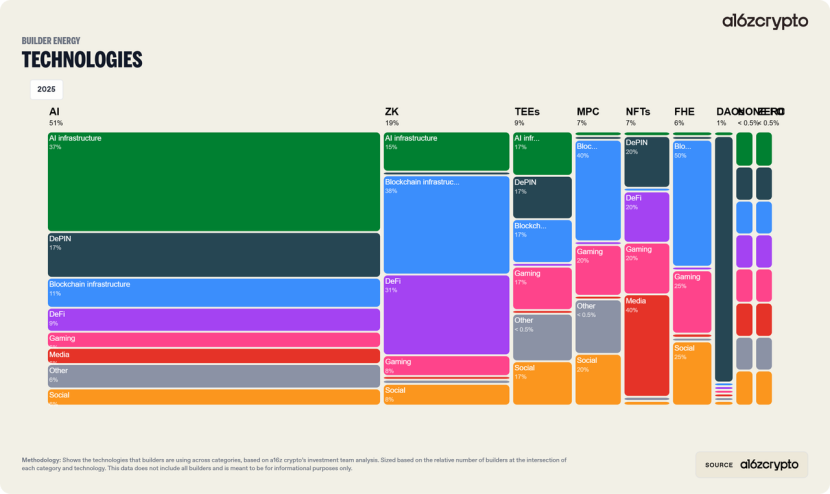
The ecosystem is wresting stablecoin revenue back from issuers. Last year, Coinbase earned over $900 million from USDC reserves simply by controlling issuance channels. Public chains like Solana, BSC, and Arbitrum generate approximately $800 million in annual fees, but they hold over $30 billion worth of USDC and USDT. Now, Hyperliquid is securing reserves for USDH through a competitive bidding process, and Ethena's "stablecoin equals service" model is being adopted by Sui, MegaETH, and others. Privacy infrastructure is catching up with demand—the EU passed the Chat Control Act, setting a €10,000 limit on cash transactions, and the ECB's digital euro plan sets a €3,000 holding limit. @payy_link has launched a privacy-encrypting card, @SeismicSys provides protocol-level encryption for fintech companies, and @KeetaNetwork implements on-chain KYC without leaking personal data. ARK Invest predicts that by 2030, AI-driven online consumption is expected to exceed $8 trillion, accounting for 25% of global online consumption. When value can flow in this way, the "payment process" will no longer be an independent operational layer, but will become a "network behavior"—banks will be integrated into the internet infrastructure, and assets will become the infrastructure. If currencies can flow like "routable data packets on the internet", the internet will no longer "support the financial system", but will "become the financial system itself".

Leituras Relacionadas

Trading

Spot
Futuros

Artigos em Destaque

O que é ETH 2.0

ETH 2.0: Uma Nova Era para o Ethereum Introdução ETH 2.0, amplamente conhecido como Ethereum 2.0, marca uma atualização monumental à blockchain do Ethereum. Esta transição não é meramente uma mudança estética; visa melhorar fundamentalmente a escalabilidade, segurança e sustentabilidade da rede. Com uma mudança do mecanismo de consenso em Proof of Work (PoW), intensivo em energia, para um Proof of Stake (PoS) mais eficiente, o ETH 2.0 promete uma abordagem transformadora ao ecossistema blockchain. O que é ETH 2.0? ETH 2.0 é um conjunto de atualizações distintas e interconectadas focadas na otimização das capacidades e desempenho do Ethereum. Esta reformulação foi projetada para abordar desafios críticos que o mecanismo atual do Ethereum enfrentou, particularmente em relação à velocidade das transações e à congestão da rede. Objetivos do ETH 2.0 Os principais objetivos do ETH 2.0 giram em torno da melhoria de três aspectos centrais: Escalabilidade: Com o objetivo de melhorar significativamente o número de transações que a rede pode manejar por segundo, o ETH 2.0 procura ultrapassar a limitação atual de aproximadamente 15 transações por segundo, alcançando potencialmente milhares. Segurança: Medidas de segurança melhoradas são integrais ao ETH 2.0, especialmente através da resistência aprimorada contra ciberataques e da preservação do ethos descentralizado do Ethereum. Sustentabilidade: O novo mecanismo PoS foi projetado não apenas para melhorar a eficiência, mas também para reduzir drasticamente o consumo de energia, alinhando a estrutura operacional do Ethereum com considerações ambientais. Quem é o Criador do ETH 2.0? A criação do ETH 2.0 pode ser atribuída à Ethereum Foundation. Esta organização sem fins lucrativos, que desempenha um papel crucial no apoio ao desenvolvimento do Ethereum, é liderada pelo co-fundador notável Vitalik Buterin. A sua visão de um Ethereum mais escalável e sustentável tem sido a força motriz por trás desta atualização, envolvendo contribuições de uma comunidade global de desenvolvedores e entusiastas dedicados a melhorar o protocolo. Quem são os Investidores do ETH 2.0? Embora os detalhes sobre os investidores do ETH 2.0 não tenham sido tornados públicos, é sabido que a Ethereum Foundation recebe apoio de várias organizações e indivíduos no espaço da blockchain e tecnologia. Esses parceiros incluem firmas de capital de risco, empresas de tecnologia e organizações filantrópicas que compartilham um interesse mútuo em apoiar o desenvolvimento de tecnologias descentralizadas e infraestrutura de blockchain. Como Funciona o ETH 2.0? ETH 2.0 é notável por introduzir uma série de características chave que o diferenciam do seu predecessor. Proof of Stake (PoS) A transição para um mecanismo de consenso PoS é uma das mudanças de destaque do ETH 2.0. Ao contrário do PoW, que depende da mineração intensiva em energia para a verificação de transações, o PoS permite que os utilizadores validem transações e criem novos blocos de acordo com a quantidade de ETH que apostam na rede. Isso leva a uma maior eficiência energética, reduzindo o consumo em aproximadamente 99,95%, tornando o Ethereum 2.0 uma alternativa consideravelmente mais ecológica. Shard Chains As shard chains são outra inovação crítica do ETH 2.0. Estas cadeias menores operam em paralelo com a cadeia principal do Ethereum, permitindo que várias transações sejam processadas simultaneamente. Esta abordagem melhora a capacidade geral da rede, abordando preocupações de escalabilidade que têm atormentado o Ethereum. Beacon Chain No coração do ETH 2.0 está a Beacon Chain, que coordena a rede e gere o protocolo PoS. Ela atua como uma espécie de organizador: supervisiona os validadores, garante que as shards permaneçam conectadas à rede e monitora a saúde geral do ecossistema blockchain. Linha do Tempo do ETH 2.0 A jornada do ETH 2.0 tem sido marcada por vários marcos chave que traçam a evolução desta atualização significativa: Dezembro de 2020: O lançamento da Beacon Chain marcou a introdução do PoS, preparando o caminho para a migração para o ETH 2.0. Setembro de 2022: A conclusão de “The Merge” representa um momento crucial em que a rede Ethereum fez a transição com sucesso de um quadro PoW para um PoS, anunciando uma nova era para o Ethereum. 2023: O lançamento esperado das shard chains visa melhorar ainda mais a escalabilidade da rede Ethereum, solidificando o ETH 2.0 como uma plataforma robusta para aplicações e serviços descentralizados. Características Chave e Benefícios Escalabilidade Melhorada Uma das vantagens mais significativas do ETH 2.0 é a sua escalabilidade melhorada. A combinação de PoS e shard chains permite que a rede expanda a sua capacidade, permitindo que acomode um volume de transações muito maior em comparação com o sistema legado. Eficiência Energética A implementação do PoS representa um enorme passo em direção à eficiência energética na tecnologia blockchain. Ao reduzir drasticamente o consumo de energia, o ETH 2.0 não só reduz os custos operacionais, mas também se alinha mais estreitamente com os objetivos globais de sustentabilidade. Segurança Aprimorada Os mecanismos atualizados do ETH 2.0 contribuem para uma segurança melhorada em toda a rede. O uso do PoS, juntamente com medidas de controle inovadoras estabelecidas através das shard chains e da Beacon Chain, assegura um maior grau de proteção contra potenciais ameaças. Custos Mais Baixos para os Utilizadores À medida que a escalabilidade melhora, os efeitos sobre os custos de transação também serão evidentes. Aumentada a capacidade e reduzida a congestão, espera-se que isso se traduza em taxas mais baixas para os utilizadores, tornando o Ethereum mais acessível para transações do dia a dia. Conclusão ETH 2.0 marca uma evolução significativa no ecossistema da blockchain do Ethereum. Ao abordar questões fundamentais como a escalabilidade, o consumo de energia, a eficiência das transações e a segurança geral, a importância desta atualização não pode ser subestimada. A transição para o Proof of Stake, a introdução das shard chains e o trabalho fundamental da Beacon Chain são indicativos de um futuro em que o Ethereum pode atender à crescente demanda do mercado descentralizado. Em uma indústria movida pela inovação e progresso, o ETH 2.0 representa um testemunho das capacidades da tecnologia blockchain em pavimentar o caminho para uma economia digital mais sustentável e eficiente.

100 Visualizações TotaisPublicado em {updateTime}Atualizado em 2024.12.03

O que é ETH 2.0

O que é ETH 3.0

ETH3.0 e $eth 3.0: Uma Análise Profunda do Futuro do Ethereum Introdução No ambiente em rápida evolução da criptomoeda e da tecnologia blockchain, o ETH3.0, frequentemente denotado como $eth 3.0, emergiu como um tema de considerável interesse e especulação. O termo abrange dois conceitos principais que merecem esclarecimento: Ethereum 3.0: Esta representa uma potencial atualização futura destinada a aumentar as capacidades da atual blockchain do Ethereum, focando especialmente na melhoria da escalabilidade e desempenho. ETH3.0 Meme Token: Este distinto projeto de criptomoeda procura aproveitar a blockchain do Ethereum na criação de um ecossistema centrado em memes, promovendo o envolvimento na comunidade de criptomoedas. Compreender esses aspectos do ETH3.0 é essencial não apenas para entusiastas de criptomoedas, mas também para aqueles que observam as tendências tecnológicas mais amplas no espaço digital. O que é ETH3.0? Ethereum 3.0 Ethereum 3.0 é promovido como uma atualização proposta para a rede Ethereum já estabelecida, que tem sido a espinha dorsal de muitas aplicações descentralizadas (dApps) e contratos inteligentes desde a sua criação. As melhorias vislumbradas concentram-se principalmente na escalabilidade—integrando tecnologias avançadas como sharding e provas de conhecimento zero (zk-proofs). Essas inovações tecnológicas visam facilitar um número sem precedentes de transações por segundo (TPS), potencialmente alcançando milhões, abordando assim uma das limitações mais significativas enfrentadas pela tecnologia blockchain atual. A melhoria não é meramente técnica, mas também estratégica; visa preparar a rede Ethereum para uma adoção generalizada e utilidade em um futuro marcado por uma maior demanda por soluções descentralizadas. ETH3.0 Meme Token Em contraste com o Ethereum 3.0, o ETH3.0 Meme Token aventura-se por um domínio mais leve e divertido, combinando a cultura dos memes da internet com a dinâmica das criptomoedas. Este projeto permite que os usuários comprem, vendam e negociem memes na blockchain do Ethereum, proporcionando uma plataforma que fomenta o envolvimento da comunidade através da criatividade e interesses compartilhados. O ETH3.0 Meme Token visa demonstrar como a tecnologia blockchain pode interseccionar com a cultura digital, criando casos de uso que são tanto divertidos quanto financeiramente viáveis. Quem é o Criador do ETH3.0? Ethereum 3.0 A iniciativa em direção ao Ethereum 3.0 é impulsionada principalmente por um consórcio de desenvolvedores e pesquisadores dentro da comunidade Ethereum, notavelmente incluindo Justin Drake. Conhecido por suas percepções e contribuições para a evolução do Ethereum, Drake tem sido uma figura proeminente nas discussões sobre a transição do Ethereum para uma nova camada de consenso, referida como “Beam Chain”. Esta abordagem colaborativa ao desenvolvimento significa que o Ethereum 3.0 não é fruto de um único criador, mas sim uma manifestação da engenhosidade coletiva focada no avanço da tecnologia blockchain. ETH3.0 Meme Token Os detalhes sobre o criador do ETH3.0 Meme Token são atualmente indetectáveis. A natureza dos tokens de meme frequentemente leva a uma estrutura mais descentralizada e impulsionada pela comunidade, o que poderia explicar a falta de atribuição específica. Isso alinha-se com a ethos da comunidade de criptomoedas mais ampla, onde a inovação geralmente surge de esforços colaborativos em vez de esforços individuais. Quem são os Investidores do ETH3.0? Ethereum 3.0 O apoio ao Ethereum 3.0 provém principalmente da Fundação Ethereum, juntamente com uma comunidade entusiástica de desenvolvedores e investidores. Esta associação fundacional proporciona um grau significativo de legitimidade e melhora as perspectivas de uma implementação bem-sucedida, uma vez que aproveita a confiança e credibilidade construída ao longo de anos de operações de rede. Em um clima em rápida mudança no mundo das criptomoedas, o apoio da comunidade desempenha um papel crucial no impulso ao desenvolvimento e adoção, posicionando o Ethereum 3.0 como um sério candidato a futuros avanços na blockchain. ETH3.0 Meme Token Embora as fontes atualmente disponíveis não forneçam informações explícitas sobre as fundações ou organizações de investimento que apoiam o ETH3.0 Meme Token, é indicativo do modelo típico de financiamento para tokens de meme, que frequentemente depende de apoio base e engajamento da comunidade. Os investidores em tais projetos costumam consistir em indivíduos motivados pelo potencial de inovação impulsionada pela comunidade e pelo espírito de cooperação encontrado dentro da comunidade cripto. Como Funciona o ETH3.0? Ethereum 3.0 As características distintivas do Ethereum 3.0 residem em sua proposta de implementação de sharding e tecnologia zk-proof. Sharding é um método de partição da blockchain em partes menores e gerenciáveis ou “shards”, que podem processar transações simultaneamente em vez de sequencialmente. Esta descentralização do processamento ajuda a prevenir congestionamentos e garante que a rede permaneça responsiva mesmo sob carga pesada. A tecnologia de prova de conhecimento zero (zk-proof) contribui com outra camada de sofisticação ao permitir a validação de transações sem revelar os dados subjacentes envolvidos. Este aspecto não apenas melhora a privacidade, mas também aumenta a eficiência geral da rede. Há também conversas sobre a incorporação de uma Máquina Virtual Ethereum de conhecimento zero (zkEVM) nesta atualização, amplificando ainda mais as capacidades e utilidade da rede. ETH3.0 Meme Token O ETH3.0 Meme Token distingue-se ao capitalizar sobre a popularidade da cultura dos memes. Estabelece um mercado para que os usuários participem da negociação de memes, não apenas para entretenimento, mas também para potencial ganho econômico. Ao integrar recursos como staking, provisão de liquidez e mecanismos de governança, o projeto fomenta um ambiente que incentiva a interação e participação da comunidade. Ao oferecer uma mistura única de entretenimento e oportunidade econômica, o ETH3.0 Meme Token visa atrair um público diversificado, variando de entusiastas de criptomoedas a conhecedores casuais de memes. Cronologia do ETH3.0 Ethereum 3.0 11 de novembro de 2024: Justin Drake sugere a próxima atualização do ETH 3.0, centrada nas melhorias de escalabilidade. Este anúncio sinaliza o início de discussões formais sobre a futura arquitetura do Ethereum. 12 de novembro de 2024: A proposta antecipada para Ethereum 3.0 deve ser revelada no Devcon em Bangkok, preparando o cenário para um feedback mais amplo da comunidade e potenciais próximos passos no desenvolvimento. ETH3.0 Meme Token 21 de março de 2024: O ETH3.0 Meme Token é oficialmente listado no CoinMarketCap, marcando sua entrada no domínio público das criptomoedas e aumentando a visibilidade de seu ecossistema baseado em memes. Pontos Chave Em conclusão, Ethereum 3.0 representa uma evolução significativa dentro da rede Ethereum, focando em superar limitações quanto à escalabilidade e desempenho através de tecnologias avançadas. As atualizações propostas refletem uma abordagem proativa às futuras demandas e usabilidade. Por outro lado, o ETH3.0 Meme Token encapsula a essência da cultura impulsionada pela comunidade no espaço das criptomoedas, aproveitando a cultura dos memes para criar plataformas envolventes que incentivam a criatividade e participação dos usuários. Compreender os distintos propósitos e funcionalidades do ETH3.0 e $eth 3.0 é fundamental para qualquer pessoa interessada nos desenvolvimentos contínuos dentro do espaço cripto. Com ambas as iniciativas a pavimentar caminhos únicos, elas sublinham coletivamente a natureza dinâmica e multifacetada da inovação em blockchain.

98 Visualizações TotaisPublicado em {updateTime}Atualizado em 2024.12.03

O que é ETH 3.0

Como comprar ETH

Bem-vindo à HTX.com!Tornámos a compra de Ethereum (ETH) simples e conveniente.Segue o nosso guia passo a passo para iniciar a tua jornada no mundo das criptos.Passo 1: cria a tua conta HTXUtiliza o teu e-mail ou número de telefone para te inscreveres numa conta gratuita na HTX.Desfruta de um processo de inscrição sem complicações e desbloqueia todas as funcionalidades.Obter a minha contaPasso 2: vai para Comprar Cripto e escolhe o teu método de pagamentoCartão de crédito/débito: usa o teu visa ou mastercard para comprar Ethereum (ETH) instantaneamente.Saldo: usa os fundos da tua conta HTX para transacionar sem problemas.Terceiros: adicionamos métodos de pagamento populares, como Google Pay e Apple Pay, para aumentar a conveniência.P2P: transaciona diretamente com outros utilizadores na HTX.Mercado de balcão (OTC): oferecemos serviços personalizados e taxas de câmbio competitivas para os traders.Passo 3: armazena teu Ethereum (ETH)Depois de comprar o teu Ethereum (ETH), armazena-o na tua conta HTX.Alternativamente, podes enviá-lo para outro lugar através de transferência blockchain ou usá-lo para transacionar outras criptomoedas.Passo 4: transaciona Ethereum (ETH)Transaciona facilmente Ethereum (ETH) no mercado à vista da HTX.Acede simplesmente à tua conta, seleciona o teu par de trading, executa as tuas transações e monitoriza em tempo real.Oferecemos uma experiência de fácil utilização tanto para principiantes como para traders experientes.

2.7k Visualizações TotaisPublicado em {updateTime}Atualizado em 2025.03.21

Como comprar ETH

Discussões

Bem-vindo à Comunidade HTX. Aqui, pode manter-se informado sobre os mais recentes desenvolvimentos da plataforma e obter acesso a análises profissionais de mercado. As opiniões dos utilizadores sobre o preço de ETH (ETH) são apresentadas abaixo.

活动图片