Những đồng tiền thắng và thua trong tuần của thị trường crypto – KAS, DEXE, UNI, TRUMP

ambcryptoPublicado em 2026-03-22Última atualização em 2026-03-22

Resumo

Bitcoin (BTC) giảm 3,88% trong tuần qua do lo ngại leo thang căng thẳng địa chính trị ở Tây Á. Thị trường altcoin cũng giảm 1,94%, nhưng một số đồng tiền vẫn có biểu hiện nổi bật. **Tuần của những đồng tiền tăng giá:** Kaspa (KAS) dẫn đầu với mức tăng 19,5% nhờ vượt qua các đường trung bình động và khối lượng giao dịch cao. DeXe (DEXE) tiếp tục xu hướng tăng của lĩnh vực AI với mức tăng 18,62%. Fetch (FET) và Quant (QNT) cũng là những đồng tăng giá đáng chú ý. **Tuần của những đồng tiền giảm giá:** Uniswap (UNI) là một trong những đồng giảm mạnh nhất, mất 12,4% giá trị cùng với sự suy yếu của cả lĩnh vực DeFi. TRUMP token mất gần 20,51% sau khi cơn sốt từ hội nghị crypto Mar-a-Lago lắng xuống. OKB giảm 12,57% và không duy trì được đà tăng trước đó. Midnight (NIGHT), Render (RNDR) và Internet Computer (ICP) cũng nằm trong nhóm giảm giá. Triển vọng tuần tới phụ thuộc vào diễn biến giá Bitcoin. Nếu BTC giữ được hỗ trợ ở $65,6k, thị trường có thể phục hồi và tạo cơ hội cho các altcoin mạnh tiếp tục tăng giá.

Trong tuần qua, Bitcoin [BTC] đã giảm 3,88% giá trị. Mối đe dọa leo thang ở Tây Á và tác động của nó đến nền kinh tế toàn cầu đã dẫn đến một đợt bán tháo nhanh chóng vào cuối tuần.

Kể từ mức cao hôm thứ Bảy là 71,1 nghìn USD, Bitcoin đã giảm 3,5% trong vòng 24 giờ. Vốn hóa thị trường altcoin trong cùng kỳ cũng đã thu hẹp 1,94%. Một số đồng tiền vẫn có màn thể hiện đáng chú ý hàng tuần bất chấp nỗi sợ hãi trên thị trường crypto rộng hơn, và một số altcoin khác lại thể hiện sự yếu kém rõ rệt.

Đã đến lúc điểm lại những người thắng và thua lớn nhất trong tuần.

Những đồng tiền thắng trong tuần

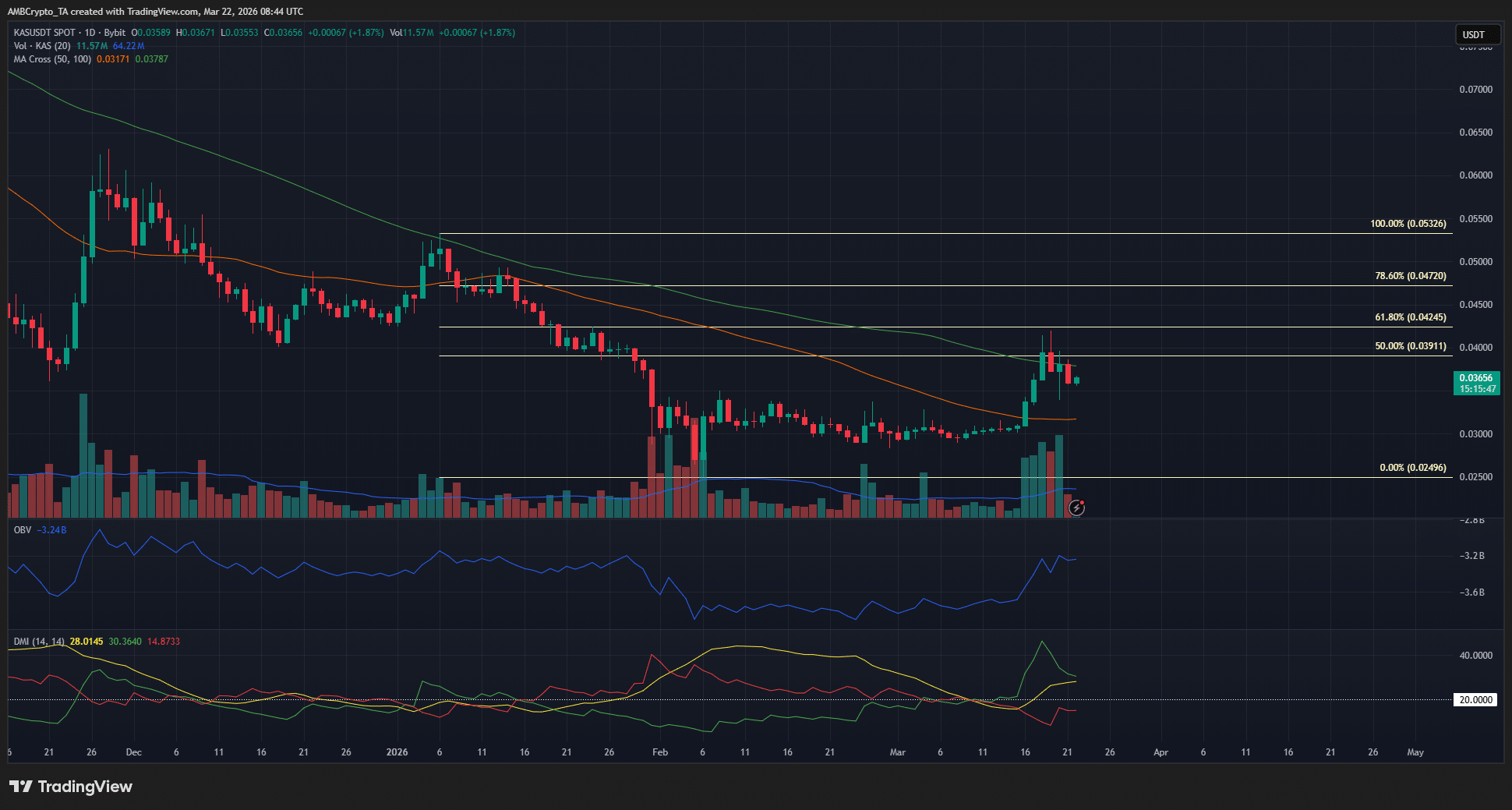
Kaspa thu hút sự chú ý của nhà đầu tư altcoin bằng cách phá vỡ đường trung bình động 100 ngày
Nguồn: KAS/USDT trên TradingView

Khung thời gian 1 ngày cho thấy Kaspa có một số động lực tăng giá trong vài ngày gần đây. Khối lượng giao dịch tăng vọt trên mức trung bình 20 ngày vào thứ Hai, ngày 16 tháng 3 và vẫn duy trì ở mức cao kể từ đó.

OBV đang hướng tới các mức cao mới, và DMI cho thấy một xu hướng tăng mạnh đang diễn ra khi KAS ghi nhận mức tăng 19,5% trong tuần.

Tuy nhiên, hành động giá cho thấy một cấu trúc swing giảm. Vùng kháng cự chính mà phe bull cần vượt qua là $0,042-$0,047.

Giá đã vượt qua các đường trung bình động 50 và 100 ngày, nhưng các đường MA này vẫn chưa tạo thành giao cắt tăng giá để cho thấy động lượng tăng liên tục trên khung thời gian này.

Đợt tăng của DeXe củng cố sức mạnh tương đối của lĩnh vực AI trong crypto

AMBCrypto đã lưu ý trong báo cáo hàng tuần trước đó rằng mức tăng trưởng vốn hóa thị trường của lĩnh vực AI là rất bùng nổ. Các token AI phổ biến đã chứng kiến mức tăng 30% hoặc hơn trong một tuần.

DeXe [DEXE] đã tiếp tục xu hướng này, với mức tăng 18,62% trong tuần này.

Một số token hàng đầu khác trong lĩnh vực AI không thể duy trì tốc độ, khiến sức mạnh tương đối của DeXe càng trở nên đáng chú ý. Vùng $7,4 là vùng cung then chốt ở phía trên.

River tiến gần hơn tới việc phá vỡ các mức cao cục bộ

Một báo cáo gần đây của AMBCrypto cho thấy River một lần nữa đã thiết lập một cấu trúc tăng giá. Một đợt điều chỉnh có thể xảy ra về mức 18 USD trong trường hợp Bitcoin bán tháo đã được dự đoán. Áp lực bán gần đây trên BTC hầu như không đủ để đẩy lùi phe bull của RIVER.

Nó có khả năng phá vỡ mức cao cục bộ $28,7 và tiếp tục đà tăng trong tuần tới.

Những đồng thắng đáng chú ý khác

Artificial Superintelligence Alliance [FET] là một token AI khác có màn trình diễn hàng tuần nổi bật với mức tăng 16,55%. Phe bull của FET sẽ tiếp tục ở trong vị thế mạnh miễn là giá duy trì trên mức $0,2.

Quant [QNT] là một người thắng khác trong tuần qua, tăng 12,6% trong tuần này. Nó đã thách thức mức kháng cự $80 nhưng không thể vượt qua ngay từ lần thử đầu tiên.

Những đồng thua trong tuần

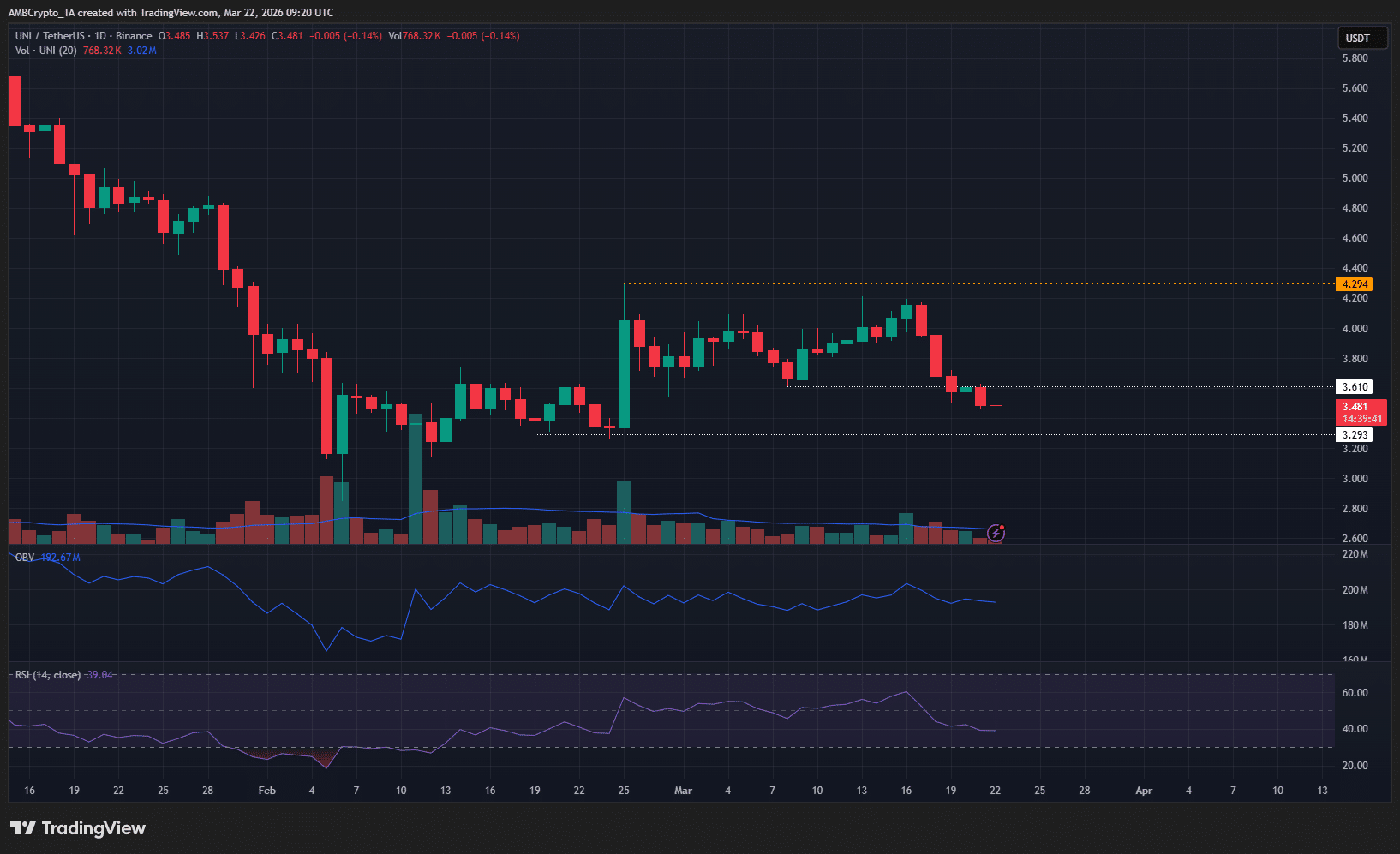
Uniswap giảm 12,4% trong tuần cùng với sự yếu kém của lĩnh vực DeFi
Nguồn: UNI/USDT trên TradingView

Dữ liệu từ Glassnode cho thấy vốn hóa thị trường của lĩnh vực DeFi đã giảm 4,5% trong tuần. Trong số các token hàng đầu của họ, UNI là đồng yếu nhất. Một tuần trước, nó đang hướng tới mức cao cục bộ $4,29.

Phe bull đang có những tiến triển ổn định, nhưng tiến triển này nhanh chóng bị xóa sổ. Chỉ trong một tuần, hỗ trợ $3,6 đã bị mất. RSI đã giảm trở lại dưới mức trung lập 50, và tiến trình của OBV cũng đã chậm lại.

TRUMP tiếp tục đối mặt với áp lực bán sau sự cường điệu hóa từ hội nghị

Token Official Trump [TRUMP] là một kẻ thua cuộc nổi bật khác từ giao dịch tuần trước. Nó giảm gần 5% trong 24 giờ và 20,51% trong tuần. Giá của memecoin này đã bùng nổ để chạm mốc 4 USD sau thông báo về hội nghị crypto Mar-a-Lago.

Kể từ đó, xu hướng giảm dài hạn hơn một lần nữa khẳng định vị thế.

OKB không thể duy trì động lực tăng giá trước đó

OKB, token của sàn giao dịch OKX và token gas, tiếp tục trượt dốc trên biểu đồ giá. Đầu tháng này, Intercontinental Exchange đã công bố định giá 25 tỷ USD cho OKX khi tiết lộ một khoản đầu tư chiến lược.

Tin tức này đã đẩy giá OKB tăng vọt vượt 120 USD, nhưng đợt tăng này không được duy trì. Altcoin này đã giảm 31,9% so với mức cao $124,2. Chỉ trong tuần qua, nó đã giảm 12,57%.

Những đồng thua đáng chú ý khác

Một số đối tượng quen thuộc cũng lọt vào danh sách các altcoin nổi bật hàng tuần. Midnight [NIGHT] tiếp tục chuỗi thua lỗ của mình với mức giảm 16,6% trong tuần.

Render [RENDER] và Internet Computer [ICP] là những token crypto AI phổ biến khác đãi bôi trong tuần qua.

Hai đồng này lần lượt ghi nhận mức lỗ hàng tuần là 10,37% và 9,66%.

Căng thẳng địa chính trị có thể khiến tuần tới trở nên ảm đạm

Bitcoin đang giao dịch trong một vùng giá trị và thể hiện một cơ hội mua trong ngắn hạn. Nếu giá có thể duy trì trên hỗ trợ cục bộ $65,6k, sẽ có cơ hội phục hồi vượt quá $70k.

Điều này có thể cho một số altcoin được chọn có cơ hội tăng cao hơn, đặc biệt là những đồng đã thể hiện sức mạnh tương đối so với BTC trong những tuần gần đây.


Tóm tắt cuối cùng

  • Đợt bán tháo Bitcoin vào thứ Bảy đã ảnh hưởng đến một số altcoin tồi tệ hơn nhiều so với những altcoin khác.
  • Kaspa và DeXe là những người thắng hàng đầu trong tuần này, trong khi các token Midnight, TRUMP và OKB tiếp tục lao dốc gần đây.

Perguntas relacionadas

QTuần qua, Bitcoin (BTC) đã giảm bao nhiêu phần trăm giá trị?

ABitcoin (BTC) đã giảm 3.88% giá trị trong tuần qua.

QHai đồng altcoin nào là những người chiến thắng hàng đầu trong tuần theo bài báo?

AKaspa (KAS) và DeXe (DEXE) là những người chiến thắng hàng đầu, với mức tăng lần lượt là 19.5% và 18.62%.

QĐồng token TRUMP đã giảm bao nhiêu phần trăm trong tuần?

AĐồng token TRUMP đã giảm 20.51% trong tuần qua.

QLý do chính dẫn đến đợt bán tháo trên thị trường tiền điện tử là gì?

AMối đe dọa leo thang căng thẳng ở Tây Á và tác động của nó đến nền kinh tế toàn cầu là lý do chính dẫn đến đợt bán tháo.

QVùng hỗ trợ cục bộ quan trọng mà Bitcoin cần giữ để có cơ hội phục hồi là gì?

ABitcoin cần giữ được vùng hỗ trợ cục bộ ở mức $65.6k để có cơ hội phục hồi vượt qua $70k.

Leituras Relacionadas

Has the 'Digital Gold' Narrative for BTC Failed?

**Title: Has the "Digital Gold" Narrative for Bitcoin Failed?** The article argues that Bitcoin's "digital gold" narrative remains valid despite a recent sharp price decline (from a peak near $126k in Oct 2025 to briefly under $61k in Feb 2026). It presents a long-term investment framework based on three core points: **1. Viewing Bitcoin as an Asset:** Bitcoin is presented as a superior potential store of value compared to gold. Key arguments are its absolute scarcity (21 million cap), superior portability, and transparent auditability via its public ledger. While acknowledging its current use in early, volatile stages (~3-4% global adoption), the author draws parallels to the early, disruptive phases of the internet and e-commerce. **2. Understanding the Recent Downturn:** The current ~50% correction is framed as a predictable, consensus-driven cycle following its post-halving peak (the 2024 halving preceded the Oct 2025 high). A crucial factor is a historic "changing of hands": the influx of new institutional buyers via ETFs allowed early, low-cost holders (miners, OG believers) to take profits. The author notes that while severe, Bitcoin's historical drawdowns (e.g., 93% in 2011, 77% in 2021-22) have been progressively smaller, suggesting maturing holder structure and decreasing volatility over time. **3. The Long-Term Perspective:** The long-term thesis hinges on Bitcoin capturing a portion of gold's market value. With Bitcoin's market cap at ~$1.4 trillion (at $70k) versus gold's ~$20 trillion, significant upside potential exists if the "digital gold" narrative is partially realized. However, the author strongly cautions that short-term risks remain, the bottom is unpredictable, and high volatility is inherent. The real risk is not Bitcoin failing but poor personal position management (over-leverage, wrong capital) and a lack of deep understanding, which can force investors out during severe downturns. The conclusion uses Amazon's 95% crash post-2000 dot-com bubble and subsequent 42x recovery as an analogy. The ultimate question is not if Bitcoin's price will rise, but if an investor's strategy and conviction can withstand the volatility to see the long-term play out. The recent divergence (gold up, Bitcoin down) is posed not as a narrative failure, but as potential evidence of this ongoing, painful transition from a speculative asset to a mainstream allocation.

marsbitHá 1h

Has the 'Digital Gold' Narrative for BTC Failed?

marsbitHá 1h

Has BTC's 'Digital Gold' Narrative Failed?

The article discusses Bitcoin's "digital gold" narrative, its recent price drop, and long-term outlook through the perspective of "Jason". It argues the narrative is not a failure but that Bitcoin represents a superior, new asset class due to its fixed supply (21 million), portability, and auditability. The piece compares its current ~3-4% global adoption rate to early internet/e-commerce, suggesting significant growth potential. Regarding the 2025-2026 price decline (from ~$126k to briefly under $61k), the author views it as a predictable, consensus-driven sell-off within Bitcoin's ~4-year cycle post-halving, exacerbated by a major "handover" from early, low-cost holders to new institutional buyers via ETFs. A key observation is that historical peak-to-trough drawdowns have lessened over time (e.g., 93% in 2011 to ~50% in 2026), indicating maturing volatility as holder structure changes. For the long term, the author uses a simple framework: Bitcoin's total market cap (~$1.4T at $70k) is only about 7% of gold's (~$20T). Even capturing 30-50% of gold's value would imply substantial upside. However, the article strongly cautions against viewing this as investment advice, emphasizing extreme volatility and the critical importance of risk management, position sizing, and deep fundamental understanding to survive severe drawdowns. It concludes by drawing a parallel to Amazon's 95% crash in 2000 and subsequent 42x recovery, stressing that the key is surviving market cycles to realize long-term potential.

链捕手Há 1h

Has BTC's 'Digital Gold' Narrative Failed?

链捕手Há 1h

From Code to Cognition: A Ten-Thousand-Word Guide to the Evolution of the Robot Brain

"From Code to Cognition: The Evolution of Robot Brains" The journey of robotic intelligence has shifted dramatically from manually coded systems to AI-driven brains. For decades, robots relied on layered software stacks—perception, state estimation, planning, control—each handcrafted. While predictable, they lacked adaptability. The 2010s saw deep learning revolutionize perception (e.g., object detection) and control (via reinforcement learning), but learned skills remained narrow. The arrival of Large Language Models (LLMs) marked a turning point. LLMs acted as high-level planners, interpreting natural language instructions and generating sequences of actions for traditional robotic systems to execute. However, true integration came with Visual-Language-Action (VLA) models, which fused vision, language, and motion prediction into a single network. Pioneered by models like RT-2 and open-source projects like OpenVLA, VLAs enable robots to reason and act directly from visual input and commands. The most advanced humanoid robots now employ a "dual-brain" architecture: a slow-thinking, large VLA (System 2) for reasoning and planning, and a fast-reacting, small network (System 1) for high-frequency motion control, sometimes with an even lower-level System 0 for balance. This split balances cognition with the physics of real-time movement. Computation is split between onboard hardware (e.g., NVIDIA Jetson) for safety-critical control loops and cloud/edge servers for non-critical tasks like learning and interfaces. A crucial driver is the open-source ecosystem—models like GR00T and OpenVLA allow startups to build upon pre-trained brains and fine-tune them with their own data, accelerating development. Despite progress, current systems struggle with recovery from errors, sample inefficiency, and long-horizon tasks. This has spurred the rise of **World Models**—neural networks that predict the consequences of actions. By simulating possible futures before acting (like NVIDIA Cosmos or Meta V-JEPA), robots can plan, recover, and generalize better. This represents the next frontier: shifting intelligence from learned reactions to an internal model of physics and cause-and-effect. The field is rapidly evolving. While not yet at its "ChatGPT moment," the convergence of cheaper hardware, scalable simulation, and world models points toward robots that are increasingly capable, adaptive, and useful. The question is shifting from "what can robots do?" to "what *should* they do?"

marsbitHá 1h

From Code to Cognition: A Ten-Thousand-Word Guide to the Evolution of the Robot Brain

marsbitHá 1h

AI Bubble Is Bursting

The AI Bubble is Bursting: A Necessary Purge on the Path to Ubiquitous Intelligence Market volatility has reignited debates about an AI bubble, with figures like Ray Dalio pointing to high valuations. However, this parallels the dot-com bubble, which, despite its crash, laid the physical infrastructure for today's internet era. The current AI investment frenzy, with tech giants planning trillions in infrastructure spending far outstripping current AI application revenues, appears similarly imbalanced. This 'bubble' is seen as an inevitable phase for a disruptive technology, paying the "innovation tax." Critically, AI inference costs have plummeted over 99.7% since 2023, making intelligence nearly free at the margin. This hasn't reduced spending but has instead unlocked massive new demand, as seen in enterprise AI cloud expenditure tripling. This follows the Jevons Paradox: efficiency gains lead to greater total consumption. The market is now entering a cleansing phase, weeding out speculative ventures lacking real moats. The deeper shift is a move from capital expenditure (CapEx) on hardware to value creation in operational expenditure (OpEx) through AI applications that solve real industry problems. While infrastructure valuations are high, rapid earnings growth from widespread AI adoption across sectors—from manufacturing and finance to law and healthcare—may digest these valuations over time. Ultimately, this creative destruction will leave behind robust infrastructure and optimized models, cheaply powering an AI-augmented future for all industries, much as the internet became indispensable after its own bubble burst. The core productive potential remains undiminished.

链捕手Há 1h

AI Bubble Is Bursting

链捕手Há 1h

Trading

Spot
Futuros

Artigos em Destaque

Como comprar DEXE

Bem-vindo à HTX.com!Tornámos a compra de DeXe (DEXE) simples e conveniente.Segue o nosso guia passo a passo para iniciar a tua jornada no mundo das criptos.Passo 1: cria a tua conta HTXUtiliza o teu e-mail ou número de telefone para te inscreveres numa conta gratuita na HTX.Desfruta de um processo de inscrição sem complicações e desbloqueia todas as funcionalidades.Obter a minha contaPasso 2: vai para Comprar Cripto e escolhe o teu método de pagamentoCartão de crédito/débito: usa o teu visa ou mastercard para comprar DeXe (DEXE) instantaneamente.Saldo: usa os fundos da tua conta HTX para transacionar sem problemas.Terceiros: adicionamos métodos de pagamento populares, como Google Pay e Apple Pay, para aumentar a conveniência.P2P: transaciona diretamente com outros utilizadores na HTX.Mercado de balcão (OTC): oferecemos serviços personalizados e taxas de câmbio competitivas para os traders.Passo 3: armazena teu DeXe (DEXE)Depois de comprar o teu DeXe (DEXE), armazena-o na tua conta HTX.Alternativamente, podes enviá-lo para outro lugar através de transferência blockchain ou usá-lo para transacionar outras criptomoedas.Passo 4: transaciona DeXe (DEXE)Transaciona facilmente DeXe (DEXE) no mercado à vista da HTX.Acede simplesmente à tua conta, seleciona o teu par de trading, executa as tuas transações e monitoriza em tempo real.Oferecemos uma experiência de fácil utilização tanto para principiantes como para traders experientes.

174 Visualizações TotaisPublicado em {updateTime}Atualizado em 2026.06.02

Como comprar DEXE

Discussões

Bem-vindo à Comunidade HTX. Aqui, pode manter-se informado sobre os mais recentes desenvolvimentos da plataforma e obter acesso a análises profissionais de mercado. As opiniões dos utilizadores sobre o preço de DEXE (DEXE) são apresentadas abaixo.

活动图片