From Code to Cognition: A Ten-Thousand-Word Guide to the Evolution of the Robot Brain

marsbitPublicado em 2026-06-07Última atualização em 2026-06-07

Resumo

"From Code to Cognition: The Evolution of Robot Brains" The journey of robotic intelligence has shifted dramatically from manually coded systems to AI-driven brains. For decades, robots relied on layered software stacks—perception, state estimation, planning, control—each handcrafted. While predictable, they lacked adaptability. The 2010s saw deep learning revolutionize perception (e.g., object detection) and control (via reinforcement learning), but learned skills remained narrow. The arrival of Large Language Models (LLMs) marked a turning point. LLMs acted as high-level planners, interpreting natural language instructions and generating sequences of actions for traditional robotic systems to execute. However, true integration came with Visual-Language-Action (VLA) models, which fused vision, language, and motion prediction into a single network. Pioneered by models like RT-2 and open-source projects like OpenVLA, VLAs enable robots to reason and act directly from visual input and commands. The most advanced humanoid robots now employ a "dual-brain" architecture: a slow-thinking, large VLA (System 2) for reasoning and planning, and a fast-reacting, small network (System 1) for high-frequency motion control, sometimes with an even lower-level System 0 for balance. This split balances cognition with the physics of real-time movement. Computation is split between onboard hardware (e.g., NVIDIA Jetson) for safety-critical control loops and cloud/edge servers for non-critica...

Author: Matt White, Global AI Chief Technology Officer, Linux Foundation

Compiled by: Felix, PANews
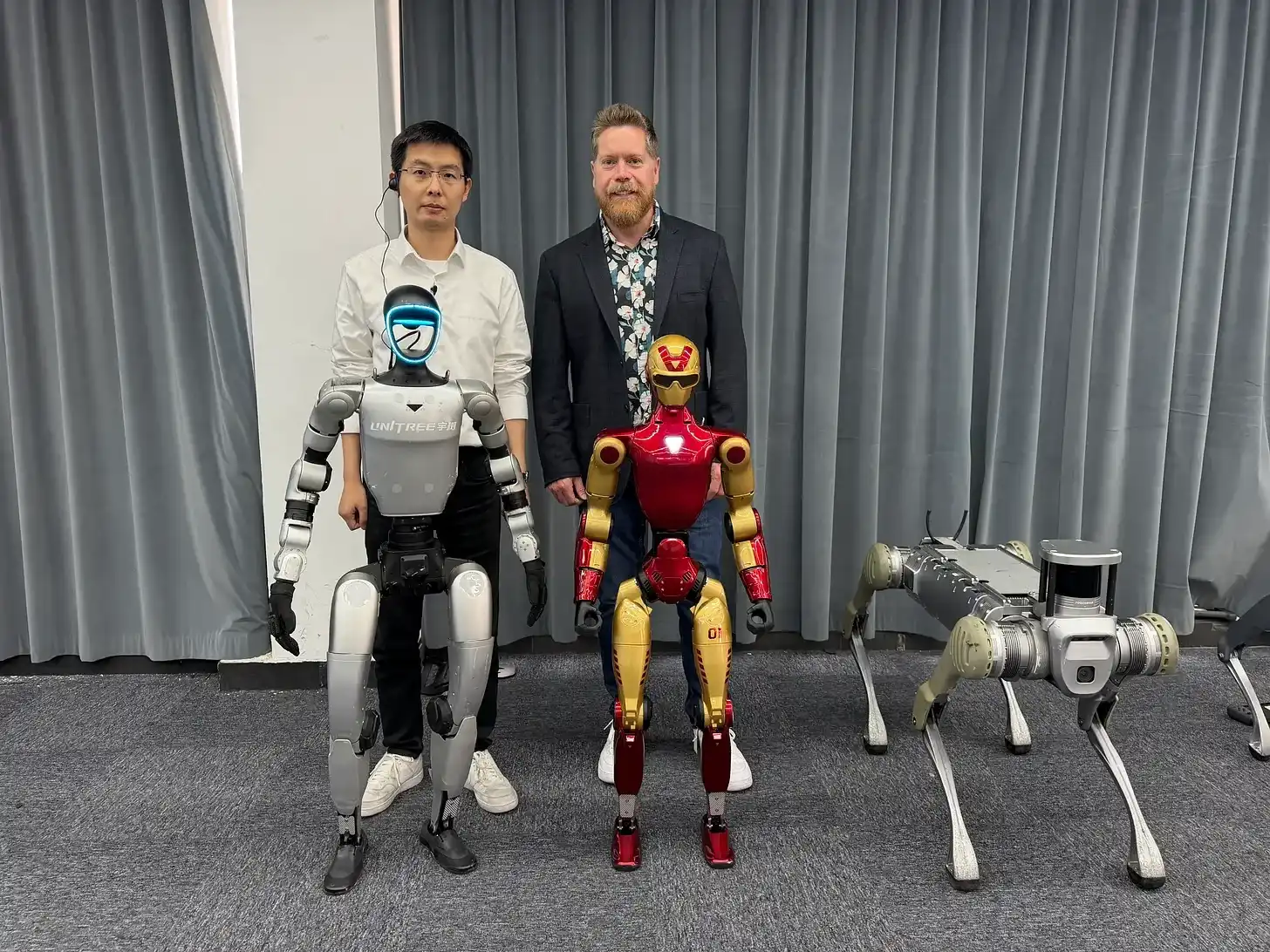
Wang Xingxing (CEO of Unitree) and Matt White

A few weeks ago in Shanghai, a traveling companion (someone intelligent, observant, and who follows the news, but not deeply familiar with robotics) asked a question over dinner that had been anticipated throughout the trip.

"Those robotic dogs we see running around, the humanoid robots performing kung fu on the demo stage at Unitree's office, and the robot arms folding clothes we saw. How do they do it? Are they powered by large language models (LLMs)? How does this actually work? Is there some kind of language model controlling their movements?"

It's a great question, and frankly: yes, in a way, but the real story is far more interesting. The robots you see on social media are not ChatGPT in a metal shell. They run on a technology stack (multiple layers of AI working together). This stack has changed more in the past three years than in the previous thirty. Language models are part of it. Vision models, motion models, behavior trees, classic control loops, and an emerging family of systems called "world models" are also crucial components. And "world models" might be the most significant development of all.

This is a long article. It will start from the beginning, walk through each major transformation step by step, and arrive at the current stage: where robots can not only react to the world but also imagine it.

One: The Pre-LLM Era: When Robots Were Just Software

For decades, building a robot meant writing a massive amount of code, and almost none of it involved learning.

Classic industrial robots were carefully constructed towers of meticulously designed modules. Like the orange robotic arms welding Toyota chassis in the 1990s or Boston Dynamics' BigDog in the early 2000s.

  • Perception: Filtering camera feeds, performing edge detection, using geometric matching to identify workpiece positions.
  • State Estimation: Combining wheel encoders, gyroscopes, and accelerometers (sensor fusion) to determine the robot's position and speed.
  • Planning: Given a target pose, computing a collision-free path within a known map using algorithms like A* or RRT.
  • Control: At the lowest level, PID controllers adjusting motor torque hundreds or thousands of times per second to follow that path.

These layers were often written by different people in different labs and painstakingly stitched together. Behaviors (e.g., "if the cup is red, pick it up; otherwise, wait") were encoded as state machines or behavior trees: flowcharts for the robot to follow step-by-step.
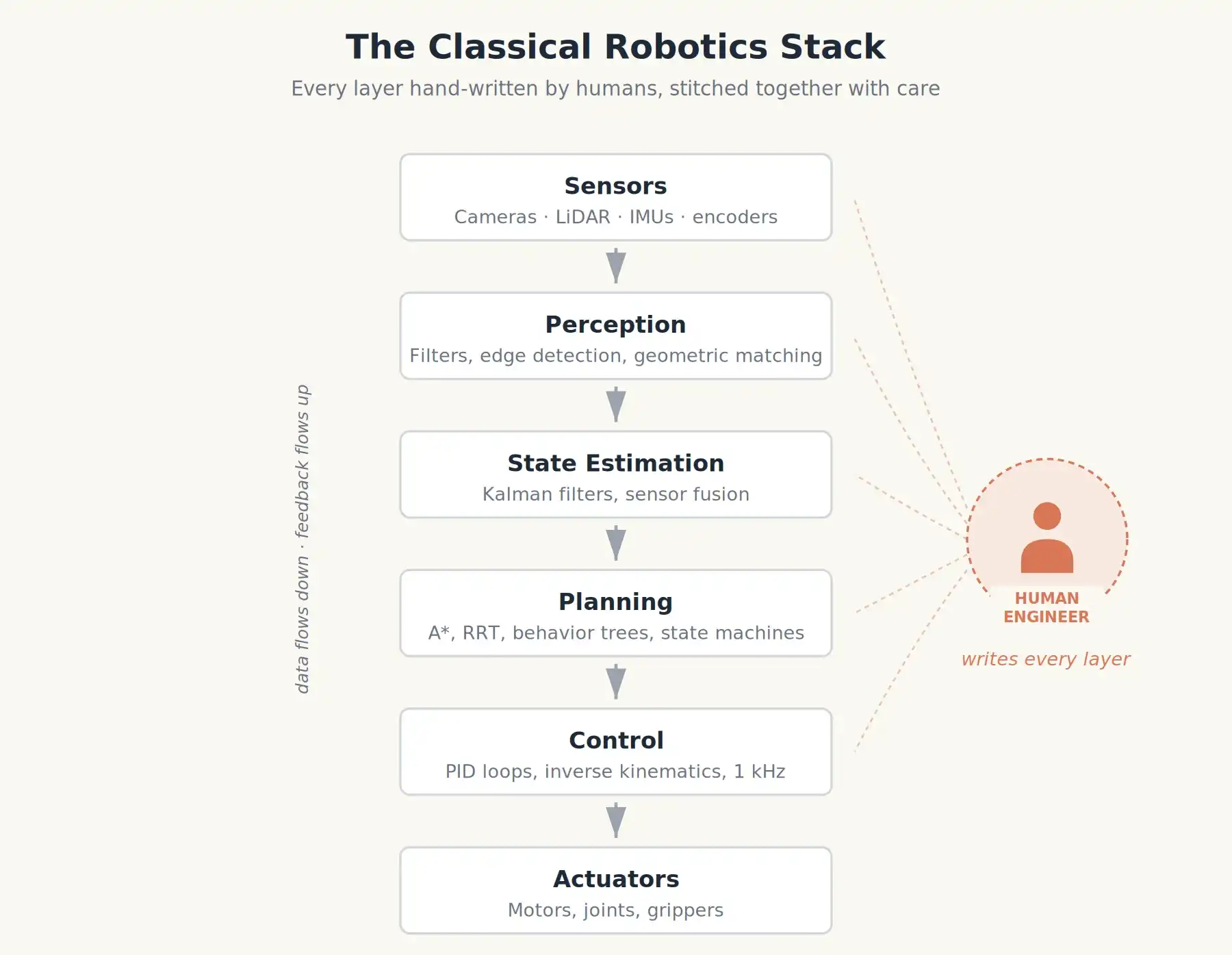
The advantages of this approach are obvious. It's predictable and meets safety standards. This is why your car has functional ABS brakes.

The disadvantages are equally obvious. Such a robot is only as smart as the scenarios the engineer envisioned. Put it in a new factory, under new lighting, or with a new cup color, and it breaks. Its ability to generalize is almost zero.

Two: Machine Learning Quietly Steps In

In the 2010s, deep learning began tackling the perception layer. Convolutional neural networks (CNNs) that beat humans at ImageNet image classification could be retrained to detect grasp points on objects, segment furniture in a room, or recognize human poses. Suddenly, the top "perception" layer of the stack didn't need handcrafting; you could just train it.

Then, learning crept into the "control" layer. Researchers from UC Berkeley, DeepMind, and OpenAI showed that reinforcement learning (letting a robot agent try millions of times in simulation and reinforcing what works) could produce surprisingly dexterous gaits, hand-object manipulation (OpenAI's one-handed Rubik's Cube solve in 2019 was a milestone), and locomotion strategies adaptable to different terrains.

A parallel line of research was imitation learning, often called behavior cloning: record hundreds of attempts of a human teleoperating a robot on a task, then train a neural network to predict what action the human would take given what the robot sees.

The key point in all this: each learned policy was too narrow. Train a network to pick up a red block, and it doesn't know what to do with a yellow cup. Train it to walk on grass, and it falls on tile. Generalization remained the unsolved problem.

It's worth noting that an infrastructure emerged during this period that still underpins almost everything today: ROS, the Robot Operating System (first released in November 2007). ROS is not an operating system in the Windows or Linux sense, but a middleware framework, a universal robot plumbing system. It allows "camera nodes," "navigation nodes," "arm controller nodes," and dozens of others to publish and subscribe to messages over a shared bus.

The current version, ROS2, runs at the bottom layer of the vast majority of research and commercial robots worldwide, from Stanford labs to Chinese humanoid robot startups. When people talk about a robot's "operating system," they almost always mean ROS2 plus the various perception, planning, and control packages running on top of it.
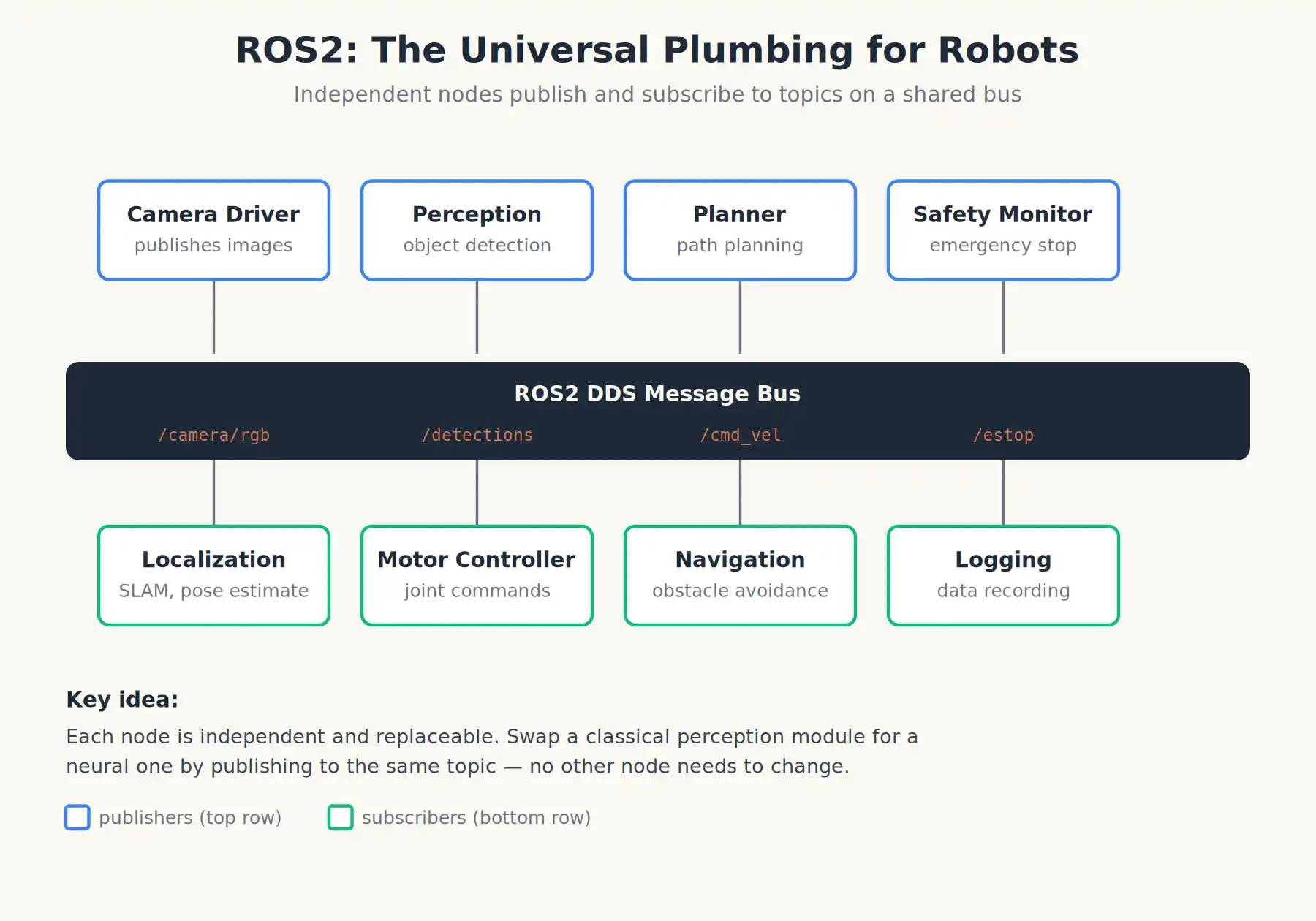
ROS2: It's not the OS, but the universal plumbing that lets disparate robot software talk to each other

Three: LLMs for Robotics

Then came ChatGPT.

Suddenly there was this thing: the LLM. It could read simple English instructions, do multi-step reasoning, write code, and call functions. Roboticists realized almost instantly: this was the missing piece they had struggled with for years. The hardest part of getting a robot to do something useful in a home or office often wasn't motor control, but human-robot interaction: how does a human tell the robot what to do, and how does the robot decompose that goal into atomic actions it already knows how to perform?

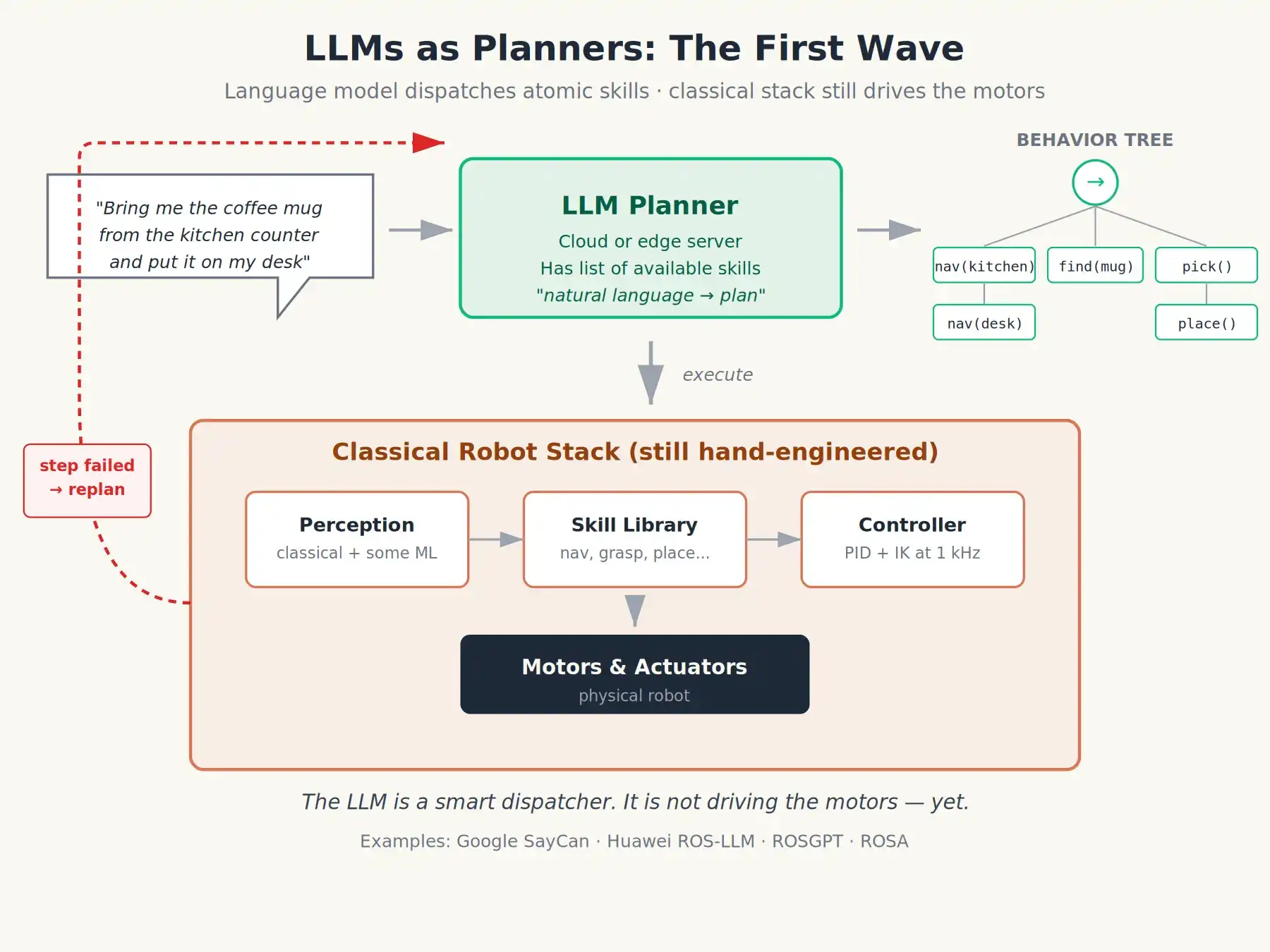
The first wave of applying LLMs to robotics was to treat the language model as a natural language compiler sitting on top of ROS. The pattern:

  1. User says in English: "Bring the coffee mug from the kitchen counter to my desk."

  2. LLM generates a plan based on a list of available atomic skills for the robot: a sequence of function calls, a state machine, or a behavior tree written in XML.

  3. ROS2 nodes execute the plan step by step. If a step fails, the failure is reported back to the LLM for re-planning.

Google's SayCan project in 2022 was a very clean version of this idea: the LLM proposed skills, a separate "affordance" model scored the likelihood of each skill succeeding right now, and the robot picked the combination with the highest joint score. Open frameworks like ROS-LLM, ROSGPT, and ROSA, led by Huawei Research labs, popularized this pattern.

This was indeed a huge leap. Suddenly, you could tell a robot "clean the table, put recyclables in the blue bin," and it would attempt something sensible. But note the remaining issues: the language model is still at the planning layer. The actual motion commands are still generated by those painstakingly designed or narrowly trained controllers underneath. The LLM is just an intelligent dispatcher; it's not driving.
Four: Vision-Language-Action Models (VLA), When the Brain Starts Driving
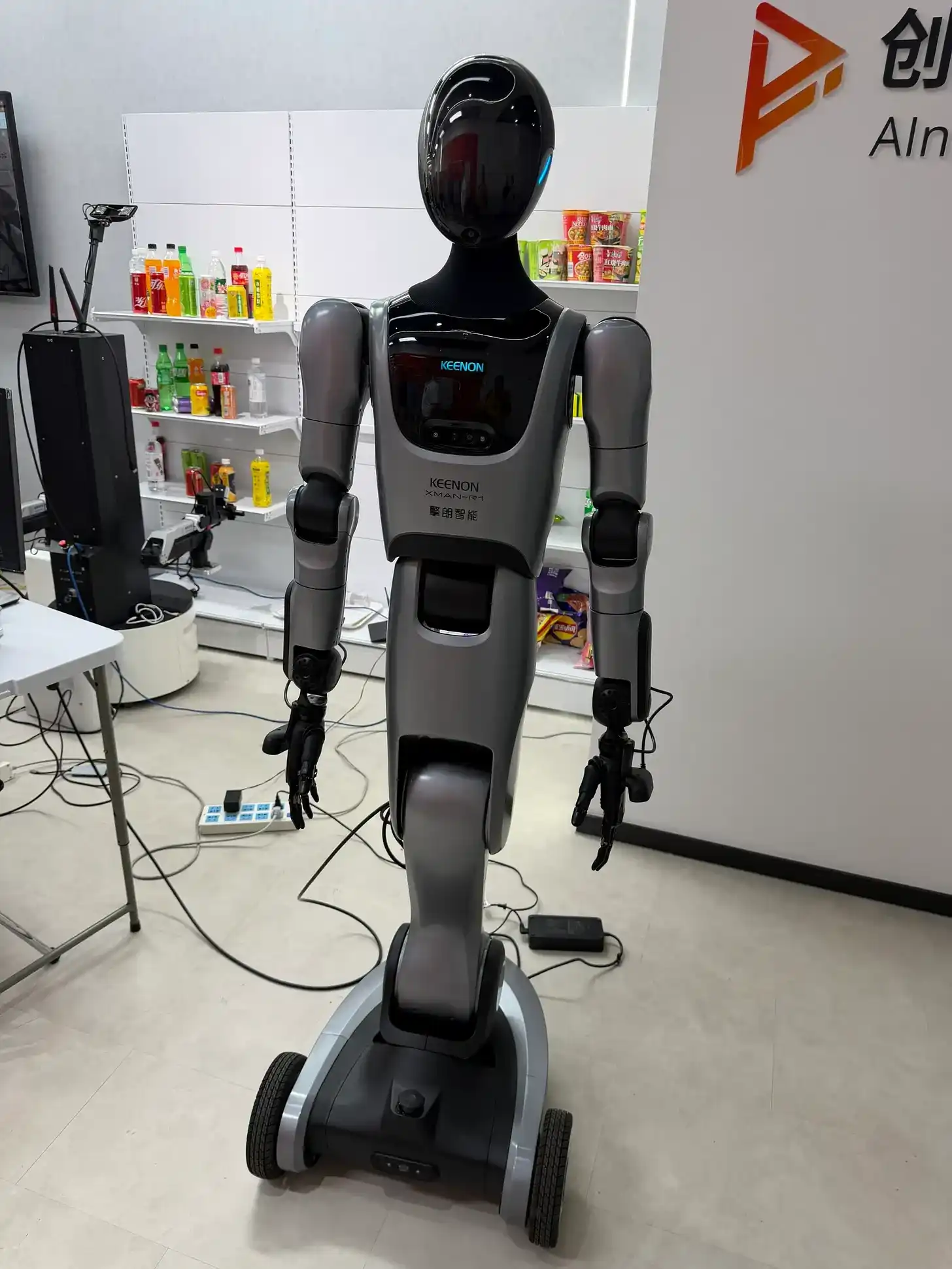
Keenon XMAN-R1 robot picking medicine from shelves in an automated pharmacy at Beijing Galbot. For just $100k

The next leap was harder and more important. Researchers asked a more ambitious question: What if the model could not just plan but also directly generate actions? What if you fed camera images and language instructions directly into a neural network and got back the next millisecond's joint movements?

This is the Vision-Language-Action model (VLA). It is now the dominant paradigm for humanoids and quadrupeds.

The first widely known vision-language robot was Google DeepMind's RT-2 in 2023. The cleverness was this: take a large vision-language model (trained for image captioning and Q&A) and continue training it on robot demonstration data, but treat robot actions as just another token to predict. The same neural network that could output "cat sits on mat" could now output a series of tokens encoding "move right paw forward 3 cm, close gripper, lift 5 cm." Reasoning and action were in the same model.

Then, in mid-2024, a team led by Stanford released OpenVLA, an open-source 7-billion-parameter VLA model trained on the Open X-Embodiment dataset, a collection of over a million training episodes from 21 different research labs across 22 different robot bodies. For the first time, someone outside Google could download a generalist robot model and start hacking. It changed the field overnight.

Today, leading VLAs, though few, are rapidly evolving:

  • π0 and π0.5 from Physical Intelligence: Excellent at task adaptation.
  • NVIDIA Isaac GR00T N1.7: Open weights, commercial license, designed for humanoids, the model most Chinese hardware companies are currently fine-tuning with their own data.
  • Figure AI's Helix and newer Helix-02: Proprietary, but architecturally significant.
  • AgiBot's Genie Envisioner: A Chinese world-model-based platform.
  • SmolVLA, NORA, ACoT-VLA, CogACT: A growing crop of VLAs from academia exploring different design directions.

How VLAs Work (No Math)

Think of a VLA as fusing three input streams into one output stream.

First stream is vision. RGB cameras (sometimes depth sensors or lidar), sometimes tactile sensors on fingertips, processed by a vision encoder (usually a Transformer model like DINOv2 or SigLIP) that compresses each image into a few hundred "vision tokens" summarizing what the robot sees.

Second stream is language. Your instruction ("hand me the screwdriver") gets tokenized just like in ChatGPT.

These two streams are concatenated and fed into a Transformer "backbone" (often a small open-source language model like Qwen3 or Llama). This backbone does the reasoning, combining what it sees with what it's asked.

Third stream: action, out the other end. This is where architectures diverge:

  • Discrete action tokens: The model directly generates tokens that decode to joint angles or end-effector positions, just like ChatGPT generates words. Simple but can be jerky at high frequency.
  • Diffusion or flow-matching action head: A separate tiny network takes the backbone's output and denoises a smooth trajectory of joint positions, like an image diffusion model but for motion. This is what π0 does, producing smoother, more natural actions.
  • Action chunking: Predicts not the next single command but the next half-second of commands all at once, smoothing out jitter.
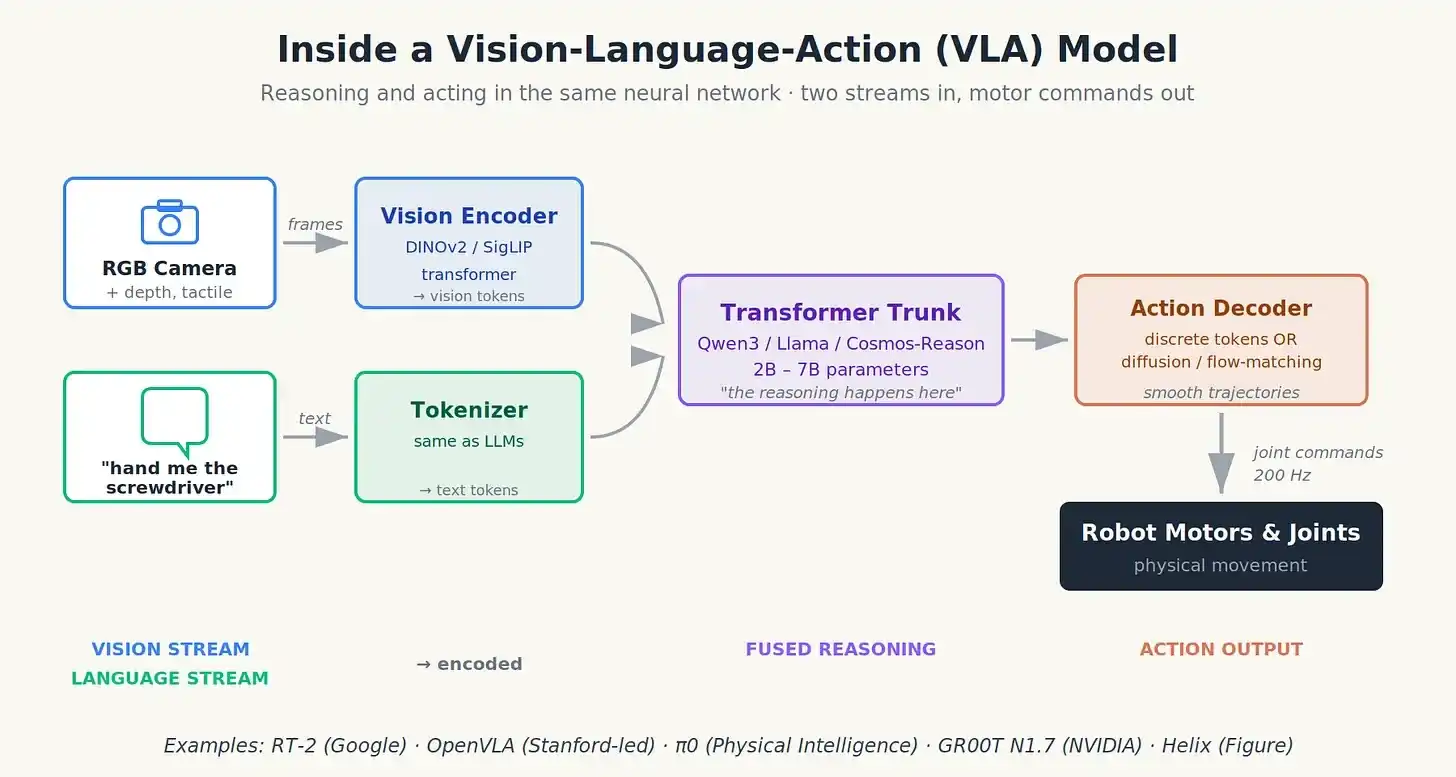
In a VLA model: two input streams in, motion commands out, reasoning and action fused in one network.

This is the crucial architectural shift: reasoning and action are no longer separate. Teaching a neural network to recognize a cup also teaches it how to grasp it. This coupling is what gives VLAs the generalization their predecessors lacked.

Five: The Two-Brain Strategy, How LLMs and VLAs Work Together

Here's a detail rarely explained clearly in marketing. The best-performing humanoid robots today don't run a single VLA system; they run two models at different speeds talking to each other. This is sometimes called the dual-system or System 1 / System 2 architecture, borrowing from Daniel Kahneman's psychology framework that humans have a fast, intuitive brain and a slow, deliberate thinking brain.

Figure AI's Helix made this design classic, and now it (and its variants) is copied almost everywhere. Crucially, NVIDIA's GR00T N1.7 uses this design, as do most Chinese humanoids. The structure:

  • System 2 (S2): The slow-thinking brain. A ~7-billion-parameter vision-language model running at about 7–9 Hz (7 to 9 times per second). Its job is to observe the scene, parse the instruction, do multi-step reasoning ("the bowl is behind the cereal box; I need to move the box first"), and emit high-level intents—often a compact set of internal vectors, not words.
  • System 1 (S1): The fast-reacting brain. A much smaller (~80-million-parameter) visuomotor policy model running at 200 Hz. It takes S2's intent vectors plus the latest sensor data and outputs continuous joint commands. It does no real "thinking," just reacts.

Recently, Figure's Helix-02 added a System 0. It sits beneath the dual brains, a reflex layer, not a third cognitive layer. This is a 10-million-parameter network running at 1 kHz, handling low-level balance and whole-body coordination, replacing over a hundred thousand lines of hand-coded C++ motion control. Think of S0 as a learned spinal cord: it doesn't reason or plan, just keeps the body upright and coordinated while thinking happens above.
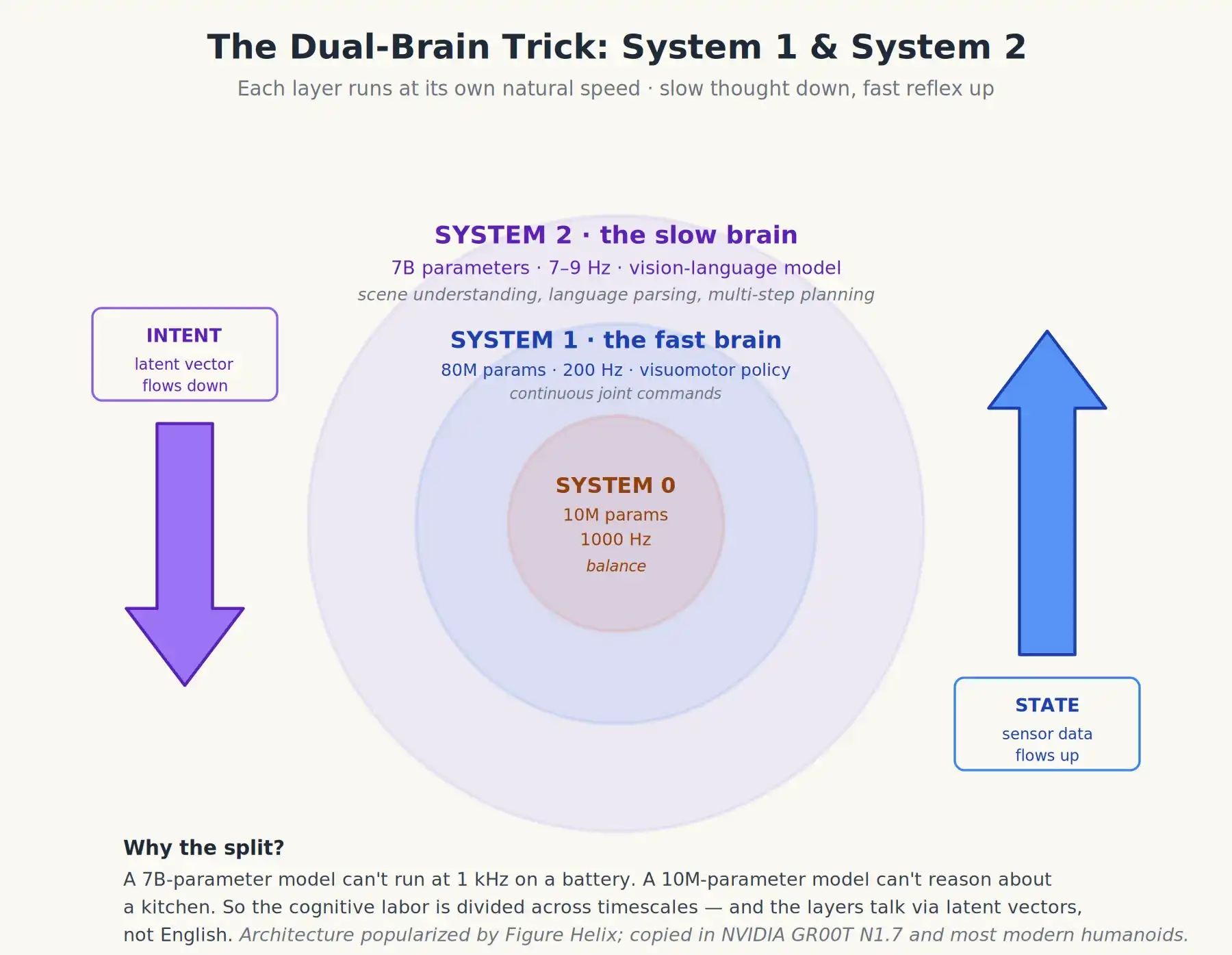
The dual-brain architecture of a modern humanoid: System 2 thinks slow, System 1 reacts fast—with a System 0 reflex layer beneath for balance, contact, and whole-body coordination

This division stems from physics. If motion commands are issued only every 200 milliseconds (the speed of a large VLA), the robot moves like it's underwater. Motion command updates must be faster than the natural oscillation of the joints they control, meaning hundreds to thousands of updates per second. No 7-billion-parameter Transformer model can run that fast on a battery-powered robot.

So, cognition is split: a big, slow model thinks; a tiny, fast model acts. They don't talk in English but in learned latent vectors: the slow model emits an abstract goal, and the fast model knows how to interpret it.

Six: Cloud, Edge, and Where the "Brain" Lives

Where does all this computation actually happen?

Today, there's a strong, almost ideological consensus across robotics teams that safety-critical control loops must run locally. Two reasons:

Latency. Round-trip over WiFi or cellular is optimistically 30-80 ms. Motion commands need updates every 1-5 ms. That network loop simply doesn't work.

Reliability. Robots operate in factories, warehouses, kitchens, hospitals. Networks drop. If a lost Wi-Fi signal stops the robot, it's a safety hazard.

So, the modern split is roughly:

Onboard (local), on something like an NVIDIA Jetson Thor or AGX Thor module (~2,000 TFLOPS, 128 GB RAM, 40–130 W):

  • All of S0/S1: balance, locomotion, fine motor control.
  • The VLA itself (System 2), increasingly quantized to FP8 or FP4 to fit hardware constraints. Models in the 2B to 7B parameter range can now run on-device.
  • Perception, sensor fusion, and safety monitors that can override anything else.

Cloud or remote server (if present):

  • Conversational interfaces ("Hey robot, what should I cook for dinner?"): Latency-tolerable.
  • Fleet learning: Thousands of robots send teleoperation data back to a server to aggregate into the next model version.
  • Large-scale, long-horizon planning, potentially using frontier-scale models.
  • Operator dashboards and monitoring.

There's also a growing middle layer: local edge servers in the factory or warehouse, communicating with a robot fleet over a local network with single-digit millisecond latency. Larger LLMs might live here, doing high-level scheduling a single robot doesn't need to manage itself.

China's humanoid robot wave is built on this assumption: Unitree, AgiBot, XPeng IRON, Fourier, EngineAI. Their robots have onboard compute (often Jetson, sometimes domestic chips like Huawei Ascend), with the cloud used for fleet learning and conversational interfaces, not control loops.
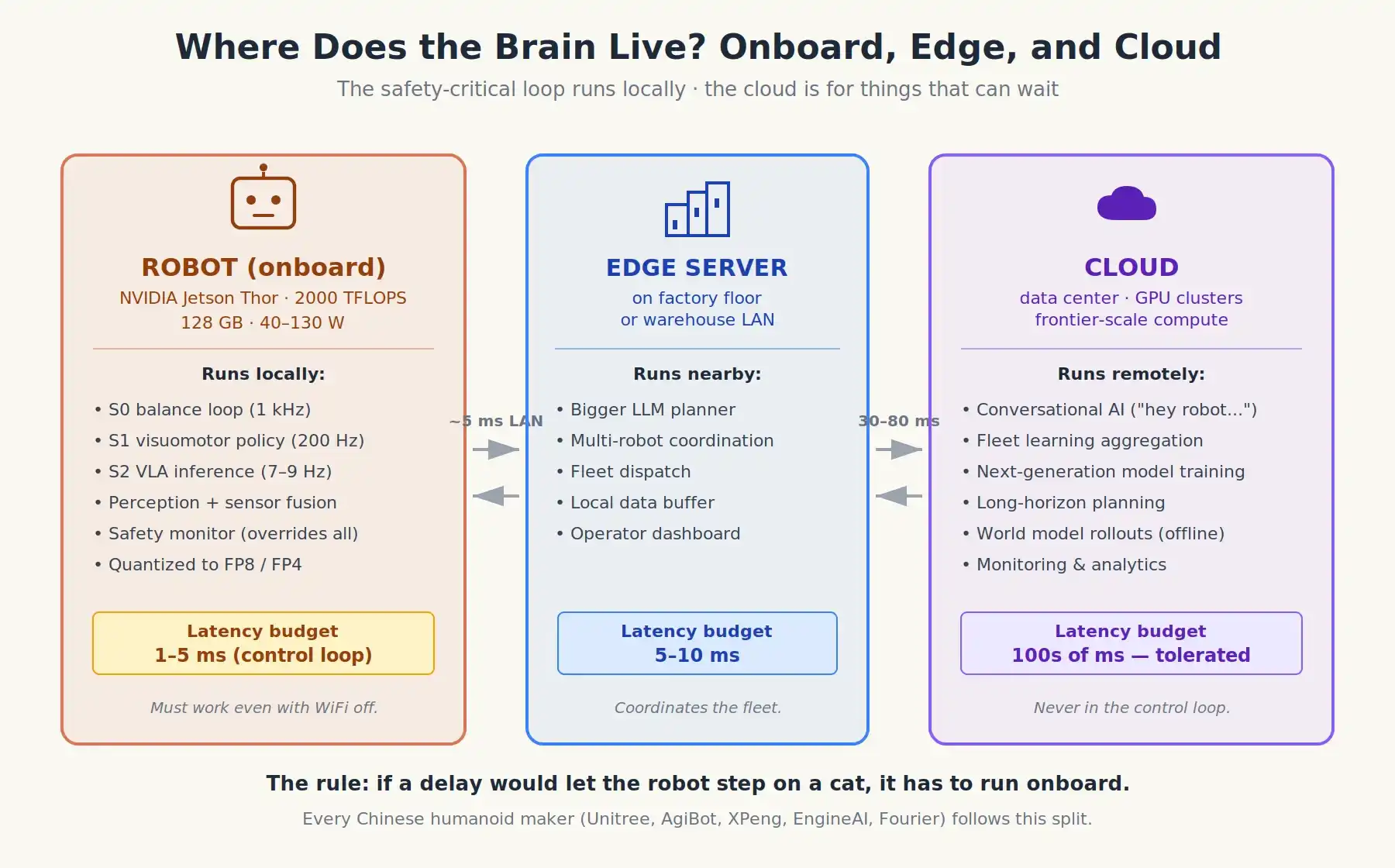
Where the robot brain actually lives: safety-critical loops are local, cloud for things that can wait

Seven: Why Open-Source Models Are Quietly Becoming the Center of Gravity

If you only watched demos, you'd think the field was dominated by a few well-funded US companies. The reality is more complex. The speed of physical AI progress is largely set by open-source weight models anyone can download and fine-tune.

The list is short but significant:

  • OpenVLA (Stanford): The first open-source 7B generalist robot model.
  • NVIDIA Isaac GR00T (N1, N1.5, N1.7): Open weights forthcoming, commercial license upcoming, trained on tens of thousands of hours of human egocentric video. GR00T N1.7, released March 2026, will make its dual-system architecture free for anyone with a humanoid.
  • Physical Intelligence's π0: Weights released for research.
  • NVIDIA Cosmos: Open-world foundation models.
  • AgiBot World: Large open-source dataset of teleoperated humanoid demos from a Shanghai startup.
  • Hugging Face's LeRobot: An open library that has become the gathering place for all of the above.
  • Mimic robotics' mimic-video: An open-source video-to-action model with 10x sample efficiency over traditional VLAs.

This matters for two reasons. First, a robotics startup doesn't need to spend tens of millions pre-training a foundation model: they can take GR00T or π0 and fine-tune it with their own robot's data. This is what Unitree, EngineAI, Booster, Galbot, and dozens of smaller Chinese companies do. It's why a company with a few hundred employees can produce a talking, walking, shirt-folding humanoid: they're standing on the shoulders of an open stack.

Second, open-source models are the only realistic path to safety. If a fully closed model runs inside a robot on some factory floor, with zero external visibility into its reasoning, that's a regulatory nightmare. Open models let auditors, researchers, and operators actually inspect what the robot was trained on.

Eight: What's Still Broken

If you've seen enough robot demo videos, you've also seen plenty of robot fail videos. The current generation of LLM+VLA robots is genuinely impressive but also genuinely limited. Here's what's broken:

  • Mid-task recovery. VLAs handle unexpected variation better than anything before. But when things truly go wrong (mis-grab, object rolls, human walks into workspace), getting back on track is still weak. Robots will mindlessly repeat failed actions.
  • Sample efficiency. Training a VLA from scratch requires tens of thousands of hours of teleoperation data. A human learns to use a new tool in minutes. This efficiency gap is huge.
  • Cross-embodiment generalization. A model trained on a Franka arm in a Stanford lab doesn't perfectly transfer to a Unitree humanoid in a Shenzhen warehouse. The bodies are different.
  • Long-horizon tasks. Any behavior requiring over 30-60 seconds of coherent action with multiple sub-goals tends to drift. "Make me breakfast" remains out of reach.
  • Physical common sense. VLAs are trained to imitate, not to understand. They don't truly understand that knocking over a cup of water will spill it. They've just seen examples and predict what happens next via pattern matching.
  • Spatial reasoning. Despite being multimodal, they are surprisingly weak at tasks like "go around the obstacle, not through it" or "stack these things without toppling."

This final cluster of weaknesses is driving the field to bet on a very different kind of model.

Nine: World Models

Imagine this: Instead of training a robot to predict actions, train it to predict the consequences of actions.

A world model is a neural network that, given the current world state (often a video or sequence of frames) and a proposed action, predicts what the world will look like next. Simply, think of it as a learned video predictor with a steering wheel. You show it the last second of camera feed and say "robot moves arm forward 10 cm," and it generates a realistic video of what the next second will look like.

Why is this important?

Because once you have a world model, the robot can think before it acts. It can imagine three or four different candidate actions, predict their outcomes, score them, and pick the best one—all before any motor moves. This is how a chess engine works: it doesn't memorize moves; it simulates futures. This capability never existed for physical robots before because we never had a model accurate enough to simulate the messy real world.
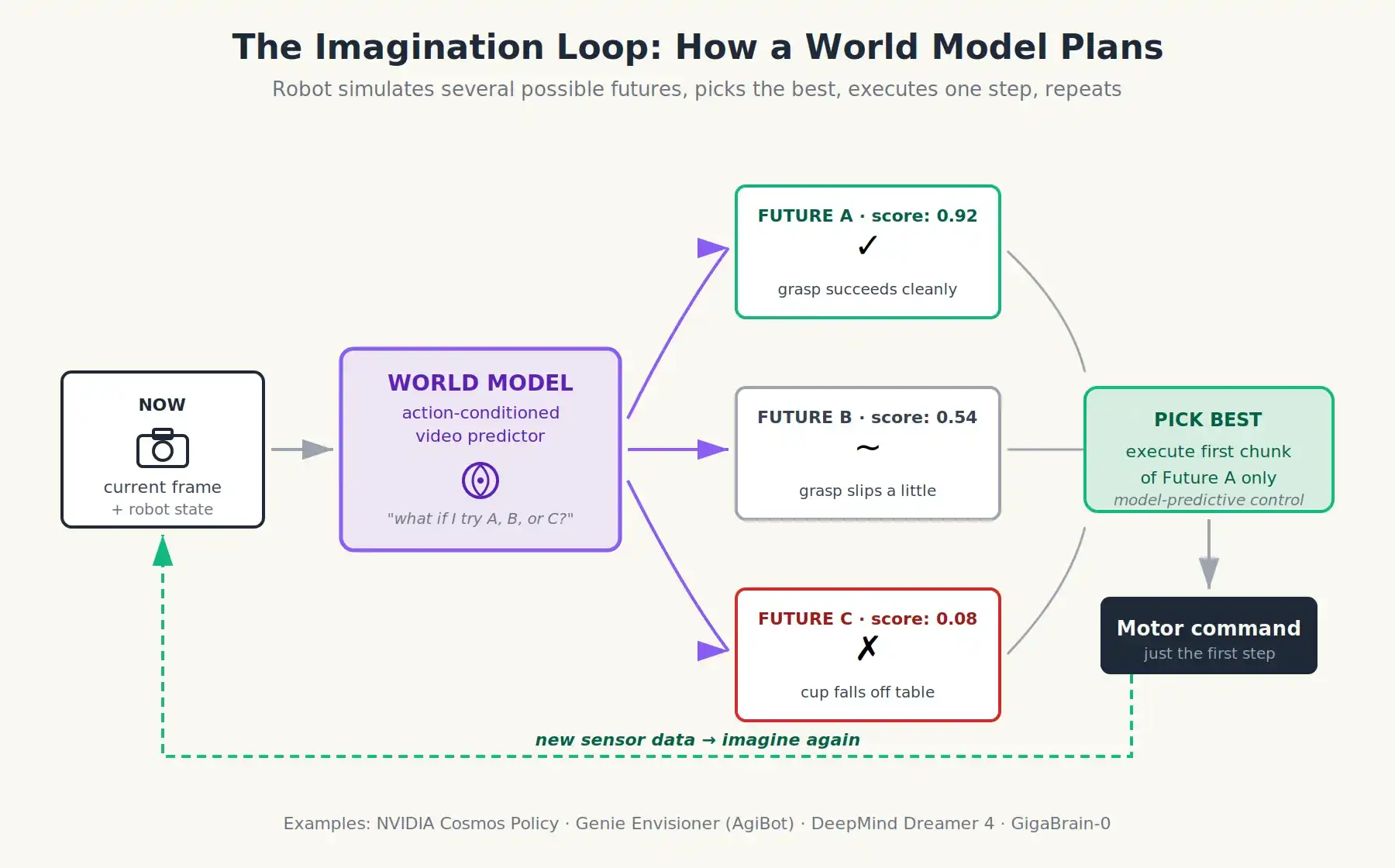
World models let a robot simulate multiple possible futures, score them, and pick the best one before any motor moves

What does a world model look like in 2026?

The state-of-the-art world models are diverse but rapidly evolving. Here are a few:

  • NVIDIA Cosmos: A suite of open-world foundation models, including Cosmos Predict 2.5 (generative), Cosmos Transfer 2.5 (controllable simulation), Cosmos Reason 2 (vision-language reasoner for robotics), and the newest Cosmos Policy, which goes further by fine-tuning the world model to output actions for control directly. Cosmos is trained on hundreds of thousands of GPU-hours of video data (Cosmos Predict 2.5 is the world model in this family).
  • DeepMind Genie 3: An interactive world model that can generate fully navigable environments from text prompts at 24 fps, running stably for minutes. Initially built for game environments.
  • Meta V-JEPA 2: Pretrained on over a million hours of web video, then action-conditioned with just 62 hours of robot video. Achieves 80% zero-shot pick-and-place success on real robot arms across different labs with no task-specific training. The "JEPA" approach is architecturally distinct from others.
  • DeepMind Dreamer 4: Learned to collect diamonds in Minecraft (a 20k-step task) using only offline data, no environment interaction. Proof that real reinforcement learning in imagined worlds is possible.
  • AgiBot's Genie Envisioner: A unified world model platform from China, trained on over 3,000 hours of real-world humanoid operation video. It can generate both predicted rollout trajectories and executable action trajectories. AgiBot uses NVIDIA Cosmos Predict 2 as a backbone, fine-tuned with its own data. This is exactly the "open stack + own data" pattern described earlier.
  • Toyota Research Institute's Cosmos-based world model: For teleoperation data augmentation and navigation.
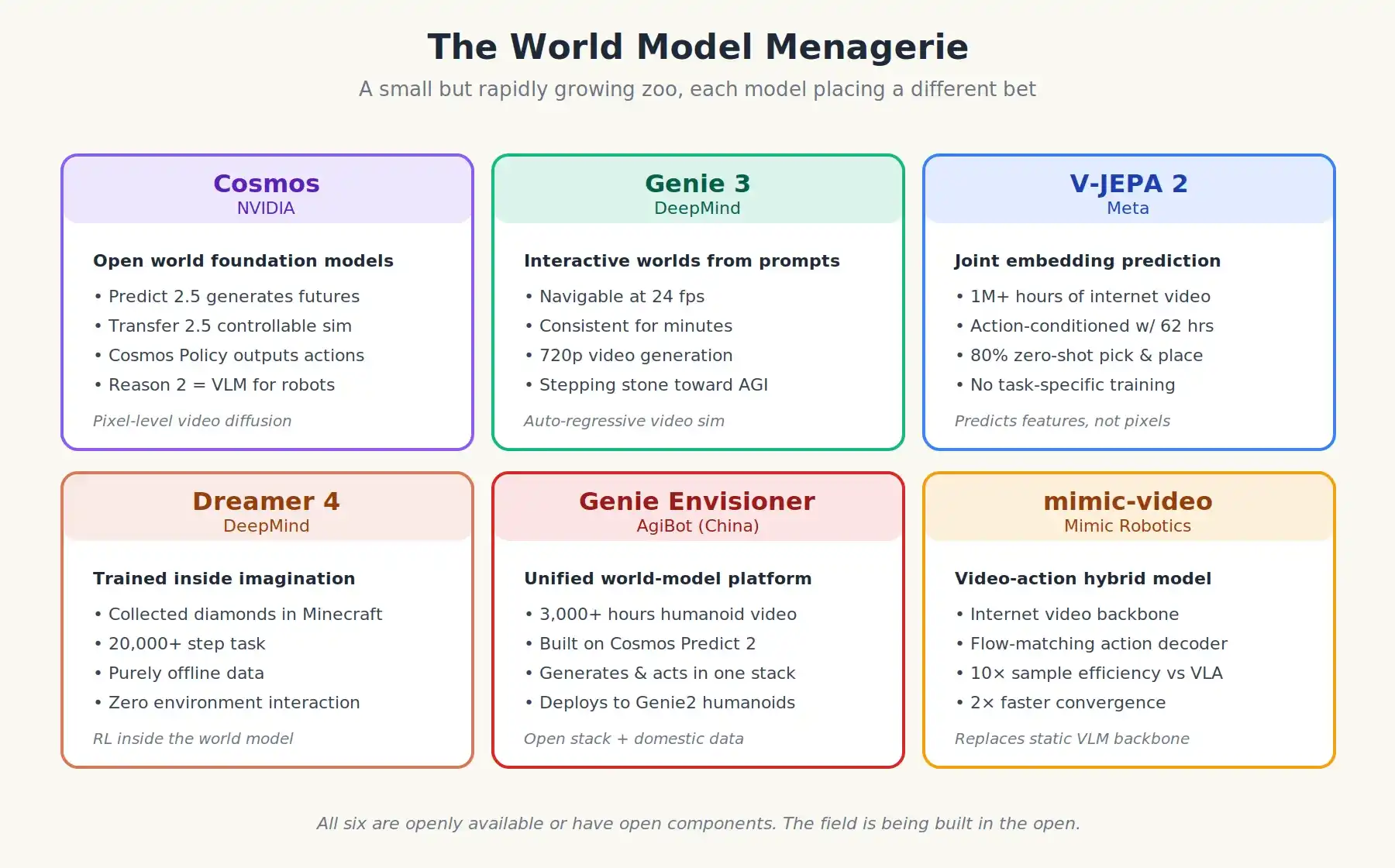
Six most important world models 2025-2026, each proposing a different idea about how machines should learn physics.

Ten: Alternative Architectures, Because the Field Isn't Settled

There's no standard way to build a world model. The architecture war is one of the most interesting debates in AI right now, directly impacting what robots will be able to do. Three camps to watch:

Pixel-level video diffusion (Cosmos/Sora school): Use diffusion models to predict the actual pixels of future frames. Pros: doubles as a synthetic data generator, can render novel robot demos that never happened. Cons: expensive, sometimes unphysical, and predicting pixels you'll never see is wasteful.

Joint-Embedding Predictive Architecture, JEPA (LeCun school): Don't predict pixels; predict the abstract representation of the next frame. Discard texture details, keep the semantic essence of what's in the scene. Pros: efficient, focused on what matters for action. Cons: harder to use. V-JEPA, V-JEPA 2, and new JEPA-VLA hybrids explore this space.

Latent action world models (Genie/Dreamer school): Learn how to compress whole videos into a latent "action language" that captures behavioral structure, then train the world model to predict the next latent state given the next latent action. Pros: lets you train on web video with no actions, then add a small amount of real robot data. Cons: latent actions are uninterpretable to humans, complicating safety analysis.
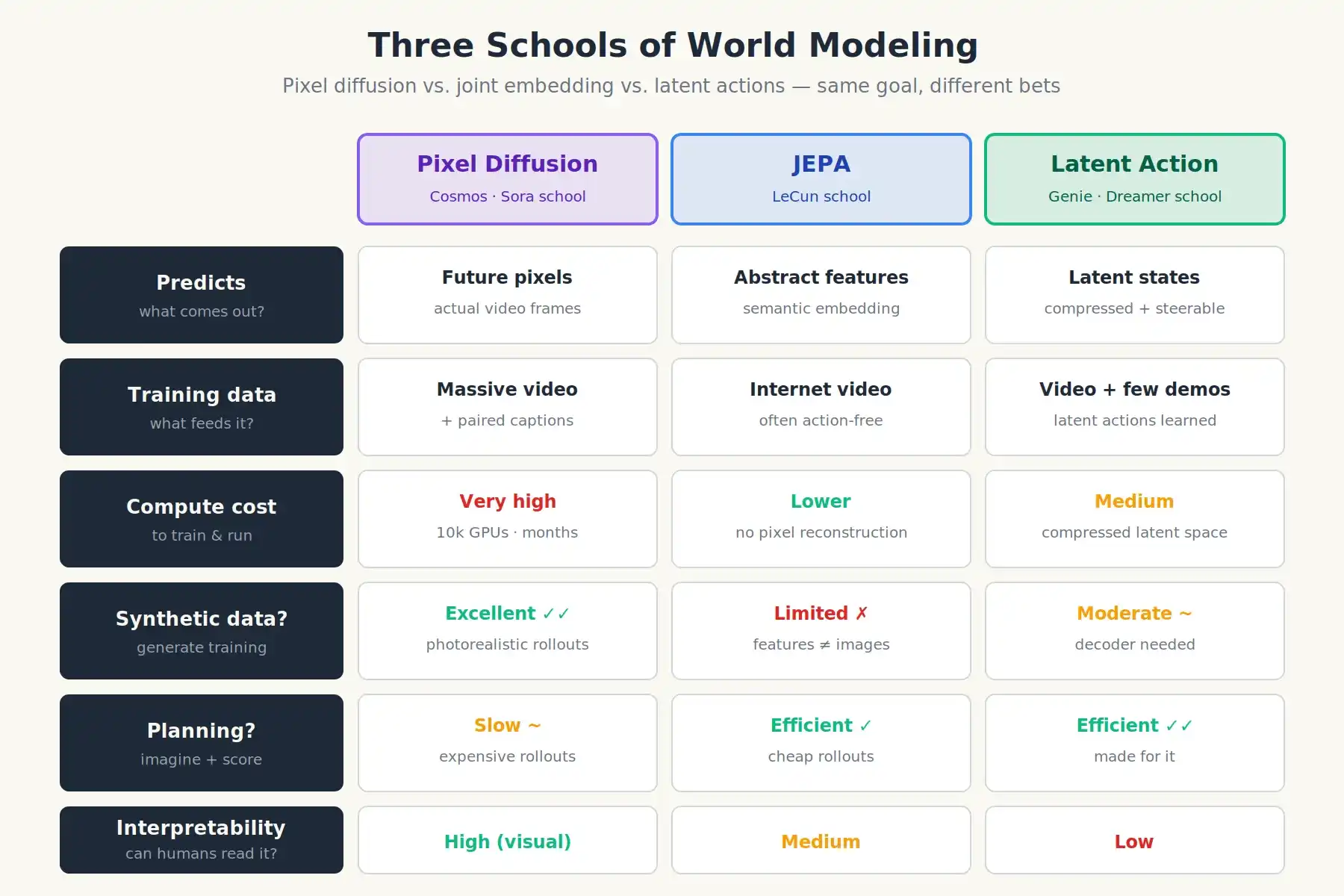
Pixel diffusion, JEPA, and latent action: same goal, wildly different ways to build a world model

Eleven: World-Model-Based Robots in Practice

If you fast-forward a few years, the architecture of a frontier humanoid robot might look like this:

A VLA with a world model riding on top. When the robot encounters a new situation, it does something like:

  • VLA proposes a few candidate next actions (it's still the policy).
  • World model takes each candidate action and simulates 1-3 seconds of imaginary video.
  • Value critic scores based on imagined outcomes: cup grasped? something fell? human bumped?
  • Robot picks the highest-scoring action and executes only its first part.
  • Real sensor data flows back; loop repeats.

This is model-predictive control, a technique used for decades to stabilize rockets and quadrotors, but with a learned world model replacing hand-derived physics equations. Its scalability comes from the world model being pre-trained on millions of hours of video, not because someone wrote Navier-Stokes equations for the kitchen.

The benefits compound:

  • Improved recovery. If a grasp slips, the world model can imagine multiple corrective paths and pick the most promising.
  • Better generalization. A world model trained on web video has seen orders of magnitude more "physics" than any robot teleoperation dataset.
  • Controllable long-horizon planning. Plan in imagination, not in reality.
  • Smaller sim-to-real gap. Instead of training in a home-built simulator (e.g., Isaac Sim, Newton physics engine) and hoping it transfers, train in a simulator that was trained to match real video. So the gap is smaller.
  • Explosion of synthetic data. A world model can generate almost-for-free millions of different robot trajectories across different lighting, materials, and object configurations. This solves the field's biggest bottleneck.

Plus, it has a crucial safety advantage. A robot that can simulate consequences can refuse dangerous actions: not because of a pre-written rule, but because it foresees a human might get hurt.
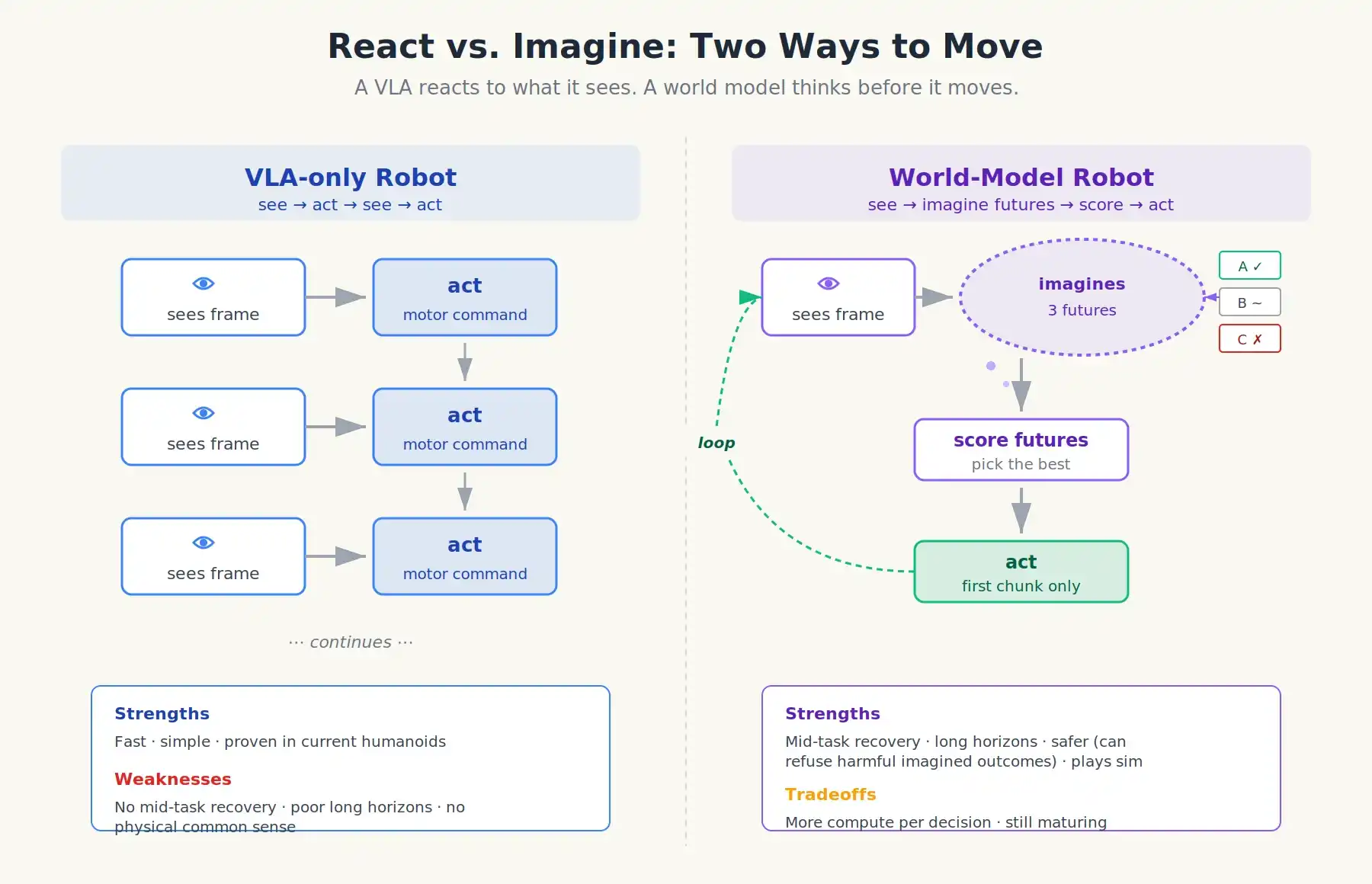
Two ways to move: VLA reacts to what it sees; world-model robot thinks before it moves

Twelve: Things You Should Also Know

Data is the real bottleneck: All the architectural innovation in the world doesn't help if you can't feed the model. Today, teleoperation (humans in VR puppeteering robots) is the primary technical choke point. A robotics company's moat is increasingly its data collection pipeline, not the model itself. AgiBot has warehouses full of operators. NVIDIA's GR00T N1.7 dexterity scaling law shows more human first-person video directly, predictably improves robot dexterity. This is also where China has structural advantages: lower-cost data collection labor, more permissive deployment environments, and state coordination of supply chains.

Simulation is a parallel universe. NVIDIA's Isaac Sim, the new open-source Newton physics engine (v1.0 to be official in April 2026), and the Omniverse platform let companies train robots in millions of parallel simulated worlds without ever deploying in reality. Most of what looks like "robot intelligence" is actually cultivated in simulation and then ported to hardware.

Economics are starting to show. Unitree delivered ~5,500 humanoids in 2025 and targets 10k-20k in 2026. Average price dropped from ~$85k to ~$25k in two years. Unitree's R1 is $5,900. Noetix Bumi is launching at $1,400. Humanoid hardware is approaching consumer electronics pricing while the AI inside still lags the demos. That gap will close, and when it does, volumes will shift the entire industry.

Failure modes look weird. When LLM-based robots fail, they fail in ways traditional robots can't: confidently doing the wrong thing, "hallucinating" capabilities, getting stuck in dialogue loops with their own planner. The traditional robotics world is quite skeptical, and rightly so, insisting learned systems must be safety-monitored and behavior-bounded. The most reliable deployed robots today are hybrids: VLA brains inside hand-designed safety cages.

The "ChatGPT moment" narrative is a useful but misleading metaphor: Jensen Huang keeps telling everyone the ChatGPT moment for robots is here. He says that because NVIDIA sells shovels and picks. The more honest version is: we're roughly in the GPT-2 era for physical AI. It's powerful, it wows you; it's not powerful enough for unattended deployment. It's iterating fast, but the breakout moment isn't viral explosion, it's a slow, steady upward slope.

Conclusion
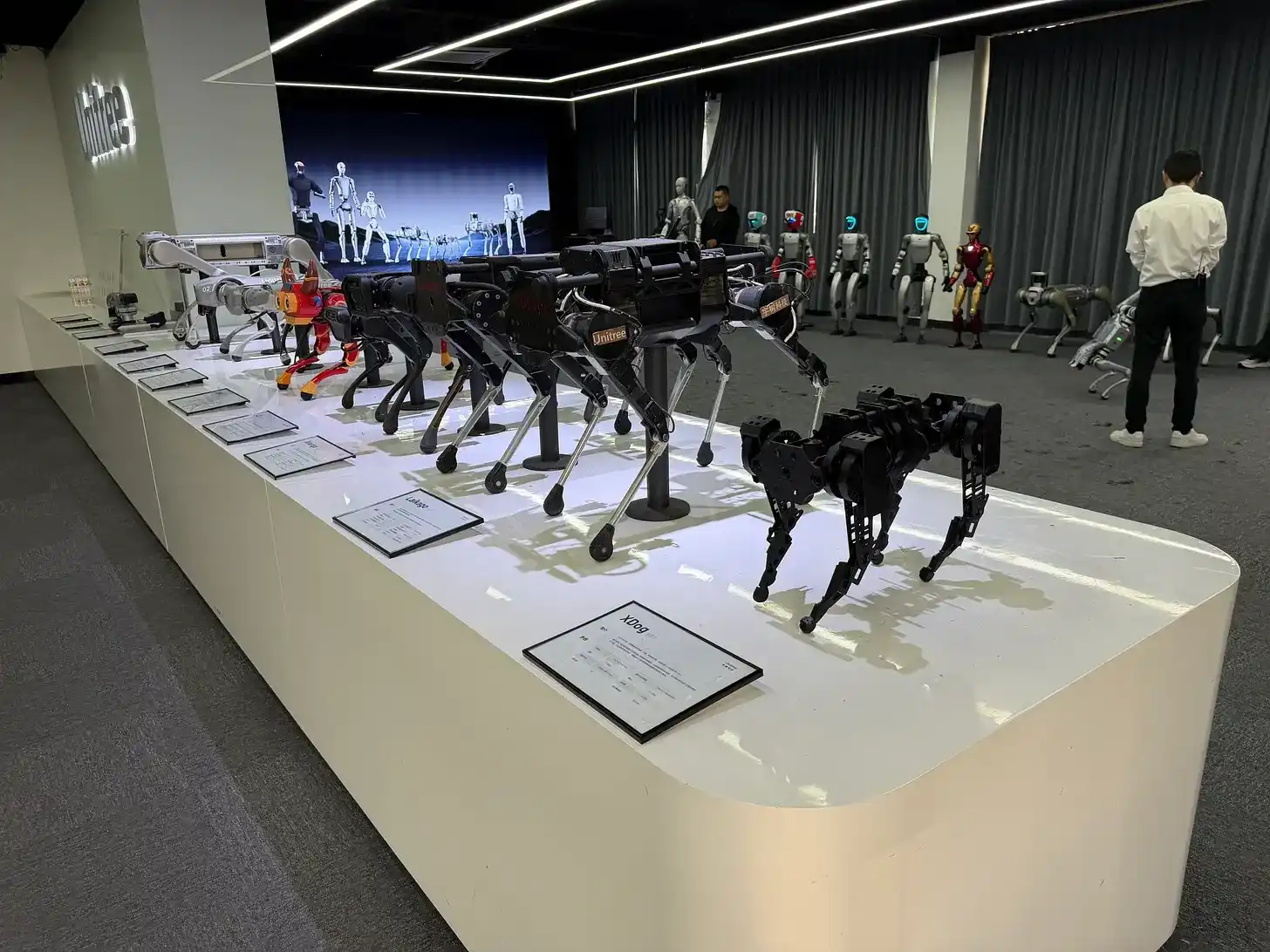
The evolution of Unitree's quadrupeds (right to left)

In the demo seen at Unitree's office, five G1 humanoids performing kung fu were meticulously choreographed, fine-tuned with an onboard VLA-style controller, and overseen by teleoperators to ensure everything worked. It wasn't fully autonomous at its core. But the entire pipeline: perception, planning, motion control, is being replaced by neural networks. Two years from now, the same robots will do the same routine without choreography because they've pre-imagined the whole routine and picked the best version.

The entire progression this article describes—from hand-coded controllers to learned perception to LLM planners to VLAs to dual-system architecture and eventually to world models—is actually the slow migration of where robot intelligence lives. It started in the engineer's head, then moved to hand-written code, then into the perception layer, into the planner, into the policy. And now it's finally moving toward the model that learns the world itself.

Each shift makes robots more general, more adaptable, more useful. If the world-model shift works, it will genuinely empower them: enough that the question stops being "what can robots do?" and becomes "what should we have them do?"

Related reading: A Rundown of Over 30 Humanoid Robot Companies: Who Will Stand Out in 2026?

Perguntas relacionadas

QWhat were the key limitations of robots before the advent of large language models (LLMs)?

ABefore LLMs, robots operated on a carefully handcrafted software stack, relying on manual code for perception (e.g., edge detection), state estimation (sensor fusion), planning (algorithms like A*), and control (e.g., PID controllers). While predictable and safe for known scenarios, these robots had almost zero generalization ability. They would fail in new environments, under different lighting, or with unseen objects. Their intelligence was limited to exactly what the engineer had pre-programmed, and they lacked the ability to parse natural language instructions or decompose complex tasks.

QWhat are Visual-Language-Action Models (VLAs), and why do they represent a significant architectural shift in robotics?

AVisual-Language-Action Models (VLAs) are neural networks that fuse visual data (from cameras) and language instructions into a single model that directly outputs low-level robot action commands (e.g., joint movements). This integrates reasoning and action generation into one network. Unlike earlier systems where a separate planner (like an LLM) would output high-level plans for lower-level controllers to execute, VLAs directly translate 'what they see' and 'what they are asked' into 'how to move.' This coupling enables far better generalization, as learning to recognize an object and learning how to manipulate it are part of the same training process.

QWhat is the 'dual-brain' or System 1 / System 2 architecture commonly used in modern humanoid robots?

AThe 'dual-brain' architecture, popularized by systems like Figure AI's Helix and used in NVIDIA's GR00T, separates cognitive processing into two specialized, communicating models. System 2 is a large, slow-thinking VLA (e.g., 7B parameters) running at ~7–9 Hz. It observes the scene, parses instructions, and performs high-level reasoning, outputting abstract 'intent' vectors. System 1 is a small, fast-reacting visuomotor policy (~80M parameters) running at 200 Hz. It takes the intent vectors and real-time sensor data to produce smooth, continuous joint commands. This division addresses physics constraints: fast action updates are needed for stability, but large models are too slow for real-time control.

QWhat is a World Model in robotics, and what potential advantages does it offer over VLAs?

AA World Model is a neural network trained to predict the future state of the world (e.g., the next video frames) given the current state and a proposed action. Instead of just reacting, a robot with a world model can 'imagine' or simulate the consequences of multiple candidate actions before executing any. This enables 'thinking before acting.' Key advantages include: improved recovery from failures (by simulating corrective paths), better generalization (trained on vast amounts of video data), feasibility of long-horizon planning (in simulation), reduced sim-to-real gap, and the ability to generate massive amounts of synthetic training data. It also offers a safety advantage by allowing the robot to foresee and potentially avoid dangerous outcomes.

QAccording to the article, why are open-source models and frameworks critically important for the current robotics ecosystem?

AOpen-source models and frameworks are crucial for two main reasons. First, they dramatically lower the barrier to entry. Startups and research labs don't need to spend tens of millions of dollars pre-training a foundation model from scratch. They can take open-weight models like NVIDIA's GR00T or Stanford's OpenVLA and fine-tune them with their own robot's data, accelerating development. This is the strategy used by many Chinese humanoid companies. Second, they are seen as essential for safety and auditability. A completely closed-source 'black box' model running a robot in a factory presents a regulatory nightmare. Open models allow researchers, auditors, and operators to inspect what the robot has been trained on and how it might reason.

Leituras Relacionadas

Has the 'Digital Gold' Narrative for BTC Failed?

**Title: Has the "Digital Gold" Narrative for Bitcoin Failed?** The article argues that Bitcoin's "digital gold" narrative remains valid despite a recent sharp price decline (from a peak near $126k in Oct 2025 to briefly under $61k in Feb 2026). It presents a long-term investment framework based on three core points: **1. Viewing Bitcoin as an Asset:** Bitcoin is presented as a superior potential store of value compared to gold. Key arguments are its absolute scarcity (21 million cap), superior portability, and transparent auditability via its public ledger. While acknowledging its current use in early, volatile stages (~3-4% global adoption), the author draws parallels to the early, disruptive phases of the internet and e-commerce. **2. Understanding the Recent Downturn:** The current ~50% correction is framed as a predictable, consensus-driven cycle following its post-halving peak (the 2024 halving preceded the Oct 2025 high). A crucial factor is a historic "changing of hands": the influx of new institutional buyers via ETFs allowed early, low-cost holders (miners, OG believers) to take profits. The author notes that while severe, Bitcoin's historical drawdowns (e.g., 93% in 2011, 77% in 2021-22) have been progressively smaller, suggesting maturing holder structure and decreasing volatility over time. **3. The Long-Term Perspective:** The long-term thesis hinges on Bitcoin capturing a portion of gold's market value. With Bitcoin's market cap at ~$1.4 trillion (at $70k) versus gold's ~$20 trillion, significant upside potential exists if the "digital gold" narrative is partially realized. However, the author strongly cautions that short-term risks remain, the bottom is unpredictable, and high volatility is inherent. The real risk is not Bitcoin failing but poor personal position management (over-leverage, wrong capital) and a lack of deep understanding, which can force investors out during severe downturns. The conclusion uses Amazon's 95% crash post-2000 dot-com bubble and subsequent 42x recovery as an analogy. The ultimate question is not if Bitcoin's price will rise, but if an investor's strategy and conviction can withstand the volatility to see the long-term play out. The recent divergence (gold up, Bitcoin down) is posed not as a narrative failure, but as potential evidence of this ongoing, painful transition from a speculative asset to a mainstream allocation.

marsbitHá 29m

Has the 'Digital Gold' Narrative for BTC Failed?

marsbitHá 29m

Has BTC's 'Digital Gold' Narrative Failed?

The article discusses Bitcoin's "digital gold" narrative, its recent price drop, and long-term outlook through the perspective of "Jason". It argues the narrative is not a failure but that Bitcoin represents a superior, new asset class due to its fixed supply (21 million), portability, and auditability. The piece compares its current ~3-4% global adoption rate to early internet/e-commerce, suggesting significant growth potential. Regarding the 2025-2026 price decline (from ~$126k to briefly under $61k), the author views it as a predictable, consensus-driven sell-off within Bitcoin's ~4-year cycle post-halving, exacerbated by a major "handover" from early, low-cost holders to new institutional buyers via ETFs. A key observation is that historical peak-to-trough drawdowns have lessened over time (e.g., 93% in 2011 to ~50% in 2026), indicating maturing volatility as holder structure changes. For the long term, the author uses a simple framework: Bitcoin's total market cap (~$1.4T at $70k) is only about 7% of gold's (~$20T). Even capturing 30-50% of gold's value would imply substantial upside. However, the article strongly cautions against viewing this as investment advice, emphasizing extreme volatility and the critical importance of risk management, position sizing, and deep fundamental understanding to survive severe drawdowns. It concludes by drawing a parallel to Amazon's 95% crash in 2000 and subsequent 42x recovery, stressing that the key is surviving market cycles to realize long-term potential.

链捕手Há 39m

Has BTC's 'Digital Gold' Narrative Failed?

链捕手Há 39m

AI Bubble Is Bursting

The AI Bubble is Bursting: A Necessary Purge on the Path to Ubiquitous Intelligence Market volatility has reignited debates about an AI bubble, with figures like Ray Dalio pointing to high valuations. However, this parallels the dot-com bubble, which, despite its crash, laid the physical infrastructure for today's internet era. The current AI investment frenzy, with tech giants planning trillions in infrastructure spending far outstripping current AI application revenues, appears similarly imbalanced. This 'bubble' is seen as an inevitable phase for a disruptive technology, paying the "innovation tax." Critically, AI inference costs have plummeted over 99.7% since 2023, making intelligence nearly free at the margin. This hasn't reduced spending but has instead unlocked massive new demand, as seen in enterprise AI cloud expenditure tripling. This follows the Jevons Paradox: efficiency gains lead to greater total consumption. The market is now entering a cleansing phase, weeding out speculative ventures lacking real moats. The deeper shift is a move from capital expenditure (CapEx) on hardware to value creation in operational expenditure (OpEx) through AI applications that solve real industry problems. While infrastructure valuations are high, rapid earnings growth from widespread AI adoption across sectors—from manufacturing and finance to law and healthcare—may digest these valuations over time. Ultimately, this creative destruction will leave behind robust infrastructure and optimized models, cheaply powering an AI-augmented future for all industries, much as the internet became indispensable after its own bubble burst. The core productive potential remains undiminished.

链捕手Há 1h

AI Bubble Is Bursting

链捕手Há 1h

Trading

Spot
Futuros

Artigos em Destaque

O que é GROK AI

Grok AI: Revolucionar a Tecnologia Conversacional na Era Web3 Introdução No panorama em rápida evolução da inteligência artificial, a Grok AI destaca-se como um projeto notável que liga os domínios da tecnologia avançada e da interação com o utilizador. Desenvolvida pela xAI, uma empresa liderada pelo renomado empreendedor Elon Musk, a Grok AI procura redefinir a forma como interagimos com a inteligência artificial. À medida que o movimento Web3 continua a florescer, a Grok AI visa aproveitar o poder da IA conversacional para responder a consultas complexas, proporcionando aos utilizadores uma experiência que é não apenas informativa, mas também divertida. O que é a Grok AI? A Grok AI é um sofisticado chatbot de IA conversacional projetado para interagir com os utilizadores de forma dinâmica. Ao contrário de muitos sistemas de IA tradicionais, a Grok AI abraça uma gama mais ampla de perguntas, incluindo aquelas tipicamente consideradas inadequadas ou fora das respostas padrão. Os principais objetivos do projeto incluem: Raciocínio Fiável: A Grok AI enfatiza o raciocínio de senso comum para fornecer respostas lógicas com base na compreensão contextual. Supervisão Escalável: A integração de assistência de ferramentas garante que as interações dos utilizadores sejam monitorizadas e otimizadas para qualidade. Verificação Formal: A segurança é primordial; a Grok AI incorpora métodos de verificação formal para aumentar a fiabilidade das suas saídas. Compreensão de Longo Contexto: O modelo de IA destaca-se na retenção e recordação de um extenso histórico de conversas, facilitando discussões significativas e contextualizadas. Robustez Adversarial: Ao focar na melhoria das suas defesas contra entradas manipuladas ou maliciosas, a Grok AI visa manter a integridade das interações dos utilizadores. Em essência, a Grok AI não é apenas um dispositivo de recuperação de informações; é um parceiro conversacional imersivo que incentiva um diálogo dinâmico. Criador da Grok AI A mente por trás da Grok AI não é outra senão Elon Musk, um indivíduo sinónimo de inovação em vários campos, incluindo automóvel, viagens espaciais e tecnologia. Sob a égide da xAI, uma empresa focada em avançar a tecnologia de IA de maneiras benéficas, a visão de Musk visa reformular a compreensão das interações com a IA. A liderança e a ética fundacional são profundamente influenciadas pelo compromisso de Musk em ultrapassar os limites tecnológicos. Investidores da Grok AI Embora os detalhes específicos sobre os investidores que apoiam a Grok AI permaneçam limitados, é reconhecido publicamente que a xAI, a incubadora do projeto, é fundada e apoiada principalmente pelo próprio Elon Musk. As anteriores empreitadas e participações de Musk fornecem um forte apoio, reforçando ainda mais a credibilidade e o potencial de crescimento da Grok AI. No entanto, até agora, informações sobre fundações ou organizações de investimento adicionais que apoiam a Grok AI não estão prontamente acessíveis, marcando uma área para exploração futura potencial. Como Funciona a Grok AI? A mecânica operacional da Grok AI é tão inovadora quanto a sua estrutura conceptual. O projeto integra várias tecnologias de ponta que facilitam as suas funcionalidades únicas: Infraestrutura Robusta: A Grok AI é construída utilizando Kubernetes para orquestração de contêineres, Rust para desempenho e segurança, e JAX para computação numérica de alto desempenho. Este trio assegura que o chatbot opere de forma eficiente, escale eficazmente e sirva os utilizadores prontamente. Acesso a Conhecimento em Tempo Real: Uma das características distintivas da Grok AI é a sua capacidade de aceder a dados em tempo real através da plataforma X—anteriormente conhecida como Twitter. Esta capacidade concede à IA acesso às informações mais recentes, permitindo-lhe fornecer respostas e recomendações oportunas que outros modelos de IA poderiam perder. Dois Modos de Interação: A Grok AI oferece aos utilizadores a escolha entre “Modo Divertido” e “Modo Regular”. O Modo Divertido permite um estilo de interação mais lúdico e humorístico, enquanto o Modo Regular foca em fornecer respostas precisas e exatas. Esta versatilidade assegura uma experiência adaptada que atende a várias preferências dos utilizadores. Em essência, a Grok AI combina desempenho com envolvimento, criando uma experiência que é tanto enriquecedora quanto divertida. Cronologia da Grok AI A jornada da Grok AI é marcada por marcos fundamentais que refletem as suas fases de desenvolvimento e implementação: Desenvolvimento Inicial: A fase fundamental da Grok AI ocorreu ao longo de aproximadamente dois meses, durante os quais o treinamento inicial e o ajuste do modelo foram realizados. Lançamento Beta do Grok-2: Numa evolução significativa, o beta do Grok-2 foi anunciado. Este lançamento introduziu duas versões do chatbot—Grok-2 e Grok-2 mini—cada uma equipada com capacidades para conversar, programar e raciocinar. Acesso Público: Após o seu desenvolvimento beta, a Grok AI tornou-se disponível para os utilizadores da plataforma X. Aqueles com contas verificadas por um número de telefone e ativas há pelo menos sete dias podem aceder a uma versão limitada, tornando a tecnologia disponível para um público mais amplo. Esta cronologia encapsula o crescimento sistemático da Grok AI desde a sua concepção até ao envolvimento público, enfatizando o seu compromisso com a melhoria contínua e a interação com o utilizador. Principais Características da Grok AI A Grok AI abrange várias características principais que contribuem para a sua identidade inovadora: Integração de Conhecimento em Tempo Real: O acesso a informações atuais e relevantes diferencia a Grok AI de muitos modelos estáticos, permitindo uma experiência de utilizador envolvente e precisa. Estilos de Interação Versáteis: Ao oferecer modos de interação distintos, a Grok AI atende a várias preferências dos utilizadores, convidando à criatividade e personalização na conversa com a IA. Base Tecnológica Avançada: A utilização de Kubernetes, Rust e JAX fornece ao projeto uma estrutura sólida para garantir fiabilidade e desempenho ótimo. Consideração de Discurso Ético: A inclusão de uma função de geração de imagens demonstra o espírito inovador do projeto. No entanto, também levanta considerações éticas em torno dos direitos autorais e da representação respeitosa de figuras reconhecíveis—uma discussão em curso dentro da comunidade de IA. Conclusão Como uma entidade pioneira no domínio da IA conversacional, a Grok AI encapsula o potencial para experiências transformadoras do utilizador na era digital. Desenvolvida pela xAI e impulsionada pela abordagem visionária de Elon Musk, a Grok AI integra conhecimento em tempo real com capacidades avançadas de interação. Esforça-se por ultrapassar os limites do que a inteligência artificial pode alcançar, mantendo um foco nas considerações éticas e na segurança do utilizador. A Grok AI não apenas incorpora o avanço tecnológico, mas também representa um novo paradigma de conversas no panorama Web3, prometendo envolver os utilizadores com conhecimento hábil e interação lúdica. À medida que o projeto continua a evoluir, ele permanece como um testemunho do que a interseção da tecnologia, criatividade e interação humana pode alcançar.

472 Visualizações TotaisPublicado em {updateTime}Atualizado em 2024.12.26

O que é GROK AI

O que é ERC AI

Euruka Tech: Uma Visão Geral do $erc ai e as suas Ambições no Web3 Introdução No panorama em rápida evolução da tecnologia blockchain e das aplicações descentralizadas, novos projetos surgem frequentemente, cada um com objetivos e metodologias únicas. Um desses projetos é a Euruka Tech, que opera no vasto domínio das criptomoedas e do Web3. O foco principal da Euruka Tech, particularmente do seu token $erc ai, é apresentar soluções inovadoras concebidas para aproveitar as capacidades crescentes da tecnologia descentralizada. Este artigo tem como objetivo fornecer uma visão abrangente da Euruka Tech, uma exploração das suas metas, funcionalidade, a identidade do seu criador, potenciais investidores e a sua importância no contexto mais amplo do Web3. O que é a Euruka Tech, $erc ai? A Euruka Tech é caracterizada como um projeto que aproveita as ferramentas e funcionalidades oferecidas pelo ambiente Web3, focando na integração da inteligência artificial nas suas operações. Embora os detalhes específicos sobre a estrutura do projeto sejam um tanto elusivos, ele é concebido para melhorar o envolvimento dos utilizadores e automatizar processos no espaço cripto. O projeto visa criar um ecossistema descentralizado que não só facilita transações, mas também incorpora funcionalidades preditivas através da inteligência artificial, daí a designação do seu token, $erc ai. O objetivo é fornecer uma plataforma intuitiva que facilite interações mais inteligentes e um processamento eficiente de transações dentro da crescente esfera do Web3. Quem é o Criador da Euruka Tech, $erc ai? Neste momento, a informação sobre o criador ou a equipa fundadora da Euruka Tech permanece não especificada e algo opaca. Esta ausência de dados levanta preocupações, uma vez que o conhecimento sobre o histórico da equipa é frequentemente essencial para estabelecer credibilidade no setor blockchain. Portanto, categorizamos esta informação como desconhecida até que detalhes concretos sejam disponibilizados no domínio público. Quem são os Investidores da Euruka Tech, $erc ai? De forma semelhante, a identificação de investidores ou organizações de apoio para o projeto Euruka Tech não é prontamente fornecida através da pesquisa disponível. Um aspeto que é crucial para potenciais partes interessadas ou utilizadores que consideram envolver-se com a Euruka Tech é a garantia que vem de parcerias financeiras estabelecidas ou apoio de empresas de investimento respeitáveis. Sem divulgações sobre afiliações de investimento, é difícil tirar conclusões abrangentes sobre a segurança financeira ou a longevidade do projeto. Em linha com a informação encontrada, esta seção também se encontra no estado de desconhecido. Como funciona a Euruka Tech, $erc ai? Apesar da falta de especificações técnicas detalhadas para a Euruka Tech, é essencial considerar as suas ambições inovadoras. O projeto procura aproveitar o poder computacional da inteligência artificial para automatizar e melhorar a experiência do utilizador no ambiente das criptomoedas. Ao integrar IA com tecnologia blockchain, a Euruka Tech visa fornecer funcionalidades como negociações automatizadas, avaliações de risco e interfaces de utilizador personalizadas. A essência inovadora da Euruka Tech reside no seu objetivo de criar uma conexão fluida entre os utilizadores e as vastas possibilidades apresentadas pelas redes descentralizadas. Através da utilização de algoritmos de aprendizagem automática e IA, visa minimizar os desafios enfrentados por utilizadores de primeira viagem e agilizar as experiências transacionais dentro do quadro do Web3. Esta simbiose entre IA e blockchain sublinha a importância do token $erc ai, que se apresenta como uma ponte entre interfaces de utilizador tradicionais e as capacidades avançadas das tecnologias descentralizadas. Cronologia da Euruka Tech, $erc ai Infelizmente, devido à informação limitada disponível sobre a Euruka Tech, não conseguimos apresentar uma cronologia detalhada dos principais desenvolvimentos ou marcos na jornada do projeto. Esta cronologia, tipicamente inestimável para traçar a evolução de um projeto e compreender a sua trajetória de crescimento, não está atualmente disponível. À medida que informações sobre eventos notáveis, parcerias ou adições funcionais se tornem evidentes, atualizações certamente aumentarão a visibilidade da Euruka Tech na esfera cripto. Esclarecimento sobre Outros Projetos “Eureka” É importante abordar que múltiplos projetos e empresas partilham uma nomenclatura semelhante com “Eureka.” A pesquisa identificou iniciativas como um agente de IA da NVIDIA Research, que se concentra em ensinar robôs a realizar tarefas complexas utilizando métodos generativos, bem como a Eureka Labs e a Eureka AI, que melhoram a experiência do utilizador na educação e na análise de serviços ao cliente, respetivamente. No entanto, estes projetos são distintos da Euruka Tech e não devem ser confundidos com os seus objetivos ou funcionalidades. Conclusão A Euruka Tech, juntamente com o seu token $erc ai, representa um jogador promissor, mas atualmente obscuro, dentro do panorama do Web3. Embora os detalhes sobre o seu criador e investidores permaneçam não divulgados, a ambição central de combinar inteligência artificial com tecnologia blockchain destaca-se como um ponto focal de interesse. As abordagens únicas do projeto em promover o envolvimento do utilizador através da automação avançada podem diferenciá-lo à medida que o ecossistema Web3 avança. À medida que o mercado cripto continua a evoluir, as partes interessadas devem manter um olhar atento sobre os avanços em torno da Euruka Tech, uma vez que o desenvolvimento de inovações documentadas, parcerias ou um roteiro definido pode apresentar oportunidades significativas no futuro próximo. Neste momento, aguardamos por insights mais substanciais que possam desvendar o potencial da Euruka Tech e a sua posição no competitivo panorama cripto.

511 Visualizações TotaisPublicado em {updateTime}Atualizado em 2025.01.02

O que é ERC AI

O que é DUOLINGO AI

DUOLINGO AI: Integrar a Aprendizagem de Línguas com Inovação Web3 e IA Numa era em que a tecnologia transforma a educação, a integração da inteligência artificial (IA) e das redes blockchain anuncia uma nova fronteira para a aprendizagem de línguas. Apresentamos DUOLINGO AI e a sua criptomoeda associada, $DUOLINGO AI. Este projeto aspira a unir o poder educativo das principais plataformas de aprendizagem de línguas com os benefícios da tecnologia descentralizada Web3. Este artigo explora os principais aspectos do DUOLINGO AI, analisando os seus objetivos, estrutura tecnológica, desenvolvimento histórico e potencial futuro, mantendo a clareza entre o recurso educativo original e esta iniciativa independente de criptomoeda. Visão Geral do DUOLINGO AI No seu cerne, DUOLINGO AI procura estabelecer um ambiente descentralizado onde os alunos podem ganhar recompensas criptográficas por alcançar marcos educativos em proficiência linguística. Ao aplicar contratos inteligentes, o projeto visa automatizar processos de verificação de habilidades e alocação de tokens, aderindo aos princípios do Web3 que enfatizam a transparência e a propriedade do utilizador. O modelo diverge das abordagens tradicionais de aquisição de línguas ao apoiar-se fortemente numa estrutura de governança orientada pela comunidade, permitindo que os detentores de tokens sugiram melhorias ao conteúdo dos cursos e à distribuição de recompensas. Alguns dos objetivos notáveis do DUOLINGO AI incluem: Aprendizagem Gamificada: O projeto integra conquistas em blockchain e tokens não fungíveis (NFTs) para representar níveis de proficiência linguística, promovendo a motivação através de recompensas digitais envolventes. Criação de Conteúdo Descentralizada: Abre caminhos para educadores e entusiastas de línguas contribuírem com os seus cursos, facilitando um modelo de partilha de receitas que beneficia todos os colaboradores. Personalização Através de IA: Ao empregar modelos avançados de aprendizagem de máquina, o DUOLINGO AI personaliza as lições para se adaptar ao progresso de aprendizagem individual, semelhante às características adaptativas encontradas em plataformas estabelecidas. Criadores do Projeto e Governança A partir de abril de 2025, a equipa por trás do $DUOLINGO AI permanece pseudónima, uma prática frequente no panorama descentralizado das criptomoedas. Esta anonimidade visa promover o crescimento coletivo e o envolvimento das partes interessadas, em vez de se concentrar em desenvolvedores individuais. O contrato inteligente implementado na blockchain Solana indica o endereço da carteira do desenvolvedor, o que significa o compromisso com a transparência em relação às transações, apesar da identidade dos criadores ser desconhecida. De acordo com o seu roteiro, o DUOLINGO AI pretende evoluir para uma Organização Autónoma Descentralizada (DAO). Esta estrutura de governança permite que os detentores de tokens votem em questões críticas, como implementações de funcionalidades e alocação de tesouraria. Este modelo alinha-se com a ética de empoderamento comunitário encontrada em várias aplicações descentralizadas, enfatizando a importância da tomada de decisão coletiva. Investidores e Parcerias Estratégicas Atualmente, não existem investidores institucionais ou capitalistas de risco publicamente identificáveis ligados ao $DUOLINGO AI. Em vez disso, a liquidez do projeto origina-se principalmente de trocas descentralizadas (DEXs), marcando um contraste acentuado com as estratégias de financiamento das empresas tradicionais de tecnologia educacional. Este modelo de base indica uma abordagem orientada pela comunidade, refletindo o compromisso do projeto com a descentralização. No seu whitepaper, o DUOLINGO AI menciona a formação de colaborações com “plataformas de educação blockchain” não especificadas, com o objetivo de enriquecer a sua oferta de cursos. Embora parcerias específicas ainda não tenham sido divulgadas, estes esforços colaborativos sugerem uma estratégia para misturar inovação em blockchain com iniciativas educativas, expandindo o acesso e o envolvimento dos utilizadores em diversas vias de aprendizagem. Arquitetura Tecnológica Integração de IA O DUOLINGO AI incorpora dois componentes principais impulsionados por IA para melhorar as suas ofertas educativas: Motor de Aprendizagem Adaptativa: Este motor sofisticado aprende a partir das interações dos utilizadores, semelhante a modelos proprietários de grandes plataformas educativas. Ele ajusta dinamicamente a dificuldade das lições para abordar desafios específicos dos alunos, reforçando áreas fracas através de exercícios direcionados. Agentes Conversacionais: Ao empregar chatbots alimentados por GPT-4, o DUOLINGO AI oferece uma plataforma para os utilizadores se envolverem em conversas simuladas, promovendo uma experiência de aprendizagem de línguas mais interativa e prática. Infraestrutura Blockchain Construído na blockchain Solana, o $DUOLINGO AI utiliza uma estrutura tecnológica abrangente que inclui: Contratos Inteligentes de Verificação de Habilidades: Esta funcionalidade atribui automaticamente tokens aos utilizadores que passam com sucesso em testes de proficiência, reforçando a estrutura de incentivos para resultados de aprendizagem genuínos. Emblemas NFT: Estes tokens digitais significam vários marcos que os alunos alcançam, como completar uma seção do seu curso ou dominar habilidades específicas, permitindo-lhes negociar ou exibir as suas conquistas digitalmente. Governança DAO: Membros da comunidade com tokens podem participar na governança votando em propostas-chave, facilitando uma cultura participativa que incentiva a inovação nas ofertas de cursos e funcionalidades da plataforma. Cronologia Histórica 2022–2023: Conceituação O trabalho preliminar para o DUOLINGO AI começa com a criação de um whitepaper, destacando a sinergia entre os avanços em IA na aprendizagem de línguas e o potencial descentralizado da tecnologia blockchain. 2024: Lançamento Beta Um lançamento beta limitado introduz ofertas em línguas populares, recompensando os primeiros utilizadores com incentivos em tokens como parte da estratégia de envolvimento comunitário do projeto. 2025: Transição para DAO Em abril, ocorre um lançamento completo da mainnet com a circulação de tokens, promovendo discussões comunitárias sobre possíveis expansões para línguas asiáticas e outros desenvolvimentos de cursos. Desafios e Direções Futuras Obstáculos Técnicos Apesar dos seus objetivos ambiciosos, o DUOLINGO AI enfrenta desafios significativos. A escalabilidade continua a ser uma preocupação constante, particularmente no equilíbrio dos custos associados ao processamento de IA e à manutenção de uma rede descentralizada responsiva. Além disso, garantir a criação e moderação de conteúdo de qualidade num ambiente descentralizado apresenta complexidades na manutenção dos padrões educativos. Oportunidades Estratégicas Olhando para o futuro, o DUOLINGO AI tem o potencial de aproveitar parcerias de micro-certificação com instituições académicas, proporcionando validações verificadas em blockchain das habilidades linguísticas. Além disso, a expansão cross-chain poderia permitir que o projeto acedesse a bases de utilizadores mais amplas e a ecossistemas de blockchain adicionais, melhorando a sua interoperabilidade e alcance. Conclusão DUOLINGO AI representa uma fusão inovadora de inteligência artificial e tecnologia blockchain, apresentando uma alternativa focada na comunidade aos sistemas tradicionais de aprendizagem de línguas. Embora o seu desenvolvimento pseudónimo e o modelo económico emergente tragam certos riscos, o compromisso do projeto com a aprendizagem gamificada, educação personalizada e governança descentralizada ilumina um caminho a seguir para a tecnologia educativa no domínio do Web3. À medida que a IA continua a avançar e o ecossistema blockchain evolui, iniciativas como o DUOLINGO AI poderão redefinir a forma como os utilizadores interagem com a educação linguística, empoderando comunidades e recompensando o envolvimento através de mecanismos de aprendizagem inovadores.

442 Visualizações TotaisPublicado em {updateTime}Atualizado em 2025.04.11

O que é DUOLINGO AI

Discussões

Bem-vindo à Comunidade HTX. Aqui, pode manter-se informado sobre os mais recentes desenvolvimentos da plataforma e obter acesso a análises profissionais de mercado. As opiniões dos utilizadores sobre o preço de AI (AI) são apresentadas abaixo.

活动图片