2025 Crypto x AI Year in Review: Which Narratives Survived?

深潮Publicado em 2025-12-15Última atualização em 2025-12-15

Resumo

The 2025 Crypto x AI landscape saw a shift from speculative narratives to practical, utility-driven applications. Key surviving narratives include DeFAI (Decentralized Finance AI), which evolved through three phases: abstraction layers (simplifying DeFi interactions), autonomous yield agents (managing "set-and-forget" strategies), and AI Vaults (auditable, agent-generated smart contracts). Projects like Giza and Almanak led this space. AI agents, initially overhyped for entertainment, declined due to lack of utility but resurged with new standards like Coinbase's x402 and Ethereum's ERC-8004, enabling verifiable, decentralized agent economies. Decentralized AI (DeAI) emerged as a critical pillar, with Bittensor leading a "Darwinian AI" ecosystem that coordinates global resources for model training, reinforcement learning, and privacy-preserving computation. This infrastructure supports商业化 AI agents and enhances DeFi and prediction markets. Prediction markets integrated AI for forecasting and liquidity provision, though they face challenges like limited liquidity and edge decay. Overall, the trend moved from speculation to infrastructure, with 2026 poised for crypto-native AI products gaining indispensability.

Author:0xJeff

Compiled by: Deep Tide TechFlow

Reviewing the history of Crypto and AI, the narratives that survived and thrived, and the future of this field in 2026.

2024 was the year Crypto x AI truly started trending on Crypto Twitter—the market saw an influx of interesting, useful, and entertaining crypto agents, each with its own token.

In 2025, speculation around crypto agents gradually shifted towards real AI applications, decentralized AI moved from research and conceptual stages to early productization, and "Darwinian AI" became the preferred way to attract new talent and accelerate the development of decentralized AI. Meanwhile, DeFi x AI emerged as the most valuable sub-sector, further enhancing crypto's core value proposition.

2026 will be the year of Crypto AI.

Thanks to the efforts and experiments accumulated between 2024 and 2025, we are beginning to see early signs of product-market fit and a clearer direction on how cryptocurrencies, blockchain, and distributed systems can enhance AI.

Narratives that lacked inherent utility or market demand, or couldn't compete with Web2 AI startups, either died out or stagnated (e.g., AI x Gaming, AI Entertainment, Generative AI, Video/Voice Agents, AI Workflows for Productivity).

Those that survived transformed into innovative models that could change how we work.

DeFAI is the New Generation of DeFi

DeFAI (Decentralized Finance AI) emerged in the crypto space in early 2025, sparking a massive wave of using AI to enhance existing DeFi systems.

The first iteration of DeFi x AI was called "Abstraction layers"—through ChatGPT-like interfaces, users could directly prompt the desired outcome.

This was an "aha moment" for many, as DeFi itself is highly complex—users need to find the right bridges to transfer assets or gas fees, understand how top decentralized exchanges (DEXs) and lending protocols on new chains work, and grasp the nature, risks, and underlying assets of protocols.

Tools that could help users quickly achieve their desired results seemed like the perfect first step to make DeFi more accessible.

While it sounded great in theory, integration in reality faced many challenges. Most DeFAI solutions were either full of vulnerabilities or very difficult to use. UI/UX issues were maddening—users didn't know how to input prompts or even what they could or couldn't input.

As a result, most projects failed, with only a few players pivoting or continuing to deepen their efforts.

  • @HeyAnonai was once a top DeFAI project but has now pivoted to a trading assistant and prediction market tool.

  • @griffaindotcom hasn't updated on X since April and appears to have vanished.

Those who persisted and doubled down:

  • @AIWayfinder continues with its terminal/ChatGPT-style interface and has expanded functionality to include perpetual trading, DeFi strategies, predictions, and more.

  • @bankrbot remains focused on being a terminal-based co-pilot, helping users with trade execution, research, and analysis.

  • @Infinit_Labs focuses on DeFi strategy execution while introducing crowdsourced/creator-driven DeFi strategies (becoming a hub where users can curate and/or invest in top DeFi strategies).

The first iteration of DeFAI failed to achieve product-market fit (PMF) in 2025, but some of these projects might succeed in helping newcomers navigate the on-chain environment more easily.

The failure of the first generation to find PMF spurred the rise of the second generation of DeFAI projects: "autonomous yield agents." The core idea is that users no longer need to think about how to input prompts, which strategy to execute, when to rebalance, or what strategy to choose next—instead, autonomous agents handle all the heavy lifting for users.

This model offers a simple "set and forget" experience, where users delegate all complex operations to personalized smart agents. @gizatechxyz was the first project to popularize this model, with its agent system equipped with numerous security measures (e.g., smart wallets with preset permissions defining what they can and cannot do and which protocols they can interact with; session keys allowing agents limited-time access to necessary permissions to complete tasks).

This time, preliminary product-market fit was validated—Giza achieved approximately $30 million in Assets under Agent (AuA) and generated over $3 billion in trading volume on top lending protocols. The second-tier project @ZyfAI_ also saw significant growth, reaching about $8 million in AuA and around $1.1 billion in trading volume.

However, challenges remain. Large capital, institutional funds, and significant sums remain cautious about entrusting hundreds of millions to autonomous agents, primarily due to concerns about "black-box" operations, potential erroneous decisions (e.g., AI "hallucinations"), and other issues.

It is in this context that the third generation of DeFAI emerged: "AI Vaults." This model leverages a group of specialized smart agents to quickly generate and optimize DeFi smart contracts. @almanak was the first project to realize that this architecture could combine the advantages of both models.

In this model, the core of the strategy remains the DeFi smart contract. These contracts are generated by smart agents in minutes via "vibe-code," drastically reducing the time required for quants and capital allocators to create complex strategies. These contracts are auditable, with everything open and transparent, similar to traditional DeFi contracts that have been battle-tested for years and are more secure.

DeFAI Outlook

DeFAI is gradually evolving towards optimizing AI systems to support DeFi, with its main iterations including:

  1. Abstraction layers—Lowering the barrier to entry, helping new users interested in trading and DeFi yield farming get started quickly.

  2. Autonomous agents—Assisting users in managing "set and forget" DeFi strategies, simplifying the operational process.

  3. AI vaults—Providing more efficient strategy-building tools for on-chain capital allocators, significantly improving efficiency.

In the future, these three directions will likely continue to optimize for their respective target user groups, while we can also expect major DeFi protocols, wallet services, and centralized/decentralized exchanges (CEXs/DEXs) to gradually adopt these products to improve the user DeFi experience.

Trends Worth Watching but Still Early

  1. Trading agents: Currently, most dApps either offer market analysis or are "black-box" AIs that trade for users, while products providing a full-featured, end-to-end solution from scratch are not yet mature. @Cod3xOrg offers the most comprehensive solution, but its UI/UX still needs optimization to suit everyday users.

  2. Dynamic DeFi: Using machine learning systems to make DeFi strategies more dynamic, thereby achieving better risk-adjusted returns. @AlloraNetwork is currently the only project exploring this space but is still in a very early stage.

The Rise, Fall, and Rebirth of AI Agents

The AI agent narrative was first led by @virtuals_io in late 2024, entering the public eye by combining AI applications/products with fair-launched tokens.

This narrative emerged at an opportune time when the market was tired of low-circulation, high-fully diluted valuation (FDV) venture-backed tokens, and high-circulation, low-FDV fair-launched tokens paired with the right narrative were the perfect antidote.

The first generation of AI agents were primarily entertainment and "alpha" agents. For example, @truth_terminal spurred a wave of AI agents on X (commonly called "slops") that spent all day chatting and replying to users. Initially, they were purely for entertainment but gradually evolved into more useful tools (e.g., sharing market analysis, token analysis, etc.). Among them, @aixbt_agent became a standout in this field due to its popular "degen" persona that was both funny and professional.

With the rapid proliferation of "slops," demand for development frameworks surged—these middleware tools helped developers easily build AI agent workflows on X. ElizaOS (initially named AI16Z) quickly became a household name, launching the largest open-source AI wave in crypto history. This further spurred the emergence of more AI agents but also led to growing fatigue among Crypto Twitter (CT) users.

By 2025, the AI agent narrative gradually cooled down, primarily due to a lack of actual utility and overhyped valuations.

It's worth noting that the actual definition of an AI agent is an application that can:

  1. Extract information from a changing and unstructured environment;

  2. Reason about the information based on goals;

  3. Discover patterns in data and learn how to leverage them;

  4. Perform operations its owner hadn't even considered.

(Credit to @almanak for the precise definition)

The initial AI agent products weren't truly "AI agents" in this sense; they were more like AI workflows or applications designed to attract attention, impressive at first sight.

However, as people realized this, attention began shifting to other narratives, such as DeFAI, DeAI, robotics, or even moving away from Crypto x AI entirely.

Things changed in October-November 2025. The payment standard x402, developed by Coinbase, began gaining traction among enterprises, including giants like Google and Cloudflare. More Web3 developers started experimenting with x402, leading to many refreshing applications, such as token launches via x402 links or on-demand payment microservices based on x402.

Simultaneously, the Ethereum Foundation increased its investment in AI, and the ERC-8004 standard began gaining popularity. This standard creates a decentralized "trust layer" for autonomous AI agents, giving them verifiable identity, reputation, and proof of work, enabling them to reliably discover, collaborate, and transact without centralized institutions. The Ethereum Foundation also formed the Ethereum dAI team specifically to support AI agent teams using ERC-8004.

The emergence of x402 and ERC-8004 once again fueled market excitement for the AI agent narrative, but due to macroeconomic volatility, this hype and market uptick didn't last long.

Nevertheless, @virtuals_io remains the premier AI agent hub, but so far, we haven't seen any application or agent from this narrative break out with significant user numbers or revenue.

Perhaps 2026 will see such a breakthrough agent, or perhaps not. My prediction is that breakthrough agents will likely emerge first in other narrative areas, particularly DeFAI and DeAI.

Regardless, frameworks and standards like x402, ERC-8004, and ACP (provided by Virtuals) will shape the future of the on-chain AI agent economy in 2026.

Decentralized AI: The True Crypto x AI Product-Market Fit (PMF)

Since 2023 (or even earlier), decentralized AI (DeAI) has been a potential direction in the Crypto x AI narrative. The prospect of using blockchain and tokens to build distributed systems where humans and machines collectively contribute work and resources is undoubtedly huge.

In reality, we find many underutilized resources:

  • GPUs, gaming chips, edge devices (e.g., work laptops, phones) may be idle more than half the time;

  • Engineers and data scientists from India, Pakistan, and the Philippines are skilled but lack access to top tech companies and cutting-edge AI labs;

  • Investors worldwide want to support early-stage startups driving the next generation of AI innovation to change the world but may not have access to Y Combinator (YC) and Silicon Valley companies.

This is where decentralized AI comes in. Through coordination layers and "Darwinian AI" ecosystems, various resources are integrated, allowing stakeholders to contribute to the development of open-source and decentralized AI in their own way.

  • A developer from Pakistan can train the most accurate ETH price prediction model and be handsomely rewarded;

  • An investor from Iceland can invest in a $20 million market cap startup focused on reinforcement learning innovation;

  • A gamer from Mongolia can contribute their idle GPU resources to support AI model training.

The examples are endless.

2025 was a year of significant progress for decentralized AI (DeAI). Countless research papers and experiments emerged in decentralized training, reinforcement learning, federated learning, privacy preservation, verification techniques, security, and more. @MessariCrypto covered these developments in its "2025 State of AI Report"—check it out if you haven't.

Highlights of the Year

  1. Bittensor (@opentensor) solidified its leadership in the decentralized AI ecosystem

Bittensor successfully solidified its position as the leader of the decentralized AI ecosystem, becoming a hub for many unique AI startups (subnets). There are now 128 subnets, each innovating and developing in different areas. Bittensor subsidizes the operational and capital expenditures of AI development through coordinated incentive mechanisms, driving innovation. Its "Darwinian AI" concept (driving development through incentivized competition and innovation competition) has also inspired many other projects.

  1. Decentralized Reinforcement Learning (RL) achieved scale

Decentralized reinforcement learning technology has been proven to work at scale. Reinforcement learning is often used to optimize models, making them smarter through self-learning and self-play. Multiple decentralized AI labs, such as @gensynai, @NousResearch, @PrimeIntellect, @Gradient_HQ, and @Pluralis, have made progress in reinforcement learning. Once commercialized, this technology has the potential to provide highly intelligent domain-specific solutions for enterprises, such as sales/customer service agents, logistics/supply chain agents, legal, finance, etc.

  1. Enhanced AI transparency and compliance

    To make AI trusted by enterprises, governments, and traditional financial institutions, AI must no longer be a "black box" but a more deterministic and compliant tool. The following technologies are being gradually adopted:

    1. TEE (Trusted Execution Environment) for hardware security (@PhalaNetwork);

    2. AI output verification technologies like zkML, opML, EigenAI (@eigencloud);

    3. Private data and computation (@vana);

    4. Federated learning (@flock_io), training AI while keeping data local and private.

  2. The rise of multi-agent systems (Swarm)

The rise of multi-agent systems increased the need for coordination and orchestration. Standards like MCP (Multi-Agent Communication Protocol) facilitated integration, while orchestration layers enabled multiple agents to collaborate, providing users with more complex AI workflows. Projects like @questflow and @openservai are driving this direction.

All these developments point to a future where both domain-specific application scenarios and crypto-native use cases (e.g., DeFi, trading, prediction, on-chain operations) can be executed and scaled in a safer, more efficient manner. The risks of AI vulnerabilities, runaway AI, and "hallucinations" will be significantly reduced.

Decentralized AI (DeAI) Outlook

More and more startups from Y Combinator (YC) and Silicon Valley are choosing to develop open-source models and adopt decentralized computing, a trend that is accelerating. Inference service providers like @chutes_ai already support billions of tokens processed daily, a trend expected to continue into 2026.

Decentralized AI will drive the birth of commercially viable AI agents suitable for traditional enterprises.

Furthermore, its infrastructure will also support the growth of yield farming, trading, and prediction agents, becoming a core pillar for DeFi protocols, prediction market platforms, centralized exchanges (CEX), and mainstream wallet services.

If you want to dive deeper into decentralized AI, you can read the following articles:

  1. From Closed AI to Open-Source AI to Decentralized AI ➔ Trends Driving DeAI

  2. How Decentralized AI Competes with Centralized AI ➔ Decentralized Training and Reinforcement Learning (RL)

  3. The Economies of Scale of Decentralized AI ➔ The Network Effects of DeAI

The Rise of Prediction Markets and AI

With the rise of prediction markets, machine learning systems found an excellent application—not only predicting event outcomes but also making directional bets and providing liquidity in prediction markets.

The latter, in particular, is growing in popularity. Multiple subnets on Bittensor, such as @sportstensor, @SynthdataCo, @webuildscore, and @sire_agent, are developing machine learning systems that can: Predict the prices of cryptocurrencies like BTC, ETH, SOL; Develop prediction market yield vault products that place bets and generate yield for users.

  • Sportsensor: Became the official liquidity provider/market maker for @Polymarket earlier this year, focusing on sports and esports markets.

  • Synth: Publicly predicted on Polymarket, achieving a return of over 20x in just two months, growing capital from $3,000 to $60,000 with its accurate prediction signals.

  • Sire: Achieved 5%-10% weekly returns on investment through its prediction market yield vault product.

We also see more Darwinian AI projects entering this space, exploring the deep integration of prediction markets and AI.

  1. @AlloraNetwork: Making DeFi More Dynamic

AlloraNetwork uses machine learning systems provided by a network of contributors to predict asset prices and volatility. These price and volatility models can be integrated into smart contracts as AI Oracles, enabling dynamic strategy adjustments based on predictions. For example:

  • Automatic leverage and deleverage loop strategies;

  • AI-managed CLAMM strategies (Concentrated Liquidity Market Making);

  • Delta-neutral strategies (risk hedging). These functions significantly enhance the flexibility and efficiency of DeFi.

  1. @crunchDAO: The Supply Side of Darwinian AI

crunchDAO focuses on the supply side of Darwinian AI, attracting high-quality engineers, data scientists, and talent to participate and contribute to machine learning subnets (like Synth). By mining and optimizing these subnets, it drives the improvement of AI prediction capabilities.

  1. @FractionAI_xyz: Enhancing AI Agent Capabilities Through Competition

FractionAI uses real competition environments to drive the fine-tuning and expansion of domain-specific AI agent capabilities. They launched agent-centric "Spaces," which are games that allow AI agents to continuously improve. The most notable projects include:

  • ALFA: Humans can bet on agent vs. agent trading duels;

  • StableUp: AI agents for stablecoin yield farming.

Beyond the booming prediction markets, Bittensor's competitions and trading contests by @the_nof1 have also injected strong momentum into this field, further promoting the rapid growth of prediction markets x AI.

Prediction Markets x AI Outlook

With the development of large language models (LLMs) and AI workflows, AI terminals, copy-trading in prediction markets, data analysis, and signal tools will become more prevalent. These tools will greatly simplify information research and acquisition, providing prediction market traders with more edge. Among them, @Polysights remains the leader in mining internal signals.

Prediction market APIs and yield vault products that users can "set and automatically profit" will also become more widely available, offering more opportunities for users to try.

Despite the bright prospects, prediction markets still face two major challenges:

  1. Insufficient liquidity: Prediction markets are relatively small, with scarce liquidity;

  2. Edge decay: When bet sizes increase, the trading edge quickly diminishes.

Therefore, machine learning systems focused on arbitrage and providing liquidity (e.g., liquidity mining via limit orders in Yes/No markets) might become the most successful products in prediction markets in 2026. As prediction markets attract significant capital, point rewards and airdrop value will be worth mining, similar to Hyperliquid's early days in perpetuals.

The Future of Decentralized AI and Finance
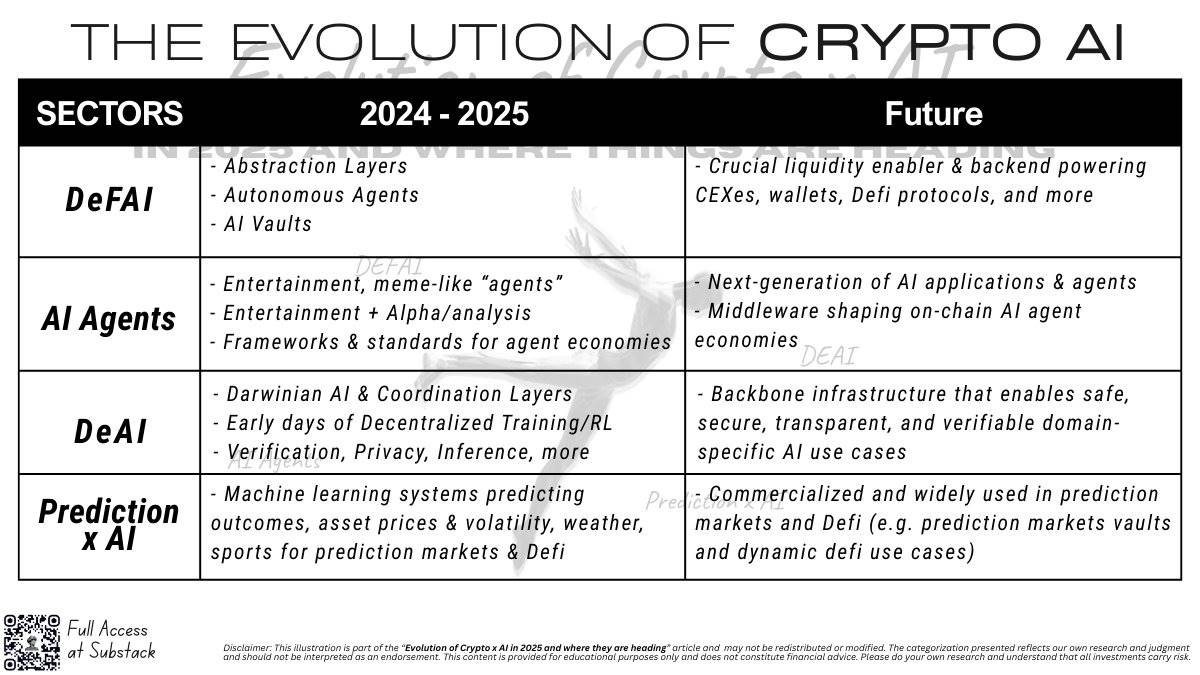
Across all areas, the same trend is evident—the narratives that survived are those with real users, actual utility, and economic alignment.

Decentralized Finance AI (DeFAI) will gradually mature into a three-layer architecture:

  1. Abstraction layer

  2. Automation layer

  3. Strategy creation layer powered by AI agents

It will quietly become the entry and execution layer for millions of users accessing on-chain finance, most of whom may not even realize they are using crypto technology.

Once overhyped AI agents will re-emerge as verifiable economic actors.

This transformation is thanks to standards that赋予AI agents identity, reputation, and deterministic behavior, currently being actively developed and supported by the Ethereum Foundation, Coinbase, Google, Cloudflare, and others.

Decentralized AI (DeAI) remains the most important structural pillar. The networks that excel in the following areas will become long-term winners:

  • Efficiently coordinating computational resources

  • Attracting and retaining global developer talent

  • Verifying results and provenance

  • Providing enterprise-grade reliability

As markets deepen, tools optimize, and machine learning-driven liquidity becomes a sustainable source of yield, prediction markets x AI will continue to expand. However, liquidity constraints and edge decay will remain fundamental challenges for any participant trying to scale capital.

Overall, these development trends indicate that the entire industry is moving from narrative to infrastructure, from speculation to systematic solutions, from hype to actual products. 2026 will be the year crypto-native AI products start becoming indispensable.

If you are new to Crypto x AI, it is recommended to read this "Beginner's Guide" to quickly get up to speed with the latest developments in this field.


Perguntas relacionadas

QWhat are the three main iterations of DeFAI (Decentralized Finance AI) that evolved in 2025, and what is the core purpose of each?

AThe three main iterations of DeFAI are: 1. Abstraction layers - Lower the barrier to entry, helping new users interested in trading and DeFi yield farming get started quickly. 2. Autonomous agents - Assist users in managing 'set-and-forget' DeFi strategies, simplifying the operational process. 3. AI vaults - Provide more efficient strategy-building tools for on-chain capital allocators, significantly improving efficiency.

QAccording to the article, what was the key factor that caused the initial AI agent narrative to cool down in 2025?

AThe AI agent narrative cooled down in 2025 primarily due to a lack of actual utility and overhyped valuations. The initial AI agent products were not true 'AI agents' but rather AI workflows or applications designed to attract attention, and people eventually realized this.

QWhich project is highlighted as the leader in the decentralized AI (DeAI) ecosystem, and what concept did it popularize?

ABittensor (@opentensor) is highlighted as consolidating its leadership in the decentralized AI ecosystem. It popularized the 'Darwinian AI' concept, which drives development through incentivized competition and innovation.

QWhat two major standards, mentioned in the article, contributed to a renewed excitement for the AI agent narrative in late 2025?

AThe two major standards that renewed excitement for the AI agent narrative were Coinbase's payment standard x402, which gained traction with enterprises, and the Ethereum Foundation's ERC-8004 standard, which created a decentralized 'trust layer' for autonomous AI agents.

QWhat are the two fundamental challenges that Prediction Markets x AI face, as outlined in the article's outlook?

AThe two fundamental challenges facing Prediction Markets x AI are: 1. Lack of Liquidity - The prediction market is small with scarce liquidity. 2. Edge Decay - The trading edge (advantage) quickly disappears when bet sizes are scaled up.

Leituras Relacionadas

Three Frameworks for Ordinary People to Achieve AI Capability Leap: Say Goodbye to the Dilemma of 'Repeating Inputs Every Day'

Summary: This article outlines three frameworks for maximizing AI efficiency, moving beyond basic prompt usage. 1. **Three-Layer Evolution**: Users progress from (1) **Prompt** (one-off instructions, reset each session), to (2) **Project** (context-aware within a specific project), to (3) **Skill** (permanent, auto-applied knowledge). Most users stagnate at the first layer, repeating the same instructions daily with no cumulative improvement. Skills transform the AI from a chat tool into a personalized work system. 2. **Transaction vs. Compound Interest Mindset**: Using prompts is a linear transaction—effort and output are 1:1, and stopping resets progress. Investing time in building Skills is compound interest; a small initial time investment pays continuous dividends, as each Skill permanently elevates the AI's baseline performance. 3. **Thin Harness, Fat Skills**: The system architecture should prioritize thick, well-defined Skills (90% of the value—containing processes, standards, and domain knowledge) and a thin "harness" (the minimal technical environment). Avoid over-engineering the toolchain while neglecting the AI's actual knowledge. Skills are permanent assets that automatically improve with model updates. The key takeaway: Identify tasks you repeat, encode them into Skills (using tools like Claude's Skill Creator), and shift focus from daily prompting to building a compounding, self-improving AI system.

marsbitHá 9m

Three Frameworks for Ordinary People to Achieve AI Capability Leap: Say Goodbye to the Dilemma of 'Repeating Inputs Every Day'

marsbitHá 9m

Trading

Spot
Futuros

Artigos em Destaque

O que é GROK AI

Grok AI: Revolucionar a Tecnologia Conversacional na Era Web3 Introdução No panorama em rápida evolução da inteligência artificial, a Grok AI destaca-se como um projeto notável que liga os domínios da tecnologia avançada e da interação com o utilizador. Desenvolvida pela xAI, uma empresa liderada pelo renomado empreendedor Elon Musk, a Grok AI procura redefinir a forma como interagimos com a inteligência artificial. À medida que o movimento Web3 continua a florescer, a Grok AI visa aproveitar o poder da IA conversacional para responder a consultas complexas, proporcionando aos utilizadores uma experiência que é não apenas informativa, mas também divertida. O que é a Grok AI? A Grok AI é um sofisticado chatbot de IA conversacional projetado para interagir com os utilizadores de forma dinâmica. Ao contrário de muitos sistemas de IA tradicionais, a Grok AI abraça uma gama mais ampla de perguntas, incluindo aquelas tipicamente consideradas inadequadas ou fora das respostas padrão. Os principais objetivos do projeto incluem: Raciocínio Fiável: A Grok AI enfatiza o raciocínio de senso comum para fornecer respostas lógicas com base na compreensão contextual. Supervisão Escalável: A integração de assistência de ferramentas garante que as interações dos utilizadores sejam monitorizadas e otimizadas para qualidade. Verificação Formal: A segurança é primordial; a Grok AI incorpora métodos de verificação formal para aumentar a fiabilidade das suas saídas. Compreensão de Longo Contexto: O modelo de IA destaca-se na retenção e recordação de um extenso histórico de conversas, facilitando discussões significativas e contextualizadas. Robustez Adversarial: Ao focar na melhoria das suas defesas contra entradas manipuladas ou maliciosas, a Grok AI visa manter a integridade das interações dos utilizadores. Em essência, a Grok AI não é apenas um dispositivo de recuperação de informações; é um parceiro conversacional imersivo que incentiva um diálogo dinâmico. Criador da Grok AI A mente por trás da Grok AI não é outra senão Elon Musk, um indivíduo sinónimo de inovação em vários campos, incluindo automóvel, viagens espaciais e tecnologia. Sob a égide da xAI, uma empresa focada em avançar a tecnologia de IA de maneiras benéficas, a visão de Musk visa reformular a compreensão das interações com a IA. A liderança e a ética fundacional são profundamente influenciadas pelo compromisso de Musk em ultrapassar os limites tecnológicos. Investidores da Grok AI Embora os detalhes específicos sobre os investidores que apoiam a Grok AI permaneçam limitados, é reconhecido publicamente que a xAI, a incubadora do projeto, é fundada e apoiada principalmente pelo próprio Elon Musk. As anteriores empreitadas e participações de Musk fornecem um forte apoio, reforçando ainda mais a credibilidade e o potencial de crescimento da Grok AI. No entanto, até agora, informações sobre fundações ou organizações de investimento adicionais que apoiam a Grok AI não estão prontamente acessíveis, marcando uma área para exploração futura potencial. Como Funciona a Grok AI? A mecânica operacional da Grok AI é tão inovadora quanto a sua estrutura conceptual. O projeto integra várias tecnologias de ponta que facilitam as suas funcionalidades únicas: Infraestrutura Robusta: A Grok AI é construída utilizando Kubernetes para orquestração de contêineres, Rust para desempenho e segurança, e JAX para computação numérica de alto desempenho. Este trio assegura que o chatbot opere de forma eficiente, escale eficazmente e sirva os utilizadores prontamente. Acesso a Conhecimento em Tempo Real: Uma das características distintivas da Grok AI é a sua capacidade de aceder a dados em tempo real através da plataforma X—anteriormente conhecida como Twitter. Esta capacidade concede à IA acesso às informações mais recentes, permitindo-lhe fornecer respostas e recomendações oportunas que outros modelos de IA poderiam perder. Dois Modos de Interação: A Grok AI oferece aos utilizadores a escolha entre “Modo Divertido” e “Modo Regular”. O Modo Divertido permite um estilo de interação mais lúdico e humorístico, enquanto o Modo Regular foca em fornecer respostas precisas e exatas. Esta versatilidade assegura uma experiência adaptada que atende a várias preferências dos utilizadores. Em essência, a Grok AI combina desempenho com envolvimento, criando uma experiência que é tanto enriquecedora quanto divertida. Cronologia da Grok AI A jornada da Grok AI é marcada por marcos fundamentais que refletem as suas fases de desenvolvimento e implementação: Desenvolvimento Inicial: A fase fundamental da Grok AI ocorreu ao longo de aproximadamente dois meses, durante os quais o treinamento inicial e o ajuste do modelo foram realizados. Lançamento Beta do Grok-2: Numa evolução significativa, o beta do Grok-2 foi anunciado. Este lançamento introduziu duas versões do chatbot—Grok-2 e Grok-2 mini—cada uma equipada com capacidades para conversar, programar e raciocinar. Acesso Público: Após o seu desenvolvimento beta, a Grok AI tornou-se disponível para os utilizadores da plataforma X. Aqueles com contas verificadas por um número de telefone e ativas há pelo menos sete dias podem aceder a uma versão limitada, tornando a tecnologia disponível para um público mais amplo. Esta cronologia encapsula o crescimento sistemático da Grok AI desde a sua concepção até ao envolvimento público, enfatizando o seu compromisso com a melhoria contínua e a interação com o utilizador. Principais Características da Grok AI A Grok AI abrange várias características principais que contribuem para a sua identidade inovadora: Integração de Conhecimento em Tempo Real: O acesso a informações atuais e relevantes diferencia a Grok AI de muitos modelos estáticos, permitindo uma experiência de utilizador envolvente e precisa. Estilos de Interação Versáteis: Ao oferecer modos de interação distintos, a Grok AI atende a várias preferências dos utilizadores, convidando à criatividade e personalização na conversa com a IA. Base Tecnológica Avançada: A utilização de Kubernetes, Rust e JAX fornece ao projeto uma estrutura sólida para garantir fiabilidade e desempenho ótimo. Consideração de Discurso Ético: A inclusão de uma função de geração de imagens demonstra o espírito inovador do projeto. No entanto, também levanta considerações éticas em torno dos direitos autorais e da representação respeitosa de figuras reconhecíveis—uma discussão em curso dentro da comunidade de IA. Conclusão Como uma entidade pioneira no domínio da IA conversacional, a Grok AI encapsula o potencial para experiências transformadoras do utilizador na era digital. Desenvolvida pela xAI e impulsionada pela abordagem visionária de Elon Musk, a Grok AI integra conhecimento em tempo real com capacidades avançadas de interação. Esforça-se por ultrapassar os limites do que a inteligência artificial pode alcançar, mantendo um foco nas considerações éticas e na segurança do utilizador. A Grok AI não apenas incorpora o avanço tecnológico, mas também representa um novo paradigma de conversas no panorama Web3, prometendo envolver os utilizadores com conhecimento hábil e interação lúdica. À medida que o projeto continua a evoluir, ele permanece como um testemunho do que a interseção da tecnologia, criatividade e interação humana pode alcançar.

349 Visualizações TotaisPublicado em {updateTime}Atualizado em 2024.12.26

O que é GROK AI

O que é ERC AI

Euruka Tech: Uma Visão Geral do $erc ai e as suas Ambições no Web3 Introdução No panorama em rápida evolução da tecnologia blockchain e das aplicações descentralizadas, novos projetos surgem frequentemente, cada um com objetivos e metodologias únicas. Um desses projetos é a Euruka Tech, que opera no vasto domínio das criptomoedas e do Web3. O foco principal da Euruka Tech, particularmente do seu token $erc ai, é apresentar soluções inovadoras concebidas para aproveitar as capacidades crescentes da tecnologia descentralizada. Este artigo tem como objetivo fornecer uma visão abrangente da Euruka Tech, uma exploração das suas metas, funcionalidade, a identidade do seu criador, potenciais investidores e a sua importância no contexto mais amplo do Web3. O que é a Euruka Tech, $erc ai? A Euruka Tech é caracterizada como um projeto que aproveita as ferramentas e funcionalidades oferecidas pelo ambiente Web3, focando na integração da inteligência artificial nas suas operações. Embora os detalhes específicos sobre a estrutura do projeto sejam um tanto elusivos, ele é concebido para melhorar o envolvimento dos utilizadores e automatizar processos no espaço cripto. O projeto visa criar um ecossistema descentralizado que não só facilita transações, mas também incorpora funcionalidades preditivas através da inteligência artificial, daí a designação do seu token, $erc ai. O objetivo é fornecer uma plataforma intuitiva que facilite interações mais inteligentes e um processamento eficiente de transações dentro da crescente esfera do Web3. Quem é o Criador da Euruka Tech, $erc ai? Neste momento, a informação sobre o criador ou a equipa fundadora da Euruka Tech permanece não especificada e algo opaca. Esta ausência de dados levanta preocupações, uma vez que o conhecimento sobre o histórico da equipa é frequentemente essencial para estabelecer credibilidade no setor blockchain. Portanto, categorizamos esta informação como desconhecida até que detalhes concretos sejam disponibilizados no domínio público. Quem são os Investidores da Euruka Tech, $erc ai? De forma semelhante, a identificação de investidores ou organizações de apoio para o projeto Euruka Tech não é prontamente fornecida através da pesquisa disponível. Um aspeto que é crucial para potenciais partes interessadas ou utilizadores que consideram envolver-se com a Euruka Tech é a garantia que vem de parcerias financeiras estabelecidas ou apoio de empresas de investimento respeitáveis. Sem divulgações sobre afiliações de investimento, é difícil tirar conclusões abrangentes sobre a segurança financeira ou a longevidade do projeto. Em linha com a informação encontrada, esta seção também se encontra no estado de desconhecido. Como funciona a Euruka Tech, $erc ai? Apesar da falta de especificações técnicas detalhadas para a Euruka Tech, é essencial considerar as suas ambições inovadoras. O projeto procura aproveitar o poder computacional da inteligência artificial para automatizar e melhorar a experiência do utilizador no ambiente das criptomoedas. Ao integrar IA com tecnologia blockchain, a Euruka Tech visa fornecer funcionalidades como negociações automatizadas, avaliações de risco e interfaces de utilizador personalizadas. A essência inovadora da Euruka Tech reside no seu objetivo de criar uma conexão fluida entre os utilizadores e as vastas possibilidades apresentadas pelas redes descentralizadas. Através da utilização de algoritmos de aprendizagem automática e IA, visa minimizar os desafios enfrentados por utilizadores de primeira viagem e agilizar as experiências transacionais dentro do quadro do Web3. Esta simbiose entre IA e blockchain sublinha a importância do token $erc ai, que se apresenta como uma ponte entre interfaces de utilizador tradicionais e as capacidades avançadas das tecnologias descentralizadas. Cronologia da Euruka Tech, $erc ai Infelizmente, devido à informação limitada disponível sobre a Euruka Tech, não conseguimos apresentar uma cronologia detalhada dos principais desenvolvimentos ou marcos na jornada do projeto. Esta cronologia, tipicamente inestimável para traçar a evolução de um projeto e compreender a sua trajetória de crescimento, não está atualmente disponível. À medida que informações sobre eventos notáveis, parcerias ou adições funcionais se tornem evidentes, atualizações certamente aumentarão a visibilidade da Euruka Tech na esfera cripto. Esclarecimento sobre Outros Projetos “Eureka” É importante abordar que múltiplos projetos e empresas partilham uma nomenclatura semelhante com “Eureka.” A pesquisa identificou iniciativas como um agente de IA da NVIDIA Research, que se concentra em ensinar robôs a realizar tarefas complexas utilizando métodos generativos, bem como a Eureka Labs e a Eureka AI, que melhoram a experiência do utilizador na educação e na análise de serviços ao cliente, respetivamente. No entanto, estes projetos são distintos da Euruka Tech e não devem ser confundidos com os seus objetivos ou funcionalidades. Conclusão A Euruka Tech, juntamente com o seu token $erc ai, representa um jogador promissor, mas atualmente obscuro, dentro do panorama do Web3. Embora os detalhes sobre o seu criador e investidores permaneçam não divulgados, a ambição central de combinar inteligência artificial com tecnologia blockchain destaca-se como um ponto focal de interesse. As abordagens únicas do projeto em promover o envolvimento do utilizador através da automação avançada podem diferenciá-lo à medida que o ecossistema Web3 avança. À medida que o mercado cripto continua a evoluir, as partes interessadas devem manter um olhar atento sobre os avanços em torno da Euruka Tech, uma vez que o desenvolvimento de inovações documentadas, parcerias ou um roteiro definido pode apresentar oportunidades significativas no futuro próximo. Neste momento, aguardamos por insights mais substanciais que possam desvendar o potencial da Euruka Tech e a sua posição no competitivo panorama cripto.

397 Visualizações TotaisPublicado em {updateTime}Atualizado em 2025.01.02

O que é ERC AI

O que é DUOLINGO AI

DUOLINGO AI: Integrar a Aprendizagem de Línguas com Inovação Web3 e IA Numa era em que a tecnologia transforma a educação, a integração da inteligência artificial (IA) e das redes blockchain anuncia uma nova fronteira para a aprendizagem de línguas. Apresentamos DUOLINGO AI e a sua criptomoeda associada, $DUOLINGO AI. Este projeto aspira a unir o poder educativo das principais plataformas de aprendizagem de línguas com os benefícios da tecnologia descentralizada Web3. Este artigo explora os principais aspectos do DUOLINGO AI, analisando os seus objetivos, estrutura tecnológica, desenvolvimento histórico e potencial futuro, mantendo a clareza entre o recurso educativo original e esta iniciativa independente de criptomoeda. Visão Geral do DUOLINGO AI No seu cerne, DUOLINGO AI procura estabelecer um ambiente descentralizado onde os alunos podem ganhar recompensas criptográficas por alcançar marcos educativos em proficiência linguística. Ao aplicar contratos inteligentes, o projeto visa automatizar processos de verificação de habilidades e alocação de tokens, aderindo aos princípios do Web3 que enfatizam a transparência e a propriedade do utilizador. O modelo diverge das abordagens tradicionais de aquisição de línguas ao apoiar-se fortemente numa estrutura de governança orientada pela comunidade, permitindo que os detentores de tokens sugiram melhorias ao conteúdo dos cursos e à distribuição de recompensas. Alguns dos objetivos notáveis do DUOLINGO AI incluem: Aprendizagem Gamificada: O projeto integra conquistas em blockchain e tokens não fungíveis (NFTs) para representar níveis de proficiência linguística, promovendo a motivação através de recompensas digitais envolventes. Criação de Conteúdo Descentralizada: Abre caminhos para educadores e entusiastas de línguas contribuírem com os seus cursos, facilitando um modelo de partilha de receitas que beneficia todos os colaboradores. Personalização Através de IA: Ao empregar modelos avançados de aprendizagem de máquina, o DUOLINGO AI personaliza as lições para se adaptar ao progresso de aprendizagem individual, semelhante às características adaptativas encontradas em plataformas estabelecidas. Criadores do Projeto e Governança A partir de abril de 2025, a equipa por trás do $DUOLINGO AI permanece pseudónima, uma prática frequente no panorama descentralizado das criptomoedas. Esta anonimidade visa promover o crescimento coletivo e o envolvimento das partes interessadas, em vez de se concentrar em desenvolvedores individuais. O contrato inteligente implementado na blockchain Solana indica o endereço da carteira do desenvolvedor, o que significa o compromisso com a transparência em relação às transações, apesar da identidade dos criadores ser desconhecida. De acordo com o seu roteiro, o DUOLINGO AI pretende evoluir para uma Organização Autónoma Descentralizada (DAO). Esta estrutura de governança permite que os detentores de tokens votem em questões críticas, como implementações de funcionalidades e alocação de tesouraria. Este modelo alinha-se com a ética de empoderamento comunitário encontrada em várias aplicações descentralizadas, enfatizando a importância da tomada de decisão coletiva. Investidores e Parcerias Estratégicas Atualmente, não existem investidores institucionais ou capitalistas de risco publicamente identificáveis ligados ao $DUOLINGO AI. Em vez disso, a liquidez do projeto origina-se principalmente de trocas descentralizadas (DEXs), marcando um contraste acentuado com as estratégias de financiamento das empresas tradicionais de tecnologia educacional. Este modelo de base indica uma abordagem orientada pela comunidade, refletindo o compromisso do projeto com a descentralização. No seu whitepaper, o DUOLINGO AI menciona a formação de colaborações com “plataformas de educação blockchain” não especificadas, com o objetivo de enriquecer a sua oferta de cursos. Embora parcerias específicas ainda não tenham sido divulgadas, estes esforços colaborativos sugerem uma estratégia para misturar inovação em blockchain com iniciativas educativas, expandindo o acesso e o envolvimento dos utilizadores em diversas vias de aprendizagem. Arquitetura Tecnológica Integração de IA O DUOLINGO AI incorpora dois componentes principais impulsionados por IA para melhorar as suas ofertas educativas: Motor de Aprendizagem Adaptativa: Este motor sofisticado aprende a partir das interações dos utilizadores, semelhante a modelos proprietários de grandes plataformas educativas. Ele ajusta dinamicamente a dificuldade das lições para abordar desafios específicos dos alunos, reforçando áreas fracas através de exercícios direcionados. Agentes Conversacionais: Ao empregar chatbots alimentados por GPT-4, o DUOLINGO AI oferece uma plataforma para os utilizadores se envolverem em conversas simuladas, promovendo uma experiência de aprendizagem de línguas mais interativa e prática. Infraestrutura Blockchain Construído na blockchain Solana, o $DUOLINGO AI utiliza uma estrutura tecnológica abrangente que inclui: Contratos Inteligentes de Verificação de Habilidades: Esta funcionalidade atribui automaticamente tokens aos utilizadores que passam com sucesso em testes de proficiência, reforçando a estrutura de incentivos para resultados de aprendizagem genuínos. Emblemas NFT: Estes tokens digitais significam vários marcos que os alunos alcançam, como completar uma seção do seu curso ou dominar habilidades específicas, permitindo-lhes negociar ou exibir as suas conquistas digitalmente. Governança DAO: Membros da comunidade com tokens podem participar na governança votando em propostas-chave, facilitando uma cultura participativa que incentiva a inovação nas ofertas de cursos e funcionalidades da plataforma. Cronologia Histórica 2022–2023: Conceituação O trabalho preliminar para o DUOLINGO AI começa com a criação de um whitepaper, destacando a sinergia entre os avanços em IA na aprendizagem de línguas e o potencial descentralizado da tecnologia blockchain. 2024: Lançamento Beta Um lançamento beta limitado introduz ofertas em línguas populares, recompensando os primeiros utilizadores com incentivos em tokens como parte da estratégia de envolvimento comunitário do projeto. 2025: Transição para DAO Em abril, ocorre um lançamento completo da mainnet com a circulação de tokens, promovendo discussões comunitárias sobre possíveis expansões para línguas asiáticas e outros desenvolvimentos de cursos. Desafios e Direções Futuras Obstáculos Técnicos Apesar dos seus objetivos ambiciosos, o DUOLINGO AI enfrenta desafios significativos. A escalabilidade continua a ser uma preocupação constante, particularmente no equilíbrio dos custos associados ao processamento de IA e à manutenção de uma rede descentralizada responsiva. Além disso, garantir a criação e moderação de conteúdo de qualidade num ambiente descentralizado apresenta complexidades na manutenção dos padrões educativos. Oportunidades Estratégicas Olhando para o futuro, o DUOLINGO AI tem o potencial de aproveitar parcerias de micro-certificação com instituições académicas, proporcionando validações verificadas em blockchain das habilidades linguísticas. Além disso, a expansão cross-chain poderia permitir que o projeto acedesse a bases de utilizadores mais amplas e a ecossistemas de blockchain adicionais, melhorando a sua interoperabilidade e alcance. Conclusão DUOLINGO AI representa uma fusão inovadora de inteligência artificial e tecnologia blockchain, apresentando uma alternativa focada na comunidade aos sistemas tradicionais de aprendizagem de línguas. Embora o seu desenvolvimento pseudónimo e o modelo económico emergente tragam certos riscos, o compromisso do projeto com a aprendizagem gamificada, educação personalizada e governança descentralizada ilumina um caminho a seguir para a tecnologia educativa no domínio do Web3. À medida que a IA continua a avançar e o ecossistema blockchain evolui, iniciativas como o DUOLINGO AI poderão redefinir a forma como os utilizadores interagem com a educação linguística, empoderando comunidades e recompensando o envolvimento através de mecanismos de aprendizagem inovadores.

383 Visualizações TotaisPublicado em {updateTime}Atualizado em 2025.04.11

O que é DUOLINGO AI

Discussões

Bem-vindo à Comunidade HTX. Aqui, pode manter-se informado sobre os mais recentes desenvolvimentos da plataforma e obter acesso a análises profissionais de mercado. As opiniões dos utilizadores sobre o preço de AI (AI) são apresentadas abaixo.

活动图片