The most sophisticated institutional teams don't just need better data. They need it inside the environments where their research and execution workflows already run.
We've launched Glassnode's Snowflake Data Sharing environment, becoming the first provider to bring comprehensive on-chain analytics into the Snowflake ecosystem.
To get started or learn more about Glassnode Data Shares, talk to our product experts.
Access Trusted Digital Asset Data Directly in Your Environment
Snowflake is the data warehouse of choice for institutional finance. But until now, integrating digital asset data into these workflows meant building custom API ingestion pipelines, managing ETL jobs, and reconciling data updates. That's engineering overhead that should be spent on alpha generation.
Our Snowflake integration eliminates all of it. Through Snowflake Marketplace private listings, our data shares deliver the full history of every trusted Glassnode metric directly into your environment.
You query it like any other table in your warehouse, because that's exactly what it is.
What's Included
This is the same data that powers the research workflows of the world's leading crypto-native institutions, now accessible without a single API call.
On-Chain Analytics | Address activity, entity behavior, supply dynamics, exchange flows, miner metrics, and advanced clustering-based insights across Bitcoin, Ethereum, and beyond.
Derivatives | Futures open interest, funding rates, liquidations, plus our recently expanded options suite: premiums, taker flows, combo strategies, implied volatility surfaces, and more.
Spot & Exchange Data | Exchange balances, inflow/outflow dynamics, and venue-level breakdowns showing capital rotation in real time.
ETFs & Corporate Treasuries | Bitcoin and Ethereum ETF flows, AUM dynamics, and corporate treasury holdings.
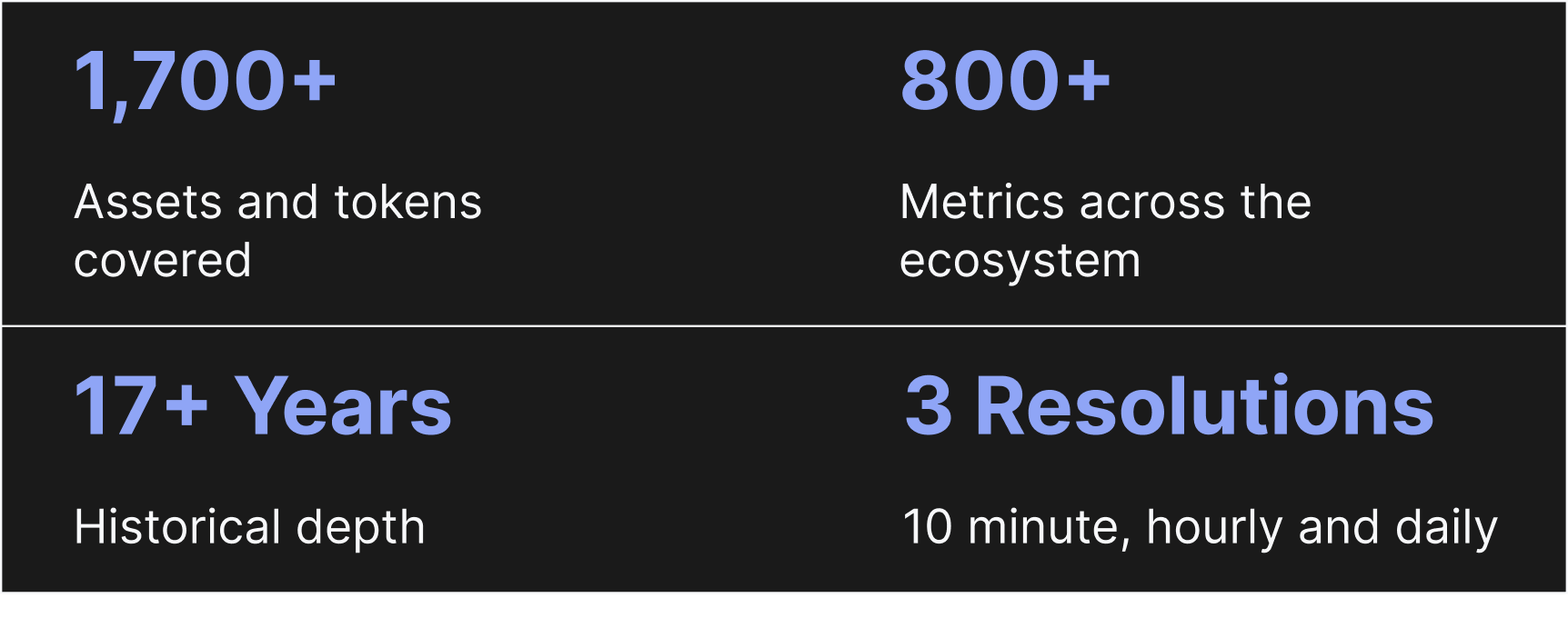
Multiple Resolutions | 10-minute, hourly, and daily granularity for everything from intraday signals to long-horizon macro research.
Built For The Workflows You Run
Quantitative & Systematic Trading | Query the full depth of on-chain, derivatives, and market data in SQL alongside your proprietary signals. PiT variants for backtesting fidelity. Sub-hourly resolution for intraday signals. No rate limits, no pagination.
Risk & Portfolio Construction | A unified view of exchange concentration, leverage dynamics, ETF flows, and supply overhangs. Native Snowflake delivery means direct integration with existing risk dashboards.
Multi-Strategy & Macro Research | Join Glassnode data with equity, fixed income, and macro datasets already in your warehouse. Same query layer, no middleware.
Fund Operations & Compliance | No bespoke pipelines means less operational risk. Snowflake's access controls and audit logging handle governance out of the box. Point-in-time timestamps provide data lineage for regulatory requirements and internal governance.
Eliminate Look-Ahead Bias from Backtests
For quantitative teams, historical data integrity is non-negotiable. Backtesting on retroactively revised data isn't backtesting. It's overfitting.
Glassnode is the first to offer point-in-time (PiT) blockchain data in Snowflake. PiT metrics are append-only and historically immutable. Each data point reflects exactly what was known when it was computed. No retroactive corrections, no look-ahead bias.
This matters because on-chain data is inherently mutable. Clustering improvements, late-reported exchange data, and refined labeling can all trigger revisions to standard metrics. PiT variants freeze the record, so your backtests reflect the information that was actually available to participants at each point in time. Every PiT data point includes a computed_at timestamp for full auditability.
Getting Started
Whether you're building backtested systematic models, integrating crypto into a cross-asset framework, or standing up institutional-grade risk infrastructure, Glassnode on Snowflake is the fastest path from blockchain data to production.
To request a trial or to learn more about Glassnode Data Shares, reach out to our institutional team at sales@glassnode.com.
The setup for Glassnode on Snowflake
- Retrieve your Snowflake account identifier via Snowflake's standard process or a simple SQL query.
- Share it with the Glassnode team. We provision access through Snowflake Marketplace private listings.
- Accept the listing. After initial replication, the data is live in your warehouse.
Data shares are organized by package (on-chain, market, signals, common, metadata), so you subscribe to what you need. Updates flow automatically.
Alternatively, you can initiate a trial via the Snowflake listing.
Glassnode Delivers the Analytical Depth That Drives Alpha
Coverage alone doesn't differentiate. What sets us apart is analytical depth built over nearly a decade of institutional-grade data engineering.
Proprietary entity adjustment | Our clustering technology identifies real-world entities (exchanges, institutions, long-term holders, miners) rather than raw addresses. Noisy blockchain data becomes actionable intelligence.
Full-stack derivatives | On-chain, futures, options, and spot from a single provider with unified methodology and consistent quality.
Expanding coverage | New chains, instruments, and products get added continuously. Your Snowflake environment reflects every update automatically.
* Default historical data during the trial is limited to 14 days and 1h/24h resolutions - contact sales@glassnode.com to request a trial with higher resolution and extended history.
- Follow us on X for timely market updates and analysis
- Join our Telegram channel for regular market insights
- For on-chain metrics, dashboards, and alerts, visit Glassnode Studio