Original Author: Sanqing, Foresight News
On February 2, Hyperliquid announced that the HIP-4 proposal had gone live on the testnet on February 2. This proposal aims to build a prediction market infrastructure by introducing "Outcome Trading." Additionally, from late January to early February 2026, the cryptocurrency market showed weakness, with Bitcoin's price falling below the $75,000 mark, leading to a broad market correction. However, Hyperliquid's native token HYPE bucked the trend, rising over 40% in the past week.
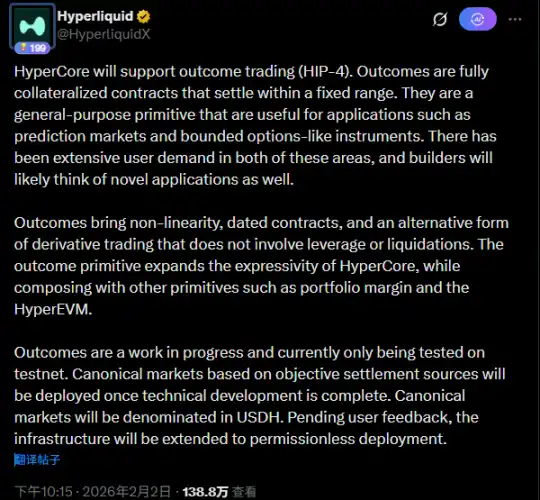
Image Source: Hyperliquid Tweet
However, as Hyperliquid expands its business, it has encountered allegations of technological infringement from a peer. On February 2, Sky Guo, founder of the RWA public chain project Cypherium, publicly accused Hyperliquid of infringing on its patented technology on social media. Sky Guo claimed that Hyperliquid's underlying consensus engine, HyperCore, uses a patented optimized version of the PoS-based HotStuff algorithm and demanded that Hyperliquid cease the infringement.
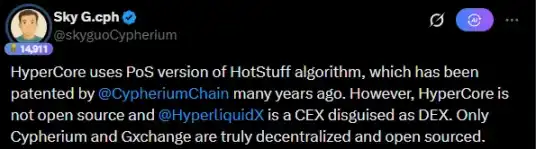
Image Source: Sky Guo Tweet
Core Dispute: The Technical Boundaries of Patent US 11,411,721 B2
The core of this dispute revolves around a formal patent issued by the United States Patent and Trademark Office (USPTO) on August 9, 2022, with the number US 11,411,721 B2. The assignee of this patent is Cypherium Blockchain Inc., and its title is "Systems and methods for selecting and utilizing a committee of validator nodes in a distributed system."
The patent details a mechanism for dynamically selecting and reconfiguring a validator committee, supporting node election through PoW, PoS, or PoA, and emphasizes the use of Aggregate Signatures to enhance consensus efficiency and fault tolerance. The patent also proposes specific implementation paths such as Two-phase Reconfiguration and Tree-structured Hierarchy.
Cypherium believes that these technologies are key to implementing HotStuff in large-scale, high-performance networks (such as Hyperliquid's 200,000 TPS), and this constitutes the core barrier of the patent rights.
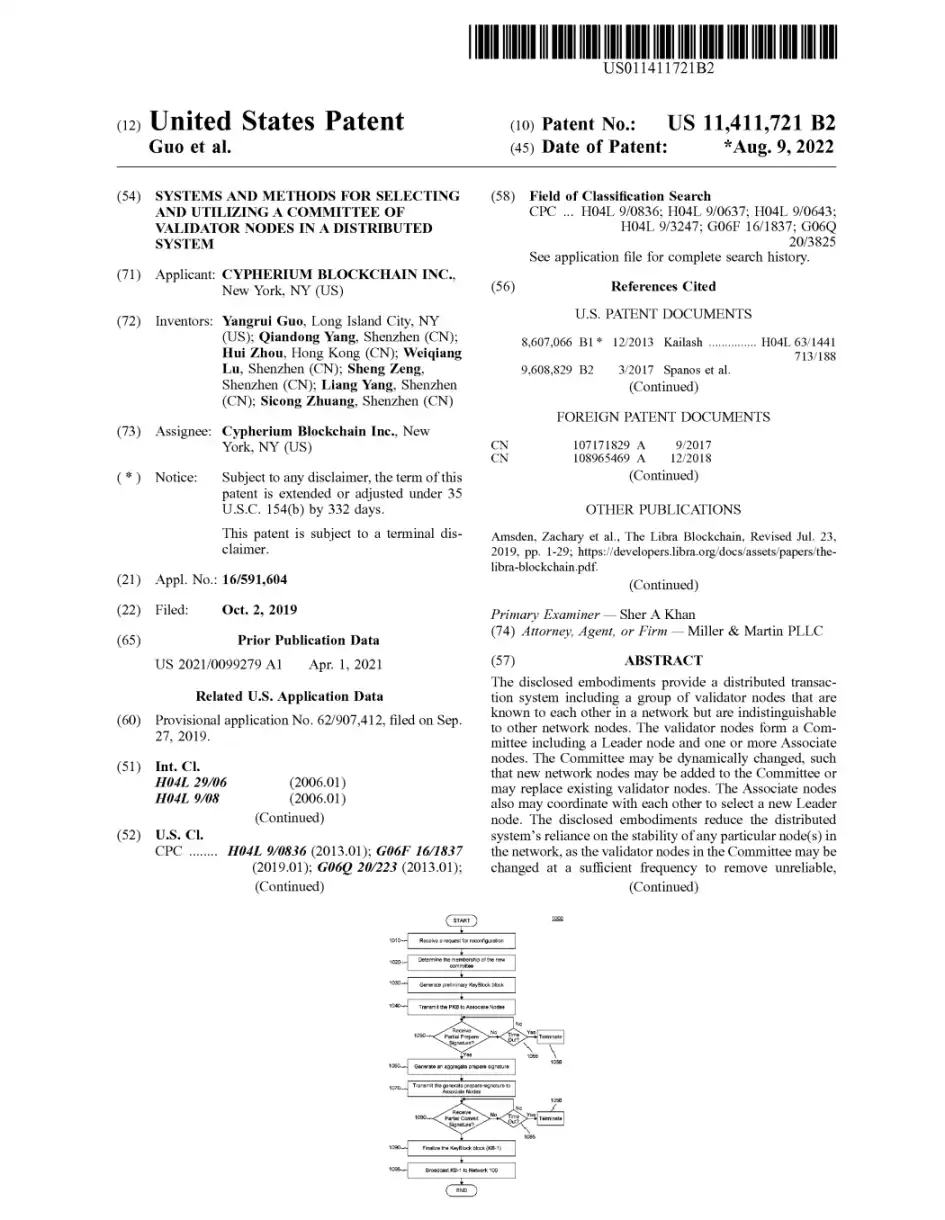
First Page of Cypherium Patent US 11,411,721 B2 | Image Source: Google Patents
The technical dispute centers on both parties' improvements and applications of the consensus algorithm HotStuff, but HotStuff itself is an open-source consensus protocol published in academia between 2018 and 2019.
Cypherium's CypherBFT combines HotStuff with PoW to achieve permissionless operation, while Hyperliquid's HyperBFT is a custom variant optimized for low-latency transactions.
However, Cypherium claims that its patent covers specific enhancement logic for HotStuff in a PoS environment. Hyperliquid has not yet responded regarding whether HyperBFT uses the unique claims covered by the patent.
Escalation of Accusations: From Questioning Transparency to Alleging Infringement
Prior to this infringement allegation, Sky Guo's criticism of Hyperliquid primarily focused on code transparency.

Image Source: Sky Guo Tweet
This lack of transparency, on one hand, protects Hyperliquid's commercial advantage in high-concurrency processing; on the other hand, it makes it difficult for the project to prove its innocence through public audits when facing external technical质疑 (questioning/doubt).
Sky Guo believes that it is precisely because HyperCore borrowed the dynamic committee selection logic described in his patent that it achieved its sub-second finality.
Sky Guo claims to have sent a legal letter to the Hyperliquid team and relevant responsible persons, accusing them of using the patented technology without permission. He stated that the Hyperliquid side is currently avoiding the issue and has not responded to the legal correspondence.
Solid Evidence or Ambush Marketing?
From a superficial legal and technical logic perspective, the US patent US 11,411,721 B2 held by Cypherium is indeed a formally issued legal document. Its scope of protection确实涵盖 (does indeed cover) key aspects of consensus mechanisms such as dynamic committee selection, signature aggregation, and two-phase reconfiguration.
According to Hyperliquid's publicly available technical documentation, the underlying HyperCore engine确实运行 (does indeed run) on a custom variant of the HotStuff algorithm called HyperBFT. HotStuff is precisely the technology改良对象 (improvement target) heavily involved in the claims of this patent.
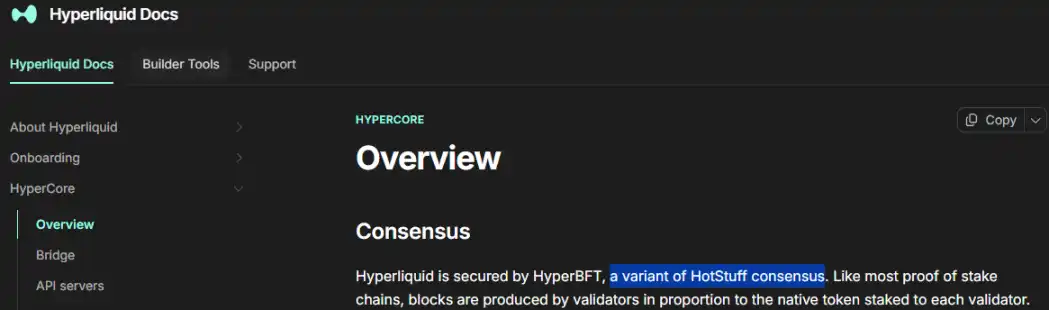
Image Source:Hyperliquid Docs
Furthermore, since Hyperliquid's core codebase is currently closed-source, this black-box属性 (attribute) makes it difficult for the outside world to determine whether its specific implementation path avoids the relevant patent through public code audits.
However, in reality, HotStuff and its variants are hardly new in the high-performance Layer 1 race. From Meta's (formerly Facebook) aborted Libra/Diem, to the currently prominent Aptos (AptosBFT), Monad (MonadBFT), and even early research iterations of Sui's core consensus, all have been significantly influenced by HotStuff's linear communication complexity and responsive design.
Additionally, the timing and context of the accusation are thought-provoking. Sky Guo published the infringement allegation at 12:00 on February 3, coinciding with strong market performance of the HYPE token and the热度 (heat/buzz) surrounding the HIP-4 proposal for the prediction market.
On social platforms, some KOLs expressed support for this rights protection action, but the comment sections of related posts featured疑似推广内容 (suspected promotional content) about "G-Exchange." "G-Exchange" is an upcoming new project within the Cypherium ecosystem. The coincidence in the timeline between this technical accusation and the预热 (pre-launch warm-up) of a new project makes this series of维权动作 (rights protection actions)疑似 (suspected of being) ambush marketing to generate buzz for the new business.
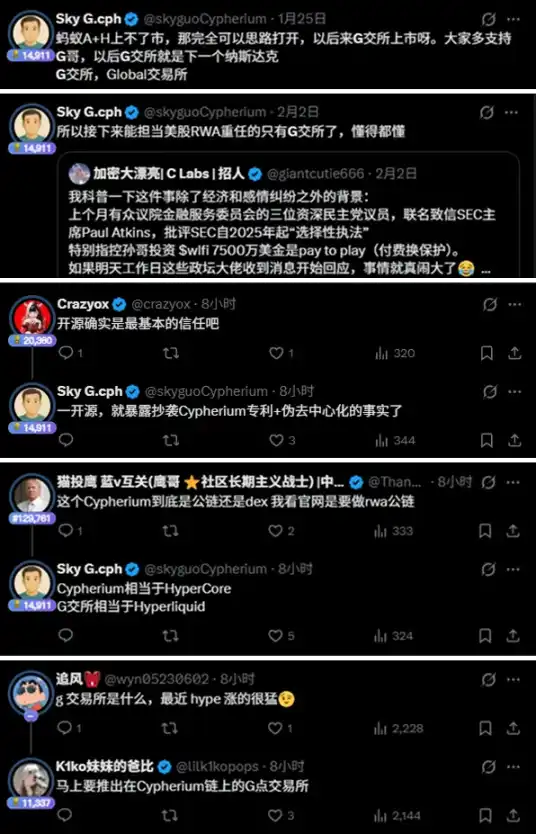
Image Source: Sky Guo and other X account tweets
Whether the accusation is a "real hammer" (solid evidence) or "ambush marketing," Hyperliquid seems to have reached a crossroads. As its business expands, community calls for increased transparency are growing. Faced with infringement质疑 (doubts/questions), will Hyperliquid insist on its black-box advantage, or will it prove its innocence through partial open-sourcing or third-party audits? This concerns the trust foundation of its decentralization narrative.
Note: 9.92 million HYPE tokens are scheduled to be unlocked on February 6, accounting for 2.79% of the circulating supply, with a value of approximately $357 million (based on a price of $36).