Aptos introduces post-quantum signatures before they’re urgently needed

cointelegraphPublished on 2025-12-18Last updated on 2025-12-18

Abstract

Aptos is advancing a proposal to introduce post-quantum digital signatures as an optional security upgrade, addressing growing concerns that future quantum computers could eventually break current cryptographic systems. The Aptos Improvement Proposal AIP-137 would integrate the SLH-DSA (FIPS 205) signature scheme at the account level, making Aptos one of the first major blockchains to natively support quantum-resistant accounts. Existing accounts would remain unchanged, and adoption would be opt-in. This move reflects broader industry attention to quantum risks, with other networks like Solana also testing quantum-resistant solutions. While some in the crypto space, including Bitcoin pioneers, view the quantum threat as distant or overhyped, Aptos and others are taking proactive steps to prepare for a post-quantum era.

Blockchain network Aptos is moving toward a post-quantum signature option, reflecting growing concern that advances in quantum computing are no longer purely theoretical and could eventually affect how blockchain networks secure accounts and transactions.

On Thursday, Aptos outlined a proposal to introduce post-quantum signatures, addressing the network’s reliance on digital signatures for ownership, transaction authorization and overall security.

While existing cryptographic schemes remain secure against classical computers, researchers warn that sufficiently powerful quantum machines could one day forge them, potentially compromising account security retroactively.

“Quantum computing is not a distant spectre anymore,” Aptos Labs wrote in a post on X, pointing to early discussions around quantum scaling by IBM and growing regulatory momentum, including the publication of post-quantum cryptography standards by the US National Institute of Standards and Technology (NIST).

“This matters for networks like Aptos because Cryptographically Relevant Quantum Computers (CRQCs) can make today’s signature schemes forgeable, possibly breaking security models,” the post said.

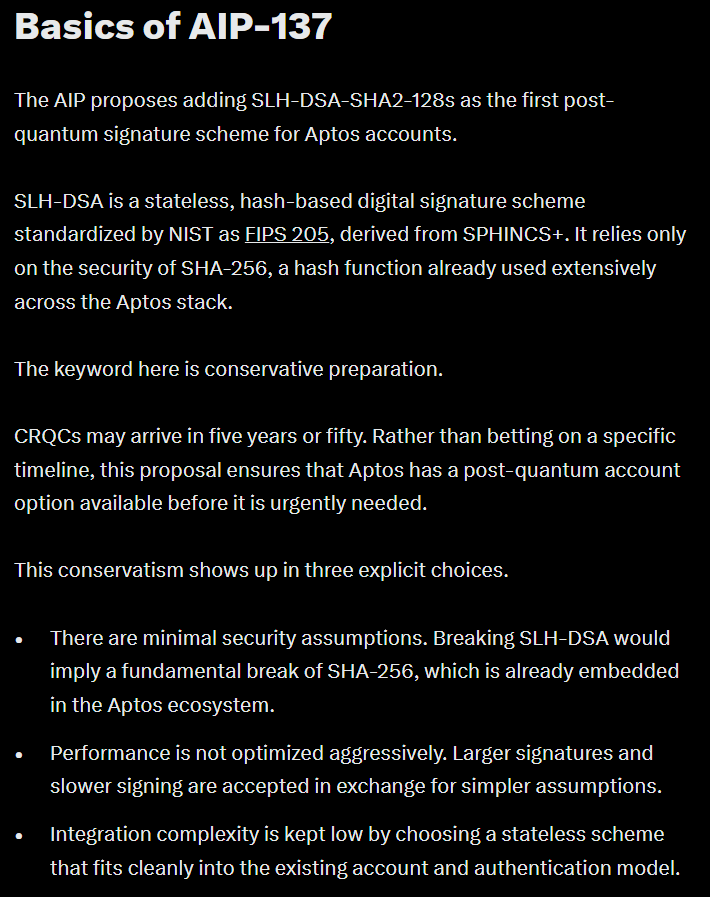
In response, developers have proposed AIP-137, an Aptos Improvement Proposal authored by cryptographers at Aptos Labs, which would add support for a post-quantum signature scheme at the account level.
Source: Aptos Labs

If approved through governance, AIP-137 would introduce SLH-DSA, a hash-based digital signature scheme standardized as FIPS 205, as an optional account signature type. The change would make Aptos one of the earliest production blockchains to natively support post-quantum accounts.

However, existing accounts would remain unaffected. Post-quantum accounts would be opt-in only, allowing users to adopt selectively.

Aptos is one of the larger layer-1 proof-of-stake blockchains, designed primarily to support decentralized applications. Earlier this year, its head of ecosystem, Ash Pampati, told Cointelegraph that consumer-focused applications were gaining traction on the network, particularly those blending elements of Web2 and Web3.

As Cointelegraph previously reported, Aptos has also emerged as a venue for tokenized real-world assets, with asset managers including Franklin Templeton and BlackRock deploying products on the network.

Related: Google announces quantum advantage, 13,000 times faster than supercomputers

The race against quantum

While many in the crypto industry argue that quantum threats to blockchains, particularly Bitcoin, remain years away, networks are increasingly taking preparatory steps, with Aptos far from alone in doing so.

Earlier this month, Solana tested quantum-resistant transactions on a dedicated testnet, an experiment aimed at evaluating how post-quantum signature schemes could be integrated into its transaction model without disrupting existing accounts.

Within the Bitcoin community, a smaller but vocal group of developers, researchers and fund managers has also begun pushing for faster progress on quantum-resistant cryptography.

Some have rallied around BIP-360, a proposed Bitcoin Improvement Proposal that would introduce quantum-resistant signature options. However, the idea remains in its early stages and is subject to debate.
Source: Adam Back

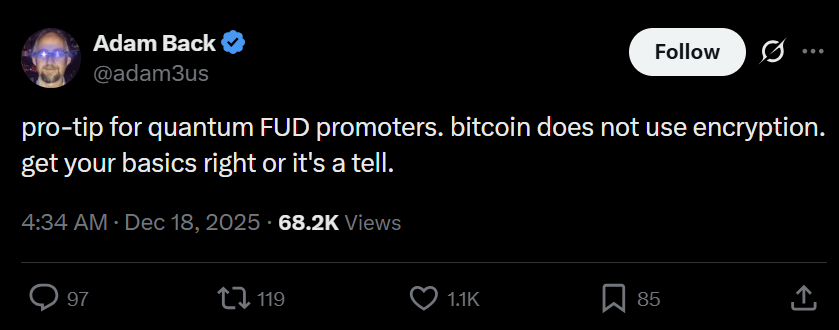
Others, including early Bitcoin figure Adam Back, have dismissed near-term quantum concerns as a form of fear, uncertainty and doubt, or FUD, arguing that Bitcoin does not rely on encryption for its core security model. Instead, Bitcoin uses digital signature schemes and cryptographic hash functions, which are not imminently threatened by practical quantum computers.

Related: Are quantum computers stealing Bitcoin? Inside Josh Mandell’s claim and the pushback


Related Questions

QWhat is the main reason Aptos is introducing post-quantum signatures?

AAptos is introducing post-quantum signatures due to growing concern that advances in quantum computing could eventually compromise the network's security by making today's digital signature schemes forgeable.

QWhat specific proposal has Aptos Labs put forward for post-quantum signatures?

AAptos Labs has proposed AIP-137, which would add support for the SLH-DSA (FIPS 205) hash-based digital signature scheme as an optional account signature type.

QWill existing Aptos accounts be automatically upgraded to post-quantum security?

ANo, existing accounts will remain unaffected. The post-quantum account option will be opt-in only, allowing users to adopt it selectively.

QBesides Aptos, which other blockchain network has recently tested quantum-resistant technology?

ASolana tested quantum-resistant transactions on a dedicated testnet earlier this month to evaluate integration of post-quantum signature schemes.

QWhat is the name of the proposed Bitcoin Improvement Proposal for quantum resistance mentioned in the article?

AThe proposed Bitcoin Improvement Proposal for quantum-resistant signature options is BIP-360.

Related Reads

Trading

Spot
Futures

Hot Articles

HTX Learn: Learn Hot Cryptos to Share 20,000 USDT​

To enhance your understanding of this week's featured cryptos, we are rolling out various rewarding events. Join them now and bring home generous rewards through learning and trading.

26.9k Total ViewsPublished 2026.03.31Updated 2026.03.31

HTX Learn: Learn Hot Cryptos to Share 20,000 USDT​

How to Buy EDGE

Welcome to HTX.com! We've made purchasing edgeX (EDGE) simple and convenient. Follow our step-by-step guide to embark on your crypto journey.Step 1: Create Your HTX AccountUse your email or phone number to sign up for a free account on HTX. Experience a hassle-free registration journey and unlock all features.Get My AccountStep 2: Go to Buy Crypto and Choose Your Payment MethodCredit/Debit Card: Use your Visa or Mastercard to buy edgeX (EDGE) instantly.Balance: Use funds from your HTX account balance to trade seamlessly.Third Parties: We've added popular payment methods such as Google Pay and Apple Pay to enhance convenience.P2P: Trade directly with other users on HTX.Over-the-Counter (OTC): We offer tailor-made services and competitive exchange rates for traders.Step 3: Store Your edgeX (EDGE)After purchasing your edgeX (EDGE), store it in your HTX account. Alternatively, you can send it elsewhere via blockchain transfer or use it to trade other cryptocurrencies.Step 4: Trade edgeX (EDGE)Easily trade edgeX (EDGE) on HTX's spot market. Simply access your account, select your trading pair, execute your trades, and monitor in real-time. We offer a user-friendly experience for both beginners and seasoned traders.

1.6k Total ViewsPublished 2026.03.31Updated 2026.04.08

How to Buy EDGE

What Are U.S. Stock Futures?

U.S. stock futures refer to tokenized U.S. stock perpetual futures listed on cryptocurrency exchanges (e.g., HTX).

25.3k Total ViewsPublished 2026.04.08Updated 2026.04.08

What Are U.S. Stock Futures?

Discussions

Welcome to the HTX Community. Here, you can stay informed about the latest platform developments and gain access to professional market insights. Users' opinions on the price of A (A) are presented below.

活动图片