Zcash – All about a potential ZEC breakout after $10M inflows, whales lead the charge

ambcryptoPublished on 2026-04-01Last updated on 2026-04-01

Abstract

Zcash (ZEC) is approaching a critical technical juncture, testing a wedge resistance level after a strong three-day bullish run that began from the $212 demand zone. This price compression suggests a potential breakout is imminent. A daily close above the $233 resistance could confirm the breakout and attract momentum traders. On-chain data indicates significant whale accumulation in both spot and futures markets, alongside over $10 million in net inflows within 48 hours, signaling strong institutional interest and growing confidence. If the breakout succeeds, ZEC could enter an expansion phase targeting the next resistance around $289. However, failure to break above the wedge may lead to extended consolidation.

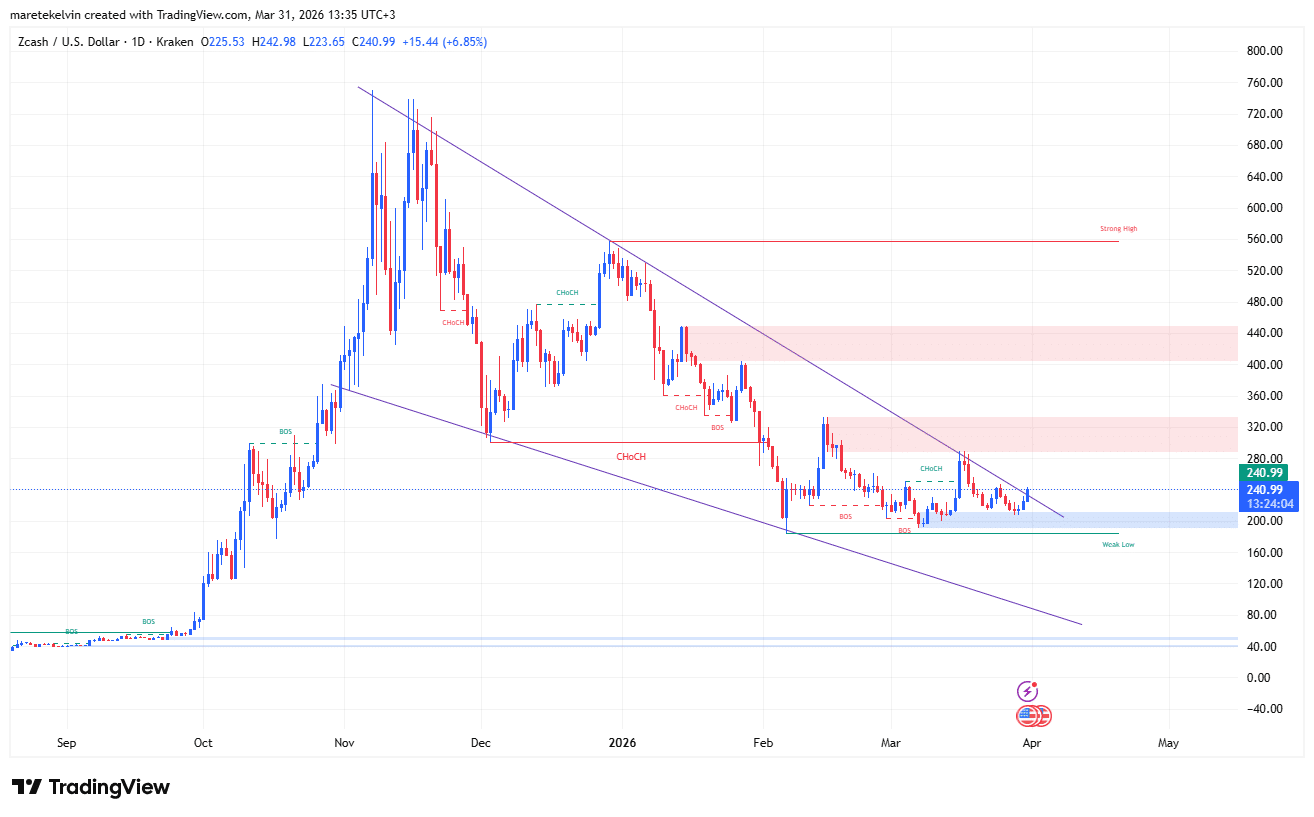
Zcash (ZEC), at the time of writing, seemed to be approaching a key technical moment on the charts. After three days of a strong bullish run, the token’s price was pressing against a wedge of resistance.

The structure has tightened lately and hence, a breakout may soon be close.

Demand zone sparks strong recovery

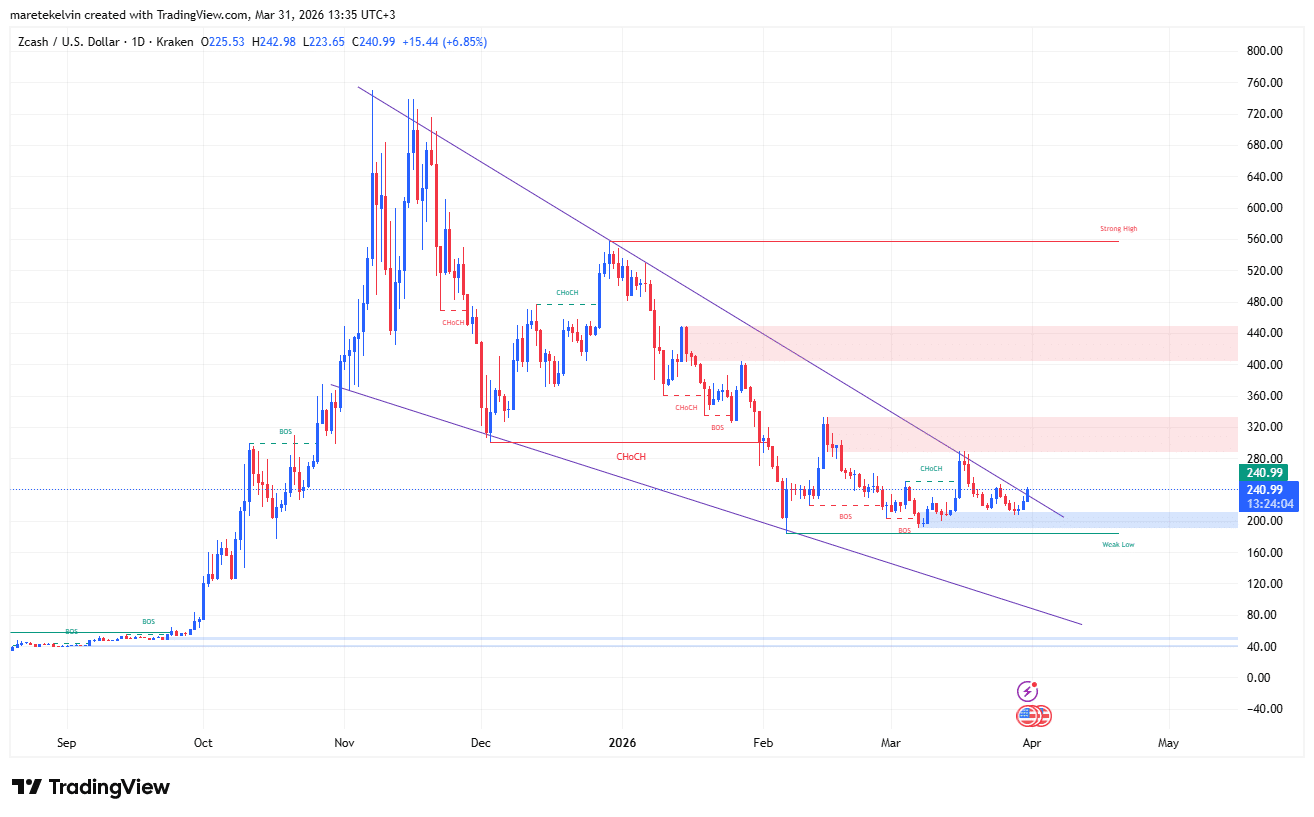
The recent bullish move began at the $212 demand zone. Buyers stepped in aggressively at that key level of demand and initiated the explosive move.
Source: TradingView

Since then, ZEC has printed consecutive bullish sessions. Momentum clearly shifted too. This kind of reaction often marks the start of a larger move.

Wedge resistance now in focus

At press time, ZEC was trading at the edge of a wedge consolidation pattern. In fact, price compression has been building for days too.

A daily close above this resistance would be significant. This could confirm a successful breakout and likely attract momentum traders and investor as a result.

Until then, however, the level remains a key barrier to protect current buyers and long-term holders who are holding long positions.

ZEC whales are making moves following significant spot inflows

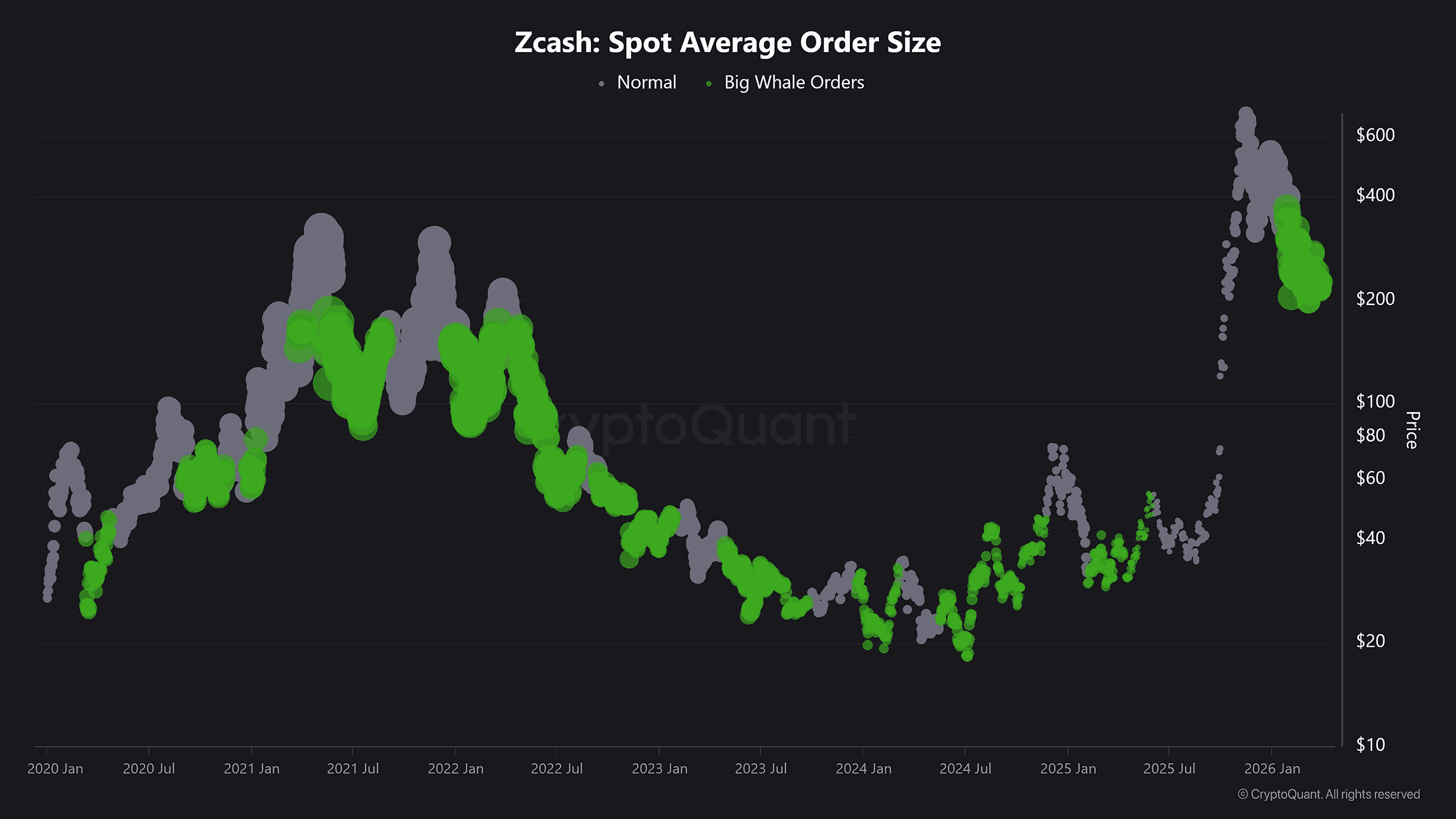
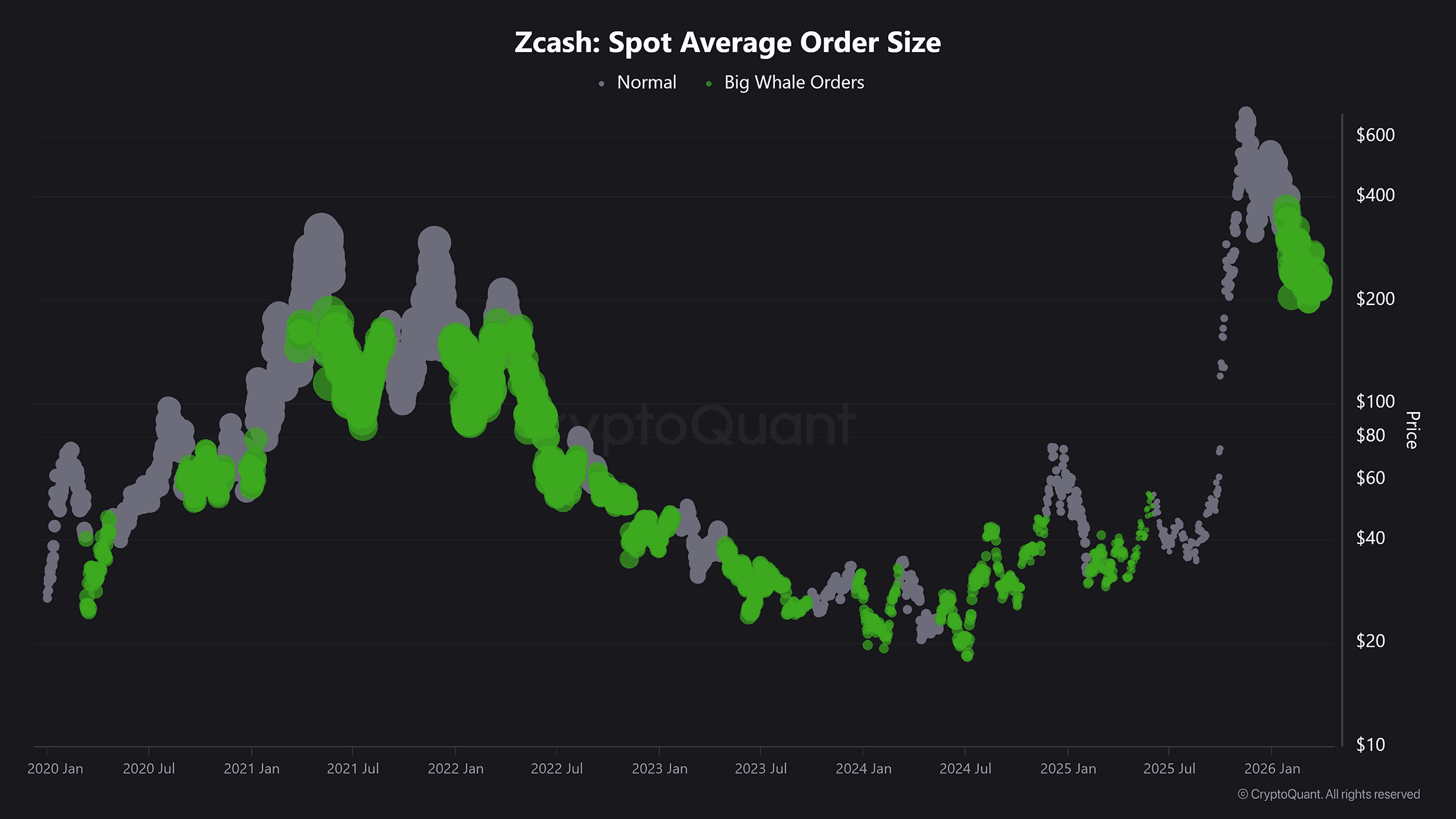
On-chain data lent more weight to ZEC’s bullish structure. Whales have been actively accumulating across both Spot and Futures markets. This pointed to strategic accumulation more than anything, especially given that the development seemed to align with the altcoin’s price.

If the accumulation spree sustains itself, the altcoin’s bullish move could be amplified further to initiate the anticipated breakout.
Source: CryptoQuant

That’s not all either as ZEC also recorded over $10 million in net inflows within 48 hours.

This is a sign of growing confidence. Not just retail interest, but larger players may be positioning early too.
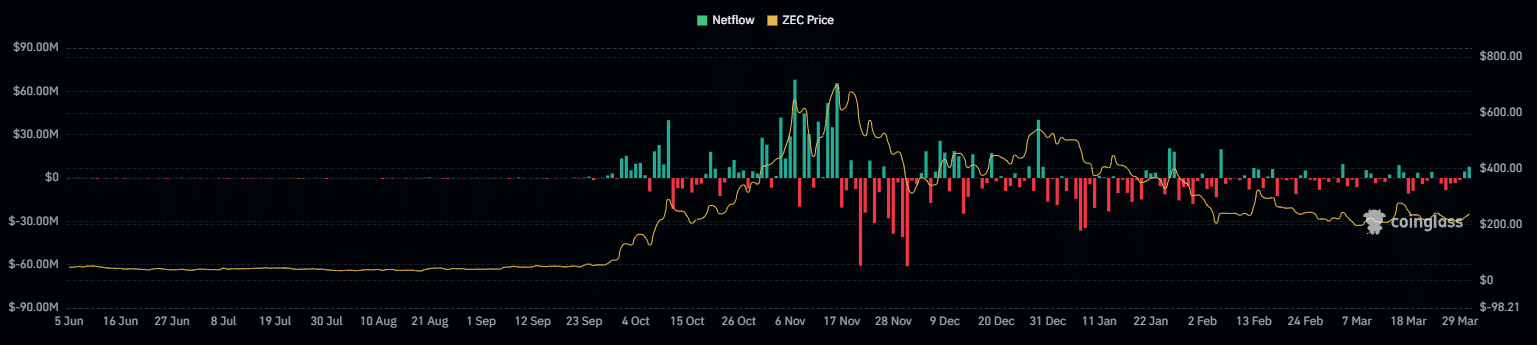
Source: Coinglass

What’s next for ZEC?

The setup is clear.

If bulls secure a breakout above the wedge at around $233, ZEC could enter an expansion phase to surge towards the next resistance around $289. Strong inflows and whale backing would support that move.

However, failure to break resistance could extend its consolidation.

Momentum might be favouring the upside at press time. However, confirmation is still needed.


Final Summary

  • ZEC has been testing a wedge resistance after a strong three-day bullish run.

  • Whale accumulation and $10M inflows could support a potential breakout.

Related Questions

QWhat key technical pattern was Zcash (ZEC) approaching at the time of writing?

AZEC was approaching a wedge resistance pattern on the charts after a strong three-day bullish run.

QWhere did the recent bullish move for ZEC begin, indicating a strong demand zone?

AThe recent bullish move began at the $212 demand zone, where buyers stepped in aggressively.

QHow much in net inflows did ZEC record within 48 hours, and what does it signify?

AZEC recorded over $10 million in net inflows within 48 hours, signaling growing confidence and potential early positioning by larger players.

QWhat could a daily close above the wedge resistance level confirm for ZEC?

AA daily close above the wedge resistance would confirm a successful breakout, likely attracting momentum traders and investors.

QWhat is the next key resistance level for ZEC if it breaks out of the wedge pattern?

AIf ZEC breaks above the wedge resistance at approximately $233, it could surge towards the next resistance level around $289.

Related Reads

Raising Interest Rates Is Not a Tech Killer, EPS Is: A Strategy for Discarding the Weak and Retaining the Strong After the AI Theme's Sharp Decline

**Summary: Rising Interest Rates Are Not the Killer of Tech; EPS Is: The "Keep the Strong, Ditch the Weak" Strategy After the AI Theme Plunge** The author argues that the sharp sell-off in tech and AI-related stocks, triggered by a strong US jobs report that heightened Fed rate hike fears, represents a "pullback to pick up passengers" rather than a "car crash." The true end of a tech bull market is not determined by an extra 25 basis point hike, but by industry overcapacity and the disproval of earnings per share (EPS) expectations. Historical analysis shows that during past rate hike cycles, the Nasdaq-100 often outperformed, provided EPS growth remained strong. The current phase is seen as a shift from a "broad narrative-driven rally" to a "focused verification stage" for AI. The investment strategy should be to "keep the strong, ditch the weak." * **Retain exposure** to high-conviction AI infrastructure leaders with clear order visibility, stable margins, strong cash flow, and upward EPS revisions (e.g., AI servers, advanced packaging, optical modules, key cloud suppliers). * **Reduce exposure** to high-beta, narrative-driven stocks with unclear profit paths (e.g., some quantum computing, space, or speculative chip stocks), especially on rebounds. Valuation concerns should focus on whether earnings can catch up to high multiples, not on high P/E alone. Crowded positioning signals a concentration into quality assets, not necessarily a market top. The upcoming Q2 earnings season will be a key validation point. The core principle is to hold stocks with proven EPS, while using macro events (CPI data, central bank meetings) to manage timing and risk.

marsbit34m ago

Raising Interest Rates Is Not a Tech Killer, EPS Is: A Strategy for Discarding the Weak and Retaining the Strong After the AI Theme's Sharp Decline

marsbit34m ago

The Largest IPO in History Ignites Heated Debate: Is SpaceX Worth $1.77 Trillion?

SpaceX's potential IPO is priced at $135 per share, aiming to raise $75 billion and valuing the company at approximately $1.77 trillion, which would make it the largest IPO in history. This valuation has sparked intense debate among investors. Bullish analysts, including major underwriters Goldman Sachs and Morgan Stanley, argue the valuation is justified by SpaceX's long-term potential. They see it not just as a rocket company but as a future leader in space infrastructure, with key growth drivers being Starlink satellite internet, low-cost rocket launches, and future AI-related ventures. They project revenues reaching hundreds of billions to trillions of dollars by 2030-2040. ARK Invest's model suggests a 2030 enterprise value could reach $2.5 trillion. Bearish analysts from independent research firms like Morningstar, PitchBook, and New Constructs contend the IPO price is excessively high, already pricing in unrealistic future growth. Using DCF and sum-of-the-parts models, they estimate fair value between $780 billion and $1.7 trillion, significantly below the IPO target. They highlight risks such as the speculative nature of AI projections, over-dependence on Elon Musk, high growth expectations, and corporate governance concerns. Trefis set a target price of just $79 per share. While both sides acknowledge SpaceX's unique position in commercial space, the core disagreement centers on whether the $135 share price offers a reasonable margin of safety or is overly optimistic. Despite the valuation controversy, reported strong demand for the IPO indicates significant market interest.

marsbit2h ago

The Largest IPO in History Ignites Heated Debate: Is SpaceX Worth $1.77 Trillion?

marsbit2h ago

After the Passage of the GENIUS Act and the CLARITY Act, What Is the Correct Architecture for On-Chain Yield?

The article discusses the evolution of on-chain credit, distinguishing three markets: overcollateralized crypto lending, unsecured lending (largely unsuccessful), and asset-backed credit (ABC). ABC, backed by identifiable real-world collateral with legal recourse, is identified as the fastest-growing category and the only one credibly addressing adverse selection—the core problem in credit where the riskiest borrowers self-select. Current growth in on-chain Real World Assets (RWAs), particularly tokenized private credit funds (e.g., Maple Finance, Centrifuge), is substantial but often merely "wraps" existing fund structures, inheriting their risks rather than solving adverse selection at the protocol level. The regulatory landscape is a key driver, with the US GENIUS Act (prohibiting stablecoin issuers from paying yield) and the proposed CLARITY Act (closing loopholes on indirect yield) set to redefine permissible yield-bearing products. This makes vaults (like ERC-4626) the critical architecture—they become the primary compliant vehicle for delivering yield, functioning as issuance, disclosure, distribution, and recovery mechanisms. The author's thesis is that the correct post-GENIUS/CLARITY architecture involves building ABC solutions where credit assessment, structure, and recovery are encoded directly into the smart contract vault layer, moving beyond mere tokenized fund wrappers to solve adverse selection fundamentally and ensure regulatory compliance.

Foresight News3h ago

After the Passage of the GENIUS Act and the CLARITY Act, What Is the Correct Architecture for On-Chain Yield?

Foresight News3h ago

Trading

Spot
Futures

Hot Articles

How to Buy ZEC

Welcome to HTX.com! We've made purchasing Zcash (ZEC) simple and convenient. Follow our step-by-step guide to embark on your crypto journey.Step 1: Create Your HTX AccountUse your email or phone number to sign up for a free account on HTX. Experience a hassle-free registration journey and unlock all features.Get My AccountStep 2: Go to Buy Crypto and Choose Your Payment MethodCredit/Debit Card: Use your Visa or Mastercard to buy Zcash (ZEC) instantly.Balance: Use funds from your HTX account balance to trade seamlessly.Third Parties: We've added popular payment methods such as Google Pay and Apple Pay to enhance convenience.P2P: Trade directly with other users on HTX.Over-the-Counter (OTC): We offer tailor-made services and competitive exchange rates for traders.Step 3: Store Your Zcash (ZEC)After purchasing your Zcash (ZEC), store it in your HTX account. Alternatively, you can send it elsewhere via blockchain transfer or use it to trade other cryptocurrencies.Step 4: Trade Zcash (ZEC)Easily trade Zcash (ZEC) on HTX's spot market. Simply access your account, select your trading pair, execute your trades, and monitor in real-time. We offer a user-friendly experience for both beginners and seasoned traders.

3.3k Total ViewsPublished 2024.03.29Updated 2026.06.02

How to Buy ZEC

Discussions

Welcome to the HTX Community. Here, you can stay informed about the latest platform developments and gain access to professional market insights. Users' opinions on the price of ZEC (ZEC) are presented below.

活动图片













