XRP Spot ETFs Riding The Bullish Wave, Attracting Broader Wall Street Allocation

bitcoinistPublished on 2026-02-13Last updated on 2026-02-13

Abstract

Despite a volatile and bearish broader cryptocurrency market, Spot XRP ETFs continue to demonstrate strong performance, attracting significant capital from both retail and institutional investors. Data shows consistent inflows into these regulated products since January 27, with Canary Capital, Franklin Templeton, Bitwise, and 21Shares collectively accumulating over 48.7 million XRP in a nine-day period. This trend reflects growing institutional confidence in gaining exposure to XRP without direct custodial risks. Notably, Goldman Sachs has invested over $152 million in XRP Spot ETFs, as revealed in its Q4 2025 filing, signaling deeper Wall Street involvement and a new phase of integration with traditional finance.

Even with the broader cryptocurrency market becoming highly volatile and bearish, the Spot XRP ETFs are still displaying remarkable performance. In the unfavorable conditions, capital from both retail and institutional investors continues to flow into the funds, and they are drawing the attention of Wall Street.

Institutional Capital Still Following Into XRP Spot ETFs

XRP may be experiencing steady downside action in price, but the Spot XRP Exchange-Traded Funds (ETFs) are still riding the broader bullish wave, drawing in huge capital. Interestingly, as they continue to gain momentum across the sector, traditional finance is paying close attention to the newly launched products.

In a post on the X platform, market researcher and investor Tokenicer highlighted that the funds have been recording inflows over the past few days despite the ongoing volatile crypto landscape. Specifically, this fund has been seeing steady capital inflows since January 27.

The consistent flow of funds into these regulated instruments demonstrates the rising conviction of traditional and institutional market players looking to gain exposure to XRP without taking on direct custodial risks. In contrast to transient speculative surges, persistent inflows usually signify more profound strategic allocation choices.
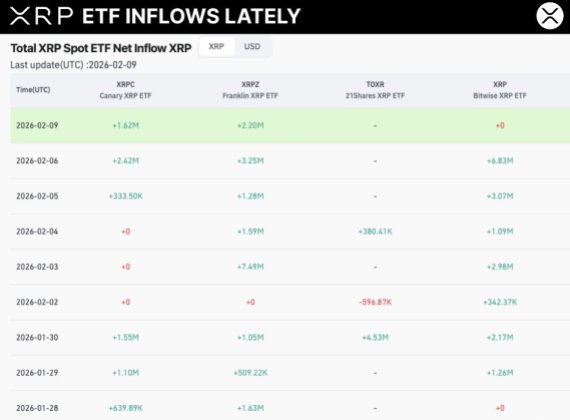
Source: Chart from Tokenicer on X

Since January 27, Canary Capital has recorded inflows of over 7.66 million XRP, Franklin Templeton has amassed over 18.9 million, Bitwise added more than 17.74 million, and 21Shares saw inflows of +4.31 million of the token. As seen on the chart shared by the expert, there has been a total of 48.7 million XRP across 4 ETFs in a 9-day period.

According to the expert, all of these inflows are taking place in a market that is laced by downside pressure. This period is where most of the retail interest in crypto has been sucked out, bringing the market back to the point where players are making fun of crypto again. “Now just imagine what these numbers look like during a euphoria run as we saw in Nov 2024,” Tokenicer added.

Goldman Sachs Expands ETF Exposure

The recent capital flows indicate that rather than buying tokens directly, Wall Street investors are growing more at ease exposing themselves to XRP through regulated investment vehicles. An indication of this trend is Goldman Sachs’s significant investment in the funds and the token.

Xaif Crypto, an investor and crypto analyst, reported that Goldman Sachs has invested over $152 million in XRP Spot ETFs. This was disclosed in the firm’s Q4 2025 13F filing. With this substantial amount invested in the funds, Wall Street is no longer just watching the altcoin; instead, it is allocating its capital into the token.

Such a move marks a notable step for institutional adoption of the altcoin within regulated markets. As inflows increase and liquidity deepens, its increasing position in mainstream portfolios may signal a new stage in its integration with conventional financial markets.

XRP trading at $1.37 on the 1D chart | Source: XRPUSDT on Tradingview.com

Related Questions

QDespite the bearish crypto market, what is the current performance trend of Spot XRP ETFs?

ASpot XRP ETFs are displaying remarkable performance and continue to attract capital inflows from both retail and institutional investors, riding the broader bullish wave.

QAccording to the article, which specific financial institution has invested over $152 million in XRP Spot ETFs as per its Q4 2025 filing?

AGoldman Sachs has invested over $152 million in XRP Spot ETFs, as disclosed in the firm's Q4 2025 13F filing.

QWhat total amount of XRP flowed into the 4 mentioned ETFs over the 9-day period starting January 27?

AA total of 48.7 million XRP flowed into the 4 ETFs (Canary Capital, Franklin Templeton, Bitwise, and 21Shares) over the 9-day period.

QHow does the article characterize the significance of persistent inflows into XRP ETFs, as opposed to transient speculative surges?

APersistent inflows into these regulated instruments usually signify more profound strategic allocation choices by traditional and institutional players, rather than transient speculative surges, demonstrating rising conviction.

QWhat does the increasing institutional investment in XRP through ETFs indicate about Wall Street's approach to gaining exposure to the asset?

AIt indicates that Wall Street investors are growing more comfortable gaining exposure to XRP through regulated investment vehicles like ETFs, rather than buying tokens directly, to avoid custodial risks.

Related Reads

Three Frameworks for Ordinary People to Achieve AI Capability Leap: Say Goodbye to the Dilemma of 'Repeating Inputs Every Day'

Summary: This article outlines three frameworks for maximizing AI efficiency, moving beyond basic prompt usage. 1. **Three-Layer Evolution**: Users progress from (1) **Prompt** (one-off instructions, reset each session), to (2) **Project** (context-aware within a specific project), to (3) **Skill** (permanent, auto-applied knowledge). Most users stagnate at the first layer, repeating the same instructions daily with no cumulative improvement. Skills transform the AI from a chat tool into a personalized work system. 2. **Transaction vs. Compound Interest Mindset**: Using prompts is a linear transaction—effort and output are 1:1, and stopping resets progress. Investing time in building Skills is compound interest; a small initial time investment pays continuous dividends, as each Skill permanently elevates the AI's baseline performance. 3. **Thin Harness, Fat Skills**: The system architecture should prioritize thick, well-defined Skills (90% of the value—containing processes, standards, and domain knowledge) and a thin "harness" (the minimal technical environment). Avoid over-engineering the toolchain while neglecting the AI's actual knowledge. Skills are permanent assets that automatically improve with model updates. The key takeaway: Identify tasks you repeat, encode them into Skills (using tools like Claude's Skill Creator), and shift focus from daily prompting to building a compounding, self-improving AI system.

marsbit23m ago

Three Frameworks for Ordinary People to Achieve AI Capability Leap: Say Goodbye to the Dilemma of 'Repeating Inputs Every Day'

marsbit23m ago

Trading

Spot
Futures
活动图片