XRP sinks below $2 despite $1B in ETF inflows: How low can price go?

cointelegraphPublished on 2025-12-15Last updated on 2025-12-15

Abstract

Spot XRP ETFs have attracted nearly $1 billion in inflows over 20 consecutive days, signaling strong institutional interest. Despite this, XRP’s price fell below the key $2 support level, declining over 11% in 10 days. Technical analysis indicates limited support around $1.93, with the next major support at $1.78. A break below that could push prices toward $1.61 or even the 200-week EMA near $1.40. The RSI has hit its lowest since July 2024, suggesting increasing downward momentum.

Spot XRP (XRP) exchange-traded funds have continued to attract investor interest, drawing in almost $1 billion in inflows since their launch. Unfortunately, this didn’t help the bulls hold the price above the psychological $2 support level.

Key takeaways:

  • Spot XRP ETFs saw inflows for 20 consecutive days, totalling $1.2 billion.

  • XRP price extended its downtrend, slipping below a key moving support level.

Spot XRP ETFs add $1 billion in 3 weeks of inflows

US-based spot XRP ETFs have recorded inflows for twenty consecutive days, underscoring institutional demand for the network’s native asset.

According to data from SoSoValue, XRP ETFs added $20.2 million on Friday, bringing cumulative inflows to $990.9 million and total assets to over $1.2 billion. The Franklin XRP ETF (XRPZ) led with $8.7 million in inflows on Friday, bringing its net assets to $175 million.

Related: XRP buy signal flashes as funding rate turns deeply negative: Will bulls step in?

Bitwise XRP ETF (XRP) and Canary XRP ETF (XRPC) were the only other products that recorded inflows on Dec. 12, while Grayscale XRP Trust ETF (GXRP) and 21shares XRP ETF (TOXR) did not see any flows.
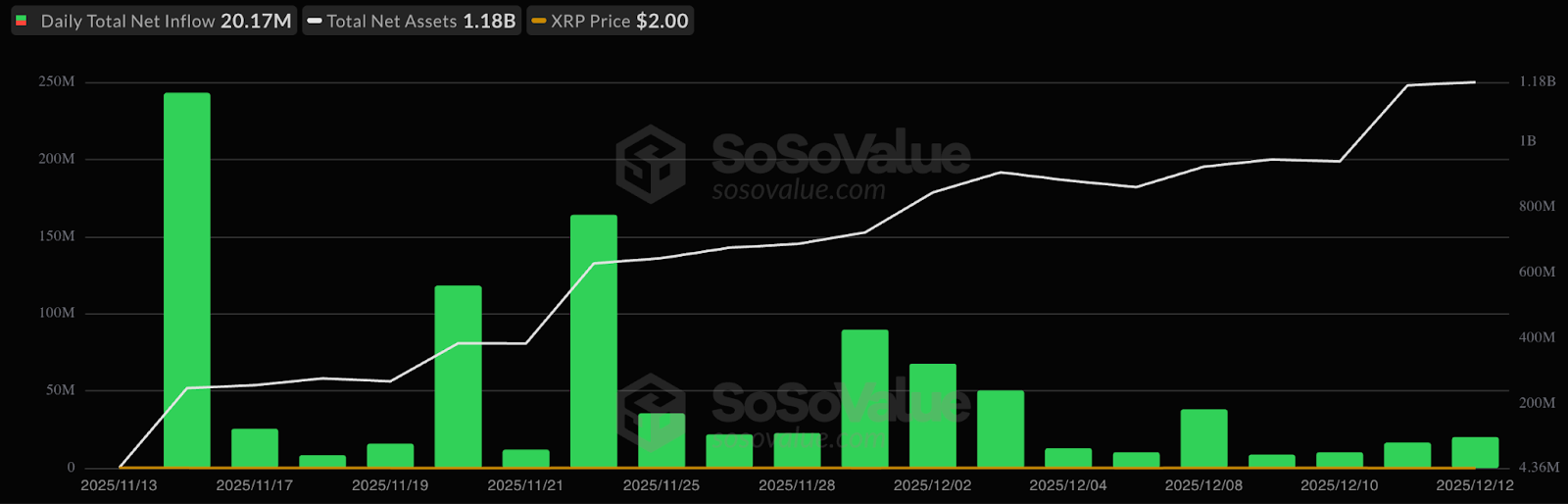
XRP ETFs inflows. Source: SoSoValue

Such a strong start for XRP ETFs reflected confidence among institutional investors. By comparison, spot Bitcoin (BTC) ETFs saw $49 million in inflows on the same day.

Spot Ether (ETH) ETFs posted $19.4 million in outflows, reducing their cumulative inflows to $13.1 billion. The funds also shed $42.3 million on Thursday.

“US spot $XRP ETFs have now recorded 20 straight days of inflows since launch, even as $BTC and $ETH ETFs continue to struggle with outflows,” said analyst Bitcoinsensus in a Monday post on X, adding:

“Institutional demand for XRP is heating up fast.”

As Cointelegraph reported, XRP ETF demand backs the bullish case for the altcoin with a rally to $10 still in the cards for 2026.

XRP price loses key support levels

The persistent demand for XRP ETFs has, however, failed to hold its price above $2, with the technical setup indicating a potential for a deeper correction.

XRP’s price extended its bearish trajectory on Monday, falling over 11% over the last 10 days and dropping below $2 for the second time since Nov. 21.

The XRP/USDT pair is currently testing a daily order block around $1.93, a level with limited support, according to data from Glassnode.

Glassnode's UTXO realized price distribution (URPD) — a metric that shows the average prices at which SOL holders bought their coins — reveals smaller clusters of these buy levels below $1.90. This means that fewer holders are likely to defend the price there.

The next significant support sits at $1.78, where approximately 1.85 billion XRP were previously acquired.
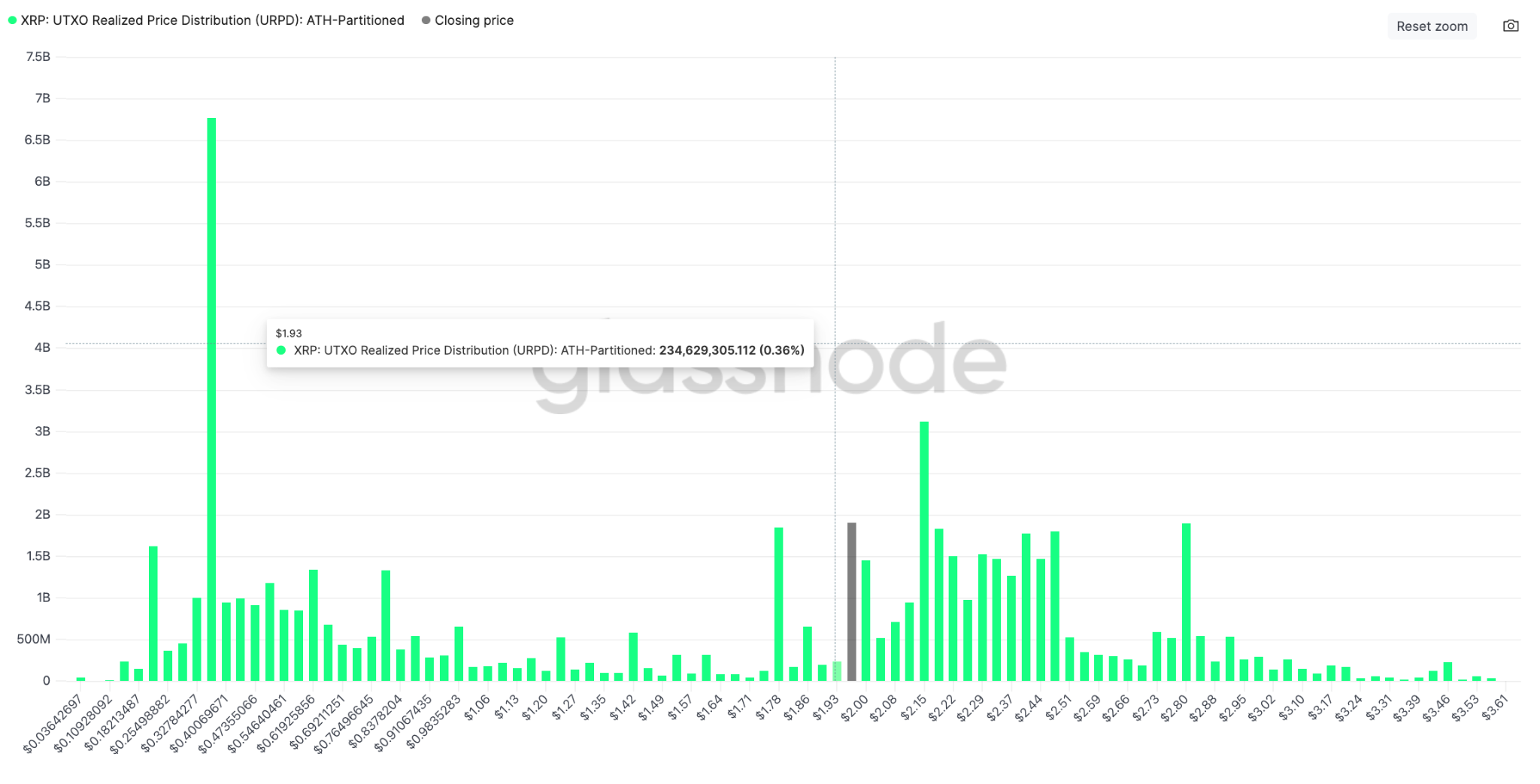
XRP: UTXO realized price distribution (URPD). Source: Glassnode

If the price breaks below this level, it could drop toward the green zone shown below, supported by the $1.61 local low and the 200-week EMA, which is around $1.40 and represents the last line of defense for the XRP price.
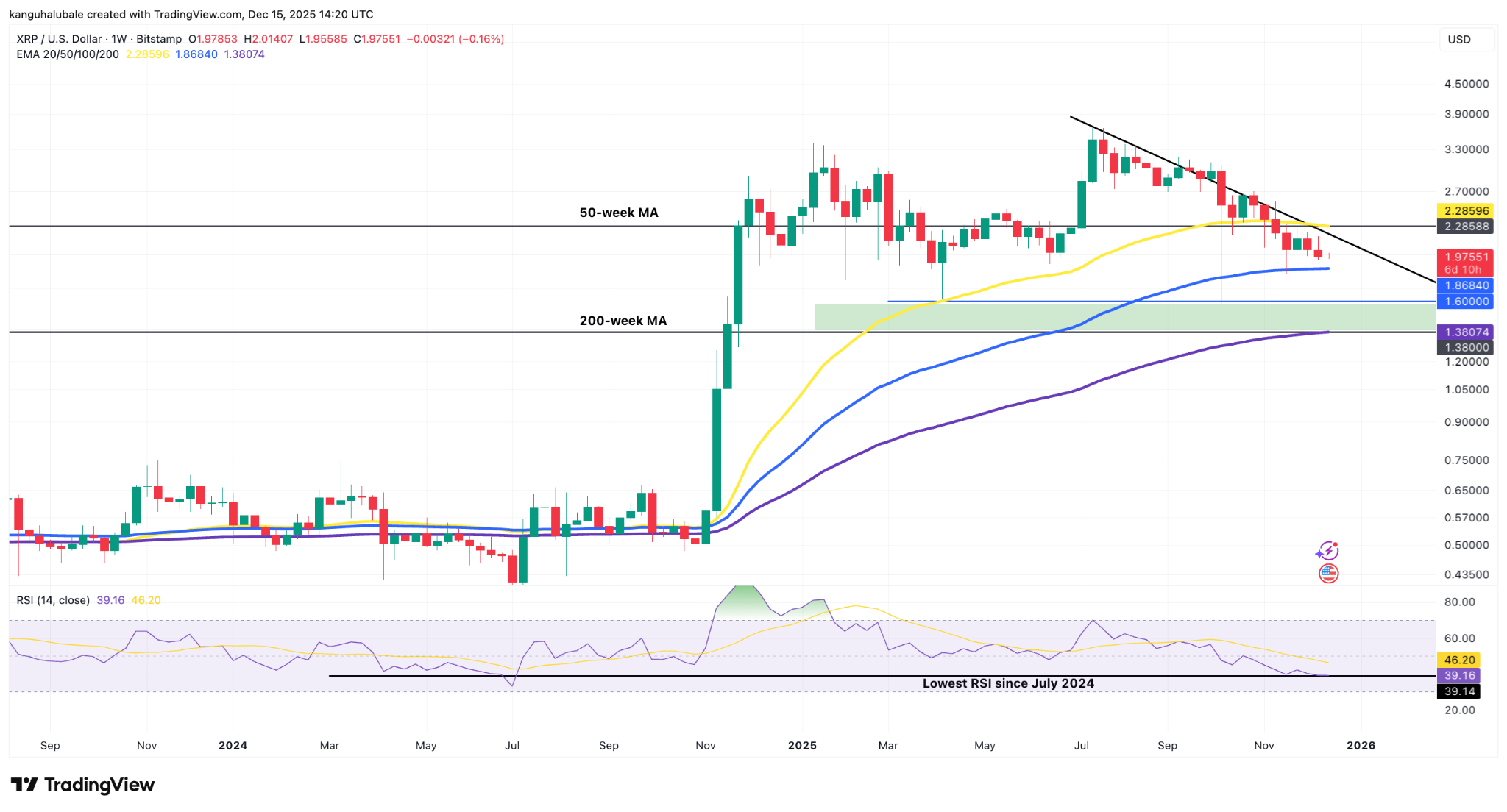
XRP/USDT weekly chart. Source: Cointelegraph/TradingView

XRP’s downside momentum is also increasing based on the relative strength index, or RSI, which has hit its lowest level since July 2024.

As Cointelegraph reported, a break below $2 will see the XRP/USDT pair extend the decline to $1.75 and subsequently to the local low at $1.61.

This article does not contain investment advice or recommendations. Every investment and trading move involves risk, and readers should conduct their own research when making a decision. While we strive to provide accurate and timely information, Cointelegraph does not guarantee the accuracy, completeness, or reliability of any information in this article. This article may contain forward-looking statements that are subject to risks and uncertainties. Cointelegraph will not be liable for any loss or damage arising from your reliance on this information.


Related Reads

Huawei Cloud Rejects Token Price War, Zhou Yuefeng Seeks a New Winning Formula for AI Cloud

At the 2026 Huawei Cloud INSPIRE Creator Conference, CEO Zhou Yuefeng outlined Huawei Cloud's distinct strategy in the competitive AI cloud market. Instead of engaging in price wars based on token volume or Maas revenue—a common focus for rivals like Alibaba Cloud and ByteDance's Volcano Engine—Huawei Cloud is shifting the competition towards real-world productivity gains. Zhou highlighted three core differentiators: a fully domestic computing stack (Ascend, Kunpeng), a focus on government and enterprise clients rather than consumer internet, and a deep commitment to open-source ecosystems. To this end, Huawei Cloud launched a suite of new products under the "Agentic Infra" paradigm, including the AICS Lingqu computing cluster, AMS memory storage, and the ModelArts Next platform. These aim to solve enterprise challenges in deploying AI agents, such as latency, memory, scheduling, and security. The strategy further involves creating specialized industry zones ("AI Dream Factories") for sectors like healthcare and embodied intelligence. For example, a smart medical zone developed with Shanghai Ruijin Hospital aims to democratize expert-level diagnostic capabilities. In essence, Huawei Cloud is positioning itself not as a commodity token provider, but as the foundational infrastructure for industrial AI, leveraging its domestic supply chain and hybrid cloud solutions to serve sectors where productivity, not just scale, is the ultimate measure of value.

marsbit2h ago

Huawei Cloud Rejects Token Price War, Zhou Yuefeng Seeks a New Winning Formula for AI Cloud

marsbit2h ago

70% of the Public Opposes AI, Americans Hope the U.S. Loses the AI War

70% of Americans believe AI development is moving too fast, with growing public resistance evolving from online criticism to real-world protests and violence. This widespread anti-AI sentiment stems from fears of job losses, rising utility costs, environmental damage, threats to democracy, and financial instability. Key incidents illustrate the backlash: Google's former CEO Eric Schmidt was loudly booed at a graduation for promoting AI; AI company ads are vandalized; protests and even violent attacks target AI firms and data centers. Polls show deep public pessimism and strong local opposition to data center construction, often surpassing resistance to nuclear power plants. The core grievances are economic and practical: AI is seen as automating jobs, concentrating wealth, and increasing household electricity and water bills due to massive data center resource demands. Environmentalists also oppose AI's high energy use and carbon emissions. This opposition has turned AI into a major political issue in the US. While the Trump administration prioritizes AI innovation for global competition, bipartisan pushback is growing. Democrats and factions within the MAGA movement are forming temporary alliances to support stricter regulations and local bans on new data centers, pressuring the administration to choose between its tech industry backers and its voter base. The situation highlights a profound national divide over AI's future.

marsbit2h ago

70% of the Public Opposes AI, Americans Hope the U.S. Loses the AI War

marsbit2h ago

Trading

Spot
Futures

Hot Articles

What is XRP 2.0

XRP 2.0: A New Frontier in the Cryptocurrency Landscape Introduction to XRP 2.0 In the ever-evolving realm of cryptocurrency, new projects continuously emerge, vying for attention and adoption. One such promising initiative is XRP 2.0, a novel cryptocurrency project designed to leverage advanced blockchain technology and robust encryption methodologies. While the name draws parallels with Ripple’s XRP, it’s crucial to note that XRP 2.0 operates independently, focusing on enhancing transaction security, privacy, and scalability. As the digital financial landscape increasingly embraces decentralized solutions, XRP 2.0 aims to contribute meaningfully to web3 and the overall expansion of crypto projects. What is XRP 2.0? At its core, XRP 2.0 is a cryptocurrency project that aims to create a secure and decentralized digital currency ecosystem. Its foundational technology integrates sophisticated blockchain principles with cutting-edge encryption techniques. The overarching goal of XRP 2.0 is to establish itself as a reliable and efficient platform enabling swift transaction execution while prioritizing enhanced privacy protections for its users. The project is promoted as a solution to many limitations faced by existing cryptocurrencies, proposing a system that can handle a higher volume of transactions with improved speed and privacy. This versatility positions XRP 2.0 as a significant contender in a marketplace riddled with various digital currencies. Who is the Creator of XRP 2.0? The identity of the creator behind XRP 2.0 has been flagged as ‘Wilbur.’ However, comprehensive details regarding Wilbur or their associated entity remain elusive. The anonymity of many cryptocurrency creators is not an uncommon phenomenon in the industry, often designed to maintain a degree of privacy and security. Who are the Investors of XRP 2.0? As of now, specific information related to the investment foundations or organizations supporting XRP 2.0 is not publicly available. In the cryptocurrency sector, the backing by reputed investors can significantly influence a project's credibility and success, yet the transparency regarding the financial supporters of XRP 2.0 has not been established. How Does XRP 2.0 Work? XRP 2.0 stands out by employing a combination of blockchain technology and advanced encryption algorithms that ensures secure and decentralized transactions. Its innovative structure includes unique features designed to foster user engagement and broaden functionalities beyond conventional cryptocurrency transactions. Among these features, XRP 2.0 incorporates AI-powered capabilities, such as text-to-image and text-to-speech functionalities. These additions are designed to enhance the interactive experience for users, promoting broader applicability across various sectors. By bridging technological advancements with user-centered design, XRP 2.0 aims to capture the attention of a diverse range of individuals and enterprises looking to integrate cryptocurrency solutions into their operational frameworks. Timeline of XRP 2.0 Understanding XRP 2.0 requires examining the milestones that have defined its journey thus far: July 23, 2023: XRP 2.0 is introduced as a novel cryptocurrency project, aiming to revolutionize secure and decentralized transaction capabilities in the blockchain domain. September 8, 2023: The launching of another project, XRP20, occurs, marking the emergence of an ERC-20 token on the Ethereum blockchain that remains unrelated to XRP 2.0. November 13, 2023: The XRP Ledger undergoes a significant update with the release of rippled server software version 2.0.0. It is essential to note that this development is disconnected from the XRP 2.0 cryptocurrency project. Key Points About XRP 2.0 To distill the essence of XRP 2.0, several critical factors emerge: Unique Features: The inclusion of features like AI-powered text-to-image and text-to-speech further diversifies the potential applications of XRP 2.0. Blockchain Technology: The framework utilizes advanced blockchain mechanisms and encryption protocols, ensuring a secure and decentralized environment for transactions. Scalability and Privacy: XRP 2.0 prioritizes enhanced privacy protections in transaction processes and the scalability necessary to accommodate a growing user base. No Affiliation with Ripple: Importantly, despite its name, XRP 2.0 does not have any allegiance or collaboration with Ripple’s XRP, distinguishing its operational framework and objectives within the cryptocurrency ecosystem. Conclusion XRP 2.0 represents an ambitious venture into the cryptocurrency sphere, aiming to offer a combination of security, privacy, and efficiency in digital transactions. By integrating sophisticated technologies and user-friendly features, the project sets out to broaden the horizons of what cryptocurrency can achieve in today's digital economy. While the anonymity of its creator and lack of disclosed investors might raise questions for some, XRP 2.0's focus on advanced functionalities and decentralisation enhances its appeal amidst an increasingly crowded crypto market. As the cryptocurrency landscape continues to evolve, XRP 2.0 may yet emerge as a pivotal player in the expansion of secure and scalable blockchain solutions.

942 Total ViewsPublished 2024.04.01Updated 2024.12.03

What is XRP 2.0

Discussions

Welcome to the HTX Community. Here, you can stay informed about the latest platform developments and gain access to professional market insights. Users' opinions on the price of XRP (XRP) are presented below.

活动图片