XRP Ledger Security Debate Intensifies After BatchGate Scare

bitcoinistPublished on 2026-03-03Last updated on 2026-03-03

Abstract

Following the near-miss incident known as BatchGate, a significant security concern has sparked a broader debate around governance and safety protocols on the XRP Ledger. Validator operator Daniel Keller criticized the existing review process as a "systemic failure" and withdrew support for all pending amendments. He emphasized that validators are governance participants, not unpaid auditors, and called for amendment proposers—particularly Ripple—to provide comprehensive documentation, testing, and security proofs. Keller also urged Ripple to increase investment in core protocol engineering and security. Other community members, like validator Vet, advocated for slower amendment rollouts, paid audits, and larger bug bounty programs. Keller disagreed with simply slowing down development, instead pushing for better incentives and resources to maintain progress without compromising security. The incident has raised fundamental questions about whether the XRPL’s amendment process has sufficient safeguards for the scale of changes being proposed. At the time of reporting, XRP was trading at $1.3566.

The fallout from the XRP Ledger’s BatchGate scare is turning into a broader argument about who is actually responsible for protocol safety and how much scrutiny major amendments should face before they get anywhere near mainnet. In a statement published Monday, longtime validator operator Daniel Keller said the near-miss around XLS-56 exposed “a systemic failure in review processes” and prompted him to withdraw support for all amendments currently under consideration.

Keller’s post was framed as a clarification of what dUNL validators are supposed to do, after what he described as widespread confusion following the Batch incident. His central point was that validators are governance participants, not unpaid auditors. “The role of dUNL validators is specific and limited: We coordinate the activation (or rejection) of amendments by casting ‘Yay’ or ‘Nay’ votes once an amendment is proposed,” he wrote. “We are supposed to judge pending amendments. That is our primary governance function.”

That distinction matters because XLS-56, also known as Batch, was halted only after a logic flaw in signature validation was uncovered shortly before mainnet activation. The bug could have enabled unauthorized transaction execution and potentially put billions in XRP at risk before the amendment was paused and patched in rippled 3.1.1.

XRP Ledger Governance Concerns, With Ripple in Focus

For Keller, the episode was not an isolated mistake but the latest example of a deeper structural problem. “The dUNL is not a free code-review or protocol-auditing body. Expecting validators to spend dozens of unpaid hours reviewing complex amendment code was never part of the design and never will be,” he wrote. “Instead, parties proposing amendments should be required to deliver comprehensive documentation, test suites, security analyses, and formal proofs upon request. If you want my vote, prove the change is safe and beneficial.”

He argued that the burden now falls on Ripple to fund that process more aggressively. “I will not vote in favour of any future amendments until Ripple makes a credible, concrete commitment to substantially increase investment in XRPL core protocol engineering, security review, and long-term sustainability,” Keller said. “If XRP is truly Ripple’s ‘North Star,’ as repeatedly stated, then the network’s foundational security and decentralisation must receive the attention and resources they deserve.”

Keller’s immediate response was blunt: withdraw all current “Yay” votes, except for pending fixes, and refuse to upgrade to rippled 3.1.1 unless staying on the earlier version risks removal from the network. He also said the fact that an independent researcher and an AI tool were ultimately needed to prevent harm underscored how thin the current safety net has become.

Other prominent XRPL voices agreed that the process needs to change, though not all backed a slowdown. Vet, a well-known XRPL validator, called the Batch incident “a massive opportunity” for the community and the XRPL Foundation to rethink how the protocol evolves. He argued for a slower amendment schedule, more paid reviews, multiple audits for larger changes, “attackathons” on testnet, and a bug bounty program big enough to attract elite researchers.

Keller, however, pushed back on the idea that the answer is simply to move slower. “In the short term, we need some sort of agreement with Cantina. They have proven themself and it’s the best we have right now,” he wrote. “Mid-term, the bug bounties need to be elevated and pay serious money. First, people need to be incentivised to look at the code; second, it must pay off to do a responsible disclosure.”

He went further in a follow-up that captured the mood of the debate: “I do not want to slow down our dev speed; it took us years to get to the current level, and we are still slow. More resources need to be allocated, and the process needs to start yesterday.”

That leaves the XRP Ledger in a tense but familiar place: a network trying to add functionality without compromising the credibility of its base layer. BatchGate did not become a live exploit. But it did force a sharper question into the open, whether XRPL’s amendment pipeline is still operating with enough review depth for the scale of change now being proposed.

At press time, XRP traded at $1.3566.
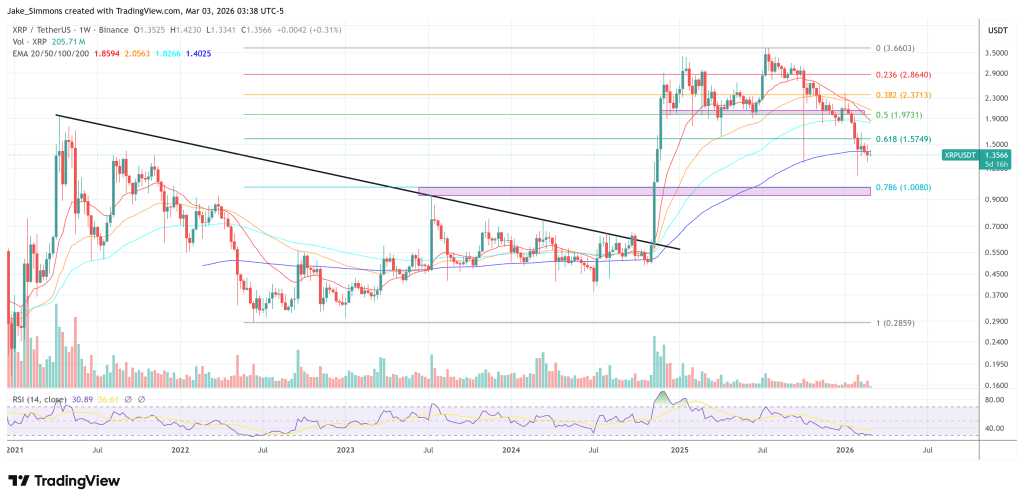
XRP falls below the 200-week EMA agan, 1-week chart | Source: XRPUSDT on TradingView.com

Trending Cryptos

Related Questions

QWhat was the main issue with the XLS-56 (Batch) amendment that caused the 'BatchGate scare'?

AThe main issue was a logic flaw in signature validation that could have enabled unauthorized transaction execution, potentially putting billions in XRP at risk before the amendment was paused and patched.

QAccording to Daniel Keller, what is the specific and limited role of dUNL validators in the XRP Ledger governance?

AKeller stated that the role of dUNL validators is to coordinate the activation or rejection of amendments by casting 'Yay' or 'Nay' votes once an amendment is proposed, and that they are governance participants, not unpaid auditors.

QWhat specific commitment does Daniel Keller demand from Ripple before he will vote in favor of future amendments?

AKeller demands that Ripple make a credible, concrete commitment to substantially increase investment in XRPL core protocol engineering, security review, and long-term sustainability.

QWhat was the immediate response of Daniel Keller following the Batch incident?

AHis immediate response was to withdraw all current 'Yay' votes (except for pending fixes) and refuse to upgrade to rippled 3.1.1 unless staying on the earlier version risked removal from the network.

QWhat broader structural problem does the Batch incident represent, according to the validator Daniel Keller?

AKeller believes the incident is not an isolated mistake but the latest example of a deeper structural problem, highlighting a systemic failure in review processes and that the dUNL is not a free code-review or protocol-auditing body.

Related Reads

Who Captures Value in Web 2.5?

Title: Who Captures Value in Web 2.5? Summary: For most of financial history, moving money was difficult and slow. Cryptocurrencies and stablecoins promised faster, cheaper transfers. However, their true potential is realized not by replacing traditional finance but by acting as an efficient, invisible settlement layer beneath it—a hybrid model called "Web 2.5." This fusion combines the regulation and familiar interfaces of traditional finance with the low-cost, programmable, always-on settlement of crypto. The critical question is: where does value accumulate in this new system? The answer lies in the coordination or "translation" layer that bridges the two financial worlds. History shows that the middleman connecting systems often captures immense value, as seen with Visa or SWIFT. This layer controls the flow of funds and can extract fees, collect float interest, and wield significant power (e.g., sanctions). Now, four main models are competing to become this dominant translation layer: protocols (like Chainlink), market utilities, banking cooperatives, and central bank clubs. For instance, Chainlink, in partnership with a consortium of banks, is piloting real-time FX settlement. SWIFT is building its own blockchain-based ledger layer. The Bank for International Settlements is testing tokenized central bank reserves. Ultimately, Web 2.5 is more promising than a purely decentralized utopia because it doesn't require abandoning existing systems. Instead, crypto becomes a commoditized, hidden infrastructure enabling faster, cheaper transactions within the traditional financial framework. The winning coordination layer will hold the power and capture the economic value in this new landscape.

链捕手3h ago

Who Captures Value in Web 2.5?

链捕手3h ago

Trading

Spot

Hot Articles

Discussions

Welcome to the HTX Community. Here, you can stay informed about the latest platform developments and gain access to professional market insights. Users' opinions on the price of S (S) are presented below.

活动图片