Can Pi Network’s protocol v25 upgrade push PI price to $0.12?

ambcryptoPublished on 2026-07-20Last updated on 2026-07-20

Abstract

Pi Network's PI token extended its bullish momentum, briefly reclaiming $0.10 before trading around $0.098 with an 11% daily gain. This rally is backed by a 200% surge in trading volume, a market cap of $1 billion, and sustained demand from investors ahead of the upcoming Protocol v25 upgrade on July 22nd. The upgrade aims to improve network stability, introduce zero-knowledge application capabilities, and restore pioneer confidence. Market sentiment is optimistic, with the Long/Short Ratio remaining above 1 for two days and positive market demand indicated by a consecutive nine-day positive Delta. Technically, PI shows strong upward momentum, flipping key moving averages and forming a bullish MACD crossover. However, the MACD remains negative, suggesting buyers have not yet fully dominated. If the upcoming upgrade fuels further accumulation, PI could sustain above $0.10 and target the $0.12 resistance level.

Pi Network [PI] extended its bullish streak, briefly reclaiming $0.1 before slightly retracing. At press time, PI was trading at around $0.098 after rising 11% on the daily charts.

This price hike was backed by a 200% jump in trading volume while the market cap reclaimed $1 billion, reflecting steady capital flow.

Protocol v25 upgrade improves PI’s stability

The crypto market has been highly anticipated for the Pi Network’s upcoming upgrade. On the 22nd of July, the network will undergo an upgrade to Protocol v25. The upgrade seeks to improve the network’s reliability and stability and to add capabilities for more efficient, privacy-preserving smart contracts.

Protocol v25 will bring BN254 cryptography and Poseidon hashing, enabling developers to build modern zero-knowledge applications. Additionally, the network updated its app profile page in the mining app, thus restoring pioneers’ confidence in the ecosystem.

Demand for the altcoin holds steady

The anticipation of the upgrade has sparked market-wide optimism, with investors rushing to reposition.

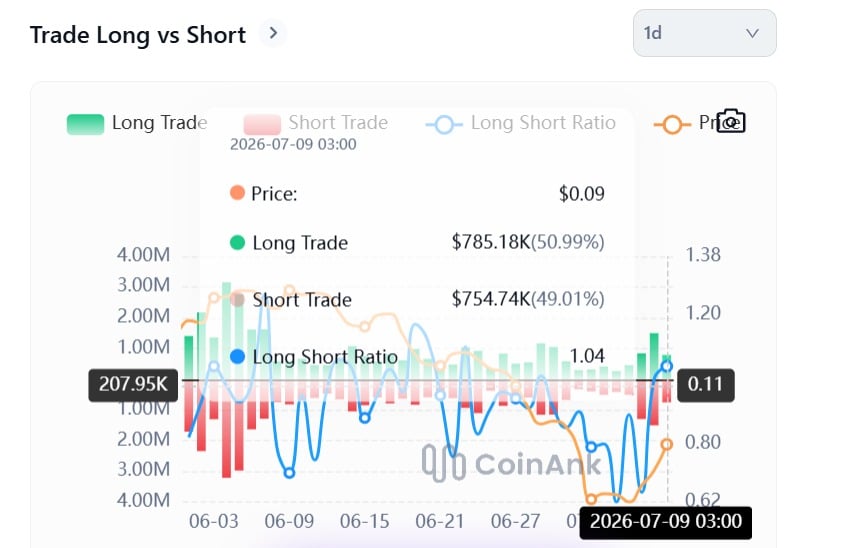
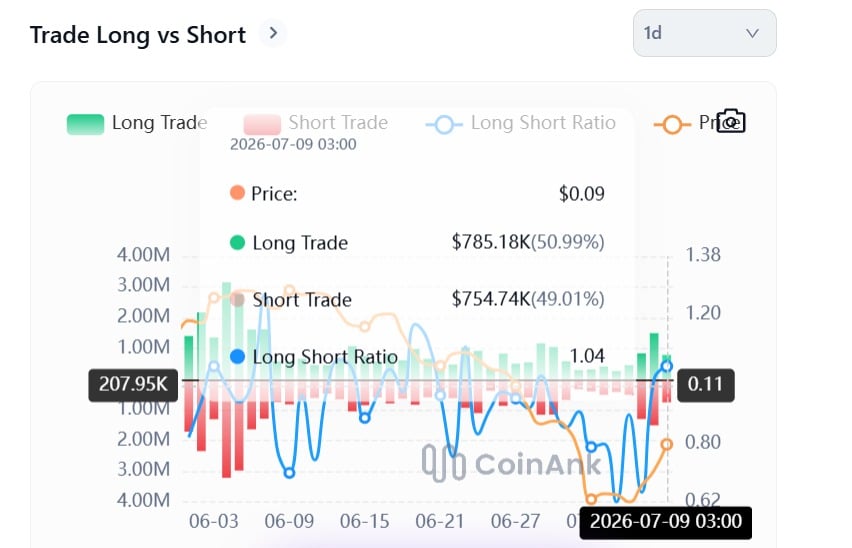
In fact, the speculative demand rebounded significantly. According to Coinank, PI’s Long/Short Ratio has remained above 1 for two consecutive days.
Source: Coinank

At press time, the metric was 1.04, with 50.9% accounting for long positions. When traders mostly open longs, it suggests they were bullish and anticipated further gains.

Moreover, investors on the spot side have been aggressively accumulating PI. Notably, the market Delta has remained positive for nine consecutive days.
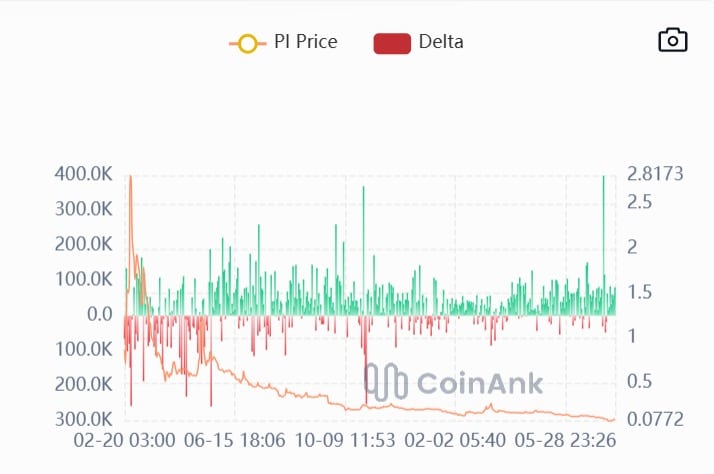
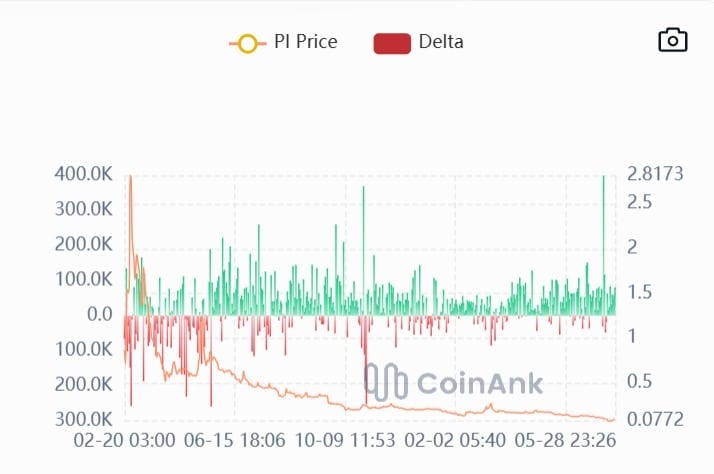
Source: Coinank

A positive delta suggests that market demand is currently strong, with buyers actively pushing prices higher. This is often a strong bullish confirmation.

Typically, when both speculators and spot buyers are active, it strengthens the market, setting the stage for further gains on price charts.

Can the momentum hold?

PI has experienced strong upside momentum, closing at higher highs for four consecutive days. As a result, the altcoin flipped both the 21 and 9-day Moving Averages, signaling strong upside momentum.
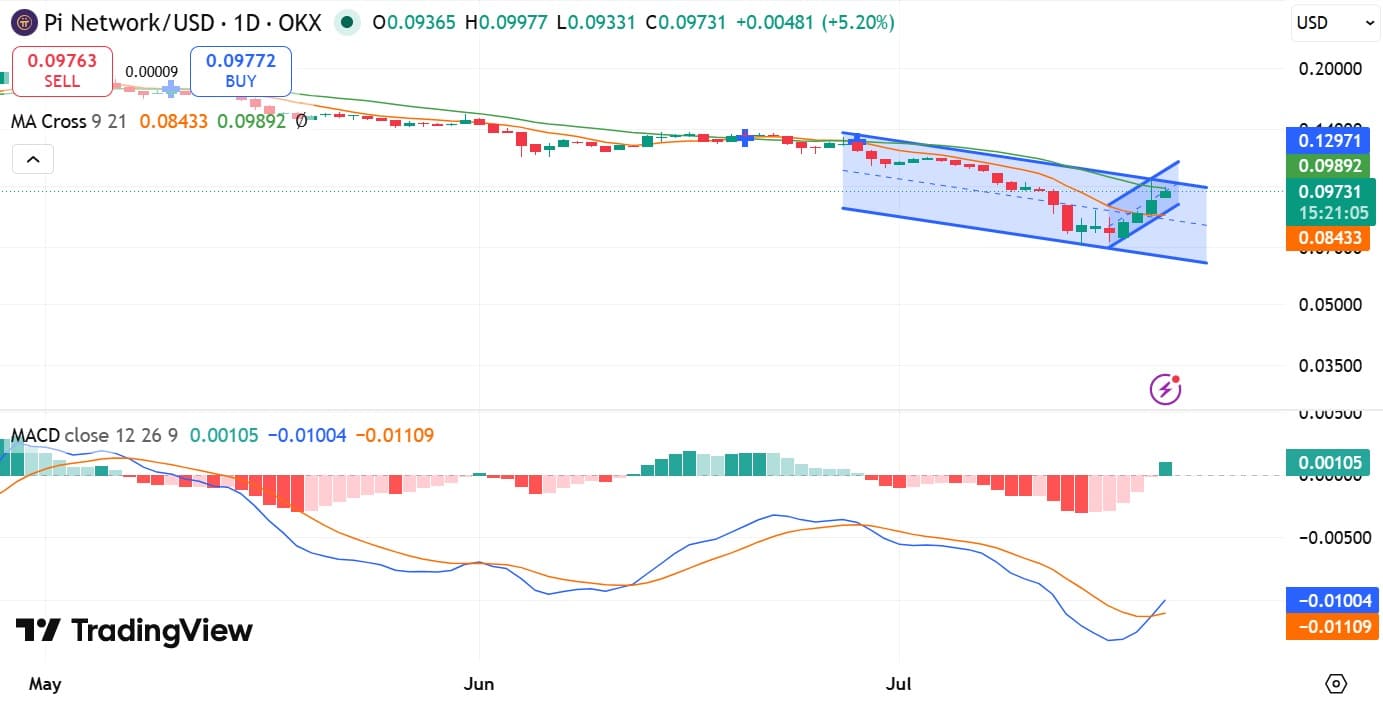
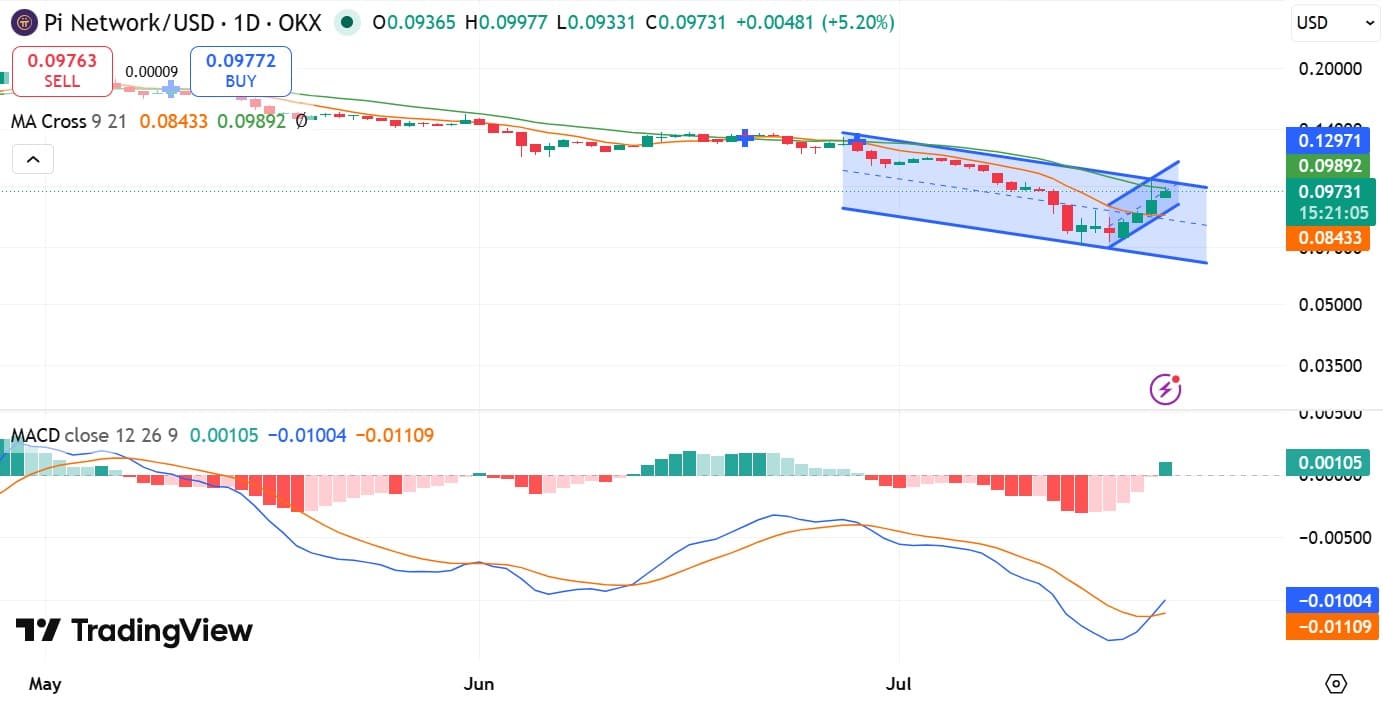
Source: TradingView

At the same time, the altcoin’s MACD formed a bullish crossover, rising to -0.009, further confirming the strengthening trend. However, the MACD remained negative, indicating that buyers have not yet fully retaken and dominated the market.

For now, if the upcoming upgrade incentivizes more market players to retake, the altcoin will make further gains. In doing so, PI will hold above $0.10 and target the $0.12 resistance.


Final Summary

  • Pi Network extended its bullish streak, rising by 11% to $0.1 before slightly retracing to $0.098 at press time.
  • PI has experienced renewed demand as traders reposition ahead of the upcoming protocol v25 upgrade.


Trending Cryptos

Related Questions

QWhat is the significance of Pi Network's Protocol v25 upgrade scheduled for July 22nd?

AThe Protocol v25 upgrade aims to improve the Pi Network's reliability and stability, add capabilities for more efficient and privacy-preserving smart contracts, and introduce BN254 cryptography and Poseidon hashing to enable developers to build modern zero-knowledge applications.

QWhat are the key on-chain and market indicators suggesting about trader sentiment towards PI ahead of the upgrade?

AKey indicators show bullish sentiment: PI's Long/Short Ratio remained above 1 for two consecutive days, with 50.9% long positions at press time. Additionally, the market delta has stayed positive for nine consecutive days, indicating strong demand and buyers actively pushing prices higher.

QBased on the technical analysis in the article, what is the potential price target for PI if the current momentum holds?

AIf the current momentum holds and the upgrade incentivizes more market players, the article suggests PI could hold above $0.10 and target the $0.12 resistance level.

QWhat recent price action did Pi Network (PI) experience according to the press time data?

AAt press time, PI was trading at around $0.098 after rising 11% on the daily charts. It had briefly reclaimed the $0.1 level before slightly retracing.

QHow did the trading volume and market capitalization of PI change alongside its recent price increase?

AThe recent price hike was backed by a 200% jump in trading volume, and the market cap reclaimed $1 billion, reflecting steady capital flow into the asset.

Related Reads

The Philadelphia Semiconductor Index Tumbles Nearly 5% in a Single Night, Optical and Memory Sectors 'Collapse' Together: Surging U.S. Bond Yields Shake AI Belief

On the evening of August 18th, the US stock market saw a sharp sell-off concentrated in the AI hardware sector, with the Philadelphia Semiconductor Index plummeting nearly 5%. Leading AI infrastructure and components companies in fields like optical communication and memory chips experienced some of the steepest declines, such as Fabrinet (-19.38%) and Kioxia ADR (-13%). The sell-off was not broad-based but rather targeted the long-duration, high-momentum stocks previously driven by AI narrative optimism. This market shift is primarily attributed to a significant surge in long-term US Treasury yields, with the 30-year yield hitting its highest level since 2007. Rising yields increase discount rates, disproportionately impacting the valuations of growth stocks whose profits are projected far into the future—a category that includes most AI hardware plays. Additional pressure came from climbing oil prices due to Middle East tensions, which fueled inflation concerns. The article identifies three structural reasons for the severity of the drop in these specific subsectors: excessive prior gains and crowded positioning, high sensitivity to the sustainability of AI capital expenditure narratives, and inherent high volatility within the supply chain. Importantly, the sell-off appears to be a valuation and positioning reset rather than a fundamental repudiation of AI, evidenced by the relatively modest decline in a bellwether like Nvidia (-2.34%). Looking ahead, the direction hinges on three key indicators: whether the 30-year Treasury yield stabilizes, the trajectory of oil prices and geopolitical risks, and the market's pricing of new AI-related corporate debt. For related Asian and A-share markets, short-term negative sentiment spillover is expected, but medium-term drivers like domestic cloud capex may provide divergence. The episode signifies a market transition from pricing AI's "story" to rigorously evaluating its returns against a backdrop of higher financing costs.

marsbit35m ago

The Philadelphia Semiconductor Index Tumbles Nearly 5% in a Single Night, Optical and Memory Sectors 'Collapse' Together: Surging U.S. Bond Yields Shake AI Belief

marsbit35m ago

Ten Years, Wang Xingxing's Comeback: Unitree Valued at 400 Billion

Over a decade ago, Wang Xingxing, a 29-year-old with a passion for robotics but little funding, demonstrated his struggling robot dog to investors in Hangzhou. In 2019, with his company Unitree nearly out of cash, he captured the attention of Sequoia Capital China's managing director Li Yannan. Despite initial skepticism about the niche market for robot dogs, Wang's vision and deep technical conviction led Sequoia to make an initial seed investment. This marked a turning point. Following Sequoia's lead, a wave of prominent investors including Meituan, Tencent, Alibaba, and various venture capital and state-backed funds joined subsequent funding rounds. Wang's relentless focus and Unitree's technological advancements propelled the company to become a global leader in humanoid robotics. On August 19th, 2027, Unitree Robotics debuted on Shanghai's STAR Market as the first listed humanoid robotics company in China. Its shares skyrocketed over 500% at opening, reaching a market valuation of approximately 400 billion yuan. Wang Xingxing became one of the wealthiest individuals of his generation on the exchange, while Sequoia China, having invested across multiple rounds, remained a major shareholder. The story is celebrated as a classic outlier's triumph—a founder without elite credentials achieving success through pure belief and perseverance. Unitree's IPO is seen as a major milestone for China's embodied AI industry, providing a valuation benchmark and accelerating the sector's maturation. As Wang once stated, he aims to be "a small boat riding the mighty torrent of technology." His journey symbolizes the beginning of a new narrative for Chinese robotics on the global stage.

marsbit36m ago

Ten Years, Wang Xingxing's Comeback: Unitree Valued at 400 Billion

marsbit36m ago

Manufacturing's Share Drops Below 25%: Is Hangzhou Unconcerned?

Hangzhou is entering a critical phase of industrial restructuring. While its manufacturing-to-GDP ratio has fallen below 25%, the city is not alarmed. Instead, it is strategically navigating a dual focus: advancing advanced manufacturing and expanding its service sector, particularly producer services. Recently, the city celebrated the IPO of a humanoid robotics company, seen as a milestone in moving beyond its e-commerce era. Simultaneously, it set an ambitious target for its service sector: to exceed 2 trillion yuan in value by 2030, with producer services making up over 60%. Data shows a clear trend: the service sector's share of GDP has risen to 75.3%, while manufacturing's share has declined to around 20.1%. This shift revives the debate on whether a strong service sector weakens a city's manufacturing "foundation." Hangzhou's approach challenges the notion of a fixed manufacturing "red line" near 25%. The city argues that the quality and integration of industries matter more than simple ratios. Its strategy is "using software to drive hardware," leveraging its core strengths in digital economy and producer services—like R&D, software, and supply chain management—to empower and add value to manufacturing. This is embodied by its emerging "AI era" companies, whose innovation in Hangzhou feeds into national industrial chains. The city believes that for a hub like Hangzhou, the key is not merely boosting visible manufacturing output, but strengthening the "invisible" competitive edge provided by high-end producer services, which ultimately determine manufacturing profitability. National policy is also shifting from insisting on a "stable" manufacturing share to acknowledging a "reasonable" range, allowing for quality-focused development. Hangzhou's future industrial blueprint aims for a manufacturing share above 22% of GDP by 2027, coupled with a dominant, high-value service sector. The goal is not to choose between manufacturing and services, but to deeply integrate them, using advanced services as the accelerator for next-generation manufacturing.

marsbit1h ago

Manufacturing's Share Drops Below 25%: Is Hangzhou Unconcerned?

marsbit1h ago

SEC Suddenly Proposes "Regulation Crypto": U.S. Token Fundraising May Become Legal Again

On August 18, the U.S. Securities and Exchange Commission (SEC) proposed a landmark set of permanent rules, "Regulation Crypto Assets," specifically designed for crypto asset investment contracts. The 402-page proposal introduces two registration exemption paths and a groundbreaking safe harbor mechanism, representing the SEC's first dedicated crypto-specific regulatory framework. Two exemption tiers are proposed: a "Startup Exemption" allowing a one-time raise of up to $5 million within four years with basic disclosure requirements, and a "Financing Exemption" permitting raises of up to $75 million every 12 months with stricter obligations, including financial statements and ongoing reporting. Both paths require "principles-based narrative disclosure," a flexible approach distinct from traditional IPO forms. The most transformative element is the investment contract safe harbor. It provides a legal path for tokens to "graduate" from being classified as securities. If an issuer completes or permanently ceases its "essential managerial efforts" as promised in the investment contract and meets specific conditions, it can file with the SEC to have the token exit the securities framework. This creates a novel legal lifecycle where a token can begin as a regulated security for fundraising and later become a non-security asset as the network decentralizes. This move is seen as the SEC pragmatically filling a legislative vacuum, as the stalled CLARITY Act in Congress faces significant delays. The proposal aims to offer a compliant pathway for token offerings within the U.S., countering the trend of projects moving overseas. While currently a proposal open for a 60-day public comment period, it signals a major potential shift from an enforcement-heavy approach toward establishing clearer rules for the crypto industry.

marsbit1h ago

SEC Suddenly Proposes "Regulation Crypto": U.S. Token Fundraising May Become Legal Again

marsbit1h ago

Trading

Spot

Hot Articles

Discussions

Welcome to the HTX Community. Here, you can stay informed about the latest platform developments and gain access to professional market insights. Users' opinions on the price of S (S) are presented below.

活动图片