XRP Ledger Linked To SWIFT In New Wave Of Backend Integration Speculation

bitcoinistPublished on 2026-04-04Last updated on 2026-04-04

Abstract

Speculation is growing that SWIFT, the global financial messaging giant, may be integrating the XRP Ledger (XRPL) into its backend infrastructure. While unconfirmed, crypto commentators note that 36 of the 50+ banks on SWIFT’s new cross-border payments list are already Ripple partners. Additionally, SWIFT recently recognized Ripple Treasury in its Certified Partner Program. The theory suggests SWIFT’s frontend remains with banks, but the backend could be powered by XRPL for faster, more efficient settlements. Ripple CTO Emeritus David Schwartz argues XRP is better suited for global finance than stablecoins due to its decentralization, speed, low cost, and growth potential—unlike stablecoins, which are tied to single currencies and vulnerable to regulatory action. XRP was trading around $1.31 at the time of reporting.

Ripple’s XRP Ledger and SWIFT are gaining serious attention in the cryptocurrency and financial sector following recent speculations about both parties. While SWIFT remains one of the leading payment firms in the world, rumors are that the company might be supported by XRPL infrastructure.

SWIFT Might Be Integrating XRP Ledger Infrastructure

SWIFT, an open global standard for financial information, is now in the spotlight as speculations are starting to swell across the market regarding the company’s inner workings. This is centered around a possible integration or relationship between SWIFT and the XRP Ledger (XRPL).

Over time, SWIFT has been hailed for its fast processing time and execution, but some analysts are starting to suggest the possibility of the XRP Ledger currently playing a role behind the scenes. Pumpius, a crypto commentator, highlighted on X that SWIFT could be secretly using the Ledger at the backend.

Even though no formal confirmation has been made, the notion that a major traditional financial messaging company might covertly access blockchain technology underscores the notable growth of the blockchain sector. The multiple partnerships between big financial institutions and Ripple Labs are reinforcing this rumor.

According to Pumpius, 36 out of the 50+ banks on SWIFT’s new retail cross-border payments list are already in partnership with leading payment firm Ripple. In addition, SWIFT has recently made announcements regarding Ripple Treasury as an official part of its Certified Partner Program.
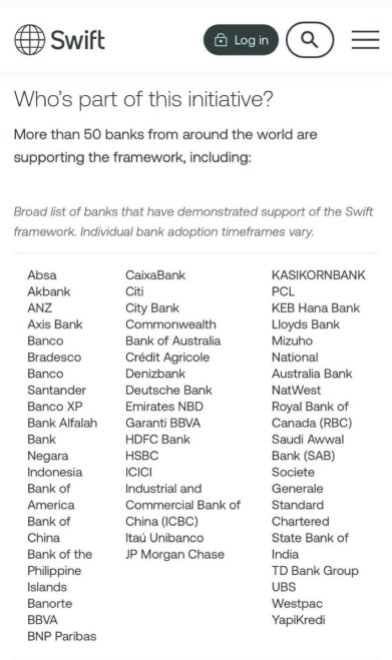
Source: Chart from Pumpius on X

As outlined by City of London banker Lord Belgrave in a strategy meeting with major banks, Ripple and the XRP Ledger were freely discussed as powering the underlying tech for cross-border payments of the next generation.

SWIFT’s frontend, which handles the customer interface, branding, and compliance, remains with each respective bank or financial institution. However, the backend is allegedly anchored on the Ledger, which is believed to be doing all the heavy tasks behind the scenes. If such a link were to exist, it might represent a major advancement in the merging of decentralized technology with legacy finance.

Pumpius stated that this architecture has been quietly building underneath the surface for years, but the recent announcement from SWIFT brought it to the notice of the public and the crypto sector.

The Token To Take Over Global Finance

With a growing role in finance, Pumpius has shared a few key points from Ripple CTO Emeritus David Schwartz on why XRP will take over global finance and outpace stablecoins. As the sector evolves, the CTO claims that banks will choose XRP over stablecoins.

One of the reasons is that stablecoins are stable to one currency, futile for global deals across borders. Also, issuers like court orders and politics can freeze or seize them anytime. Lastly, unlike stablecoins, XRP’s price can grow and offer investors real upside potential.

The altcoin is purely decentralized, offers lightning-fast atomic settlement, and has near-zero fees. Other key factors include liquidity sourcing and bridge asset design, high scalability and energy efficiency, escrow functionality, etc. In search of true freedom, speed, and future value in the sector, the altcoin is one of the best bets.

XRP trading at $1.31 on the 1D chart | Source: XRPUSDT on Tradingview.com

Related Questions

QWhat is the main speculation regarding SWIFT and the XRP Ledger mentioned in the article?

AThe main speculation is that SWIFT might be secretly using the XRP Ledger (XRPL) infrastructure for its backend operations, although no formal confirmation has been made.

QAccording to the crypto commentator Pumpius, how many banks on SWIFT's new cross-border payments list are already partnered with Ripple?

AAccording to Pumpius, 36 out of the more than 50 banks on SWIFT's new retail cross-border payments list are already in partnership with Ripple.

QWhat recent announcement from SWIFT is said to have brought this potential backend integration to public notice?

AThe article states that a recent announcement from SWIFT regarding its Certified Partner Program, which included Ripple Treasury as an official part of it, brought the speculation of the backend integration to public and crypto sector notice.

QWhat are some of the reasons, as shared by Ripple CTO Emeritus David Schwartz, for why banks would choose XRP over stablecoins?

AThe reasons include: stablecoins are tied to one currency (futile for global deals), they can be frozen or seized by issuers due to court orders or politics, and unlike stablecoins, XRP's price can grow and offer investors real upside potential.

QWhat key advantages of the XRP Ledger are highlighted for its use in global finance?

AThe key advantages highlighted are that it is purely decentralized, offers lightning-fast atomic settlement, has near-zero fees, and has features like liquidity sourcing, bridge asset design, high scalability, energy efficiency, and escrow functionality.

Related Reads

Three Months, 35 Billion Yuan: Investors Rush to Grab the OpenAI of the Physical World

Investors flock to a physical AI startup as the race for the "OpenAI of the physical world" heats up. Ji Jia Shi Jie (GigaWorld), a company dedicated to developing Artificial General Intelligence (AGI) for the physical world, has raised 3.5 billion RMB (approximately $490 million) in just three months, according to a report from investment media outlet Touzijie. The latest B2 funding round of 1 billion RMB attracted a wide range of top-tier investors, including sovereign wealth funds, industrial capital, and financial institutions. This brings the total funding for the young company, now valued over 10 billion RMB, to 3.5 billion RMB across three recent rounds. The company is led by Huang Guan, a post-90s Tsinghua University PhD with extensive experience in AI, autonomous driving, and entrepreneurship. Its core innovation is a "dual-pyramid" system comprising a five-layer data pyramid (from internet videos to real-world robot data) and a three-layer algorithm pyramid focused on world simulation, action alignment, and reinforcement learning. This system underpins its key models: the "World Action Model" (e.g., GigaBrain series for robot control) and the "World Generation Model" (e.g., GigaWorld series for simulating and understanding the physical world). Its models have reportedly achieved top rankings in global robotics benchmarks. Ji Jia Shi Jie argues that while current digital AGI excels in information processing, the next frontier is physical AGI—systems that can understand and interact with the real world. The company believes the field is approaching its "GPT-3 moment," a key inflection point in capability scaling. To achieve this, the company is pursuing a dual-market strategy. For the consumer (C) market, it launched the "SeeLight" brand and its S1 general-purpose humanoid robot, which has secured initial orders for deployment in real homes. For the business (B) market, it focuses on industrial automation with its Maker series robots, having signed agreements for large-scale deployment in factories, and its DriveDreamer world model for autonomous driving, which is already in use with over 30 automakers and tech companies. The report concludes that by bridging the gap between digital intelligence and physical action, Ji Jia Shi Jie aims to unlock a new wave of productivity, ultimately bringing physical AGI into everyday life.

marsbit7m ago

Three Months, 35 Billion Yuan: Investors Rush to Grab the OpenAI of the Physical World

marsbit7m ago

What's the Connection Between Pinduoduo's Huang Zheng and Blockchain?

This text explores the unexpected connection between Pinduoduo founder Colin Huang and blockchain, as suggested in his article *Turning Capitalism Upside Down*. Huang argues Pinduoduo's core business is about managing "uncertainty." He posits that wealth flows to the rich because they absorb life's uncertainties (e.g., illness, job loss) that devastate the poor, who pay a premium for certainty through insurance or stable prices. Pinduoduo's model attempts a "reverse insurance": by aggregating consumer demand via group-buying and flash sales, it creates a large, predictable order for manufacturers. This certainty allows factories to remove risk premiums, passing savings back as lower prices, thus partially reversing the wealth flow. The key obstacle, Huang notes, is that an individual's buying intent is an unreliable promise. He then asks if blockchain is the natural solution for this "reverse insurance." The text elaborates that blockchain, through smart contracts with binding deposits, could transform casual intent into a costly-to-break, enforceable commitment. This replaces interpersonal trust with coded rules, making promises credible, pricable, and resistant to fraud. Finally, the author draws a parallel to Bitcoin, framing two paths to creating certainty: the "Pinduoduo path" of aggregating decentralized will into scale, and the "Bitcoin path" of locking rules into immutable code. Both sacrifice something—personal freedom or system flexibility—to manufacture trust and predictability.

链捕手1h ago

What's the Connection Between Pinduoduo's Huang Zheng and Blockchain?

链捕手1h ago

The Storage Magnate Who Conquered a Trillion-Dollar Kingdom, Yet Ultimately Could Not Become the Richest

**Summary:** "The Memory Magnate Who Built a Trillion-Dollar Empire, Yet Never Became the Richest" explores the journey of Zhu Yiming, founder of GigaDevice (603986) and co-founder of the soon-to-IPO ChangXin Memory Technologies (CXMT). The article positions GigaDevice, a fabless chip designer now valued at ~¥340 billion, as a prequel to the massive IDM (Integrated Device Manufacturer) venture, CXMT. Starting in 2005 with minimal capital, Zhu strategically "picked up the pieces" by focusing on niche markets like NOR Flash and microcontrollers (MCUs), areas major players were exiting. This allowed GigaDevice to grow into a diversified semiconductor company, maintaining robust profitability even during industry downturns by controlling costs. However, the piece argues that in the highly cyclical and capital-intensive memory chip industry, the fabless model has limits. True resilience and scale require the ability for "counter-cyclical expansion" – investing heavily during downturns – a tactic only possible for IDMs like Samsung or SK Hynix. This insight led Zhu to partner with the Hefei city government in 2016 to establish CXMT, an IDM focused on DRAM. Zhu's symbolic moves, like forfeiting salary and diluting his equity, were crucial in securing the massive state and bank funding needed. CXMT's equipment base is now valued even higher than that of BYD's vast auto manufacturing empire. Despite the potential for CXMT to reach a market cap of ¥1-2 trillion upon its IPO, Zhu's indirect stake in both companies is estimated below 3%, placing his personal wealth far below that of China's top billionaires. The article concludes that his strategic vision built a trillion-yuan memory landscape, but the capital structure necessary to achieve it precluded a personal fortune of similar scale.

marsbit1h ago

The Storage Magnate Who Conquered a Trillion-Dollar Kingdom, Yet Ultimately Could Not Become the Richest

marsbit1h ago

XRP Ledger Daily Fees Drop Below $400 As Network Activity Question Returns

The XRP Ledger is drawing attention as daily network fees have fallen below $400. While low fees align with XRPL's design for affordable transactions and are often seen as a strength, the metric can also serve as an indicator of network demand and paid transaction volume. This data point of around $3,100 in weekly fee burn highlights the stark contrast with higher-fee chains like Ethereum and Bitcoin. The development fuels an ongoing debate. Proponents view low fees as a sign of efficiency and accessibility, while critics may question if the network is generating sufficient high-value activity relative to its market cap and payments-focused narrative. The article cautions against overstating the finding, noting a single low-fee day does not signify network failure. It instead adds context to discussions about XRPL's usage, especially alongside Ripple's broader initiatives in stablecoins (RLUSD), AI payments, and enterprise infrastructure. The report recommends monitoring for a fee rebound, checking transaction counts for a fuller picture, and confirming the trend via native explorers like Bithomp. It frames the story within a larger market shift where on-chain data, protocol updates, and infrastructure developments are becoming crucial alongside price action. The editorial stance is to present the verified data, explain its significance for assessing network activity, and avoid hype, positioning it as part of the daily crypto conversation.

bitcoinist6h ago

XRP Ledger Daily Fees Drop Below $400 As Network Activity Question Returns

bitcoinist6h ago

Trading

Spot
Futures

Hot Articles

Discussions

Welcome to the HTX Community. Here, you can stay informed about the latest platform developments and gain access to professional market insights. Users' opinions on the price of S (S) are presented below.

活动图片















