XRP ETF activity is pushing the asset into a phase where market structure increasingly outweighs market sentiment, as exchange-held supply continues to contract while institutional access expands. Analysts are now examining whether sustained ETF absorption could function as a long-term demand sink, tightening liquid supply and reshaping the mechanics of price discovery.
Shrinking Supply? Institutional Absorption Of XRP ETFs Accelerates
A market commentator on X has drawn attention to a sharp and sustained decline in XRP balances held across centralized exchanges, pointing to a structural change in how the asset is being absorbed and held. According to the figures cited, XRP ETFs have removed approximately 750 million XRP from exchanges within a matter of weeks, leaving an estimated 1.5 billion XRP remaining in liquid exchange reserves. This pace of absorption places exchange-held supply on a visibly contracting trajectory.
The same X account shared an on-chain chart that visually substantiates the decline in exchange-held XRP. The data shows total balances across centralized exchanges trending steadily lower throughout 2025. Notably, this contraction occurs while price action remains relatively contained, indicating that supply is being withdrawn from exchanges without provoking sharp directional moves. This separation between declining liquidity and stable pricing points to deliberate, conviction-driven absorption, consistent with long-term institutional positioning.
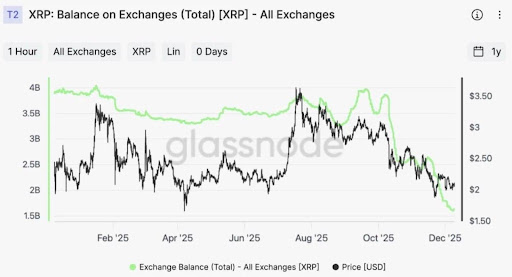
ETF-held XRP, by design, functions as locked capital rather than short-term liquidity. Once absorbed into exchange-traded products and institutional custody structures, tokens are effectively sidelined from day-to-day trading activity. This creates a largely one-directional supply dynamic, reducing the amount of XRP available to respond to new demand. On-chain data visualized in the chart supports this interpretation, showing consistent outflows that persist through both local price peaks and pullbacks.
Regulatory developments further contextualize this trend. The market commentator explicitly links the tightening supply to the Clarity Act, which provides a framework for compliant institutional participation. With clearer legal treatment, XRP becomes suitable for long-term balance sheet exposure and operational use.
Why 2026 Is Emerging As A Structural Inflection Point
The supply narrative gains additional weight when viewed through a forward-looking lens. Projections pointing to early 2026 as a potential supply shock window are based not on aggressive acceleration, but on simple continuation. At the current rate of ETF-driven absorption, exchange balances could approach critically thin levels, creating a low-float market structure where marginal demand exerts disproportionate influence on price.
The chart underscores this risk. As exchange-held XRP compresses toward historically low territory, the remaining liquid supply increasingly defines price discovery. In such conditions, price formation shifts away from speculative churn and toward liquidity mechanics, where availability, custody constraints, and institutional flows dominate outcomes.
Taken together, falling exchange balances, sustained ETF absorption, and the regulatory clarity introduced by the Clarity Act all point to a market steadily tightening. Should these conditions persist into early 2026, XRP’s next major phase is likely to be shaped by scarcity and institutional liquidity dynamics, establishing a structural inflection point for the asset.