World Gold Council Proposes “Gold as a Service” Framework Impacting Tokenized Gold Market

TheNewsCryptoPublished on 2026-03-20Last updated on 2026-03-20

Abstract

The World Gold Council has introduced a "Gold as a Service" framework aimed at modernizing the global tokenized gold infrastructure. This system connects physical gold custody with digital issuance, enabling more efficient creation of gold-backed products. It is structured around three core components: physical custody, digital issuance, and synchronization systems that link assets to blockchain records. The framework is expected to impact major market players like Tether Gold (XAUT) and Paxos Gold (PAXG), which currently dominate the tokenized gold sector but operate on fragmented systems. By introducing standardized processes for custody, compliance, and redemption, the initiative seeks to unify the market, improve regulatory alignment, and reduce operational costs. This development is seen as a significant step in merging traditional gold markets with blockchain technology, potentially driving greater adoption among institutional investors and fintech companies. The Council emphasized that the framework is designed to foster future growth rather than target existing issuers.

The World Gold Council created a “Gold as a Service” framework to help modernize tokenized gold infrastructure worldwide. It does this by connecting physical gold custody and digital issuance systems, allowing companies to issue gold-backed products more efficiently. It is built on three levels of physical custody, digital issuance, and synchronization systems that connect assets and blockchain records.
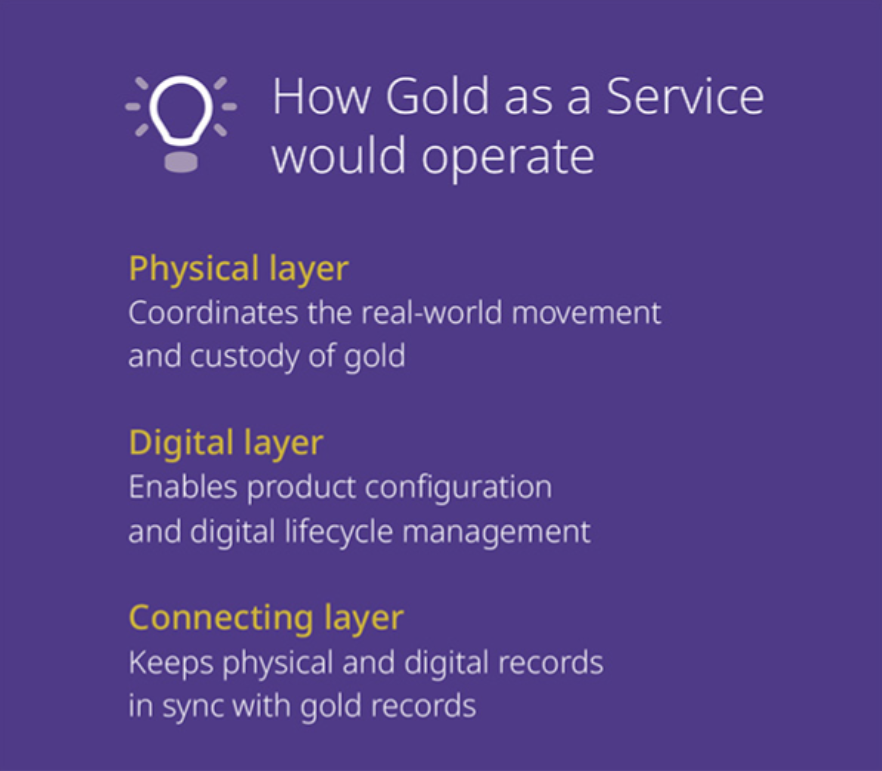
Source: World Gold Council

The World Gold Council CEO, David Tait, said, “Financial services are undergoing a rapid and pervasive digital transformation.” He further added that shared infrastructure would help in improving accessibility, tradability, and integration of gold in modern financial systems worldwide.

Impact on Tether Gold and Paxos Gold Market Leaders

Currently, Tether Gold (XAUT) and Paxos Gold (PAXG) currently dominate the overall tokenized gold market. Also, they collectively command a large market share in the overall market worldwide. Both of these operate on different systems for custody, audit, and redemption, and this is causing fragmentation in the overall digital gold market worldwide.

The new framework also outlines a set of standardized processes that include custody coordination, compliance checks, and redemption systems that are to be followed on all platforms globally. Such a framework would ensure that all platforms are aligned in terms of regulatory compliance. It has been noted that such a platform can enable hundreds of new issuances to happen in a more efficient manner.

The Potential and Development Mark

The platform can potentially lead to lower operational costs as well as better integration between tokenized gold assets on various blockchain platforms globally. This can further increase adoption rates among institutional investors as well as fintech companies that are entering the tokenized commodity space. Officials emphasized that the platform focuses on enabling growth. Rather than targeting existing issuers in the space.

The development marks a significant convergence between traditional gold markets and blockchain technology as the adoption of digital assets continues to gain momentum globally. Analysts noted that tokenized gold can act as a major growth driver in traditional gold markets globally.

Highlighted Crypto News:

Ondo Finance Expands Tokenized Securities Offering With BlackRock IBIT and Galaxy Digital

TagsBlockchainCryptocurrencyDigital assetsGoldservice

Related Questions

QWhat is the main purpose of the 'Gold as a Service' framework proposed by the World Gold Council?

AThe main purpose is to modernize tokenized gold infrastructure worldwide by connecting physical gold custody and digital issuance systems, allowing companies to issue gold-backed products more efficiently.

QWhich two products currently dominate the tokenized gold market according to the article?

ATether Gold (XAUT) and Paxos Gold (PAXG) currently dominate the tokenized gold market.

QWhat are the three levels that the 'Gold as a Service' framework is built upon?

AIt is built on three levels: physical custody, digital issuance, and synchronization systems that connect assets and blockchain records.

QWhat benefits does the World Gold Council CEO believe shared infrastructure will bring to gold?

ADavid Tait believes shared infrastructure will help improve accessibility, tradability, and integration of gold in modern financial systems worldwide.

QHow can the new framework potentially impact operational costs and adoption rates?

AThe framework can lead to lower operational costs and better integration, which can further increase adoption rates among institutional investors and fintech companies entering the tokenized commodity space.

Related Reads

Agents Take Over Traffic Distribution Power: What Are Tencent, ByteDance, and Alibaba Competing For?

In the race to dominate the AI era's entry point, China's tech giants—Tencent, ByteDance, and Alibaba—are aggressively deploying AI Agents to control the future of traffic distribution. Alibaba is pursuing a dual-track "closed loop + openness" strategy. Its Qianwen app is evolving into a super-Agent integrated across its ecosystem (Taobao, Alipay, etc.) to handle complex tasks like travel planning. Concurrently, it is opening its platform to external brands (Luckin Coffee, KFC) and has launched a B2B Agent platform, "Wukong," targeting enterprise automation. Its other flagship, Quark, aims to be an "AI super search box" for information and tasks. ByteDance is executing an omnipresent "sprawl strategy." Its Doubao app boasts over 300 million monthly active users and is evolving into a default AI entry point for daily life, with plans for paid versions and e-commerce integration. Its core weapon is the Kouzi platform, a visual "AI assembly factory" for developers to build custom Agents. ByteDance is also pushing hardware integration, collaborating on AI phones and developing smart glasses to embed Doubao everywhere. Tencent is playing its long-held "ultimate card" by quietly embedding an AI Agent directly into WeChat. This Agent, accessible via a swipe, can understand user commands and automatically execute tasks by calling upon WeChat's millions of mini-programs (e.g., finding and ordering coffee). This leverages WeChat's unparalleled 1.4-billion-user ecosystem to position the app as an AI-powered "service operating system," a move that could dramatically reshape the competitive landscape. The core battleground is shifting from competing for "user screen time" to competing to be the "default execution layer" for user intent. The business model is evolving from an "attention economy" to an "intent economy," where the Agent that can most efficiently fulfill a user's need gains control over service access and token flow. This represents a fundamental change in how users connect with digital services, making the fight for the Agent入口 (entry point) a pivotal moment for redefining industry leadership in the AI age.

marsbit57m ago

Agents Take Over Traffic Distribution Power: What Are Tencent, ByteDance, and Alibaba Competing For?

marsbit57m ago

From Banning Doubao to Embracing Honor: Why Did WeChat Suddenly 'Change Its Face'?

The article explores the sudden shift in WeChat's strategy towards AI assistants from mobile phone manufacturers, transitioning from strict opposition to active collaboration. For over a year, WeChat fiercely resisted attempts by phone AI assistants (like ByteDance's Doubao in late 2025) to control its features via GUI automation ("simulated clicking"), citing security and data control concerns. This stance created a significant barrier for system-level AI integration. Now, Tencent has initiated A2A (Agent-to-Agent) partnerships with major phone brands like Honor, Xiaomi, OPPO, and vivo. This model allows a phone's system AI (e.g., Honor's YOYO) to parse a user's voice command and send a structured request directly to WeChat's own internal AI agent via secure APIs. WeChat then executes the action (e.g., sending a message) and returns the result. The article attributes Tencent's "change of face" to strategic pressure. While leading in social app usage, Tencent trails rivals like ByteDance and Alibaba in standalone AI app popularity. WeChat, with its vast mini-program ecosystem, is Tencent's key asset for an AI comeback. The upcoming WeChat AI agent aims to handle tasks like booking and payments within the app. However, phone system assistants remain the primary AI entry point for most users. The A2A collaboration allows Tencent to extend WeChat's AI reach to this crucial system layer while maintaining control over its core functions and data. For phone manufacturers, embracing A2A is a pragmatic move. The GUI route proved unviable due to WeChat's blocks. A2A offers a compliant path to integrate a vital service, enhancing their AI assistants' usefulness. It allows them to focus on developing their own AI ecosystems for other services while cooperating on WeChat access. The collaboration is framed as a mutual, strategic necessity: Tencent gains a distribution channel, and manufacturers gain a key functionality. The partnership relies on a "dual authorization" mechanism for security, requiring both user and app consent for each action. While questions about long-term data privacy practices remain, experts note A2A is more secure and compliant than GUI automation. Ultimately, this cooperation is seen as a tentative, calculated truce. Tencent's long-term goal is to make WeChat an AI-powered "service OS." Phone manufacturers aim to make their system AI the central user interface. Their paths may converge or clash in the future, but for now, the A2A deal represents the opening chapter in the battle for the AI-era user入口, driven by necessity and strategic calculus on both sides.

marsbit2h ago

From Banning Doubao to Embracing Honor: Why Did WeChat Suddenly 'Change Its Face'?

marsbit2h ago

Trading

Spot
Futures
活动图片





