WLFI governance overhaul approved as community vote passes with 99% support

ambcryptoPublished on 2026-03-16Last updated on 2026-03-16

Abstract

WLFI's governance overhaul proposal has been overwhelmingly approved with 99.12% community support, representing 2.7 billion tokens. The new model introduces a staking-based system where voting power is determined by stake size and commitment duration, prioritizing long-term participants. The implementation will occur in three phases: introducing governance staking, activating a Node tier with stablecoin conversion features, and launching a Super Node tier for revenue-sharing. This reform is closely tied to expanding WLFI’s USD1 stablecoin ecosystem. Following the vote, the token price stabilized near $0.105, as markets await the phased rollout.

World Liberty Financial’s governance overhaul proposal has officially passed, receiving overwhelming community support. It marks a major step in the project’s effort to reshape participation and decision-making across its ecosystem.

According to Snapshot voting results, 99.12% of votes supported the proposal, representing 2.7 billion WLFI tokens. Only 0.69% voted against, while 0.2% abstained.

The vote easily cleared the proposal’s 1 billion WLFI quorum requirement. Participation reached 275% of the required threshold, indicating strong engagement from tokenholders.

The proposal was initially introduced on 25 February, with voting taking place between 5 March and 12 March.

Governance reset gains overwhelming support

The approved proposal introduces a staking-based governance system. Holders of unlocked WLFI tokens must stake their assets to participate in governance decisions.

Both stake size and commitment duration will determine voting power. Also, tokens that remain locked will retain voting rights without requiring additional staking.

The structure is designed to prioritize long-term participation over short-term speculation. It concentrates governance influence among participants who maintain sustained exposure to the ecosystem.

Three-phase implementation plan

With the proposal approved, the new governance model will roll out through a three-phase implementation process.

Phase one will introduce governance staking for all unlocked WLFI holders. This stage will activate staking rewards alongside USD1 deposit incentives.

Phase two will introduce the Node tier. This enables larger participants to access features such as over-the-counter stablecoin conversion mechanisms and liquidity programs tied to USD1 distribution.

It will also include partnerships with licensed market makers and onboarding pathways for qualifying participants.

Phase three will activate a Super Node tier, granting qualifying participants access to partnership opportunities and a revenue-sharing framework within the ecosystem.

The phased rollout aims to gradually expand the governance framework while integrating WLFI’s stablecoin infrastructure more deeply into the network.

WLFI price shows modest stabilization

Following the vote, WLFI’s price has stabilized after a prolonged decline earlier this year.

According to TradingView data, the token was trading near $0.105, with the Relative Strength Index [RSI] around 46, indicating neutral momentum after recent volatility.
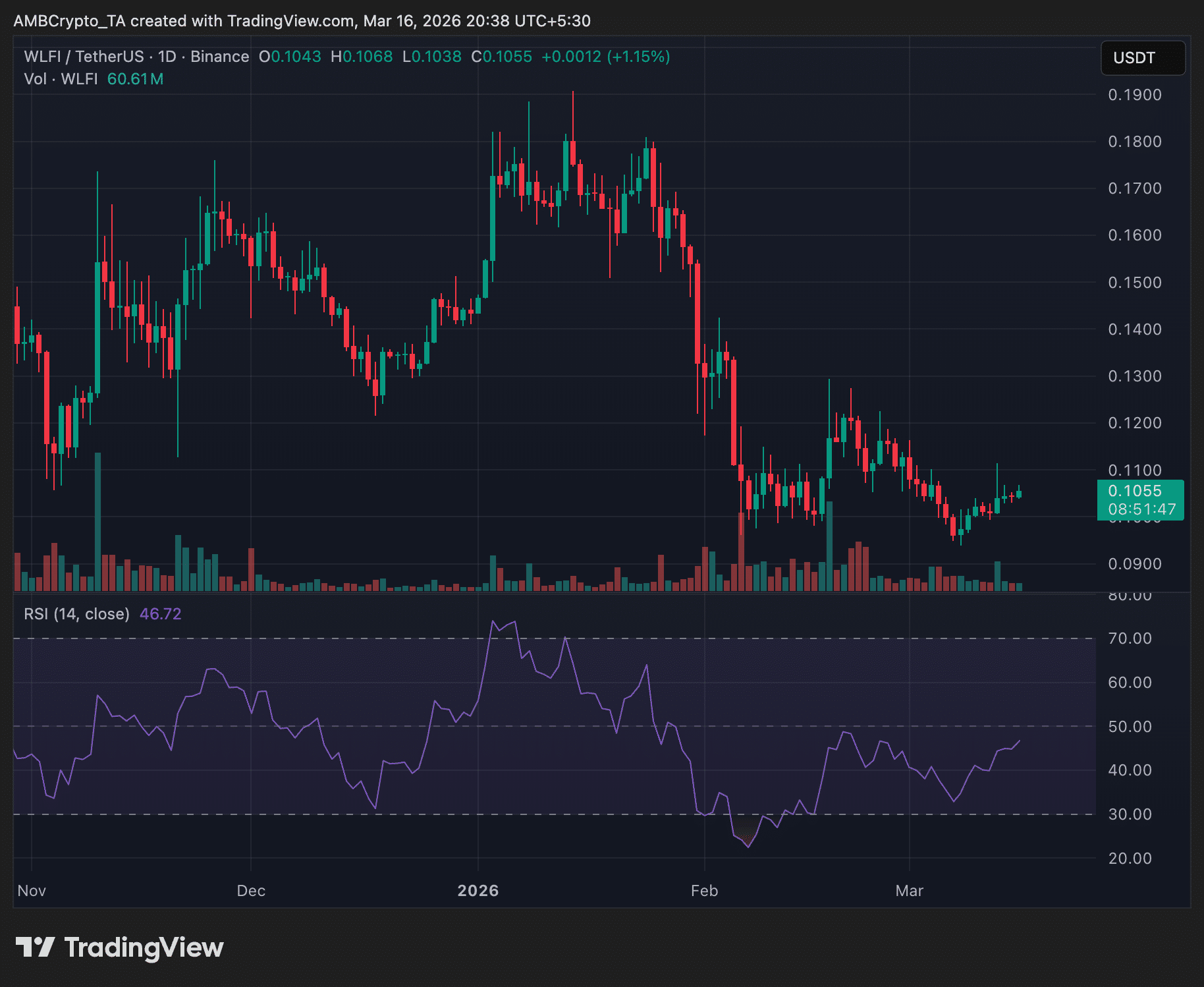
Source: TradingView

Although the governance vote represents a major structural shift for the protocol, market participants are taking a cautious approach as they await the rollout of the new system.

Governance reform tied to USD1 expansion

The governance changes are closely tied to WLFI’s broader strategy surrounding USD1, the project’s dollar-backed stablecoin.

By linking governance participation to incentives tied to USD1 liquidity and distribution, the proposal aims to align it with the growth of the ecosystem’s stablecoin infrastructure.

The success of the governance reset will likely depend on how effectively the implementation phases translate the proposal’s design into operational improvements across the network.


Final Summary

  • WLFI’s governance overhaul proposal passed with 99.12% support, clearing quorum with 2.7 billion tokens voting in favor.
  • The protocol will now roll out staking-based governance and tiered node participation as part of a three-phase implementation plan tied to USD1 expansion.


Related Questions

QWhat was the percentage of votes in favor of WLFI's governance overhaul proposal?

A99.12% of votes supported the proposal.

QHow many WLFI tokens were represented in the vote that met the quorum requirement?

A2.7 billion WLFI tokens were represented, which was 275% of the required 1 billion token quorum.

QWhat is the core mechanism introduced by the approved governance proposal for participation?

AThe proposal introduces a staking-based governance system where holders of unlocked WLFI tokens must stake their assets to participate, with voting power determined by stake size and commitment duration.

QWhat are the three phases of the new governance model's implementation?

APhase one introduces governance staking and rewards. Phase two introduces the Node tier with features like OTC stablecoin conversion. Phase three activates a Super Node tier for partnership opportunities and revenue-sharing.

QHow is the governance reform connected to the project's stablecoin, USD1?

AThe governance changes are tied to WLFI's USD1 strategy by linking governance participation to incentives for USD1 liquidity and distribution, aiming to align it with the growth of the ecosystem's stablecoin infrastructure.

Related Reads

How to Do Research Well: Deliberately Practice the Real Skills That Matter

No one truly teaches you how to do research. You're often given a desk, a pre-selected problem, and vague instructions to "create something new." Consequently, many people reverse-engineer the job based on visible outputs—papers, posts, announcements—learning only how to *appear* like a researcher rather than how to *become* one. True research capability is built from stacking small, trainable skills, nearly all of which can be developed through deliberate practice. **Pick Your Own Problem:** Most researchers absorb problems from advisors or trends, lacking the underlying reasoning. Choosing a problem you genuinely care about, as John Schulman advises, leads to original work. Develop "taste" like a muscle: predict experiment outcomes, guess paper results from methods, and track which findings remain important over time. **Upgrade Your Inputs:** Relying on shared reading lists (arXiv hot lists, filtered group chats) leads to unoriginal conclusions. Undervalued old literature often holds crucial insights (e.g., MoE, LSTM, backpropagation). Richard Sutton's "The Bitter Lesson" or Claude Shannon's 1952 talk on creative thinking are more predictive than lengthy modern surveys. Breadth matters as much as depth: draw from neuroscience, mechanism design, hardware knowledge, and honest statistics. Read papers directly, especially appendices and limitations sections. **Write Everything Down:** As Paul Graham noted, writing exposes flaws in seemingly mature ideas. Writing is the cheapest defense against self-deception. Following Feynman's principle, Darwin programmatically wrote down facts contradicting his theory to combat memory bias. Maintain a detailed log of hypotheses, setups, predictions, results, and updated understandings. Reviewing past logs fosters essential humility.

marsbit1h ago

How to Do Research Well: Deliberately Practice the Real Skills That Matter

marsbit1h ago

Following US Ban on Fable 5, Zhipu AI's Stock Soars 47%

On June 15th, shares of Zhipu AI surged dramatically on the Hong Kong stock market, peaking at a 47.6% gain before closing 32.82% higher. This sharp increase was directly triggered by two recent industry events. On June 12th, Anthropic announced it was suspending global access to its latest flagship models, Claude Fable 5 and Claude Mythos 5, to comply with a U.S. government export control order. The next day, Zhipu AI announced it would open access to its latest open-source flagship model, GLM-5.2, under the permissive MIT license. The Anthropic incident highlighted a critical issue beyond raw model capability: the risk of sudden, unpredictable loss of access to advanced AI models, especially for developers and enterprises deeply integrated with them. This has shifted industry and market focus toward factors like stability, sustainable access, and controllability. Zhipu's move, promoting "frontier intelligence for all," positions its openly available model as a reliable and accessible alternative. The GLM-5.2 model emphasizes "Long Horizon Task" capabilities with a 1M context window, targeting complex, multi-step coding and engineering workflows where maintaining context is crucial. Analysts note this event exposes the risk of dependency on closed-source models subject to single jurisdictional controls, potentially accelerating a shift toward domestic base models and localized deployments. The market's reaction signals a new valuation dimension in AI: providers who can offer stable, long-term, and sustainably accessible AI capabilities are gaining strategic importance.

marsbit2h ago

Following US Ban on Fable 5, Zhipu AI's Stock Soars 47%

marsbit2h ago

Trading

Spot
Futures

Hot Articles

Discussions

Welcome to the HTX Community. Here, you can stay informed about the latest platform developments and gain access to professional market insights. Users' opinions on the price of S (S) are presented below.

活动图片














