With $950 Million in Revenue, How Does Pump.fun Use $3 Million to 'Vote' for the Next Viral Meme?

比推Published on 2026-01-20Last updated on 2026-01-20

Abstract

Pump.fun, a leading platform in the Meme token space with over $950 million in historical revenue, has launched an investment division called Pump Fund. The fund will invest $3 million in total across 12 new tokens launched on its platform, allocating $250,000 per token at a valuation of $10 million each. In addition to financial support, selected projects will receive mentorship from Pump.fun’s founders and other resources. The initiative is part of a new "Build in Public (BiP)" hackathon, which encourages founders to publicly develop products after launching a token on Pump.fun. Participants must hold at least 10% of their token supply and are encouraged to actively engage with the community via social media and live streams. The selection process prioritizes organic growth and long-term sustainability over marketing hype. The application period opened on January 19 and will run for 30 days, with the first winners announced by February 18. The program is designed to identify and support promising Meme tokens with real utility and community backing, offering a new path for early-stage projects to gain traction.

Author: Azuma

Original Title: Pump.fun Launches Direct Investment, Spending $3 Million to Buy 12 New Memes


On the morning of January 20, Pump.fun officially announced the launch of its investment division, Pump Fund. Pump Fund will initiate its first project, the Build in Public (BiP) Hackathon, this month, investing $3 million in 12 new tokens issued through the platform, with $250,000 allocated to each token at a valuation of $10 million. In addition to financial support, Pump.fun will also provide professional guidance from its founders and other substantial resources.

As the project with the strongest revenue-generating capability in the entire Meme sector, this is the first time Pump.fun has openly expressed its support for specific Meme tokens through official channels, using real money (the attitude may be more important than the scale of funding). Therefore, the selected tokens are highly likely to become the frontrunners in the Meme sector in the coming period.

Pump.fun's Revenue-Generating Capability

Pump.fun's staggering revenue-generating ability is no secret. Data compiled by analyst Adam (@Adam_Tehc) on Dune shows that Pump.fun's historical total revenue has reached $954.8 million. Although daily revenue has significantly declined as the Meme hype cooled down, it still amounts to hundreds of thousands of dollars per day.
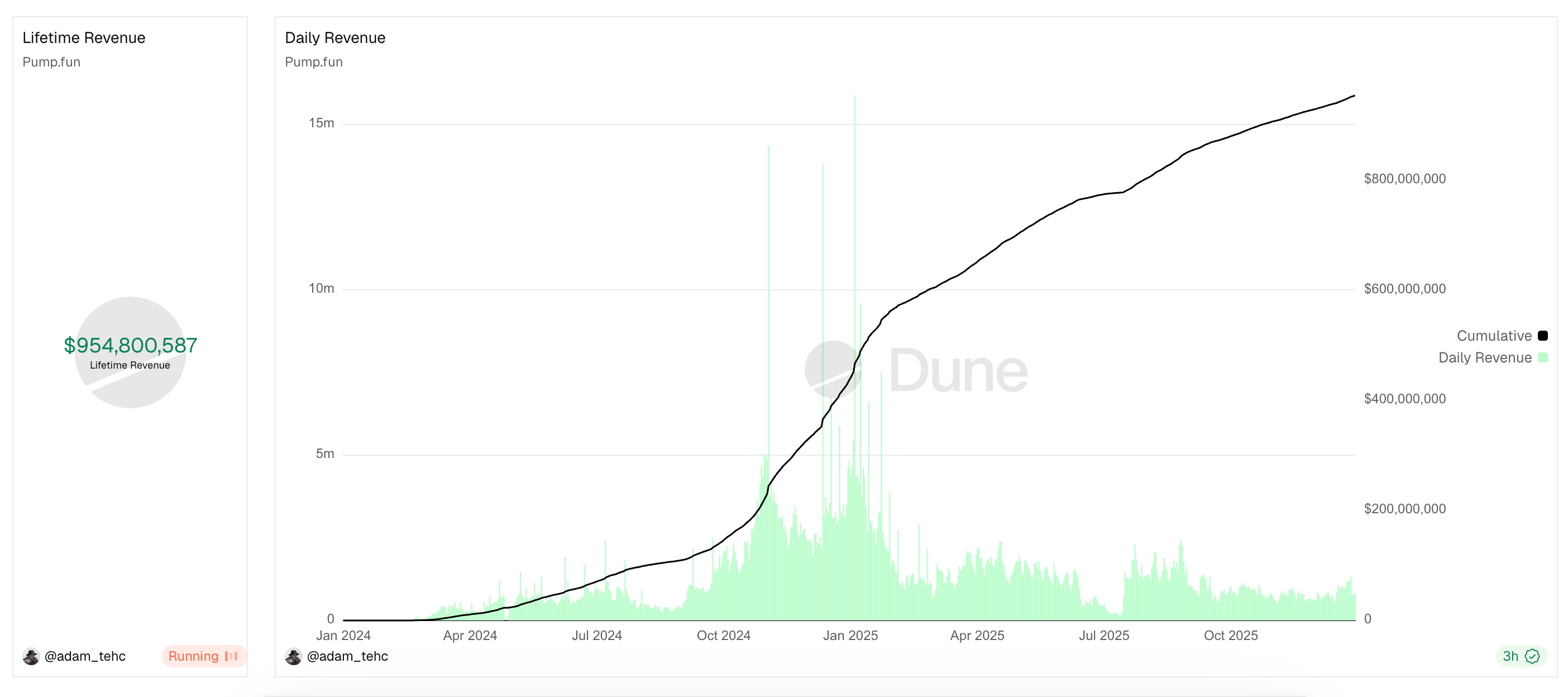
With massive real money at hand, Pump.fun is exploring other ways to give back to the ecosystem beyond PUMP token buybacks. Pump Fund and its affiliated BiP Hackathon are Pump.fun's latest attempts.

BiP Hackathon Details

According to the description on the BiP Hackathon's dedicated page, the project aims to support founders who issue tokens on Pump.fun and publicly build products. Unlike traditional hackathons where participants rely on VCs or judges for evaluation to compete for prizes, the BiP Hackathon intends to introduce token performance as a variable, allowing the market to determine whether a project is worth advancing, while enabling users to become the earliest investors.

When discussing this key difference, Pump.fun founder Alon stated in an X post: "Before Pump.fun, my co-founder and I tried many different ideas. Consumer finance, DeFi, SocialFi, NFTs—but all failed. One of the biggest problems we encountered was how difficult it was to get our products in front of users. Trying to reach the right audience was an extremely tedious task..."

Specifically, the BiP Hackathon requires:

  • Participants must issue a token on Pump.fun and then publicly build a product;

  • Participants must also hold at least 10% of the token supply to align interests;

  • Finally, the event strongly encourages founders to speak publicly on social media like X or livestream on Pump.fun to maintain effective communication with the community.

As for the types of projects, Pump.fun has not set any restrictions; they are not even limited to cryptocurrency-related products. Projects from different market stages and various verticals can participate.

Regarding how the 12 winning projects will ultimately be selected, Pump.fun did not provide specific rules but highlighted two key principles: first, organic user growth and genuine appeal are preferred over connections and flashy promotions; second, in addition to the appeal of the product itself/social media presence, the event will also assess the long-term sustainability of the projects.

Key Timelines to Watch

According to the BiP Hackathon's schedule, the application process opened on January 19. Participants are required to launch their tokens at the time of application and begin public building (including livestreaming development progress, regularly sharing updates, and maintaining community interaction). The application window will remain open for 30 days. On February 18, Pump.fun will announce the first batch of winning projects and provide funding (at least one will be announced). Considering that some projects may require more time to gain market attention and demonstrate appeal, the program will continue to operate long-term.

So the timeline is clear: if you want to spot potential opportunities among this batch of Meme tokens, you need to start paying attention to newly issued tokens on Pump.fun from now on, especially those with the Pump Fund or BiP labels. Although the first batch of winning tokens won't be announced until 30 days later, tokens likely to be selected by Pump.fun will undoubtedly show competitiveness well before that.

Overall, while Pump.fun's event may not be enough to drive a collective rebound in Meme market sentiment, it can at least contribute some new tokens with clearer evaluation dimensions.


Twitter:https://twitter.com/BitpushNewsCN

Bitpush TG Discussion Group:https://t.me/BitPushCommunity

Bitpush TG Subscription: https://t.me/bitpush

Original link:https://www.bitpush.news/articles/7604435

Related Questions

QWhat is the total historical revenue of Pump.fun as mentioned in the article?

AThe total historical revenue of Pump.fun is $954.8 million.

QWhat is the name of the new investment department launched by Pump.fun and what is its first project?

AThe new investment department is called Pump Fund, and its first project is the Build in Public (BiP) hackathon.

QHow much funding will Pump.fun provide to each of the 12 selected tokens in the BiP hackathon, and what valuation does this correspond to?

APump.fun will invest $250,000 in each of the 12 selected tokens, corresponding to a valuation of $10 million per token.

QAccording to the article, what are the two main principles Pump.fun will use to select the winning projects for the BiP hackathon?

AThe two main principles are: 1) Natural user growth and genuine appeal are favored over connections and flashy marketing. 2) The long-term sustainability of the project will be evaluated in addition to the product's appeal and social media presence.

QWhen did the application window for the BiP hackathon open, and when will the first batch of winning projects be announced?

AThe application window opened on January 19th and will be open for 30 days. The first batch of winning projects will be announced on February 18th.

Related Reads

North Korean Hackers Loot $500 Million in a Single Month, Becoming the Top Threat to Crypto Security

North Korean hackers, particularly the notorious Lazarus Group and its subgroup TraderTraitor, have stolen over $500 million from cryptocurrency DeFi platforms in less than three weeks, bringing their total theft for the year to over $700 million. Recent major attacks on Drift Protocol and KelpDAO, resulting in losses of approximately $286 million and $290 million respectively, highlight a strategic shift: instead of targeting core smart contracts, attackers are now exploiting vulnerabilities in peripheral infrastructure. For instance, the KelpDAO attack involved compromising downstream RPC infrastructure used by LayerZero's decentralized validation network (DVN), allowing manipulation without breaching core cryptography. This sophisticated approach mirrors advanced corporate cyber-espionage. Additionally, North Korea has systematically infiltrated the global crypto workforce, with an estimated 100 operatives using fake identities to gain employment at blockchain companies, enabling long-term access to sensitive systems and facilitating large-scale thefts. According to Chainalysis, North Korean-linked hackers stole a record $2 billion in 2025, accounting for 60% of all global crypto theft that year. Their total historical crypto theft has reached $6.75 billion. Post-theft, they employ specialized money laundering methods, heavily relying on Chinese OTC brokers and cross-chain mixing services rather than standard decentralized exchanges. Security experts, while acknowledging the increased sophistication, emphasize that many attacks still exploit fundamental weaknesses like poor access controls and centralized operational risks. Strengthening private key management, limiting privileged access, and enhancing coordination among exchanges, analysts, and law enforcement immediately after an attack are critical to improving defense and fund recovery chances. The industry's challenge now extends beyond secure smart contracts to safeguarding operational security at the infrastructure level.

marsbit52m ago

North Korean Hackers Loot $500 Million in a Single Month, Becoming the Top Threat to Crypto Security

marsbit52m ago

Circle CEO's Seoul Visit: No Korean Won Stablecoin Issuance, But Met All Major Korean Banks

Circle CEO Jeremy Allaire's recent activities in Seoul indicate a strategic shift for the company, moving away from issuing a Korean won-backed stablecoin and instead focusing on embedding itself as a key infrastructure provider within Korea’s financial and crypto ecosystem. Despite Korea accounting for nearly 30% of global crypto trading volume—with a market characterized by high retail participation and altcoin dominance—Circle has chosen not to compete for the role of stablecoin issuer. Instead, Allaire met with major Korean banks (including Shinhan, KB, and Woori), financial groups, leading exchanges (Upbit, Bithumb, Coinone), and tech firms like Kakao. This approach reflects a broader industry transition: the core of stablecoin competition is shifting from issuance rights to systemic positioning. With Korean regulators still debating whether banks or tech companies should issue stablecoins, Circle is avoiding regulatory uncertainty by strengthening its role as a service and technology partner. The company is deepening integration with trading platforms, building connections, and promoting stablecoin infrastructure. This positions Circle to benefit regardless of which entity eventually issues a won stablecoin. Allaire also noted the potential for a Chinese yuan stablecoin in the next 3–5 years, underscoring a regional trend of stablecoins becoming more regulated and integrated with traditional finance. Ultimately, Circle’s strategy highlights that future influence in the stablecoin market will belong not necessarily to the issuers, but to the foundational infrastructure layers that enable cross-system transactions.

marsbit1h ago

Circle CEO's Seoul Visit: No Korean Won Stablecoin Issuance, But Met All Major Korean Banks

marsbit1h ago

SpaceX Ties Up with Cursor: A High-Stakes AI Gambit of 'Lock First, Acquire Later'

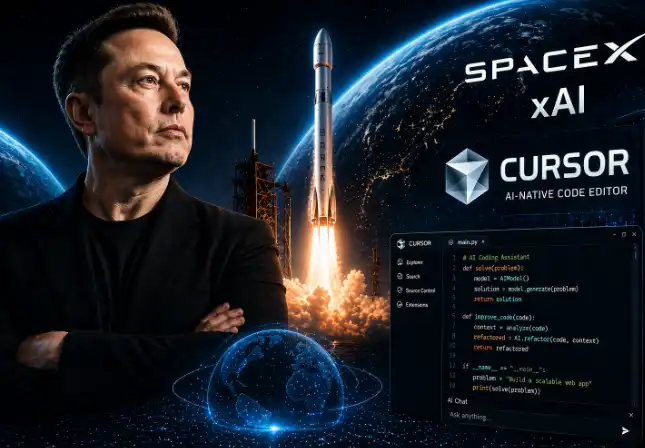
SpaceX has secured an option to acquire AI programming company Cursor for $60 billion, with an alternative clause requiring a $10 billion collaboration fee if the acquisition does not proceed. This structure is not merely a potential acquisition but a strategic move to control core access points in the AI era. The deal is designed as a flexible, dual-path arrangement, allowing SpaceX to either fully acquire Cursor or maintain a binding partnership through high-cost collaboration. This "option-style" approach minimizes immediate regulatory and integration risks while ensuring long-term alignment between the two companies. At its core, the transaction exchanges critical AI-era resources: SpaceX provides its Colossus supercomputing cluster—one of the world’s most powerful AI training infrastructures—while Cursor contributes its AI-native developer environment and strong product adoption. This synergy connects compute power, models, and application layers, forming a closed-loop AI capability stack. Cursor, founded in 2022, has achieved rapid growth with over $1 billion in annual revenue and widespread enterprise adoption. Its value lies in transforming software development through AI agents capable of coding, debugging, and system design—positioning it as a gateway to future software production. For SpaceX, this move is part of a broader strategy to evolve from a aerospace company into an AI infrastructure empire, integrating xAI, supercomputing, and chip manufacturing. Controlling Cursor fills a gap in its developer tooling layer, strengthening its AI narrative ahead of a potential IPO. The deal reflects a shift in AI competition from model superiority to ecosystem and entry-point control. With programming tools as a key battleground, securing developer loyalty becomes crucial for dominating the software production landscape. Risks include questions around Cursor’s valuation, technical integration challenges, and potential regulatory scrutiny. Nevertheless, the deal underscores a strategic bet: controlling both compute and software development access may redefine power dynamics in the AI-driven future.

marsbit2h ago

SpaceX Ties Up with Cursor: A High-Stakes AI Gambit of 'Lock First, Acquire Later'

marsbit2h ago

Trading

Spot
Futures

Hot Articles

Discussions

Welcome to the HTX Community. Here, you can stay informed about the latest platform developments and gain access to professional market insights. Users' opinions on the price of MEME (MEME) are presented below.

活动图片