Fedwatch Turns Hawkish: Probability of a Rate Hike in September at 57%

cryptonews.ruPublished on 2026-08-30Last updated on 2026-08-30

Abstract

The CME Fedwatch Tool has shifted its outlook to "hawkish," indicating a 57% probability of a 25-basis-point interest rate hike at the Fed's September 16th meeting, which would raise the target range to 3.75%-4.00%. This marks a significant increase from just 39.9% a week prior, a shift largely attributed to Fed Chair Warsh's recent Jackson Hole speech. While avoiding explicit commitment, Warsh strongly emphasized the Fed's unwavering commitment to its 2% inflation target, noting that current PCE inflation readings of 3.7% (12-month) and 4.1% (6-month) remain well above goal. He also pointed to a resilient economy with strong business investment, rising corporate profits, and stable unemployment, providing room for further tightening. However, other prediction markets like Polymarket and Kalshi show a much tighter race, placing the odds of a hold at around 52% versus a 48% chance of a hike, essentially reflecting a coin toss. This high uncertainty means upcoming inflation and jobs data will be critical in swaying the Fed's decision ahead of the mid-September FOMC meeting. For now, markets are split, with futures leaning toward a hike and prediction markets narrowly favoring a pause.

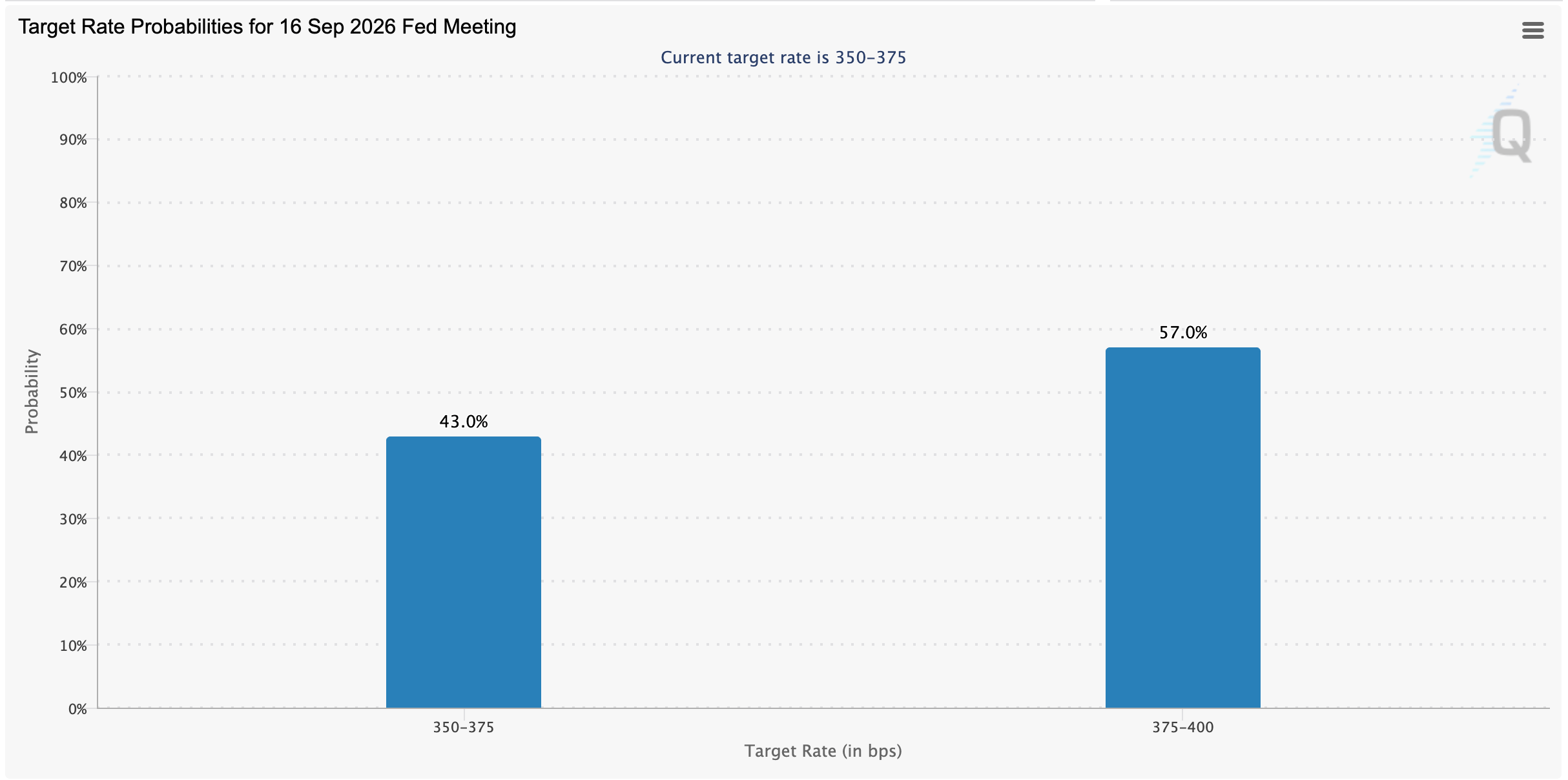
Current attention is focused on the Fed's federal funds rate decision, which will be made on September 16. The CME Fedwatch tool, which converts trading dynamics in federal funds rate futures into implied probabilities for various outcomes, estimates a 57% probability of a 25 basis point rate hike, which would raise the target range to 3.75%–4%. The probability of maintaining the current range of 3.5%–3.75% is estimated at only 43%. There is currently a high degree of uncertainty, and forecasts regarding the FOMC decision are little better than a coin toss.

Fedwatch Shifts Forecast Amid Rising Bets on September Rate Hike

This move is becoming harder to ignore when compared to traders' positions just a week ago. According to CME data, the probability of a rate hike on August 21 was only 39.9%. Of course, by August 28, following the Jackson Hole speech, it jumped to 57%, while bets on a rate cut in September have virtually disappeared from the market.
Prediction markets haven't fully embraced the 'hawkish' stance. As of this weekend, traders on Polymarket assess the probability that the Fed will leave rates unchanged at 52%, and the probability of a 25 basis point hike at 48%. Over $66.6 million has been wagered on this specific contract, while what was once a customary bet on a rate cut is now priced at just a 1% probability.

On the Kalshi prediction market, traders are facing near 50-50 odds. On the market for the September Fed meeting, which has seen over $23.8 million in volume, the probability of holding rates steady is priced at 52%, and the probability of a quarter-point hike at 48%.
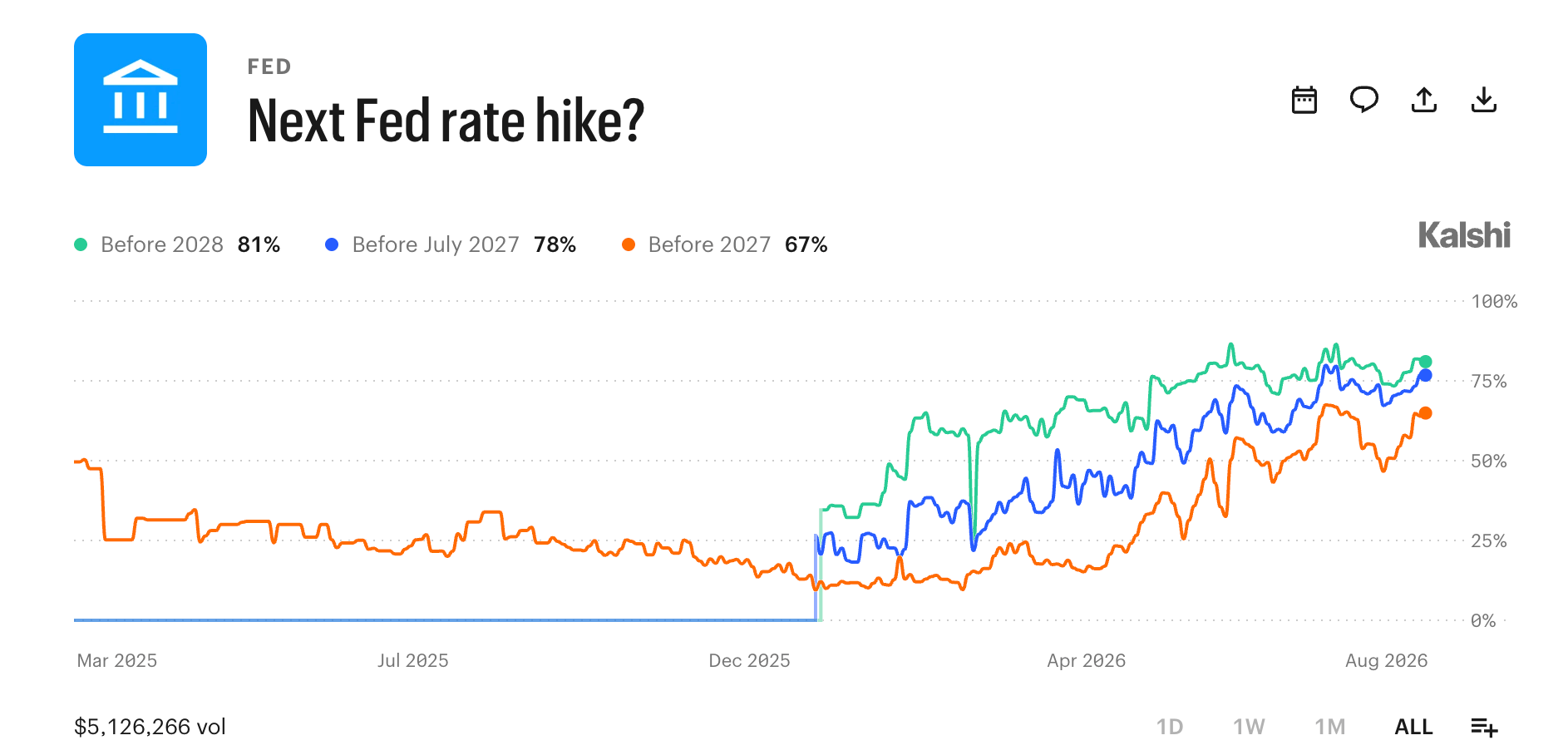
On the other hand, another betting contract on Kalshi prices a 67% probability that the Fed will raise the FFR by 2027.

Warsh Puts Stubborn Inflation Back in Focus

All this data shifted sharply following Warsh's keynote address at the Jackson Hole Economic Policy Symposium, where he carefully avoided promises about a September rate hike while repeatedly returning to the themes of stubborn inflation and the Fed's responsibility to bring prices under control.

"There should be no misunderstanding: The Fed’s goal of achieving price stability at 2 percent, measured by the PCE price index, is firm and fixed," Warsh emphasized. He also made clear that short-term interest rates remain the Fed’s primary tool for achieving this goal.

The figures cited by Warsh explain why traders detected a 'hawkish' signal in his address. The Fed’s preferred 12-month PCE inflation measure is elevated at 3.7%, while the six-month measure shows even higher growth at 4.1%. Neither of these is anywhere close to the central bank’s 2% target. Although some Fed critics believe the 2% target will never be reached again.

Warsh also described an economic situation that gives the Fed no cause for alarm about raising rates. Business investment is surging, particularly in the AI sector, S&P 500 company profits are up over 20% in the past year, and real consumer spending has increased over 2% for four consecutive quarters. Meanwhile, the unemployment rate remains at 4.1%.

Markets Brace for a 'Coin Toss' in September

It is this combination of factors that makes September awkward for proponents of a soft stance on the federal funds rate. Raising the federal funds rate restrains demand and inflation, and an economy still showing resilient growth and high employment gives policymakers significantly more room to tighten policy without immediately harming the labor market.

Warsh still refused to commit himself to a rate hike decision, stating:

"I stand here today committed to the discipline, not to a specific decision."

This signal was intentional: markets can forecast the September outcome however they wish, but the Fed has no intention of giving traders an answer weeks before the meeting. For investors, September has become a veritable 'coin toss' – the odds are 50-50, with real money on both sides. CME futures lean towards a hike, while the Polymarket and Kalshi prediction markets place a slight edge on rates being held steady.

Inflation and labor market reports now carry even greater weight, and either could tip the scales before Fed officials convene in mid-September.


Related Questions

QAccording to the CME Fedwatch tool, what is the current estimated probability of a 25 basis point interest rate hike by the Fed in September?

AAccording to the CME Fedwatch tool, the current estimated probability of a 25 basis point interest rate hike in September is 57%.

QWhat major event is cited as causing the significant shift in rate hike probabilities between August 21st and August 28th?

AThe major event cited is Chair Powell's keynote speech at the Jackson Hole Economic Policy Symposium, after which the probability of a hike jumped from 39.9% to 57%.

QWhat did Fed Chair Powell emphasize as the Fed's firm and fixed goal during his Jackson Hole speech?

AFed Chair Powell emphasized that the Fed's goal of achieving price stability at a 2% inflation rate, measured by the Personal Consumption Expenditures (PCE) index, is firm and fixed.

QHow do prediction markets like Polymarket and Kalshi assess the odds for the September Fed meeting compared to the CME Fedwatch tool?

AWhile the CME Fedwatch tool leans towards a rate hike (57%), prediction markets like Polymarket and Kalshi show slightly higher odds for the Fed holding rates steady, at approximately 52% vs. 48% for a hike.

QWhat economic conditions, as mentioned by Chair Powell, give the Fed more room to tighten policy without immediately damaging the labor market?

AThe conditions include strong business investment (especially in AI), over 20% year-over-year profit growth for S&P 500 companies, real consumer spending growth exceeding 2% over four quarters, and a stable unemployment rate of 4.1%.

Related Reads

Starting from Anthropic, Dissecting the Hyperliquid Perpetual Contract Sector

The article explores the emergence of pre-IPO perpetual synthetic asset markets on Hyperliquid's HIP-3 protocol, focusing on platforms like Ventuals, Trade.xyz, and Entropy. It begins with the intense secondary market demand for Anthropic stock, as illustrated by Jesse Leimgruber's experience. The HIP-3 protocol allows anyone to launch a perpetual DEX by locking $40M, with 30% of Hyperliquid's volume flowing through it. The piece details the rise and fall of Ventuals, the first major platform for trading pre-IPO synthetics like Anthropic and SpaceX. Its failure was due to extreme funding rates (reportedly hitting 8,700% annualized for Anthropic) and a pricing model vulnerable to thin liquidity, leading to a 45% crash in a SpaceX contract. Trade.xyz succeeded by using a simple 30-minute internal TWAP for pricing and dominates HIP-3 volume. Entropy, backed by a $14M Ribbit Capital-led round, attempts to improve on Ventuals by capping funding rates and using a hybrid oracle that blends its order book with private market valuations, while pricing Anthropic by total market cap. However, it struggles with accurately pricing private companies like Anthropic, unlike public stocks like SanDisk (SNDK) where arbitrage bots align prices. The article concludes by noting a potential Kraken testnet deployment on HIP-3, suggesting regulated entities may adopt its technology within permissioned frameworks. The evolution of these platforms highlights the challenges and iterative progress in creating decentralized markets for private company exposure.

marsbit20m ago

Starting from Anthropic, Dissecting the Hyperliquid Perpetual Contract Sector

marsbit20m ago

Trading

Spot
活动图片